Modi Turns Telangana Projects Into a Pitch for Cooperation
PM Modi used a Hyderabad project launch to frame Telangana’s development as a test of Centre-state alignment, not confrontation, while CM Revanth Reddy pressed for faster clearances.
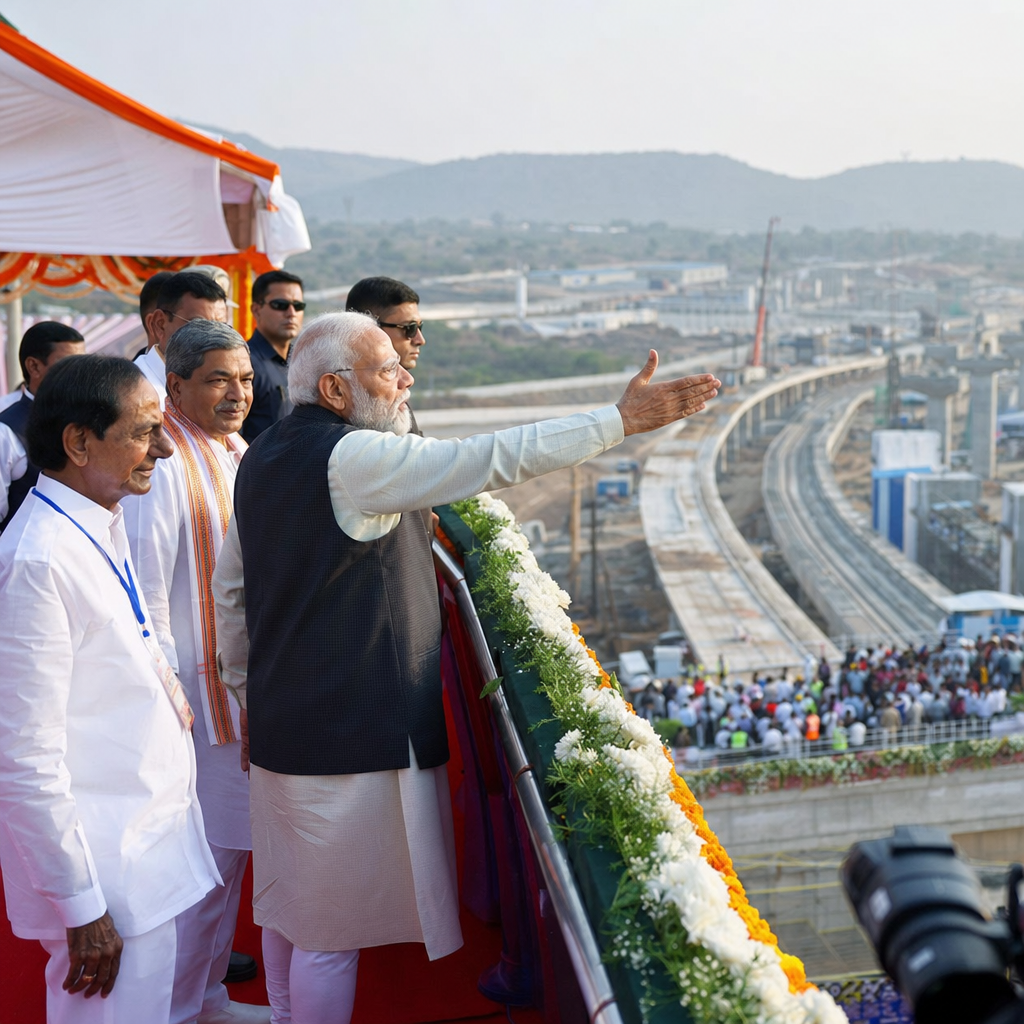
The power dynamic is clear: the Centre holds the approvals and the money, and Prime Minister Narendra Modi used that leverage on Sunday to turn a Telangana development event into a political offer. At a Hyderabad programme where he inaugurated and laid foundation stones for projects worth about Rs 9,400 crore, Modi told Chief Minister A. Revanth Reddy that he was ready to match the support Gujarat received under Manmohan Singh — but added that Telangana would do better if the Congress-led state government “join[s]” him, as reported by  NDTV and
  The New Indian Express.
What Revanth Reddy was asking for
Revanth Reddy’s message was straightforward: Telangana wants speed, not ceremony. He urged Modi to create a special single-window task force in the PMO for fast-track clearances and asked for a two-hour review of pending proposals tied to the Musi River rejuvenation project, Metro Rail expansion, radial roads and the Hyderabad–Machilipatnam express highway, according to  Deccan Chronicle and
  The Economic Times. He also pitched a “Telangana Model” aimed at making the state a $1 trillion economy by 2034, then $3 trillion by 2047, echoing Modi’s old “Gujarat Model” argument.
That is not just development rhetoric. It is a request for Delhi to remove bottlenecks that only Delhi can clear. For Revanth, the payoff is concrete: faster project execution, visible gains in infrastructure, and political credit for delivering growth in a Congress-run state. For Modi, the benefit is different: he gets to pose as the indispensable national executive, even when the request comes from a rival party government.
Why this matters politically
This exchange is more than a courtesy event. It is a live demonstration of how BJP and Congress now compete on the terrain of growth in states where neither can govern alone. Modi’s response — “join me” — was a warning disguised as an offer. He signaled cooperation, but also made clear that the Centre will set the terms of that cooperation, not Hyderabad.
That matters because Telangana is one of the more attractive economic battlegrounds in  India: a state with a strong urban base, major infrastructure demand, and a chief minister trying to brand himself as pro-investment and non-ideological. If Revanth can get clearances moving, he gains credibility. If approvals stall, the BJP can argue that the Congress cannot convert promises into projects without Delhi’s help. Either way, the Centre benefits from appearing generous while retaining veto power over pace and scale.
The event also let Modi reinforce a familiar national message: state development is inseparable from “Viksit Bharat” by 2047, NDTV reported. That framing helps the BJP in opposition states by recasting the Centre as the engine of growth and local governments as junior partners.
What to watch next
Watch whether Delhi actually moves on the specific Telangana files Revanth named: Musi, Metro Rail, and the Hyderabad–Machilipatnam corridor. The next decision point is not another speech; it is whether ministries clear land, funding and environmental approvals in the coming weeks. If they do, both sides claim credit. If they do not, Modi’s “join me” line will read less like an invitation and more like a reminder of who controls the gate.