Mnangagwa Extends Zimbabwe's Rule to 2030
Constitutional Amendment No. 3 alters presidential election process.
Model Diplomat8 min readSub-Saharan Africa
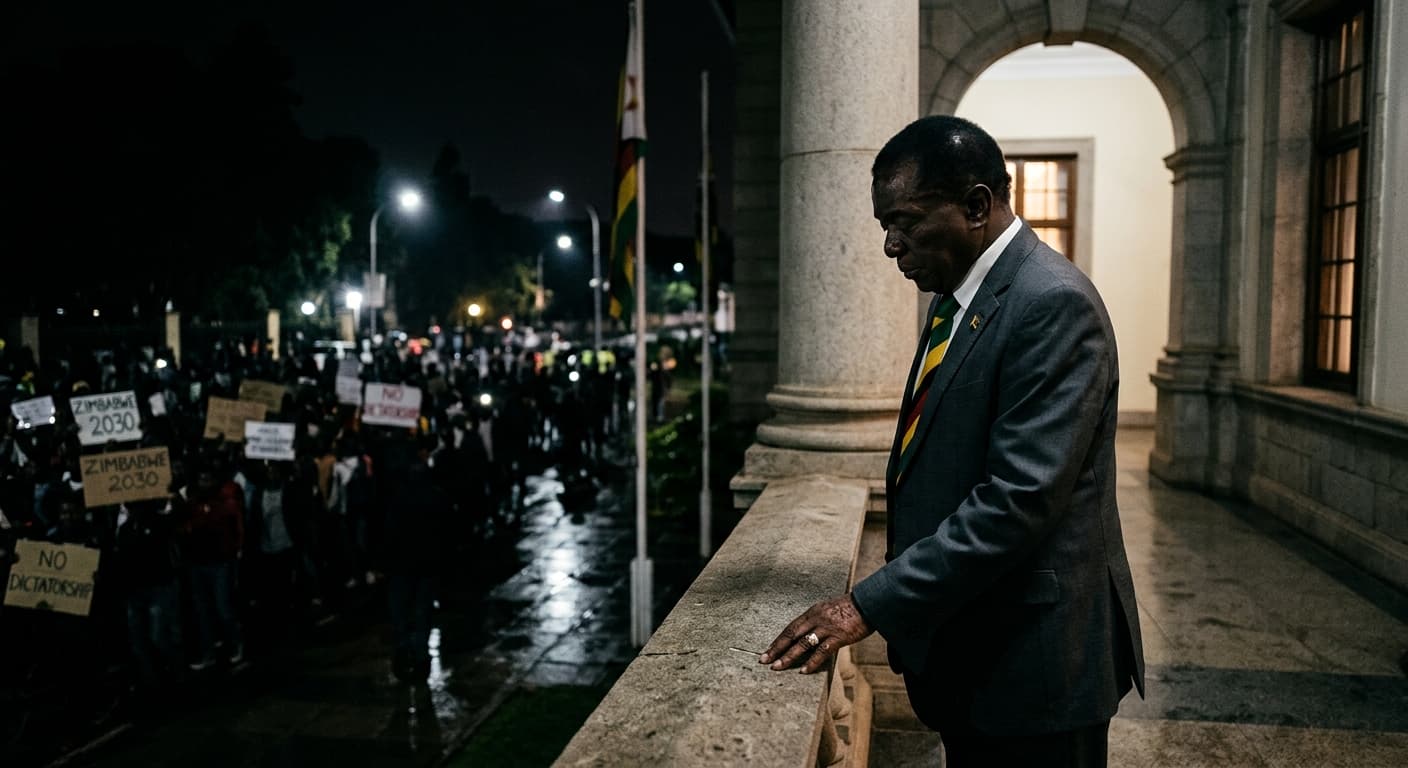
Mnangagwa Signs Zimbabwe's 2030 Rule Extension Into Law
Zimbabwe's president signed Constitutional Amendment No. 3 on July 7, 2026, extending his term to 2030 and abolishing direct presidential elections without a referendum.
President Emmerson Mnangagwa signed Constitutional Amendment (No. 3) Act into law on July 7, 2026, extending presidential and parliamentary terms from five to seven years, postponing the 2028 general election to 2030, and abolishing the direct popular vote for president in favour of election by a joint sitting of parliament. The change keeps Mnangagwa, 83, in office two years past his constitutional exit date and — by transferring the power to choose future presidents from 6.6 million registered voters to roughly 350 lawmakers his party already controls — converts Zimbabwe's contested electoral democracy into a de facto parliamentary appointment system dominated by ZANU-PF. The law was enacted without the referendum that Section 328 of the 2013 Constitution requires when a sitting president benefits from a term change, a point the Journal of Democracy called a "coup against the constitution."
What the law actually changes
Amendment No. 3 rewrites four load-bearing provisions of Zimbabwe's 2013 constitution at once. Presidential and parliamentary terms are lengthened from five to seven years. The 2028 elections are cancelled and folded into a single 2030 vote. Direct presidential elections — held every cycle since 1990 — are scrapped, with future heads of state chosen by a joint sitting of the National Assembly and Senate. The Senate itself expands from 80 to 90 seats, with the 10 new members appointed by the president, according to reporting from Al Jazeera.
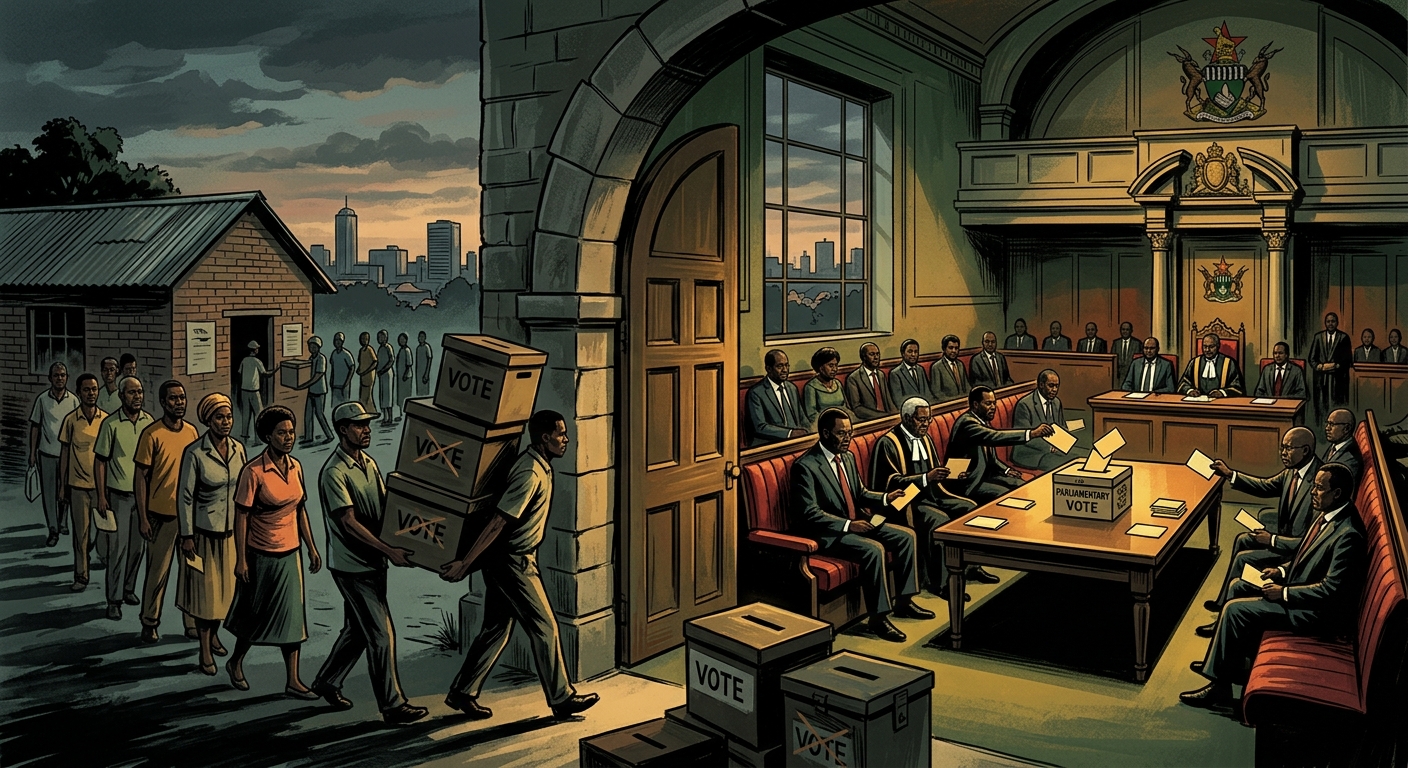
Speaker Jacob Mudenda announced the National Assembly vote on June 18, 2026 at 216 in favour to 42 against, comfortably above the 187-vote two-thirds threshold. The Senate followed on June 24, passing the bill 75 to four, Al Jazeera reported, citing Senate President Mabel Chinomona.
Human Rights Watch, in a statement issued the day after the signing, described the mechanics plainly: "Zimbabwe's President Emmerson Mnangagwa signed a law on July 7 amending the constitution to extend presidential terms from five to seven years. The amendment, approved by parliament last month, also abolishes the election of the president by popular vote and establishes a parliamentary method for selecting the president," Human Rights Watch said.
The referendum that was avoided
The 2013 constitution — approved by 94.5 percent of voters in a March 2013 referendum, according to the Journal of Democracy — was designed to prevent exactly this outcome. Section 328(7) provides that an amendment to term-limit provisions cannot benefit a sitting president unless approved in a second referendum. Constitutional lawyer David Coltart told
Al Jazeera in February that "any amendment which has the 'effect' of extending an incumbent's tenure should be subjected to a referendum."
ZANU-PF's counter-argument, laid out in parliament on June 3 by Justice Minister Ziyambi Ziyambi, is that the two-term ceiling technically remains intact — only the length of each term has changed. "This bill does not give the president a term extension or a third term. It does not take away the right to vote. It does not postpone elections," Ziyambi told the National Assembly, per Al Jazeera.
That reading did not survive contact with the arithmetic of the amendment itself, which explicitly delays the 2028 vote to 2030. It did, however, survive contact with the Constitutional Court. In May 2026, after reserving judgment for months, the court dismissed challenges brought by Lovemore Madhuku's National Constitutional Assembly on procedural grounds, Brookings noted in a June 26 analysis by scholars Chipo Dendere and Miles Tendi. Subsequent challenges by war veterans and activist Youngerson Matete were struck off the roll for technical reasons in the week before the National Assembly vote.
Why the opposition folded
The most consequential detail of the June 18 vote was not the 216 in favour — ZANU-PF holds a two-thirds majority on its own — but the roughly 30 opposition Citizens Coalition for Change (CCC) legislators who crossed the floor to back the bill, according to Farai Matiashe's on-the-ground reporting for Al Jazeera. Those defections track back to a mechanism that has quietly hollowed out Zimbabwe's parliamentary opposition since the 2023 general election.
In 2023, the CCC — led by Nelson Chamisa — won enough seats to deny ZANU-PF a two-thirds majority. Within months, Sengezo Tshabangu, claiming to be CCC interim secretary-general, began issuing "recall" letters removing CCC MPs from parliament. ZANU-PF then won nearly every subsequent by-election, delivering the ruling party the constitutional supermajority it needed. Brookings characterised the sequence as ZANU-PF "exploiting existing weaknesses within the opposition." By the time CAB3 reached the floor, activist Pride Mkono told Al Jazeera that Zimbabwe was "effectively enter[ing] a one-party state, but one dominated by a cartel of individuals."
Wicknell Chivayo, a businessman close to Mnangagwa, has faced repeated accusations of using cash and vehicle gifts to influence legislators, according to the same Al Jazeera reporting. No prosecution has followed.
The Chiwenga fault line — and what the amendment does about it
The extension is also a factional weapon. The most persistent challenge to Mnangagwa's rule has come not from the CCC but from inside ZANU-PF, where Vice President Constantino Chiwenga — the former army general who commanded the November 2017 coup against Robert Mugabe — has long been treated by insiders as the president's designated successor.
That succession clock is what Amendment No. 3 stops. By pushing the next contest to 2030, when Chiwenga will be 74, and by moving the choice of president from a national ballot to a parliamentary caucus that ZANU-PF's Politburo can whip, the law neutralises the vice-president's most plausible path to the top job. Analyst Justice Mavedzenge told Al Jazeera in April that Mnangagwa's "intention is to leave power when one of his family members is ready to take over" — a reading Mnangagwa has denied.
The internal enforcement of that agenda has been ruthless. War veteran and Chiwenga-aligned central-committee member Blessed "Bombshell" Geza, who used YouTube livestreams to condemn the extension and organise the failed 31 March 2025 stayaway, was expelled from ZANU-PF, forced into hiding, and died in circumstances his supporters call unexplained, the BBC reported. In March 2025, Mnangagwa moved Chiwenga ally General Anselem Sanyatwe from army chief to the sports ministry, an
Al Jazeera opinion piece noted at the time — the clearest signal yet that the president was pre-empting the military lever that toppled Mugabe.
The economic bet that pays for silence
Mnangagwa's insulation from external pressure rests on numbers most African autocrats do not have. Zimbabwe's economy grew 6.6 percent in 2025, outpacing most of sub-Saharan Africa, and is projected at 5 percent for 2026, according to the World Bank. Inflation fell to 4.1 percent in January 2026, and on July 7 — the same day Mnangagwa signed the amendment — the
IMF confirmed a staff-level agreement on the first review of Zimbabwe's Staff-Monitored Program.
The engine is mining. Zimbabwe holds Africa's largest lithium reserves. Mineral sales hit $983.85 million in the first quarter of 2026 alone, with lithium export earnings more than doubling year-on-year to $178.64 million, Al Jazeera reported, citing the Minerals Marketing Corporation of Zimbabwe. Chinese firms — Zhejiang Huayou Cobalt, Sinomine, Chengxin Lithium — dominate the sector and have committed hundreds of millions to on-shore processing plants at Arcadia and Bikita.
That is the leverage calculus. As long as gold prices hold, lithium volumes climb, and the IMF keeps the reform track open, the constituencies that historically forced African incumbents to negotiate — Western donors, the IMF, SADC's more democratic members — have limited grievance to weaponise. The Journal of Democracy called for coordinated pressure from Botswana, Angola and the African Union. None has materialised. Neither SADC nor the AU has issued a critical statement on the amendment.
The region's authoritarian playbook, exported
Zimbabwe is now the seventh sub-Saharan African state in a decade to alter constitutional term-limit rules to keep an incumbent in office. Al Jazeera's June 18 wire compilation listed Uganda's Yoweri Museveni, Côte d'Ivoire's Alassane Ouattara, Cameroon's Paul Biya, and Equatorial Guinea's Teodoro Obiang Nguema as the direct precedents. What distinguishes Zimbabwe's version is architecture rather than motive: rather than lifting term limits outright, Amendment No. 3 preserves the two-term ceiling as legal theatre while stretching each term, delaying the calendar, and removing the electorate from the equation entirely.
For African constitutional-design scholars, that matters. Where Museveni and Biya scrapped term limits — a move that draws automatic criticism from the African Charter on Democracy, Elections and Governance — Zimbabwe's model preserves the letter of every relevant clause while gutting the mechanism. It is a template other incumbents facing 2027 or 2028 exit dates are watching closely.
Key takeaways
- Mnangagwa signed Constitutional Amendment No. 3 on July 7, 2026, extending his term to 2030 and abolishing the direct election of Zimbabwe's president.
- The National Assembly passed the bill 216–42 on June 18; the Senate passed it 75–4 on June 24. Both chambers exceeded the two-thirds threshold.
- Section 328 of the 2013 Constitution required a referendum for any change benefiting a sitting incumbent. No referendum was held. The Constitutional Court dismissed challenges on procedural grounds in May 2026.
- The amendment neutralises Vice-President Constantino Chiwenga's succession claim by moving the choice of president from voters to a ZANU-PF-dominated parliament.
- IMF staff-level agreement on July 7 and 5 percent projected 2026 growth insulate Mnangagwa from the external leverage that has forced concessions elsewhere.
What to watch
- Constitutional Court residual cases: Human rights lawyer Lovemore Madhuku and activist Youngerson Matete have signalled they will refile challenges on the referendum question. Any hearing date set in the next 60 days will test whether the judiciary will revisit Section 328(7).
- SADC Heads of State Summit, August 2026: Zimbabwe holds the SADC Organ on Politics, Defence and Security chair until 2026. The summit is the first regional venue in which member states — particularly Botswana and Angola — can formally raise the amendment.
- IMF Executive Board review: The Fund's staff-level agreement of July 7 must still be approved by the Executive Board. Governance conditionality attached to that approval is the clearest short-term signal of Western posture.
- ZANU-PF congress, December 2027: The party's next elective congress is when Chiwenga's faction must either accept the 2030 timetable or force a challenge. That meeting, not any opposition mobilisation, is the point at which Mnangagwa's succession plan is genuinely tested.
The Bottom Line
Amendment No. 3 is not a term extension; it is a redesign. By keeping the two-term ceiling in place while lengthening terms, delaying elections, and transferring the power to choose presidents from voters to a captured parliament, Mnangagwa has closed the electoral integrity question in Zimbabwe until at least 2030 — and provided a template that preserves constitutional form while eliminating democratic substance. The decisive constraint on his rule now lies inside ZANU-PF, not at the ballot box.
Discover more

US Politics
SNAP Food Assistance Faces Legal Challenges
In 2026, SNAP faces stricter eligibility rules and mounting legal challenges, threatening food assistance for the millions of Americans who rely on the program.

US Politics
Next Generation Republicans
A leaked survey shows 39% of Republicans under 30 do not identify as MAGA, revealing a split in the GOP's future leadership.
Global Politics
Trump's Conflicting Messages on Iran War
Trump's mixed messages on Iran reflect a strategy of audience management, benefiting Tehran amid a complex geopolitical landscape.

Economics
Fed's Amex AML order puts correspondent banking on notice
Federal Reserve's Amex AML order requires board-level controls and a 90-day plan; OCC fined the bank $350 million over enterprise-wide deficiencies.