Madagascar's Colonel Takes the Palace
EU faces tough choices on Madagascar's military rule
Model Diplomat4 min readafrica
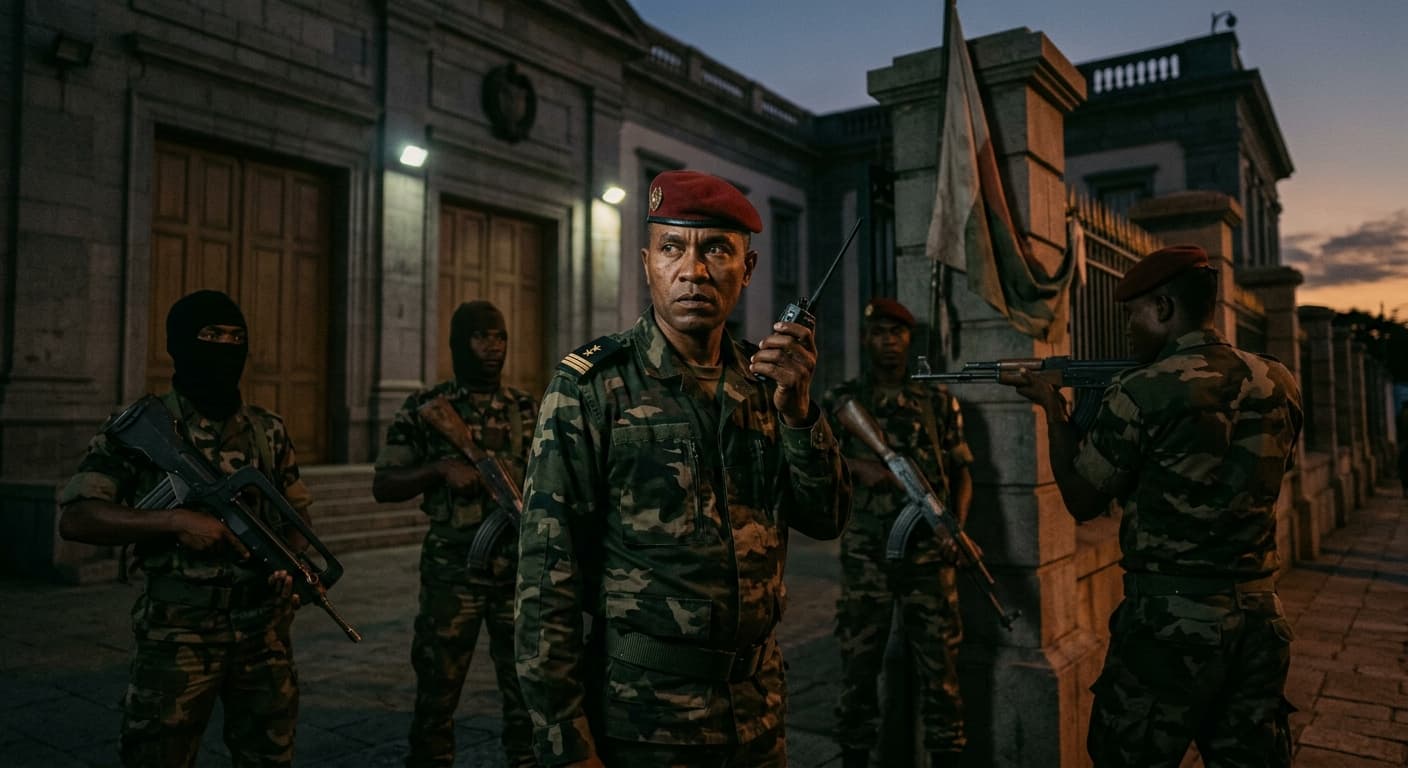
Madagascar's Colonel Takes the Palace — the EU's Sanctions Dilemma
Colonel Michael Randrianirina rode a youth uprising into power. Now Brussels must choose: isolate Madagascar like Mali and Niger, or try something different.
The numbers tell the story before the politics does. 75% of Madagascar's 31 million people live below the poverty line, only one-third have electricity, and in the capital Antananarivo, taps can run dry for six years — while bills still arrive NPR. When the Gen Z Madagascar movement took to the streets in late September 2025 over water and power cuts, it was not a political abstraction. It was a survival reflex.
By October 14, that reflex had toppled a president. Parliament voted 130–1 to impeach Andry Rajoelina for abandoning his post after he fled aboard a French military aircraft to Réunion, then Dubai BBC. Hours later, Colonel Michael Randrianirina — head of the elite CAPSAT unit that had refused orders to fire on protesters three days earlier — stood outside the Ambohitsorohitra presidential palace and declared the military in charge. The unit that installed Rajoelina in 2009 had now removed him, and the High Constitutional Court swore Randrianirina in as "President of the Refoundation of the Republic" on October 17
Al Jazeera.
The Power Dynamic: Who Holds What
Randrianirina holds the streets and the institutions, for now. Parliament remains intact and cooperated with the impeachment. The Constitutional Court provided legal cover. The protesters cheered his motorcade through Antananarivo — one demonstrator told NPR the army was "the only neutral institution that can get us back on track" NPR.
What he does not hold is recognition. The African Union suspended Madagascar on October 15, and the United Nations condemned "the unconstitutional change of power" Al Jazeera. The Southern African Development Community (SADC) echoed those alarms. Randrianirina has pledged elections within 18–24 months, a new constitution, and a transitional government that includes civilians — but he has suspended the Senate, the electoral commission, the High Court of Justice, and the human rights council
AfricScope.
This is where the ECFR analysis departs from the institutional reflex. Daria Jankiel argues that treating Madagascar like Mali, Burkina Faso, or Niger — full sanctions, diplomatic quarantine — would punish the population that drove Rajoelina out, not the colonel who replaced him ECFR. The street-to-state pipeline here is unusually direct: CAPSAT joined the protests, it did not suppress them. The UN documented at least 22 deaths and over 100 injuries before the military shifted sides
BBC. The crackdown came from forces loyal to Rajoelina — not from the unit now holding power.
The EU's Leverage Calculation
The ECFR's call is practical, not principled. Sanctions on Madagascar would hit Jirama, the state electricity and water utility, which Randrianirina has already announced an investigation into BBC. The country's debt-to-GDP ratio stands at 7.6% from Jirama alone, youth unemployment tops 30%, and GDP per capita is $453
Vivekananda International Foundation. Europe, as Madagascar's largest donor and trade partner, faces a binary choice: freeze aid and watch basic services collapse further, or condition engagement on a binding electoral calendar and institutional reforms.
The risk of the first approach is that it replicates the Sahel playbook — sanctions, isolation, then Russian and Chinese backfill. Randrianirina has already hinted at "warmer ties with Russia" BBC, the same pivot made in Bamako and Ouagadougou after those juntas hit Western friction.
The risk of the second approach is legitimacy-laundering. Randrianirina spent time in a maximum-security prison in 2023, accused of plotting a coup against the man he just deposed BBC. He has not filled the transitional government and has no binding timeline for elections. The two-year window could easily stretch — as it has in every military transition on the continent since 2020.
What to Watch
Three decision points will define the next quarter. First, the prime ministerial appointment — Randrianirina said consultations are underway for a "consensus" figure. Whoever he names signals whether the military intends to share power or merely stage-manage it. Second, the EU Foreign Affairs Council — whether Brussels issues a sanctions package or opts for what ECFR calls "technical support to build legitimate institutions." Third, the AU Peace and Security Council's next review — suspension is a political signal, not a permanent state; the question is what benchmarks it sets for re-admission.
The deeper warning here is for the continent. Madagascar's crisis did not start as a coup plot. It started as a service-delivery failure so profound that youth mobilized, a military unit defected, and a president fled within three weeks Al Jazeera. That sequence — grievances, protest, military pivot, collapse — is replicable in any state where the social contract is broken and the army calculates that firing on civilians costs more than switching sides.
Discover more
US Politics
Virginia's Redistricting Referendum
Virginia's redistricting referendum is drawing a flood of dark money, shaping future elections and the fight for congressional control amid party stakes.
India
Women’s Reservation in India
India's 33% women's reservation law is enacted but won't take effect until after 2029 due to political setbacks and census delays.
India
Women's Reservation Bill 2026: A Political Sh
India's Lok Sabha rejected the Women's Reservation Bill, exposing a political maneuver to redraw electoral maps favoring the north over the south.

Conflict & Security
Drone Warfare Killing Aid Workers at Unprec
Over 1,000 humanitarian workers killed in three years as cheap armed drones collapse legal protections. Gaza, Sudan, Ukraine, and DRC see deliberate targeting of aid convoys and hospitals with zero prosecutions.