Mauritania's Ban on Private Schools
Ghazouani's education reform aims for integration.
Model Diplomat8 min readAfrica
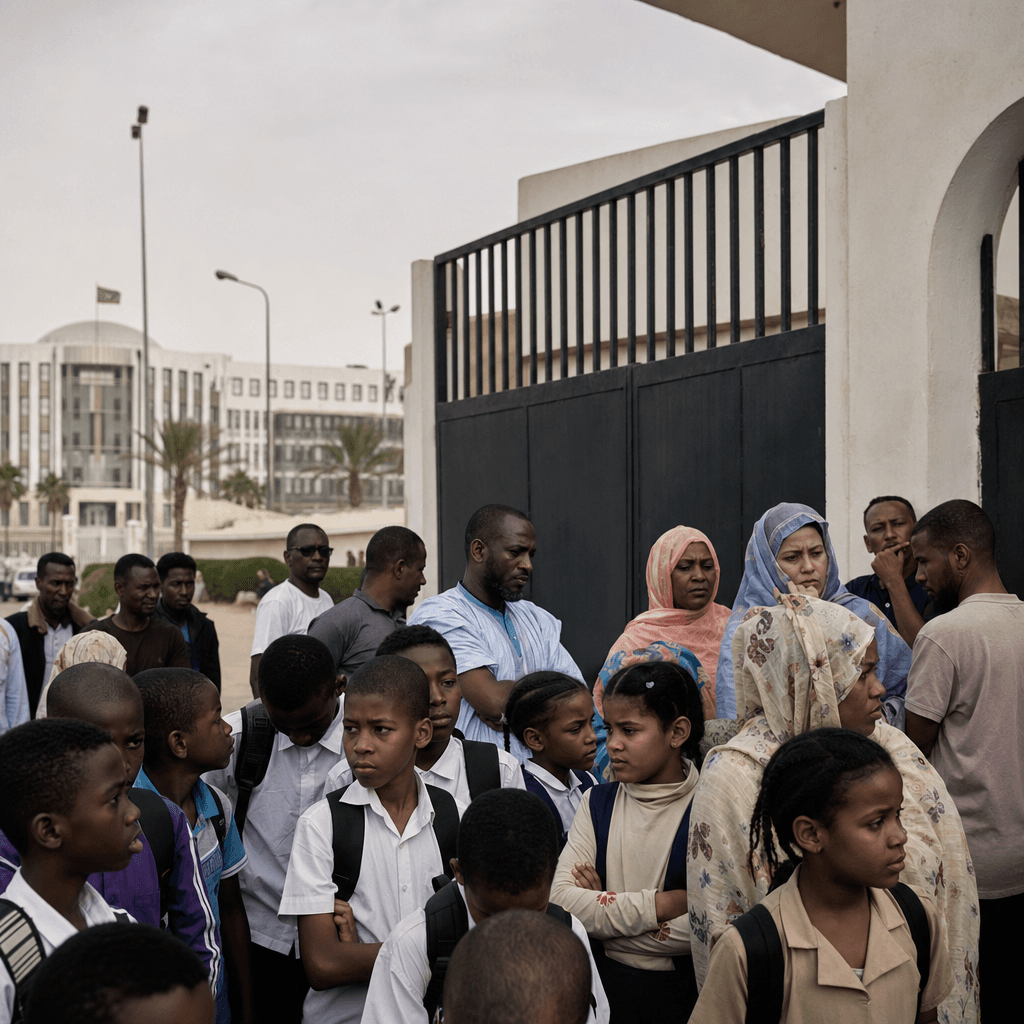
Mauritania's Ban on Private Schools: Ghazouani's Republican Gamble
Mauritania is phasing out private primary schools by 2027 to force ethnic integration into public classrooms — but only 10% of state teachers meet minimum standards.
Mauritania's 2022 education law, which bars private primary schools from admitting new students after 2027, is being sold as a rupture with a racially stratified schooling market. But the state system meant to absorb those pupils passed only 15.6% of its baccalauréat candidates in 2020, and by the government's own accounting fewer than one in ten primary teachers has the minimum knowledge required to teach. The reform's design — a total ban on private primaries, but a full exemption for private lycées — will not level the playing field; it will lower the floor while keeping the ceiling intact for those who can pay.
That is the paradox on display as the 2025–2026 school year opened on October 6, 2025, with parents, unions and school owners in Nouakchott openly asking whether President Mohamed Ould Ghazouani's "republican school" project is engineering equality or engineering a collapse.
What the law actually does
The law, adopted in 2022, does three things at once, according to reporting by Al Jazeera and the
Ecofin Agency: it makes schooling compulsory from age six; it extends free public education from primary through the entire basic-education cycle, adding middle school for the first time; and it phases out private primary education, requiring private primaries to stop admitting new students after 2027 and to run down existing cohorts through 2030.
Only private lycées — the three-year upper-secondary track — are exempt. That carve-out matters. Everything below the baccalauréat gets nationalised; the credential-issuing tier that determines admission to university and the civil service does not.
Ministry officials frame this as an anti-discrimination measure. Mohamed El Saleck Ould Taleb, a coordinator at the Ministry of National Education, told Al Jazeera that under the reform "everyone will wear the same uniform, sit at the same table, from the south to the north, and education will be the same thing." The frame builds directly on the Nouakchott Declaration signed by Ghazouani and four other Sahel heads of state on December 5, 2021, in which the Mauritanian president pledged to make school "a republican school as a place for integration of future generations."
Private educators do not buy the framing. Malick Diagne, a teacher with nearly 50 years in the sector, told Ecofin that private schools depend on primary tuition for economic survival and that eliminating it "would jeopardize many institutions." One school reported losing roughly two million ouguiyas — about $5,000 — every month as classes closed under the phase-in, according to Al Jazeera. French-language coverage by Le360 Afrique described the October rentrée as unfolding under "acute crisis" and fear of the disappearance of private education altogether. Private school owners proposed a quota system, under which a fixed share of low-income pupils would study for free, but say they never received a response from the ministry.
Who actually benefits — and who does not
The government's political case rests on Mauritania's racial geometry. The country sits where the Arab world meets the Sahel: an Arab-Berber Beidane elite has historically dominated politics and the economy over the Haratine — an Arabised Black group descended from enslaved people — and the Afro-Mauritanian minority that speaks Pulaar, Soninke and Wolof rather than Arabic. Amnesty International, in a 2018 country report, noted that 75% of Mauritanian ministers since independence have come from the Beidane community, versus 6% from the Haratine — a group the US State Department estimates makes up a plurality of the population. Slavery was only criminalised in 2007.
Private schooling maps onto that fault line. Fees at Nouakchott's higher-end French-curriculum schools can reach roughly $1,000 per term, per Al Jazeera; the poorer Haratine and Afro-Mauritanian populations rely almost exclusively on the public system. In principle, forcing everyone into the same primary classroom breaks the segregation loop.
In practice, the exemption for private lycées — the gateway to the baccalauréat and higher education — means the wealthiest families keep an escape hatch precisely at the stage that determines careers. What the law forbids at ages 6 to 12 it explicitly permits at ages 15 to 18. The reform equalises the classroom where stakes are low and preserves stratification where stakes are decisive.
Human Rights Watch has separately documented a second, quieter mechanism of exclusion: since 2011, Mauritania's biometric civil-registration process has kept some Haratine and Afro-Mauritanian children out of public schools altogether because their parents cannot produce the required documents. A 2016 joint circular from the interior and education ministries stated flatly that "no student shall be enrolled in a public or private educational institution unless the registration process has been completed in the manner stipulated by Law." Private and Quranic schools were the workaround. In
a 2018 investigation, HRW found families who could not enrol children in public schools and instead relied on private Quranic institutions — precisely the schools that will now be shuttered at the primary level. Closing that workaround without fixing the registration bottleneck risks pushing the most marginalised children out of school entirely — the opposite of the stated goal.
The private sector also served an efficiency function the state has not matched. A World Bank operations paper on engaging the private sector in Mauritanian education documented that private primary enrolment rose from 12,391 pupils in 2002 to 71,104 by 2012 — a nearly six-fold expansion at a moment when public infrastructure could not keep up. By 2010 private schools accounted for 11% of primary and 26% of secondary enrolments. That capacity is what the state is now proposing to replicate under its own management inside four years.
The absorption problem
The harder question is whether the public system can absorb the pupils it is about to inherit. The evidence base, most of it produced by Mauritania's own government and its multilateral partners, is not encouraging.
According to Mauritania's Strategy for Accelerated Growth and Shared Prosperity, submitted to the IMF and published in May 2024, teacher absenteeism runs at 20%, fewer than 16% of pupils have a textbook, and only around 10% of teachers possess the minimum pedagogical knowledge for their job. The baccalauréat pass rate was 15.6% in 2020, down from earlier in the decade. Only 34% of children who start school reach the first year of lower secondary, and just 12% reach the final year of upper secondary. Ecofin notes that the Global Partnership for Education put the share of primary teachers with minimum required knowledge at 5.9% in 2022 — an even harsher figure than the government's own.
The World Bank's education assessment ranked Mauritania 150th of 157 economies on the Human Capital Index, with a child born today expected to realise only 35% of her potential productivity. UNESCO estimates that at least 30% of school-age children are not enrolled at all, and that roughly 95% of ten-year-olds cannot read a text their peers elsewhere would handle without difficulty, per Al Jazeera's citation. On
November 25, 2025, the World Bank Board approved a new Country Partnership Framework centred on "economic diversification" and human capital — implicitly acknowledging that the current base is too thin to support the government's own reform.
| Indicator | Value | Source / Year |
|---|---|---|
| Population too poor to access quality education or health | 58% | World Bank (2024) |
| School-age children not enrolled | ≥30% | UNESCO (2024) |
| 10-year-olds who cannot read a basic text | ~95% | UNESCO |
| Primary completion rate | <70% | UNESCO (2024) |
| Primary teachers with minimum knowledge | 5.9% | Global Partnership for Education (2022) |
| Teacher absenteeism | 20% | SDI 2018, cited by IMF |
| Baccalauréat pass rate | 15.6% | Ministry of Education (2020) |
| Human Capital Index rank | 150 of 157 | World Bank |
| Donors are trying to help build the runway. On |
The historical parallel — and the political calculation
Mauritania has been here before. Ghazouani's move is the fourth attempt in six decades to use the school as an instrument of national integration. Le Monde diplomatique's 1980 dispatch on the 1979 language reform recorded that ministers of the day argued citizens were "equal in law" and therefore had to be offered "equal opportunities" through a common school. That reform, and the arabisation drive that followed, deepened rather than closed the Beidane–Afro-Mauritanian divide, culminating in the violent expulsions of the 1989 "passif humanitaire."
The Ghazouani version updates the argument. Instead of language, it uses ownership: the state owns the school, so the school will be neutral. The problem is that language remains embedded in the private-lycée exemption, in a majority-Arabic public curriculum, and in a system where — as a 2025 study of Mauritanian second-graders found — mother-tongue instruction significantly outperforms French-medium instruction for reading acquisition, but Afro-Mauritanian mother tongues remain marginal.
The political calculus is nonetheless coherent. Re-elected in June 2024, Ghazouani needs a legacy project that reads as social justice without redistributing land or challenging the Beidane commercial elite. Nationalising the primary school is cheaper than land reform and more visible than civil-registration fixes. It also lets his government point at closing schools — the ones private educators like Nouakchott teacher Abdel-Wedoud say already serve a mixed clientele — as evidence of action.
What to watch
- The 2026–27 rentrée: the last academic year in which private primaries can enrol new pupils. Enrolment data will show whether public schools are actually absorbing the shift, or whether children are dropping out.
- Teacher redeployment: the government has promised private teachers can apply to public schools, but has published no plan or budget line. A concrete decree is the load-bearing detail.
- World Bank RELANCE disbursements: tranche timing through 2027 will indicate whether donor finance is actually plugging the capacity gap the ban creates.
- Civil-registration reform: without it, the marginalised children the reform is meant to help will simply be locked out of the public system too. Watch for any revision to the 2011 biometric enrolment regime.
The Bottom Line
Mauritania's ban on private primary schools is not, in operational terms, an equality project — it is a nationalisation project draped in the language of the republican school. By exempting private lycées and leaving the biometric civil-registration bottleneck untouched, the 2022 law removes the private safety valve that Haratine and Afro-Mauritanian families had been using while preserving the elite escape hatch at the credential-issuing stage. Unless the state can raise teacher competence from roughly 6% to something recognisable as a functioning system by 2030, Ghazouani will have delivered uniformity without quality — and produced a generation of pupils poorer in schooling than the one before them.
Discover more
India
Romanian Coalition Party Demands PM Resign
Romania's Social Democrats withdrew from coalition, joining far-right AUR to topple PM Bolojan, risking €10 billion in EU funds by August 2026.
India
CPI(M) Calls to Decouple Quota from Delimita
CPI(M) advocates for a 33% women's quota in Lok Sabha by 2029, removing the need for delimitation and census linkage.

Conflict & Security
Drone Warfare Killing Aid Workers at Unprec
Over 1,000 humanitarian workers killed in three years as cheap armed drones collapse legal protections. Gaza, Sudan, Ukraine, and DRC see deliberate targeting of aid convoys and hospitals with zero prosecutions.

Global
World Normalises Taliban as Afghan Women Eras
UN data shows Afghan women erased from public life as Russia recognises the Taliban, EU hosts officials in Brussels, and ICC warrants for gender persecution go unenforced.