Mauritania's ACWA Gas Deal Reshapes LNG
A $669m gas-to-power deal transforms Mauritania's energy landscape.
Model Diplomat8 min readAfrica
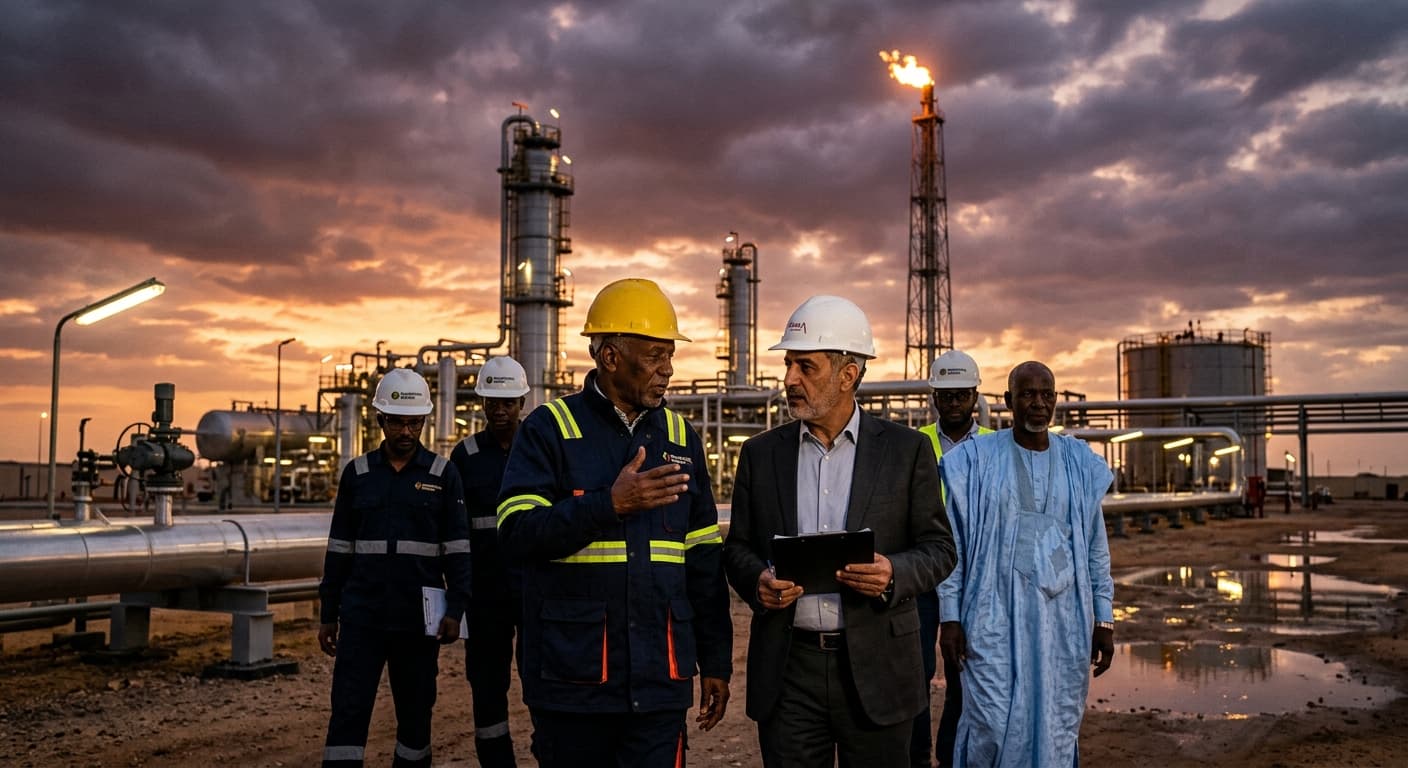
Mauritania's ACWA Gas Deal Rewrites West Africa's LNG Playbook
Nouakchott's $669m N'diago gas-to-power deal with Saudi Arabia's ACWA Power diverts offshore GTA gas from LNG exports to the domestic grid — reshaping energy security and foreign investment.
Mauritania signed a 25-year public-private partnership on July 1, 2026 with Saudi Arabia's ACWA Power to build a 230-megawatt combined-cycle gas plant at N'diago — its first large-scale gas-fired independent power project, valued at roughly $669 million. The deal is not, as most wires framed it, another Gulf capital-in-Africa story. It is a deliberate strategic pivot: for the first time, Nouakchott is redirecting a slice of its offshore Greater Tortue Ahmeyim gas away from BP's LNG export train and into its own grid — and it is a Saudi state-backed developer, not a Western major or a Chinese state utility, that will monetise it. Riyadh gets a West African beachhead, BP loses a marginal export molecule, and Mauritania finally does what Chatham House flagged it had failed to do in 2019: articulate a domestic use for its gas.
What was signed, and why the number that matters is not $669m
The Public-Private Partnership and Power Purchase Agreement were signed in Nouakchott in the presence of ACWA Power Chairman Mohammad Abunayyan, according to a SolarQuarter report on the signing. ACWA will develop, finance, build and operate the plant; state utility Société Mauritanienne d'Électricité (SOMELEC) is the offtaker.
MEED confirmed the 230 MW N'diago facility as the country's first large-scale gas-fired IPP, and
Financial Afrik reported the deal was formalised on July 1, 2026.
The load-bearing number is not the price tag. It is the base. Mauritania's installed capacity stood at 615 MW in 2023, of which just 520 MW was actually available, according to the country's Mission 300 Energy Compact filed with the World Bank. That same compact records a national electrification rate of just 55%, split brutally between 91% urban and 6% rural. Adding 230 MW of combined-cycle baseload lifts firm generation capacity by roughly 44% in a single project, and does so on domestic gas rather than the imported heavy fuel oil that has anchored SOMELEC's cost stack for two decades.
That is why the World Bank calls it "critical" to Mauritania's Mission 300 Energy Compact target of universal electricity access by 2030 — the 55% baseline means Nouakchott has to reach an additional 3.4 million people in five years. It cannot do that on diesel mini-grids alone, and it cannot do it on solar without firming capacity.
The pivot: from export-only to domestic-first
Until this signing, the GTA story read as a pure LNG-export tale. BP loaded the first cargo from the floating LNG unit on April 17, 2025, according to the Policy Center for the New South, making Mauritania and Senegal LNG exporters for the first time. Phase 1 capacity is 2.4 million tonnes per year; Phase 2 will lift that to nearly 5 Mt/y, with a potential Phase 3 pushing the field toward 10 Mt/y.
The BP–Kosmos consortium — BP 56%, Kosmos 27%, Petrosen 10% and Société Mauritanienne des Hydrocarbures 7% — always carried a clause allowing each state to draw domestic gas from the field. Chatham House flagged in its 2019 study Mauritania's Unfolding Landscape that Nouakchott had "yet to articulate a comprehensive strategy" for using that gas as anything but export revenue, and warned the FLNG-heavy project offered "few obvious local employment and business opportunities." N'diago is Nouakchott's answer, seven years late — and it lands as European buyers still pay a premium for every LNG cargo BP can lift out of the FLNG unit.
The historical parallel is instructive, and unflattering. In May 2014 the World Bank approved $261 million in IDA guarantees plus $585 million in MIGA cover for the 300 MW Banda gas-to-power project — a scheme meant to convert Mauritanian offshore gas into electricity for Mauritania, Senegal and Mali. Banda collapsed in 2014 when the Islamic Development Bank pulled its financing. A decade later, the country is finally doing what Banda promised, at smaller scale, without the regional export component, and with Gulf rather than multilateral capital in the driving seat.
Who wins: ACWA, and Riyadh's West African beachhead
ACWA Power is the load-bearing name. The Saudi developer is 44%-owned by the Public Investment Fund since its 2021 IPO, according to Al Jazeera, and runs more than 34 GW of generation across the Middle East, Africa and Asia. Per the
Gulf International Forum, the firm is on track to deliver 15 GW of new renewable capacity inside Saudi Arabia by decade's end, and its chief executive Marco Arcelli has publicly said ACWA "will not invest in the US in the short term."
That non-US posture matters here. ACWA is executing a South-South strategy — Uzbekistan, Indonesia, Egypt, Morocco, and now Mauritania — that uses Chinese equipment and Saudi capital to displace both Western majors and Chinese state utilities in third markets. Germany's SWP Berlin describes ACWA as Saudi Arabia's "national champion" for foreign power and desalination, noting the Silk Road Fund already holds 49% of ACWA Power Renewable Energy Holding. N'diago extends that hybrid Sino-Saudi financing model to the Atlantic-facing Sahel.
For Mauritania, the price of Gulf capital is comparatively cheap. ACWA is known for aggressive project-finance leverage and long-tenor PPAs at bid-based tariffs — the same playbook that produced the Noor-Ouarzazate solar complex in Morocco with World Bank and EIB co-financing. For Riyadh, the strategic return is the harder currency: a foothold in a country that borders Senegal (already an ACWA desalination client, via the
Grande-Côte $800 million PPP signed in July 2025), Mali and the disputed Western Sahara, and that Morocco has drawn into its "Atlantic Initiative" corridor. The
Policy Center for the New South notes President Ghazouani's December 2024 Rabat visit — the first by a Mauritanian head of state in over a decade — as the diplomatic hinge that made an integrated Atlantic gas-and-power corridor plausible. ACWA is now embedded in three of its four load centres.
Who loses: BP's LNG margin — and Mauritania's climate story
The obvious loser is the LNG export line. Every molecule that lands at N'diago is a molecule BP Gas Marketing cannot sell into a European spot market. A 230 MW CCGT running at roughly 55% efficiency and 85% load factor consumes on the order of 0.3 bcm/year — modest against GTA Phase 1's ~3.3 bcm/year of gross output, but not trivial when Mauritania's 7% SMH stake in the consortium already gives Nouakchott leverage to demand more, phase by phase. The precedent is what BP fears: N'diago is the first documented deviation from the export-first playbook the BBC has covered as a template for offshore West African gas.
The less obvious loser is Mauritania's climate narrative. The country was already positioning itself as a green hydrogen play — the World Bank's DREAM Project, approved in March 2025, finances the country's first large-scale battery storage system and operationalises what it calls "one of the first" green hydrogen laws in Africa. Peer-reviewed
techno-economic analysis in Sustainability already puts the levelised cost of onshore wind in Nouadhibou at 5.69–6.51 US cents/kWh — competitive with any regional CCGT. Adding 230 MW of gas baseload for 25 years locks in a fossil asset that competes for the same grid slot as those planned renewables, and does so under a Power Purchase Agreement whose take-or-pay clauses will outlive both current governments and current climate diplomacy.
The Atlantic Council's October 2025 review of natural gas in Africa's transition explicitly places Mauritania in the category of countries where "relatively low electrification rates and significant gas reserves should be encouraged and supported in building gas-to-power projects." The paper is one of the few sitting on the fence: gas is defensible when it displaces diesel and enables renewables integration, not when it crowds them out. N'diago will be judged on which of those two outcomes it produces.
Second-order effects: the regional map
Three ripples matter more than the plant itself.
First, the West African Power Pool. The World Bank's 2014 Banda documentation already envisaged Mauritanian gas-fired power exported to Mali and Senegal. Mali is currently building a 225 kV interconnection with Mauritania under the AfDB-funded PIEMM programme, and once N'diago is on the grid, Nouakchott acquires exportable firm capacity for the first time. That reorients regional power flows away from the Senegal River Basin's hydro axis toward an Atlantic gas axis.
Second, the WBG's balance sheet. Mauritania's Country Partnership Framework approved November 25, 2025 is anchored on "climate-smart systems" and private-sector-led diversification; MIGA has explicitly signalled it will "offer political risk insurance in renewable energy and gas-to-power" during the CPF period, according to the
Bank's country brief. N'diago is the first big MIGA test case in Mauritania since the 2014 Banda collapse.
Third, the SOMELEC reform track. Somelec has a commercial recovery rate of just over 77% (2023), per the Mission 300 Compact, meaning nearly a quarter of electricity billed is never collected. Signing a 25-year PPA with a private IPP forces the utility onto a hard financial covenant regime. If ACWA gets paid on time, every other IPP that Mauritania needs — and the Compact envisages an investment gap of $2.45 billion, half from the private sector — becomes bankable. If it does not, N'diago will be a warning label.
What to watch next
- Financial close: ACWA typically reaches financial close 12–18 months after PPA signing. Watch for a lender package involving IFC, MIGA, AfDB, Islamic Development Bank and Saudi export credit. A MIGA guarantee is the leading indicator.
- GTA Phase 2 FID: BP's Phase 2 investment decision — which lifts LNG capacity toward 5 Mt/y — will show whether Nouakchott extracts additional domestic gas volumes as a condition. The next signal date is the BP–Kosmos joint operating committee cycle in Q4 2026.
- SOMELEC tariff reform: the
World Bank's $30 million policy financing is conditioned on utility financial ring-fencing. First tranche disbursement in 2026 is the covenant test.
Diplomat View
N'diago is a small plant with a large signal. It is the first hard evidence that African LNG exporters can, and will, ring-fence a share of their gas for domestic power when the political economy demands it — a template that Senegal, Mozambique, Tanzania and possibly Nigeria will study. The winner in the short term is ACWA Power, which has now stitched together desalination in Senegal, gas-to-power in Mauritania and solar in Morocco into a coherent Atlantic corridor. The medium-term winner is Mauritania — provided N'diago displaces heavy fuel oil rather than crowding out the wind and solar pipeline that the DREAM Project and the Mission 300 Compact are designed to unlock. The forecast that would need to change: if ACWA reaches financial close without a MIGA guarantee and without concessional co-financing, the message will be that Gulf capital no longer needs multilateral cover in West Africa. That would be the more consequential story than the plant itself.
Discover more

Global Politics
US Naval Blockade on Iran
The US fully imposed a naval blockade on Iranian ports, escalating tensions even as Trump hinted the conflict may soon end while serious risks of war remain.

US Politics
SNAP Food Assistance Faces Legal Challenges
In 2026, SNAP faces stricter eligibility rules and mounting legal challenges, threatening food assistance for the millions of Americans who rely on the program.
India
Rajnath Singh's Durga Squad for 2026 Polls
Rajnath Singh's Durga Squad promised women's safety in Bengal but has since disappeared from the agenda, revealing BJP's true priorities.

Economics
Fed's Amex AML order puts correspondent banking on notice
Federal Reserve's Amex AML order requires board-level controls and a 90-day plan; OCC fined the bank $350 million over enterprise-wide deficiencies.