Mamata Banerjee's 2024 Election Challenges
How past wins set the stage for future defeat
Model Diplomat8 min readSouth Asia
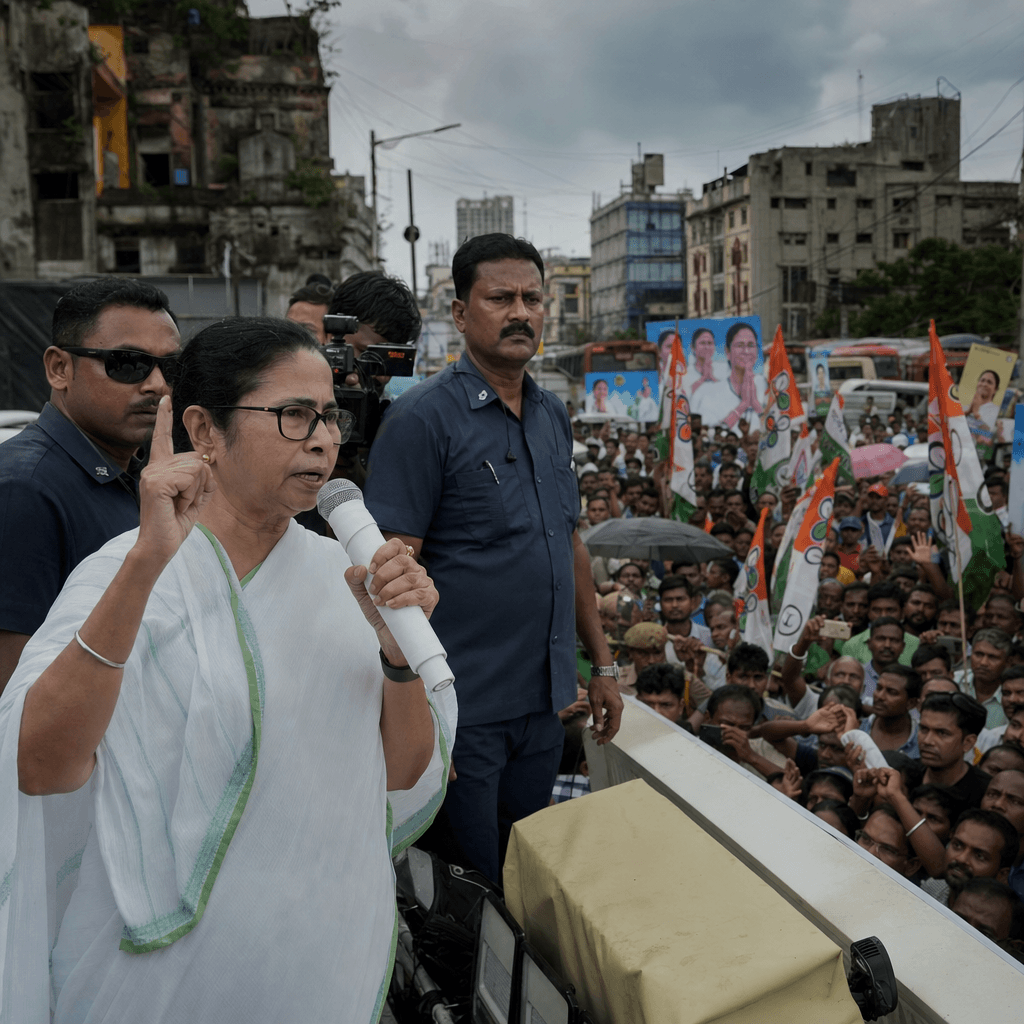
Mamata Banerjee's 2024 Election Challenges: The Wins That Set Up 2026's Defeat
How Sandeshkhali, the OBC ruling, and the INDIA-bloc split shaped Mamata Banerjee's 29-seat Lok Sabha win — and quietly seeded the assembly collapse that followed on May 4, 2026.
Mamata Banerjee walked into India's 2024 general election with two ministers in jail, a mass sexual-assault scandal in Sandeshkhali, a Calcutta High Court ruling scrapping 500,000 OBC certificates, and no alliance — after breaking from the Congress-led INDIA bloc in January. She won 29 of West Bengal's 42 Lok Sabha seats on 45.76% of the vote, according to the Election Commission of India, reducing Narendra Modi's BJP to 12. The one-line reading — that Mamata is uniquely BJP-proof — has aged badly. Two years later, on May 4, 2026, the same fault lines she overpowered in 2024 became the machinery of her defeat: the BJP took 207 seats, the Trinamool Congress crashed to 80, and Mamata herself lost Bhabanipur to Suvendu Adhikari. To understand what happened in Bengal in 2026, you have to reread 2024 — not as a triumph, but as an early warning misread as vindication.
The 2024 gauntlet: what she actually faced
Frontline described the Trinamool Congress in early 2024 as never more "beleaguered and vulnerable" since 2011, with "two heavyweight Ministers and several MLAs and influential leaders behind bars," per Frontline. The Enforcement Directorate had jailed former food minister Jyotipriya Mallick over an alleged ration-scam diversion; the school-jobs cash-for-recruitment case had put ex–education minister Partha Chatterjee behind bars; and central agencies were, as the BBC put it, "hot on the money trail."
Then came Sandeshkhali. When ED officers tried to arrest TMC block leader Shahjahan Sheikh on January 5, 2024, his supporters beat them back; women in the delta hamlet subsequently accused Sheikh and his aides of land-grab and sexual assault, in a case the BBC called a "political storm" that "dominated headlines in India for weeks." Sheikh was arrested only on February 29, after nearly two months on the run.
Two weeks before polling began, on May 22, a division bench of the Calcutta High Court cancelled every OBC certificate issued by West Bengal since 2010 — roughly 500,000 documents, most held by Muslim communities — ruling that the additions had been made "solely for electoral gain" and violated the OBC reservation statute. Mamata's reply, quoted by Business Standard, was blunt:
"We do not accept the order that scrapped OBC certificates. We will contest at a higher court after summer vacation."
And she did all of this alone. In late January 2024, Mamata walked out of Bengal seat-sharing with the Congress-Left alliance, telling Al Jazeera she would go it alone. Political scientist Rahul Verma warned at the time that a three-way split would hand seats to the BJP.
Why she won anyway in 2024
She won because welfare, women, and a one-way Muslim consolidation outran the scandals. In February 2024, weeks before the model code kicked in, her government raised the Lakshmir Bhandar monthly cash transfer to ₹1,000 for general-category women and ₹1,200 for SC/ST beneficiaries — a scheme the Observer Research Foundation had already flagged as electorally decisive since 2021. The 2021 Lokniti-CSDS post-poll survey found TMC support among women hit 50%, four points higher than among men, per the
BBC.
The Muslim vote — 27% of the state — moved as a block. An Economic and Political Weekly exchange in December 2024 identified "one-way polarisation of minority votes" alongside welfare as the twin engines of the TMC's result. Voter fear of the CAA-NRC framework, sharpened by the OBC ruling itself, pushed minority voters to consolidate behind the incumbent rather than split with Congress-Left. The
ISAS-NUS post-poll analysis noted the BJP had targeted 25–30 Bengal seats and Amit Shah had promised 30-plus; the party fell to 12 with a 1.8-point vote-share dip from 2019.
Mamata's own reading, delivered to Trinamool workers on June 4, 2024, was that she had bested Modi twice in three national contests. Kolkata's Telegraph called her "the country's most formidable Opposition leader." She had refuted every predicted debacle. And that, in hindsight, is where the story turned.
What 2024 hid — and 2026 exposed
The BJP still polled 38.73% in Bengal in June 2024 — the same 39% band it had held across three national elections. Rahul Verma of the Centre for Policy Research told the BBC after the 2026 result that once the party locked in that 39–40% floor, "it really needed only another 5-6% to cross the line." In April 2026, the BJP mopped up 44% and above; the TMC's 45.76% Lok Sabha share dropped roughly five points to around 41%. That is the entire election.
Three 2024 pressures, absorbed but not resolved, did the work.
First, Sandeshkhali was a warning, not an anomaly. The pattern — a TMC local strongman running an extortion-and-protection racket beyond the reach of Kolkata — repeated on August 9, 2024, when a 31-year-old trainee doctor was raped and murdered inside the state-run RG Kar Medical College. The Supreme Court said the crime "shocked the conscience of the nation," per the BBC, and Mamata was forced to sack the Kolkata police commissioner and the state's directors of medical education and health services after doctors' strikes ran for more than five weeks. The RG Kar protests were the largest urban middle-class revolt against her government since 2011, and — unlike Sandeshkhali, which the TMC could still frame as a BJP hit-job — they were led by her own base: junior doctors, feminist collectives, professionals.

Second, the OBC ruling metastasized into the Special Intensive Revision (SIR). Mamata told rallies she would fight to the Supreme Court, but a stay proved politically costly: it framed the TMC as the defender of a communally engineered reservation list. That perception fed straight into the BJP's 2025–26 argument that Bengal's rolls had been packed with "illegal Bangladeshi infiltrators." In the SIR that followed, the Election Commission removed roughly nine million voters — 12% of the electorate — with 2.7 million cases still pending when the state voted on April 23 and 29, 2026, per the BBC. The exclusions disproportionately hit Muslim-majority Murshidabad, Uttar Dinajpur and Malda — precisely the TMC's 2024 firewall.
Politician-activist Yogendra Yadav told Al Jazeera after the count that the 2.7 million contested deletions equalled 4.3% of the votes actually cast — in a state where the BJP's final vote-share lead was about 5%. That is the arithmetic Mamata now contests. But the political point is upstream: the OBC fight in 2024 primed the electoral-rolls fight of 2026, and Trinamool never won the citizenship-framing argument the BJP was building.
Third, the INDIA-bloc walkout worked once — and then boxed her in. Going solo in 2024 split the anti-BJP vote in some seats but consolidated Muslim voters behind the TMC as the single credible barrier to Modi. By 2026, with the Aam Janata Unnayan Party (rebel TMC leader Humayun Kabir), the AIMIM contesting 12 seats, the Indian Secular Front, and a revived Congress–CPI(M) tie-up all fishing in the same pond, the ISAS-NUS post-poll documented the damage: in Murshidabad, where Muslims are roughly two-thirds of the population, the TMC's tally collapsed from 20 of 22 seats in 2021 to nine in 2026. Across 32 majority-Muslim seats, it dropped from all 32 in 2021 to 23. Congress-CPI(M) and Muslim-interest parties ate into the base Mamata had spent a decade building.
The BJP's floor became a ceiling for Mamata
Anti-incumbency after 15 years compounded these three pressures. The ISAS-NUS pre-poll noted an urban appetite for poriborton — the same "change" slogan Mamata herself had ridden to end 34 years of Left rule in 2011. Modi campaigned in Bengal through April 2026 with the Citizenship (Amendment) Act as bait for the Matua community; the party wooed Namasudra voters in North 24 Parganas and Nadia, districts where over 300,000 Matua names were struck from the rolls, according to ISAS-NUS. When results came on May 4, the BJP had won 207 of 294 seats on 46% of the vote, per
Al Jazeera, with the TMC reduced to 80 seats and 41%. It was a near-mirror of the 2021 assembly result, flipped.
Mamata alleged the BJP "looted more than 100 seats" and called the Election Commission "the BJP's commission," per Al Jazeera. She did not concede that voters had turned. Suvendu Adhikari — her former protégé, then Nandigram victor in 2021, now assembly leader of the opposition and, from May 10, chief minister — was sworn in by Modi in a Kolkata ceremony that the BBC noted brought the BJP to Bengal for the first time in the state's history.
Diplomat View
The received wisdom on Mamata Banerjee's 2024 challenges is that she beat them. The evidence supports a harder claim: she survived them without solving them, and each unpaid bill came due in April 2026. Sandeshkhali was the prologue to RG Kar; the OBC judgment was the prologue to the SIR; going ekla against INDIA in 2024 hollowed out the alliance architecture she needed to hold the Muslim vote in 2026. The 2024 result told her the machinery still worked; the 2026 result showed it had been running on the fumes of women's welfare and a minority consolidation the BJP was already engineering ways around.
Two forecasts, falsifiable. First: unless the Supreme Court retrospectively finds the SIR unlawful and reinstates deleted voters — the case list continues — the TMC's route back through minority-majority districts is blocked for at least one more cycle. Second: Mamata, at 71, will attempt to reposition herself as the moral centre of a reconstituted INDIA bloc for the 2029 Lok Sabha; if she cannot secure a Rajya Sabha seat via a friendly state government by early 2027, that pivot fails. What would revise the call: a mid-term political crisis for the Adhikari government — Bengal's factional BJP is thin outside Modi's aura — combined with a Supreme Court order on SIR before the 2027 Rajya Sabha rotation. Absent both, the Bengal exception in Indian politics is over.
What to watch
- Supreme Court hearings on SIR deletions: pending petitions on the 2.7 million contested exclusions could reshape the 2029 electoral map in Bengal and beyond.
- The Adhikari cabinet's first budget (expected July–August 2026): whether the BJP dilutes or continues Lakshmir Bhandar will define its women-voter strategy for 2029.
- The 2027 Rajya Sabha rotation: Mamata's ability to secure an upper-house seat is the near-term signal of whether she remains a national opposition figure or slides into regional retirement.
The Bottom Line
Mamata Banerjee's 2024 election challenges — Sandeshkhali, the ED cases, the OBC ruling, the INDIA-bloc break — were not obstacles she overcame; they were faults she papered over with welfare cheques and Muslim consolidation. The 29-seat Lok Sabha win convinced her she had beaten Modi; it convinced the BJP it needed only 5 more points and a cleaner voter roll. On May 4, 2026, the BJP found both, and 15 years of Trinamool rule ended. The lesson for India's regional strongmen is unforgiving: surviving a national wave is not the same as defeating it, and welfare politics without institutional reform is a mortgage the next election collects on.
Discover more
India
Modi's Women’s Convention in Varanasi
Modi's Varanasi rally frames women's reservation as a national mission, targeting the 2027 Uttar Pradesh elections with a strategic narrative.
India
Women’s Reservation Bill 2026
The Constitution (131st Amendment) Bill, 2026 was defeated in Lok Sabha, revealing deeper political conflicts over women's reservation and delimitation.

Conflict & Security
Drone Warfare Killing Aid Workers at Unprec
Over 1,000 humanitarian workers killed in three years as cheap armed drones collapse legal protections. Gaza, Sudan, Ukraine, and DRC see deliberate targeting of aid convoys and hospitals with zero prosecutions.

Global
World Normalises Taliban as Afghan Women Eras
UN data shows Afghan women erased from public life as Russia recognises the Taliban, EU hosts officials in Brussels, and ICC warrants for gender persecution go unenforced.