Mali's Goïta Takes Defense Ministry Amid Inse
Goïta consolidates power amid insurgent threats.
Model Diplomat7 min readAfrica
Mali's Goïta Takes Defense Ministry as Insurgents Squeeze Bamako
Assimi Goïta named himself defense minister on May 4, 2026, after a suicide bombing killed Sadio Camara and JNIM-FLA fighters seized Kidal. The move concentrates power but exposes the junta's isolation.
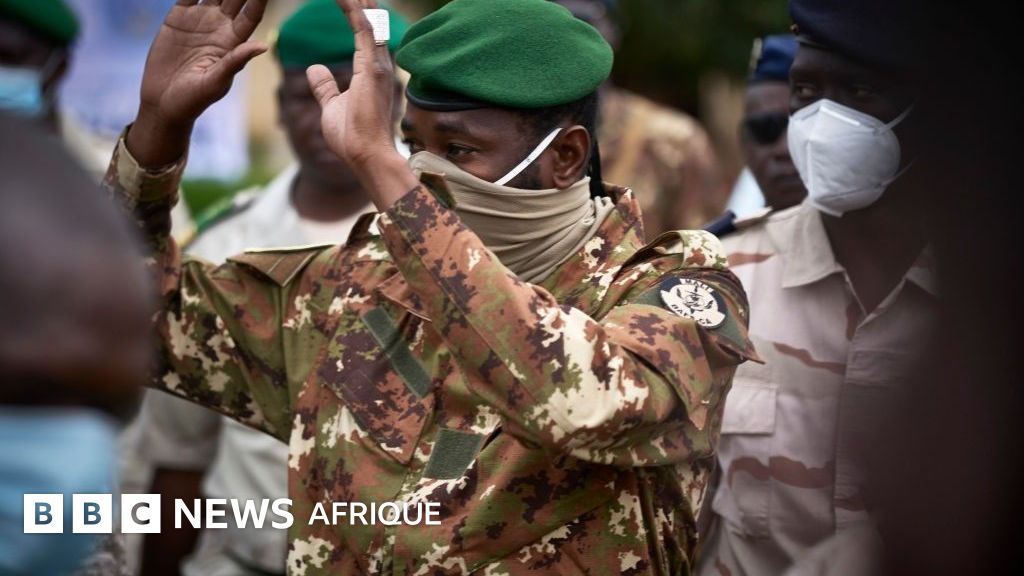
Mali's junta chief, Gen. Assimi Goïta, signed a decree on May 4, 2026, adding the defense portfolio to his presidency, nine days after a suicide truck bomb killed Defense Minister Sadio Camara and a joint offensive by al-Qaeda-linked JNIM and Tuareg separatists overran the northern city of Kidal. The consolidation is not a display of strength; it is an admission that the ruling clique has thinned to a single indispensable man, and it removes the last internal check on a five-year mandate Goïta gave himself in July 2025. What comes next will be decided not in Bamako's presidential palace but on the highway to Kidal and in the fuel queues of the besieged capital.
What the decree actually does
The decree, read on state broadcaster ORTM on the evening of May 4, cumulates the defense ministry with Goïta's post as president of the transition and supreme commander of the armed forces. Army chief of staff Gen. Oumar Diarra was named "minister delegate for defense and veterans" to run day-to-day business, according to BBC News and
BBC Afrique, which quoted the text verbatim.
RFI reported the appointment drew immediate criticism from UN human rights officials.
Camara was not a routine cabinet minister. He was the officer who arrested President Ibrahim Boubacar Keïta in the August 2020 coup, the architect of Mali's Russian turn, and — in the words of Konrad-Adenauer-Stiftung Sahel program head Ulf Laessing to BBC News — "the main interlocutor for Moscow and the brain behind the deployment of Russian mercenaries in the Sahel." He was killed on April 26 when a vehicle laden with explosives struck his residence in Kati, the garrison town 15 kilometers from Bamako. The blast also destroyed a neighboring mosque, killing worshippers and members of Camara's family.
The offensive that changed the map
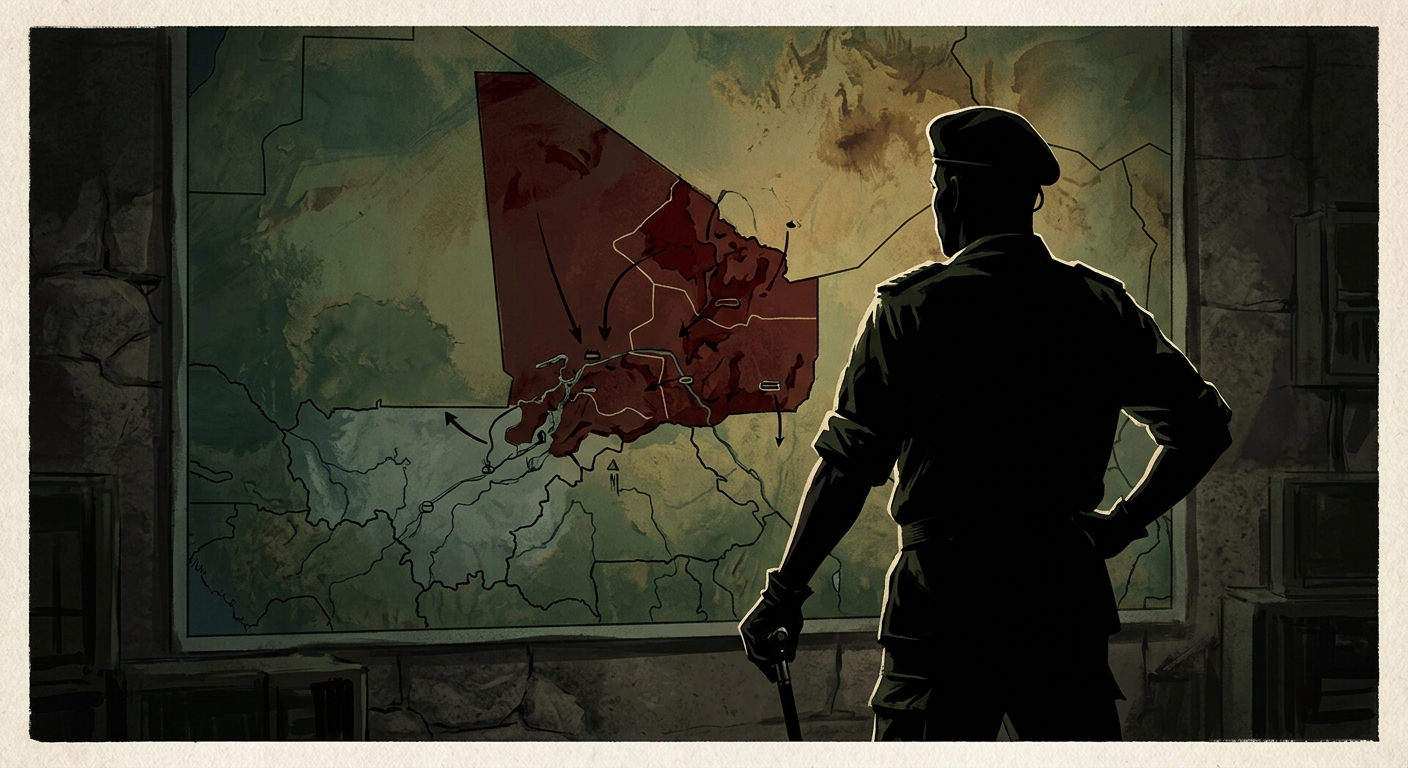
The April 25 assault was the largest joint insurgent–separatist offensive in Mali since 2012. JNIM — led by Iyad Ag Ghaly and holding an
International Criminal Court arrest warrant since 2017 — struck simultaneously in Bamako, Sévaré, Mopti, Ségou and Gao. The Tuareg-led Azawad Liberation Front (FLA), formed in 2024, drove on Kidal.
The most humiliating outcome was Russian. International Crisis Group reported that Africa Corps — Wagner's post-2023 successor with roughly 2,000 personnel in-country — negotiated its withdrawal from Kidal on April 27, reportedly with Algerian mediation, and abandoned "sophisticated equipment" to the insurgents. Africa Corps confirmed the exit on Telegram; the
BBC verified the posts. Russia's Defense Ministry then issued a face-saving statement claiming its Africa Corps "prevented a coup d'état" and "retained the authority of the legitimate government" — a claim
Al Jazeera reported alongside photos of Goïta receiving Russian Ambassador Igor Gromyko on April 28, his first public appearance since the attacks.
On April 30, JNIM declared a total blockade of Bamako, extending a fuel siege it had begun in September 2025. The BBC reported hundreds of trucks stranded on the Ségou road, less than 80 kilometers from the capital.
The July 4 rerun
Any claim that Goïta's takeover restored the initiative dissolved on July 4, 2026, when the same coalition launched a second wave. Al Jazeera reported army positions hit in Aguelhok, Anefis and Gao in the north, Sévaré in the center, and — a first — Kéniéroba in the south, where a prison complex holding political detainees came under attack. The army said 26 "terrorists" were killed; Africa Corps posted drone-strike footage from Anefis. Alex Vines of the European Council on Foreign Relations told the network that Mali's authorities have been reduced to "securitised enclaves and corridors."
That is the operational picture Goïta inherits as his own defense minister: a state that controls cities but not the roads between them, a Russian partner whose paramilitaries now escort fuel convoys rather than project force, and an insurgent alliance that has held together long enough to hit five regions in a single morning — twice.
The power play behind the portfolio
The decree is best read alongside three earlier moves. On May 13, 2025, Goïta dissolved all political parties by decree, an act UN experts publicly condemned. On July 3, 2025, Mali's transitional parliament granted him a renewable five-year presidential term, delaying elections until the country is "pacified," according to the
World Bank's Mali page and reporting by
Al Jazeera. On September 22, 2025, Mali announced its immediate withdrawal from the Rome Statute — a decision the
OHCHR-appointed independent expert Eduardo González called "a betrayal of victims."
Then in March 2026, González told the Human Rights Council that Mali was in a "dangerous spiral of authoritarianism," citing summary executions, forced disappearances and drone strikes on civilians documented in his mandate report, according to UN News. On May 5, 2026, one day after Goïta's self-appointment, OHCHR warned the human rights situation was "rapidly deteriorating," according to the
UN Department of Political and Peacebuilding Affairs.
Camara's death removed the second-most-powerful figure in the junta. In a system that has already dissolved parties, extended the leader's mandate indefinitely and exited the ICC, there was no institutional mechanism — no parliament, no party congress, no opposition — through which a successor could have been vetted, negotiated or contested. Goïta took the portfolio because taking it was the path of least resistance and because sharing it with another general would have created a rival. A Brookings analysis of Mali's democratic breakdown, published in August 2025, described the pattern bluntly: civilians in the transitional government "play a support and assistance role, while reinforcing the political legitimacy of the military," according to the Brookings paper.
"This marks an undeniable authoritarian drift." — Eduardo González, UN Independent Expert on Mali, addressing the Human Rights Council, March 2026
Who benefits, who loses
Russia loses face but not position. Africa Corps' Kidal retreat is the clearest operational failure of Moscow's Sahel model since Wagner's rebranding in June 2025. But as Elcano's July 2026 analysis of Russia's Sahel security order argues, Moscow's product is regime protection, not territorial control — and Goïta still needs the bodyguard. The Council on Foreign Relations noted that Mali is projected to be
Africa's second-largest lithium producer in 2026, giving the Kremlin reason to "tough it out."
Algeria wins the mediator's chair. The Atlantic Council reported that Algiers "reemerged as a key mediator" by facilitating the Africa Corps withdrawal from Kidal — a role denied it since relations with Bamako collapsed in 2023. That is a diplomatic upgrade Algeria did not have to fight for.
Washington is exposed. The Trump administration lifted sanctions on senior Malian officials, including Camara himself, in February 2026 and was negotiating to resume US surveillance flights over Malian airspace, according to the Center for Strategic and International Studies. Camara was the American interlocutor; his death, combined with an intensifying JNIM-FLA insurgency, leaves the deal dangling.
FLA loses its Paris audience. Spokesman Mohamed Elmaouloud Ramadane flew to Paris in late April to meet French security officials and demand Africa Corps' departure, according to Al Jazeera. Ramadane's pitch — a "moderate Sharia" governance model in the north — will not be accepted in the Élysée while FLA fights alongside a UN-designated al-Qaeda affiliate.
What to watch
The July 4 attacks show the alliance is not fraying. But the strategic questions are whether JNIM can convert the Bamako blockade into shortages severe enough to detonate urban unrest, whether Africa Corps reinforcements arrive in numbers, and whether Algeria's mediation extends beyond Kidal to a wider deconfliction. The Stimson Center warned that captured armored vehicles now in insurgent hands raise the risk of regional spillover into Niger and Burkina Faso — both Alliance of Sahel States partners bound to Bamako by the 2023 Liptako-Gourma mutual-defense charter, and both conspicuously absent from Mali's defense during the April assault.
- September 22, 2026 — Mali's ICC withdrawal completes its one-year notification period under Article 127 of the Rome Statute. The Court retains jurisdiction over crimes committed while Mali was a state party.
- Sévaré–Bamako corridor, weeks ahead — If JNIM sustains the Ségou blockade, fuel shortages will hit the capital before the October rainy-season logistics window closes.
- Africa Corps deployment posture — Watch for Russian troop rotations through Bangui or Ouagadougou hubs; a visible reinforcement would signal Moscow's decision to double down.
Diplomat View
Goïta's self-appointment is the surface event; the deeper story is that Mali's junta has run out of officers it trusts and time it can play for. The regime has, in twelve months, dissolved parties, extended its mandate indefinitely, exited the ICC, lost Kidal, and buried its most capable minister. Each step was framed as sovereignty; the cumulative effect is a state whose writ ends at the checkpoints on the Ségou road.
Our call: the junta survives the next six months but not on its current model. Either Goïta cuts a face-saving deal with the FLA — with Algeria as broker and northern autonomy as the price — or he watches the Bamako blockade grind civilian tolerance to breaking point. The forecast changes if Africa Corps quietly triples its footprint, if Turkey's Bayraktar drones return decisive tactical advantage as they did in Kidal in 2024, or if a rival colonel inside the junta concludes that one man holding the presidency, the defense ministry and the supreme command is one man too many. That last scenario — an intra-regime coup — is the one Goïta's decree was designed to prevent, and the one it most plausibly invites.
The Bottom Line
Goïta took the defense portfolio because there was no one left inside the junta safe enough to hand it to, and no institution outside it that could force him to share. The move concentrates authority at the exact moment when the state's territorial reach is shrinking to enclaves — and it makes Goïta personally accountable for a war his Russian partner is losing. If Bamako's fuel queues lengthen through the autumn, the next Malian coup will not come from JNIM. It will come from the barracks in Kati.
Discover more

Global Politics
US Seizes Iranian Ship, Tensions Surge
The US seizure of the Iranian ship Touska highlights a shift in control over the Strait of Hormuz, favoring Iran's strategic position.

Conflict & Security
Drone Warfare Killing Aid Workers at Unprec
Over 1,000 humanitarian workers killed in three years as cheap armed drones collapse legal protections. Gaza, Sudan, Ukraine, and DRC see deliberate targeting of aid convoys and hospitals with zero prosecutions.

Global
World Normalises Taliban as Afghan Women Eras
UN data shows Afghan women erased from public life as Russia recognises the Taliban, EU hosts officials in Brussels, and ICC warrants for gender persecution go unenforced.
Conflict & Security
West Africa Food Crisis: Three Shocks in 2026
Conflict, climate extremes, and the Strait of Hormuz closure drive a severe food crisis in West and Central Africa, with fertilizer prices surging 80% and millions displaced.