Macron's Syria Visit: France's Strategic Move
France signs 15 deals in Syria, challenging Gulf dominance.
Model Diplomat7 min readMiddle East
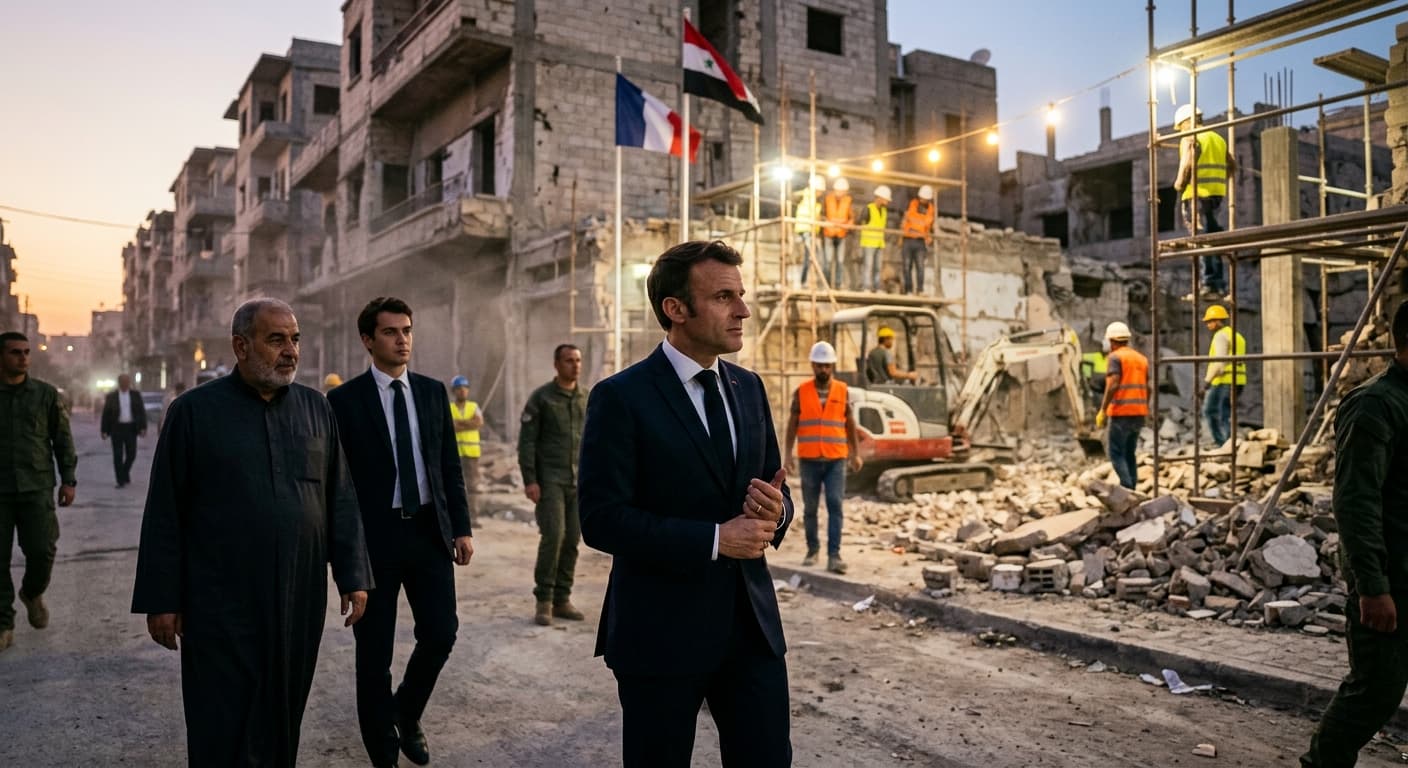
Macron in Damascus: France's Syria Gambit Rattles Gulf Diplomacy
France signed 15 cooperation deals with Syria on July 7, 2026 during Macron's Damascus trip — Paris is muscling into a reconstruction race Riyadh and Abu Dhabi thought they had won.
Emmanuel Macron landed in Damascus on July 6, 2026 with 15 bilateral agreements in his pocket, a delegation of French CEOs at his side, and one strategic objective: to keep France — and by extension Europe — from being priced out of the Syria file by Gulf capital. The visit, the first by a French president since 2009, is less a normalisation ceremony than a European counter-bid to a Gulf-Turkish stranglehold on Syrian reconstruction. The bombs that went off 125 metres from Macron's Four Seasons hotel while he was meeting Ahmed al-Sharaa did not stop the signing. They clarified the stakes.
What was actually signed
The package, formalised at a Damascus business forum, covers civil aviation, maritime and air logistics, health, banking, water and energy, and institutional support to the Syrian central bank, according to Anadolu Agency. The
BBC reported "15 bilateral agreements" signed in Macron's presence, alongside a memorandum of understanding to develop Syrian university hospitals with French backing.
The commercial anchor is CMA CGM, the Marseille-based shipping group. In May 2025, CMA CGM signed a 30-year renewal to modernise and operate the container terminal at the port of Latakia — Syria's largest by cargo volume — with a €230 million investment and a new berth, according to the International Institute for Strategic Studies. Macron's visit converts that private-sector foothold into a state-backed platform, with parallel dry-port operations planned in the Jordanian-Syrian Joint Free Zone and Adra Free Zone.
The French Development Agency (AFD) and Expertise France are the vehicles for the health-and-water tranche — the "normative" side of the offer that Carnegie analysts argue is Europe's only real comparative advantage against Gulf capital and Turkish concrete.
The Gulf angle — this is what changes
The 18 months before Macron's arrival belonged to Riyadh, Abu Dhabi and Doha. Saudi Investment Minister Khalid al-Falih pledged $6.4 billion in Damascus in July 2025, including $2.9 billion in real estate and infrastructure, per Al Jazeera. DP World, owned by the UAE, took over Tartus in an $800 million multipurpose-terminal concession that same month, replacing Russia's Stroytransgaz. Qatar's UCC Holding signed a $4 billion Damascus airport rebuild in August 2025, and Saudi Arabia's Elaf fund committed a further $2 billion for two Aleppo airports in February 2026,
Al Jazeera reported.
That is roughly $20 billion in Gulf and Gulf-adjacent pledges before Macron's plane touched down. France cannot match those cheques — and does not need to. Paris is betting on regulatory chokepoints, not cash volume. Banking correspondence, aviation certification, port operations, hospital accreditation and central-bank capacity building are the plumbing through which Gulf money actually flows. Whoever writes that plumbing writes the rules on procurement, anti-money-laundering, and — critically — which Syrian actors get to touch the reintegrated financial system.
The subtext is not lost on Riyadh. Saudi Arabia has spent a year positioning itself as al-Sharaa's diplomatic sponsor, from his first foreign trip to MBS in February 2025 through the Riyadh donor conference. As the Gulf International Forum's Madeline Stahle argued in June 2026, the Gulf states "are pursuing overlapping but competing agendas in Syria," and any Western entrant that can arbitrate between them gains outsized leverage. France, with its Lebanese file, its Paris-hosted Israel–Syria track, and now its Damascus footprint, is auditioning for exactly that arbiter role.
The primary document: what the Élysée actually committed to
France's framework for engagement was set out in the January 22, 2026 Élysée communiqué on Syria, which conditioned support on four planks: a permanent ceasefire, the January 18 accord on Kurdish integration into Syrian state structures, continued anti-Daesh coordination, and — quoting the release — the pursuit of "a united Syria… respectful of all its components, and notably its Kurdish populations." Macron restated that formula in Damascus. It matters because it distinguishes the French bid from the Turkish and Gulf bids, both of which are agnostic on Kurdish autonomy. Paris is selling al-Sharaa a legitimacy premium — Western banking access, EU market entry, IMF/World Bank engagement — in exchange for behaviour Ankara will not demand.
The corresponding May 7, 2025 Élysée readout of the Al-Sharaa Paris visit named the same conditionalities: inclusive transition, Lebanon's sovereignty, and counter-terrorism cooperation. The July 2026 deals operationalise that bargain.
Why now: the Iran–Russia vacuum and the Israel file
Two shifts made this trip possible. First, the Russian retreat: Syria terminated Stroytransgaz's Tartus contract in January 2025, and BBC Verify satellite imagery documented Russia dismantling its military equipment at the port through the winter. Iran, meanwhile, has lost the land bridge to Hezbollah and — per the Austrian Institute for International Affairs'
Cengiz Günay — has "less to offer the new Syrian leadership, and therefore less leverage." The Mediterranean flank of the Iran–Russia axis has been vacated. France is walking into that space.
Second, the Israel track runs through Paris. Syrian and Israeli officials met in Paris on July 26, 2025 to de-escalate the Suwayda crisis, and again in January 2026 to set up a US-brokered "dedicated communication cell," Al Jazeera reported. Al-Sharaa said in September 2025 that Syria and Israel had been "four to five days away" from a security agreement before the July 2025 sectarian violence in Suwayda derailed talks. Macron's Damascus visit consolidates France as the European address for that negotiation — a role Washington under Trump appears willing to tolerate because it costs the US nothing.
The security shadow
The two car-bomb explosions near Macron's hotel on the morning of July 7, which injured 18 people including four police officers, are the market signal. They followed a July 1 café bombing in central Damascus that killed nine, per BBC reporting, and a string of Islamic State-claimed attacks over the spring. Al-Sharaa's HTS-rooted government still faces active jihadist opposition, unresolved Alawite grievances after the March 2025 coastal massacres of some 1,600 people, and Druze-Bedouin fractures in Suwayda that drew Israeli air strikes on Damascus in July 2025.
Macron's line at the joint press conference — that the international community must "not let ourselves be destabilised" — is the diplomatic bet: that French insurance and export-credit agencies, plus EU regulatory cover, can price this risk in a way Gulf sovereign wealth funds cannot. If the French offer holds after a shock like Tuesday's bombs, the political premium accrues to Paris. If French firms pull back, the ceiling on European engagement is exposed.
Winners and losers
Winners. CMA CGM locks in three decades at Latakia against Iranian and Russian claims that circulated as recently as 2020. AFD and Expertise France get a large-country programme after years of Sahel retrenchment. Al-Sharaa gets a Western imprimatur that pressures Israel toward the buffer-zone deal Netanyahu outlined in December 2025 and complicates Turkish attempts to dominate the reconstruction procurement pipeline.
Losers. Russia's Tartus base is now surrounded by a French-operated Latakia and an Emirati-operated Tartus terminal — a commercial encirclement of what remains of Moscow's Mediterranean logistics. Iran loses its last plausible pathway to Latakia, which JISS analysts had once flagged as Tehran's Mediterranean gateway. Turkey's construction lobby, which expected to dominate rebuild tenders, now has to price in French competition — and French conditionality on the Kurdish file that Ankara openly opposes.
The Gulf states are split. Saudi Arabia and the UAE quietly welcome a European counterweight that constrains Turkey without displacing them. Qatar, closer to Ankara, has more to lose if French regulatory frameworks slow Turkish-Qatari contracts.
Diplomat View
Macron's Damascus trip is best read not as reconstruction diplomacy but as positional insurance — France buying the right to sit at every future Syria table for the price of 15 mostly technical agreements and one photo with a former al-Qaeda commander. The falsifiable thesis: within 18 months, either France converts CMA CGM, AFD and Expertise France into a de facto European regulatory backbone for Syrian reintegration into IMF/World Bank programmes — in which case Paris becomes the arbiter between Gulf capital, Turkish construction and Israeli security demands — or Syrian instability forces French firms to retrench, and the Gulf-Turkey duopoly hardens. The single condition that would revise this forecast downward is a second major security shock inside Damascus in the next six months that triggers a Total-style French corporate exit; the condition that would revise it upward is a signed Syria-Israel security framework in Paris before year-end, which would confirm France as the indispensable European node.
What to watch
- NATO Summit in Türkiye (July 8–9, 2026): Macron flies directly from Damascus. Watch whether Erdoğan publicly welcomes or resents France's Syria positioning, and whether a trilateral France–Türkiye–Syria track emerges on Kurdish integration.
- EU Foreign Affairs Council, autumn 2026: Kaja Kallas's next Syria review will test whether the sanctions snapback clauses embedded in the May 2025 lifting are triggered by Suwayda violence — or quietly retired.
- Syria–Israel Paris channel: Any announcement of a signed security framework restoring the 1974 disengagement lines would validate the French bet; continued deadlock over Mount Hermon and the Damascus buffer zone would expose its limits.
- CMA CGM Latakia disbursement schedule: The €230 million is staged. First-tranche milestones in Q4 2026 will show whether French capital actually flows or hedges.
Bottom line: Paris did not out-spend the Gulf in Damascus — it out-positioned it. The next 18 months determine whether that positional bet converts into structural influence over the Levant's post-Assad order, or whether Riyadh and Ankara let France hold the pen only until the ink dries.
Discover more
US Politics
Virginia's Redistricting Referendum
Virginia's redistricting referendum is drawing a flood of dark money, shaping future elections and the fight for congressional control amid party stakes.
US Politics
SNAP Food Assistance Faces Legal Challenges
In 2026, SNAP faces stricter eligibility rules and mounting legal challenges, threatening food assistance for the millions of Americans who rely on the program.

US Politics
Virginia GOP Rallies Rural Voters Against Red
Virginia Republicans are mobilizing rural voters against a Democratic-led redistricting referendum, a fight seen as pivotal to control in the 2026 midterms.

Conflict & Security
Drone Warfare Killing Aid Workers at Unprec
Over 1,000 humanitarian workers killed in three years as cheap armed drones collapse legal protections. Gaza, Sudan, Ukraine, and DRC see deliberate targeting of aid convoys and hospitals with zero prosecutions.