Macron's Aznavour Serenade
France's cultural diplomacy reshapes Caucasus security.
Model Diplomat8 min readEurope
Macron's Aznavour Serenade Signals France's Caucasus Play
Behind Macron's viral La Bohème duet with Pashinyan in Yerevan lies a hard-power pivot: France is claiming the Caucasus lane Russia can no longer defend.
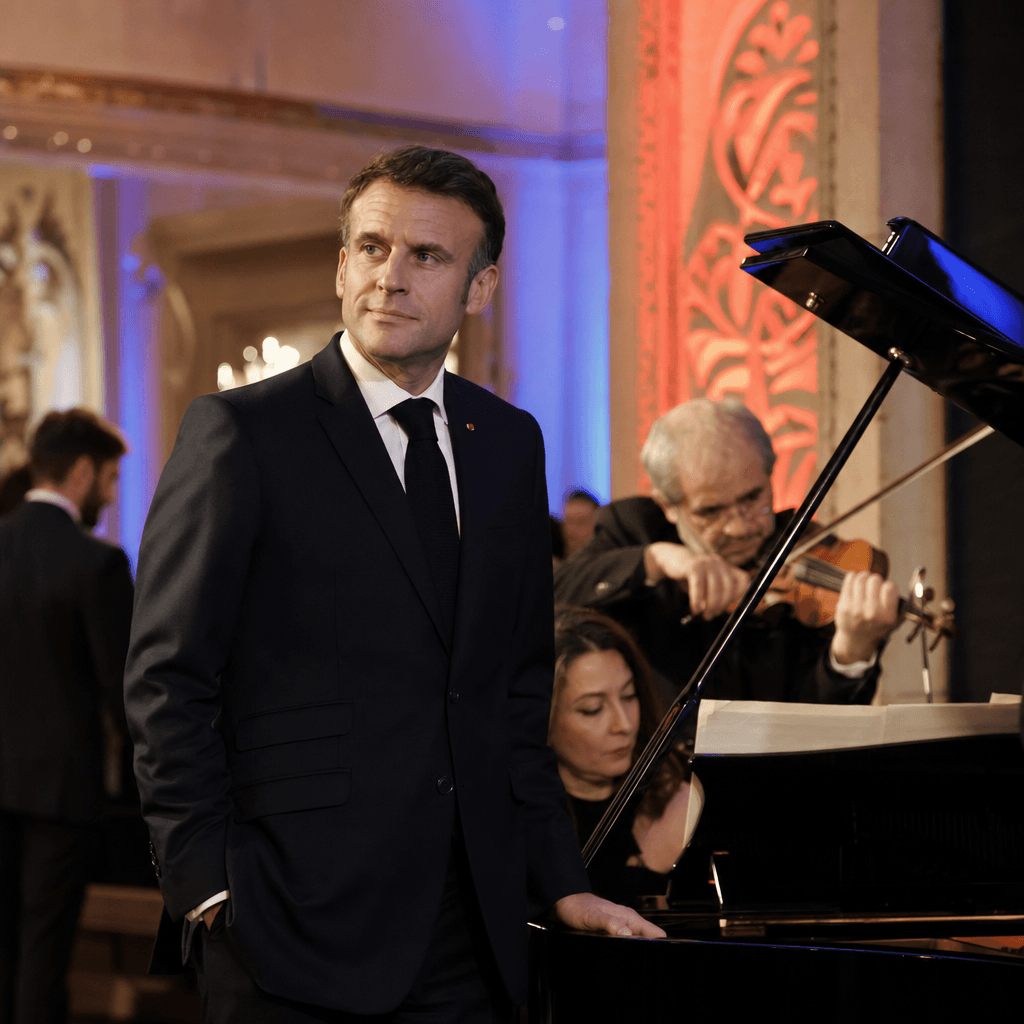
On the night of May 4, 2026, at a state dinner in Yerevan, Emmanuel Macron picked up a microphone and sang Charles Aznavour's "La Bohème" while Armenian Prime Minister Nikol Pashinyan kept time on a drum kit. The clip went viral within hours. The subtext did not: France is monetising cultural intimacy with Armenia to displace Russia as Yerevan's principal European security patron, and the serenade landed the same week Paris and Brussels signed the deals that make that displacement real. Aznavour, the son of genocide survivors and Armenia's late ambassador to the UN in Geneva, was the perfect prop. The instrument was soft. The play is hard.
The trip bracketed two summits Yerevan had never before hosted: the 8th European Political Community meeting on May 4 and the first ever bilateral EU–Armenia summit on May 5, according to the European External Action Service. More than 30 European heads of government, plus Canadian Prime Minister Mark Carney and Ukraine's Volodymyr Zelensky, converged on a capital long considered Moscow's closest South Caucasus ally,
as the BBC noted. The song came at the end of day one. The signatures came the next morning.
What Macron actually signed, before he sang
The Élysée readout treats the Aznavour moment as a coda; the substance sits in the joint communiqués. On May 4, Macron co-signed a joint statement with Britain, Poland, Lithuania, Estonia, Norway, European Council President António Costa and EU foreign-policy chief Kaja Kallas pledging "experts, capacity-building, equipment and election observation" to shield Armenia's June 7 vote from "external hybrid threats" — Kremlin interference, in plainer language, per the Élysée text.
On May 5, the EU and Armenia signed a Connectivity Partnership on transport, energy and digital links; delivered the first tranche of a €30 million European Peace Facility package to the Armenian armed forces; and established an EU Partnership Mission in Armenia, the European Commission's enlargement directorate announced. This sits on top of a previously announced €270 million EU Resilience and Growth Plan. Brussels also opened a €30-million-minimum call for private-sector investment across energy, transport and semiconductors. In Macron's own words at the joint press conference with Pashinyan, "Armenia is decisively and courageously turning toward Europe,"
per the Élysée transcript.
Then he sang.
The song was the message
Aznavour is not a random balladeer for a French president to deploy in Yerevan. He was born Shahnour Vaghinag Aznavourian in Paris in 1924 to Armenian parents who had fled the Ottoman genocide, sold more than 100 million records, and served as Armenia's ambassador to Switzerland and its representative to the UN in Geneva from 2009 until his death in 2018, as NPR's obituary detailed. "La Bohème," his 1965 chanson about impoverished young artists in Montmartre, was — famously — his own favourite song, and one of the few in his catalogue he did not write himself,
Al Jazeera reported in his 2018 obituary. Every Armenian in the room knew that. Every French viewer at home knew that. Every Russian analyst in Moscow knew that Macron had just claimed the shared cultural patrimony that Moscow, through a century of Soviet and post-Soviet policy, had also tried to own.
The Kremlin noticed. Al Jazeera reported that Macron's visit "provoked sharp criticism from the Kremlin after a video emerged of Macron singing while Pashinyan played the drums," in its June 1 dispatch on Russia–Armenia relations. Within three weeks, Moscow had banned Armenian flowers, mineral water, cognac, fresh vegetables and fruit — a coordinated economic squeeze in the two weeks before the June 7 vote,
the BBC reported. Vladimir Putin used a May 29 EAEU summit in Kazakhstan to demand Yerevan hold an immediate referendum on choosing between the EU and the Eurasian Economic Union, invoking "the Ukrainian scenario." Pashinyan refused. His Civil Contract party then won the June 7 election, though it lost its constitutional majority,
Al Jazeera reported.
The serenade did not cause the pivot. It labelled it.
The hardware behind the harmony
France's Caucasus play is not new — the song made a policy visible that has been running since 2023. Under a first arms agreement signed on October 23, 2023, Paris sold Yerevan three Thales GM-200 radars and pledged Mistral short-range air-defence missiles; on June 18, 2024, France agreed to supply 36 CAESAR 155mm self-propelled howitzers, and in December 2024 the two governments signed a formal defence cooperation programme for 2025, as the Manohar Parrikar Institute for Defence Studies and Analyses documented. The first 24 French Bastion armoured personnel carriers arrived via the Georgian port of Poti in late 2023,
according to the Valdai Club's own tracking — a rare instance where Moscow's own think tank confirms Paris' footprint.
The scale-up has been dramatic. According to the Armenian Centre for Socio-Economic Studies, roughly 95% of Armenia's military imports now come from India, France, China and others — not Russia, the BBC quoted analyst Haykaz Fanyan on June 7. SIPRI's 2024 trends report ranks France as the world's second-largest arms exporter over 2020–24, with a 187% surge in deliveries to European recipients,
in its March 2025 factsheet.
Paris is not Yerevan's only new patron. Washington is running a parallel play. On February 9, 2026, Vice President JD Vance signed a civil nuclear "123 Agreement" in Yerevan worth up to $9 billion in US exports for small modular reactors — a direct hit on Rosatom's monopoly at the ageing Metsamor plant, Al Jazeera reported. On May 26, Secretary of State Marco Rubio signed a strategic partnership plus a critical-minerals framework and locked in a 74% US stake in the "TRIPP Development Company" managing the 43-kilometre Trump Route for International Peace and Prosperity corridor across southern Armenia,
Al Jazeera reported at the time.
That geometry matters for reading the serenade. Washington is buying access to the corridor; Paris is buying access to the sovereign core — defence, air defence, officer training, cultural affinity. The two are complementary. Neither is a substitute for the other, and neither entirely replaces Russia: Moscow still supplies gas to Armenia at $177.50 per 1,000 cubic metres against European market prices above $600, the BBC noted, and remains Yerevan's largest single trading partner at 36% of foreign trade in 2025. That gas price is the single hardest lever Russia retains.
The winners: Paris, Yerevan, and one very specific defence company
Concrete beneficiaries, in order.
Emmanuel Macron. Domestically bloodied since the 2024 legislative election and 2025 pension aftershocks, Macron regains a signature foreign-policy narrative: France as the credible European sovereign-defence partner in places NATO does not tread. The Élysée's opening EPC speech in Yerevan made the pitch explicit — "this wider Europe, from Iceland to the Caucasus," beyond the EU's borders, is where French strategic autonomy earns its keep, per the Élysée transcript.
Nikol Pashinyan. He needed a European canopy visible enough to survive a hostile Russian pre-election campaign. He got it: the EU announced an additional €50 million in June to offset Russian trade coercion, on top of the €270 million resilience plan, as the BBC documented. The serenade footage — a French president in his palace, the drums under his own hand — was worth several campaign ads.
KNDS France and Thales. The Franco-German land-systems group KNDS (the CAESAR howitzer) and radar-maker Thales (GM-200) are the corporate beneficiaries of Armenia's diversification. The MP-IDSA analysis flags recurring ministerial meetings and embedded French defence advisers as part of the 2023 contract — a services tail that outlasts the hardware. Armenia's total France procurement pipeline is still small relative to Paris' Indo-Pacific book, but the reference customer value in the post-Soviet space is disproportionate.
The losers, and one quiet loser nobody names
Russia is the obvious loser: it has watched a treaty ally freeze participation in the CSTO, ratify the Rome Statute (making Putin arrestable on Armenian soil), open its nuclear future to US suppliers, and diversify 95% of its arms imports away from Moscow. Foreign Affairs framed the broader shift as "Russia losing its near abroad" in a July 2025 essay, available here.
Azerbaijan loses too, and is loudest about it. Baku responded to the earlier French arms deliveries by warning of "a new war," calling the "Macron regime" a saboteur of Armenia–Azerbaijan normalisation, as the BBC's Persian service documented. That framing collided this year with Washington's TRIPP corridor deal, which Baku broadly welcomed — a rare instance of French and American Caucasus policy pulling in different tactical directions even as both aim to shrink Russian influence.
Turkey is the quiet loser. Ankara has spent a decade positioning to be the indispensable connectivity partner of a normalised Armenia — reopening the border, running the trans-Caspian corridor, selling Bayraktar drones to Central Asia. A France-anchored security relationship in Yerevan, paired with Armenia's genocide-recognition legislation in Paris, forecloses the warmest version of that scenario. Turkish diplomats read Aznavour clips the same way Russian ones do.
Diplomat View
The Aznavour serenade is not a gaffe, a distraction, or a soft-power flourish. It is the marker Paris planted on a security relationship it has been building since October 2023 and now believes it can consolidate before Washington's TRIPP-centric approach dominates Western messaging in the Caucasus. Forecast: within the next twelve months, expect a France–Armenia bilateral defence framework agreement covering training, air defence sustainment and possibly a second CAESAR tranche; expect a formal Armenian application for EU candidate status once the constitutional-reform question with Azerbaijan is resolved; and expect Moscow to lean harder on gas pricing than on kinetic tools, because the CSTO exit removed its cheapest coercion option. What would revise this call: a Pashinyan concession to Moscow on the EAEU referendum question, a collapse of the Armenia–Azerbaijan peace track that forces Yerevan back onto Russian security guarantees, or an unexpected French pullback triggered by a domestic political crisis in Paris. Absent those, Macron just sang his own policy into permanence.
What to watch
- August 2026: Deadline window for signing the Armenia–Azerbaijan peace treaty text agreed in outline at the White House in 2025; failure resurrects Russian mediation leverage.
- Autumn 2026: Expected first CAESAR deliveries to Armenia under the June 2024 contract, per MP-IDSA's tracking — the first French heavy artillery in the South Caucasus.
- December 2026: EU Council decision expected on advancing Armenia's visa liberalisation roadmap; a positive vote unlocks the next tranche of the €270m Resilience and Growth Plan.
The Bottom Line
Macron's La Bohème duet with Pashinyan was not a viral aside — it was the public face of a defence, connectivity and cultural package that formalises France as Armenia's principal European patron in Russia's absence. The song mattered because the signatures underneath it did: a €30 million European Peace Facility tranche, an EU Partnership Mission, and a Franco-Armenian arms pipeline that has replaced Russia as the dominant supplier. If Yerevan holds its Western course through 2027, Aznavour's ballad will be remembered as the soundtrack of a South Caucasus realignment that Moscow could no longer prevent.
Discover more
India
Modi's Women’s Convention in Varanasi
Modi's Varanasi rally frames women's reservation as a national mission, targeting the 2027 Uttar Pradesh elections with a strategic narrative.
India
Romanian Coalition Party Demands PM Resign
Romania's Social Democrats withdrew from coalition, joining far-right AUR to topple PM Bolojan, risking €10 billion in EU funds by August 2026.
India
UN Expert Albanese: India Violates Law
UN Rapporteur Francesca Albanese accuses India of breaching international law, spotlighting human rights concerns in Kashmir and prompting diplomatic pushback.

Conflict & Security
Drone Warfare Killing Aid Workers at Unprec
Over 1,000 humanitarian workers killed in three years as cheap armed drones collapse legal protections. Gaza, Sudan, Ukraine, and DRC see deliberate targeting of aid convoys and hospitals with zero prosecutions.