Luhansk Drone Strike Fuels Moscow's Retaliate
Russia demands retaliation after Starobilsk strike; Ukraine responds.
Model Diplomat3 min readEurope
Luhansk Drone Strike Gives Moscow a Retaliation Hook
Russia is using the Starobilsk dormitory strike to demand retaliation, while Kyiv says it hit a military drone unit in occupied Luhansk.
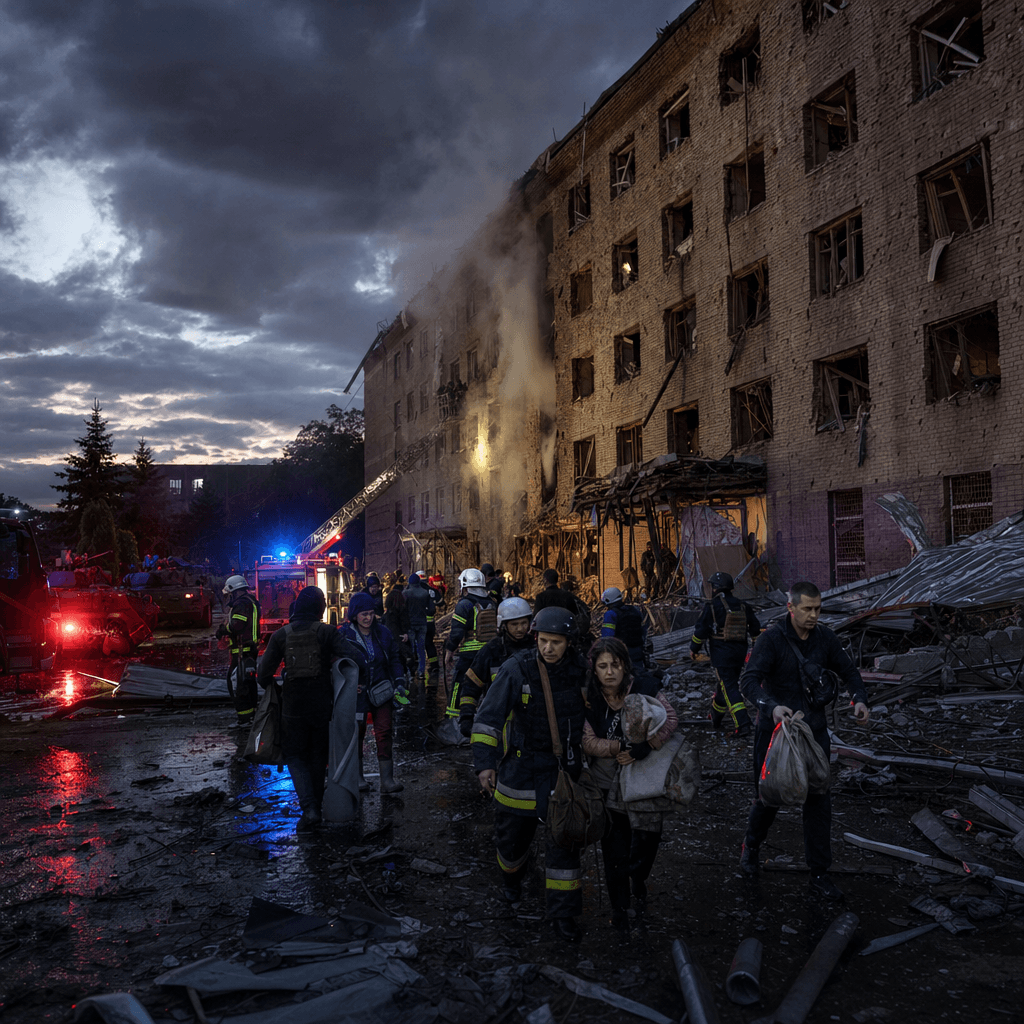
Russia now has a ready-made escalation narrative. Kremlin spokesman Dmitry Peskov called the Starobilsk strike a “monstrous crime” and Vladimir Putin labeled it a “terrorist strike,” then ordered the military to prepare retaliation, according to Reuters,
BBC and
France 24. Russian-installed officials said the drone attack hit a student dormitory at Luhansk Pedagogical University in occupied Starobilsk; early reports said at least four people were killed and 35 children were injured, while Putin later said six were dead, 39 wounded and 15 were missing as rescue work continued (
Reuters,
BBC). That shifting toll matters: Moscow is still building the case for punishment, not just reporting the damage.
Moscow’s leverage is the victim narrative
This is about more than one destroyed building. By focusing on a dormitory, children aged 14 to 18 and a collapsing five-storey structure, Moscow is trying to convert a battlefield event into a political weapon, according to Al Jazeera. The Kremlin benefits because the strike appears to validate its long-running claim that Ukraine is willing to hit civilian targets in Russian-held territory. That helps Putin justify retaliation at home and gives Russian media a clean, emotionally charged frame.
Ukraine, however, is making a different claim: that the target was not a dormitory but the headquarters of the “Rubicon” drone unit in Starobilsk, a unit it says helps carry out strikes on Ukrainian civilians (BBC,
France 24). On
Conflict, that is the key distinction. Kyiv is not only trying to damage Russian capabilities; it is trying to prove it can reach command nodes in occupied territory and make those nodes costly to operate.
Occupied Luhansk is now a messaging battlefield
Starobilsk sits about 65 kilometres from the front line, inside a region Moscow says it fully controls and treats as Russian territory (Al Jazeera). That makes every strike in Luhansk a sovereignty fight as much as a military one. Russia wants the world to see an attack on children in a school-linked facility; Ukraine wants the world to see a strike on an occupied-area military asset.
Both can be true in a broader sense: this war is now defined by drones, rear-area strikes and competing claims about what was hit. The civilian cost is obvious either way, but the political gain is asymmetric. Russia can use the incident to demand condemnation and signal resolve. Ukraine can use it to show reach and pressure Russian forces in occupied territory. The loser is anyone trapped in the middle of a zone both sides treat as expendable.
What to watch next
The next decision point is Putin’s promised response. If Russia answers with a larger drone or missile salvo, it will be trying to restore deterrence and dominate the news cycle after a humiliating local hit. If the response is restrained, that will signal limits on escalation even as Moscow talks tough. Watch for any Russian claim that Starobilsk hosted the Rubicon unit, any independent imagery of the site, and whether Kyiv ties this exchange to last week’s Russian strike on Kyiv that killed 24, as reported by BBC.
Discover more
Global
Kyiv's Empty Quiver: Ankara Summit on NATO
As Russia strikes Kyiv, NATO's Ankara summit must address Ukraine's urgent air defense needs amid dwindling interceptor supplies.
India
Russia's Balancing Act with India and China
Russia's deepening dependence on China is straining its long-standing strategic partnership with India, exposing the limits of Moscow's balancing act in Asia.
Conflict & Security
Russia Encircles Konstantinovka—Key to Donbas
Russia's encirclement of Konstantinovka could unlock the wider Donbas for further advances, marking a pivotal moment in its grinding eastern offensive.
Conflict & Security
Ukraine's Energy Offensive Hits Crimea
Ukraine's drone campaign is disrupting Russian fuel supplies and forcing rationing in Crimea, turning energy infrastructure into a key front of the war.