Lithuania Coalition Commits to 5% Defense
New government pledges significant defense spending amid US uncertainty.
Model Diplomat4 min readeurope
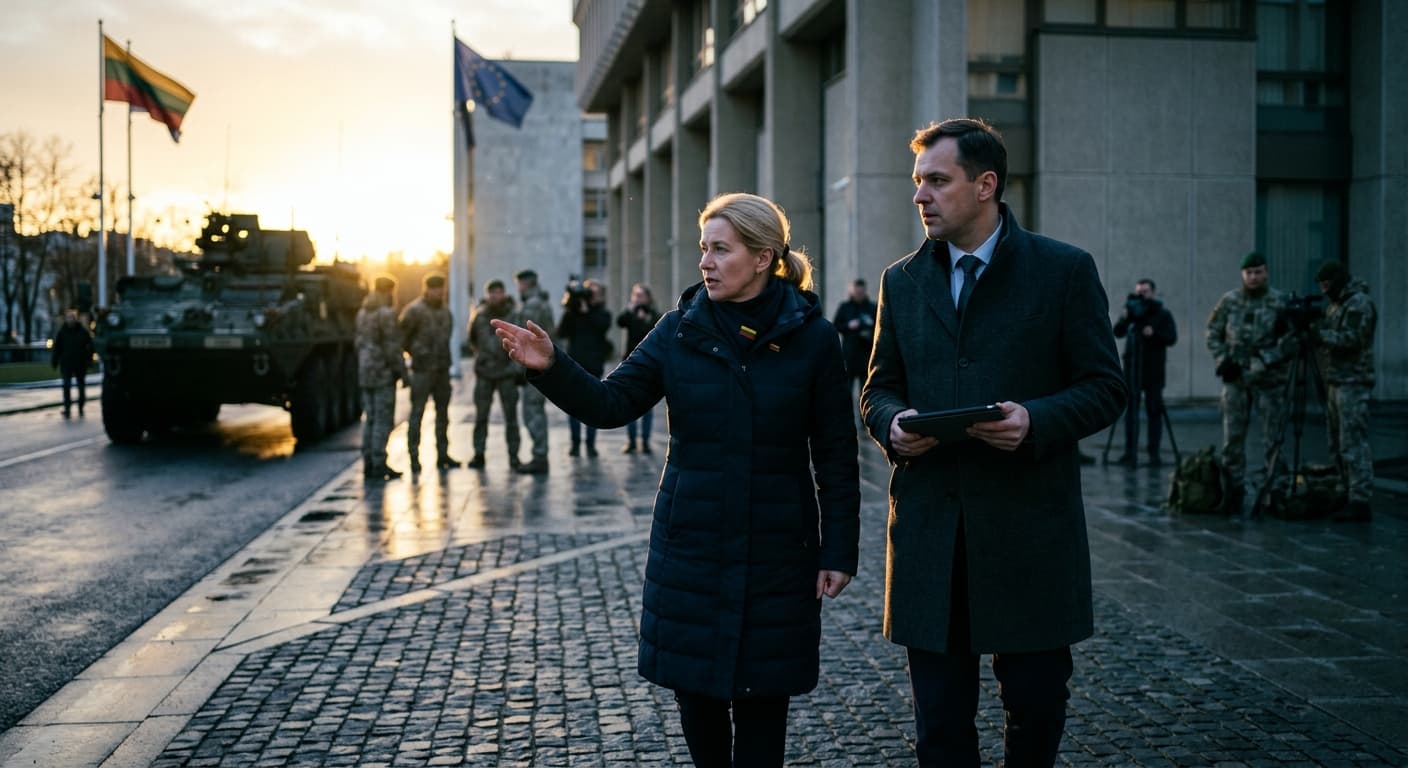
Lithuania's New Coalition Bets on 5% Defense Spend — With Washington's Commitment in Doubt
A three-party coalition with 75 seats took power in Vilnius on June 18, pledging the alliance's highest defense budget — on the same day the Pentagon announced a sweeping review of its European troop posture.
The timing was brutal. As Social Democrat leader Mindaugas Sinkevičius signed a coalition agreement committing Lithuania to spend at least 5% of GDP on defense, Pentagon chief Pete Hegseth was telling NATO defense ministers in Brussels that the U.S. would conduct a "real review" of its European force presence over the next six months and reduce participation in NATO Response Force units, Armenpress reported the same day.
The new coalition — Social Democrats, Democrats "For Lithuania," and the Farmers and Greens Union, plus the Electoral Action of Poles in Lithuania–Christian Families Alliance — holds 75 of 141 seats. That is a slim majority with a long to-do list. President Gitanas Nausėda accepted the outgoing government's resignation on June 23, clearing the way for Sinkevičius to form his cabinet, with ministerial portfolios expected to be named this week, according to Armenpress.
The coalition agreement is a document written for threat. It commits Vilnius to "seek a long-term and uninterrupted presence of U.S. military units in Lithuania, recognising the U.S. presence as the deterrence priority," Reuters reported. That language is not boilerplate: Lithuania has been without its rotational U.S. armored battalion of roughly 1,000 troops this summer for the first time since 2020, and the future of American deployments is under active review in Washington.
Why the coalition collapsed and rebuilt
The immediate trigger was the June 6 vote by Social Democrats to expel the populist Nemunas Dawn from government. Party leader Remigijus Žemaitaitis, previously convicted for antisemitic statements and barred from handling classified information, had voted against establishing a military base near Belarus. Sinkevičius told reporters the party leader was "becoming more radical" and that "what society needs today is stability, a clear direction, decision-making, and not political noise," according to Euronews.
This is the third coalition configuration since the October 2024 elections. The Social Democrats originally governed with Nemunas Dawn and Democrats "For Lithuania" — then swapped out the Democrats last August when they walked over Žemaitaitis. Now the circle has closed: Democrats are back in, Nemunas Dawn is out, and the Farmers and Greens have retained their place. Virginijus Sinkevičius, the Democrats' interim leader, captured the fragility: "It won't be easy… this will not be a stroll in the park," Daily Guardian Europe quoted him saying.
Portfolio allocation reflects the Social Democrats' dominance: they keep nine ministries — including defense, finance, foreign affairs, and interior. The Democrats "For Lithuania" take energy, health, and agriculture. The Farmers-Greens bloc with the Polish Electoral Action holds justice and economy, LRT reported.
Two gambles: US troops and China
The agreement contains two high-stakes foreign policy bets.
First, the U.S. presence. The coalition pledges to accelerate the standing up of an army division, host a German brigade, build an anti-drone protection system, and strengthen air defenses. But the 5% GDP floor — among NATO's highest — lands in a fiscal environment the IMF recently flagged as expansionary and debt-driving, with public debt projected to rise toward 55% of GDP by 2030, per the IMF's 2026 Article IV mission. The money is real; whether it buys the deterrence it's meant to depends partly on decisions made in Washington.
Second, China. The coalition agreement includes an objective to "normalise diplomatic relations with China to the level of diplomatic representation existing in other EU countries," LRT reported, while emphasizing it must be on the basis of reciprocity, Lithuanian sovereignty, and the EU's common position. This is a calibrated pivot from the confrontational posture that has defined Vilnius-Beijing ties since the 2021 opening of a Taiwan Representative Office triggered Chinese economic coercion. The Farmers' bloc insisted on an annex reserving its right to oppose civil partnerships, same-sex marriage, and the Reproductive Health Law — signaling that social conservatives intend to use their leverage on conscience votes,
LRT noted.
What to watch
The ministerial list, expected within days, will signal whether Sinkevičius is balancing factions or rewarding loyalists. The defense portfolio stays in Social Democrat hands — the name matters. Then the NATO summit, where Lithuania's 5% pledge will be tested against Hegseth's demand that Europe "assume primary responsibility for its own defense." And the China opening: whether Beijing reciprocates or demands concessions on the Taiwan office will indicate if normalization is a real path or a coalition papering-over of an intractable split. The next election is 2028. This coalition's majority is thin, its ideological range is wide, and its external environment is deteriorating. It does not have time to waste.
Discover more
India
Congress Advocates 33% Women’s Quota
Congress calls for a 33% women's reservation in the existing 543 Lok Sabha seats, countering Modi's plan to expand the house to 850 seats.
US Politics
SNAP Food Assistance Faces Legal Challenges
In 2026, SNAP faces stricter eligibility rules and mounting legal challenges, threatening food assistance for the millions of Americans who rely on the program.
India
Congress Accuses Modi of Stalling Women's Law
Congress accuses Modi of stalling women's reservation law by linking it to delimitation, revealing a deeper electoral strategy.

Economics
Fed's Amex AML order puts correspondent banking on notice
Federal Reserve's Amex AML order requires board-level controls and a 90-day plan; OCC fined the bank $350 million over enterprise-wide deficiencies.