Sri Lanka's Balancing Act Amidst War
Colombo's strategy faces tests from global conflicts and natural disasters.
Model Diplomat4 min readasia
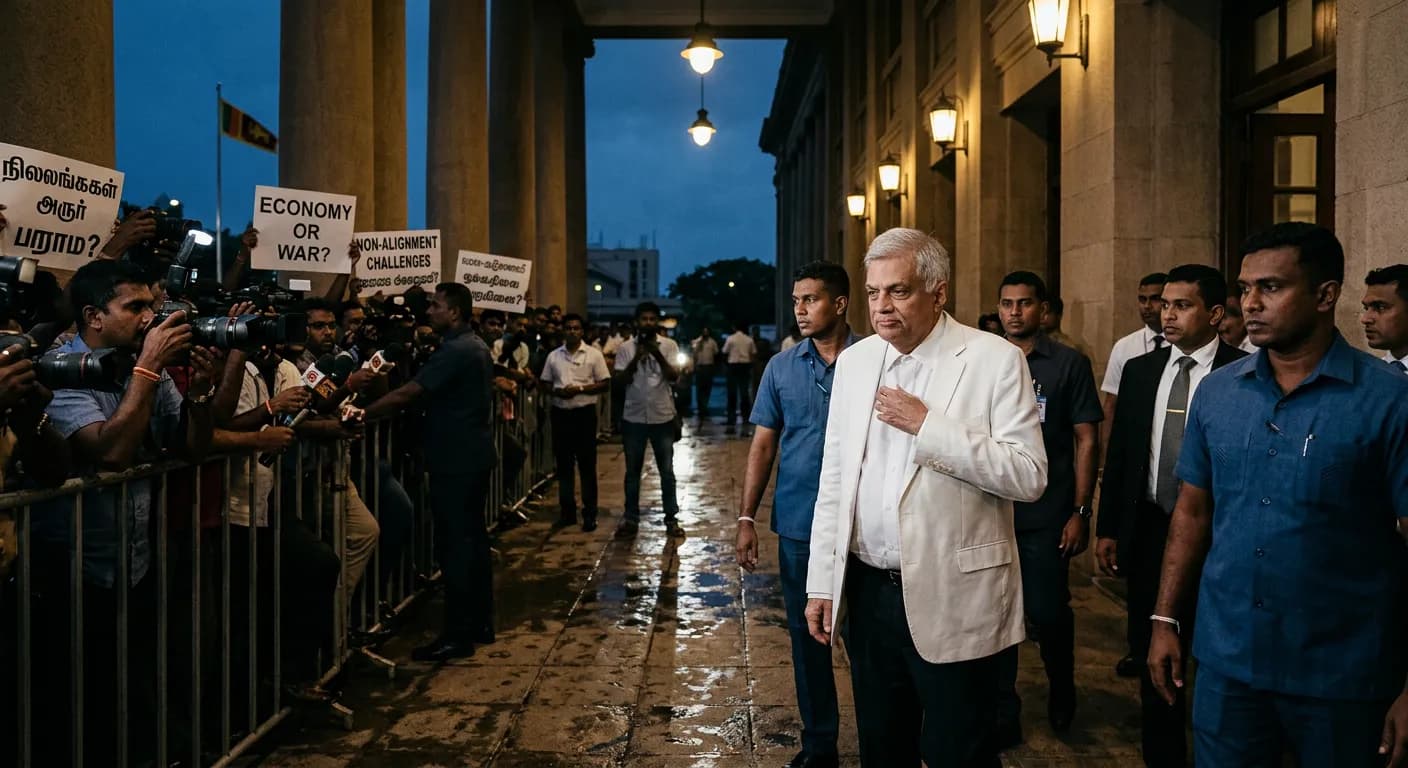
Sri Lanka's "Laying Low" Doctrine Meets the Middle East War — and Holds
Colombo's 2025 strategy of quiet balancing looked prescient on paper. Then the Iran war, a cyclone, and an IMF ultimatum tested whether "friendship towards all" survives when neutrality has real costs.
When Sri Lanka's foreign policy analysts mapped out 2025 in a Factum essay early that year, the prescription was modest: maintain the traditional "friendship towards all, enmity towards none" posture, avoid large-scale projects that draw geopolitical attention, and let economic recovery do the diplomatic work. Eighteen months later, that doctrine has been stress-tested by a sequence of shocks — a cyclone, a war, an energy-price spiral — and the balancing act has largely held, though at rising cost.
The core strategy: calibrated equidistance
President Anura Kumara Dissanayake's government entered 2025 with a clear sequencing problem. His first foreign visit went to New Delhi in December 2024, but he followed it immediately with Beijing in January 2025 — a rhythm that telegraphed continuity rather than realignment. The January trip delivered a $3.7 billion Chinese refinery investment, Sri Lanka's largest single foreign project, critical for post-default recovery. Then in April 2025, Prime Minister Narendra Modi visited Colombo, securing a five-year defence cooperation pact covering military training and intelligence-sharing, alongside a long-stalled 120-megawatt solar plant in Trincomalee. Dissanayake's reciprocal assurance — "Sri Lankan territory will not be allowed to be used by anyone to undermine India's security" — was the explicit quid pro quo New Delhi had sought since Chinese submarine visits in 2014, according to BSS/AFP.
The Factum essay had urged precisely this: "wooing the US through India," leveraging the Modi-Trump relationship, while keeping Beijing engaged on "small and beautiful" projects aligned with China's own shifting BRI framework. The early 2025 playbook executed that blueprint almost to the letter.
Two shocks that rewrote the calculus
Two events then scrambled the board. Cyclone Ditwah struck in November 2025, killing at least 641 people and causing $4.1 billion in infrastructure damage, per World Bank estimates. Then on February 28, 2026, the US-Israeli military campaign against Iran erupted — and on March 4, a US submarine torpedoed the Iranian frigate IRIS Dena roughly 40 kilometers off Sri Lanka's southern coast, killing at least 84 sailors.
Colombo's response was a real-time demonstration of the balancing doctrine under extreme pressure. Dissanayake revealed to parliament that the US had requested — and was denied — permission to station two warplanes armed with anti-ship missiles at Mattala International Airport from March 4-8. Iran had simultaneously requested a port call for three warships returning from an Indian naval exercise. Both requests were refused, as BSS/AFP reported. "We are steadfastly maintaining our position of neutrality," Dissanayake told the legislature, drawing applause.
Yet neutrality did not mean paralysis. Sri Lanka's navy rescued 32 Iranian survivors and, on humanitarian grounds, granted shelter to the 208 crew of the IRIS Bushehr, housing them at a military facility near Colombo while the vessel was moved to Trincomalee, per CNA. The distinction — deny military access, grant humanitarian refuge — was surgically calibrated. The US is Sri Lanka's largest export market; Iran is the main buyer of Sri Lankan tea. Neither could be alienated; neither was.
The economic squeeze and the IMF lever
The balancing act's cost is now visible in the economic data. The IMF approved a $700 million tranche in April 2026 — combining the fifth and sixth reviews of the $2.9 billion EFF program — but attached conditions that test Dissanayake's political room: restore cost-recovery fuel and electricity pricing, resist generalized energy subsidies, and accelerate anti-corruption governance reforms. The Middle East war forced Colombo to raise retail fuel prices by roughly a third, and the central bank hiked rates by 100 basis points to 8.75% in May 2026 to contain inflationary pressure, as
CNA reported. Growth is expected to slow to 3% in 2026 from 5% in 2025.
The Factum essay's call to emulate Vietnam as a "re-export center" and leverage middle powers like Japan and South Korea has gained traction. India's Vice President Radhakrishnan visited in April 2026, and the two sides discussed a proposed oil pipeline link alongside a suite of MOUs covering hospital construction, batik training centers, and Eastern Province development, per News First. Simultaneously, US Assistant Secretary of State S. Paul Kapur met Dissanayake in June 2026 to discuss maritime security cooperation and trade — the Indo-Pacific dimension that Washington will not let drift, as
News First reported.
What to watch next
Three decision points define the near term. First, the IMF Executive Board's demand for cost-recovery energy pricing will collide with domestic political pressure ahead of any electoral cycle — fuel subsidies are the flashpoint. Second, Dissanayake must navigate whether the Iran war's humanitarian dimension creates pressure to tilt toward one camp, especially as Iranian Foreign Minister Araghchi has vowed retaliation for the Dena sinking. Third, the deepening India-Sri Lanka economic architecture — the oil pipeline, the Trincomalee energy hub, OCI eligibility extended to sixth-generation Indian diaspora — is gradually embedding Colombo in New Delhi's orbit in ways that Beijing will notice.
The Factum essay ended with an observation that now reads as foresight: "Though small, Sri Lanka has on countless occasions soothed global tensions." The question for the rest of 2026 is whether soothing remains possible when the tensions arrive on your coastline.
Discover more
India
700 Activists Accuse PM Modi of MCC Breach
Over 700 activists allege PM Modi breached election code with a televised address attacking opposition parties just before state elections.

India
Delhi CM Rekha Gupta Blasts Opposition's Delm
Delhi CM Rekha Gupta's remarks on women's quota defeat reveal BJP's strategy for the 2029 Lok Sabha elections, focusing on delimitation.
India
Congress Accuses Modi of Stalling Women's Law
Congress accuses Modi of stalling women's reservation law by linking it to delimitation, revealing a deeper electoral strategy.

Conflict & Security
Drone Warfare Killing Aid Workers at Unprec
Over 1,000 humanitarian workers killed in three years as cheap armed drones collapse legal protections. Gaza, Sudan, Ukraine, and DRC see deliberate targeting of aid convoys and hospitals with zero prosecutions.