Las Vegas’s doping gamble challenges sport’s old order
The Enhanced Games start Sunday with banned drugs, big prize money and elite names — a direct challenge to WADA’s authority and sport’s pay model.
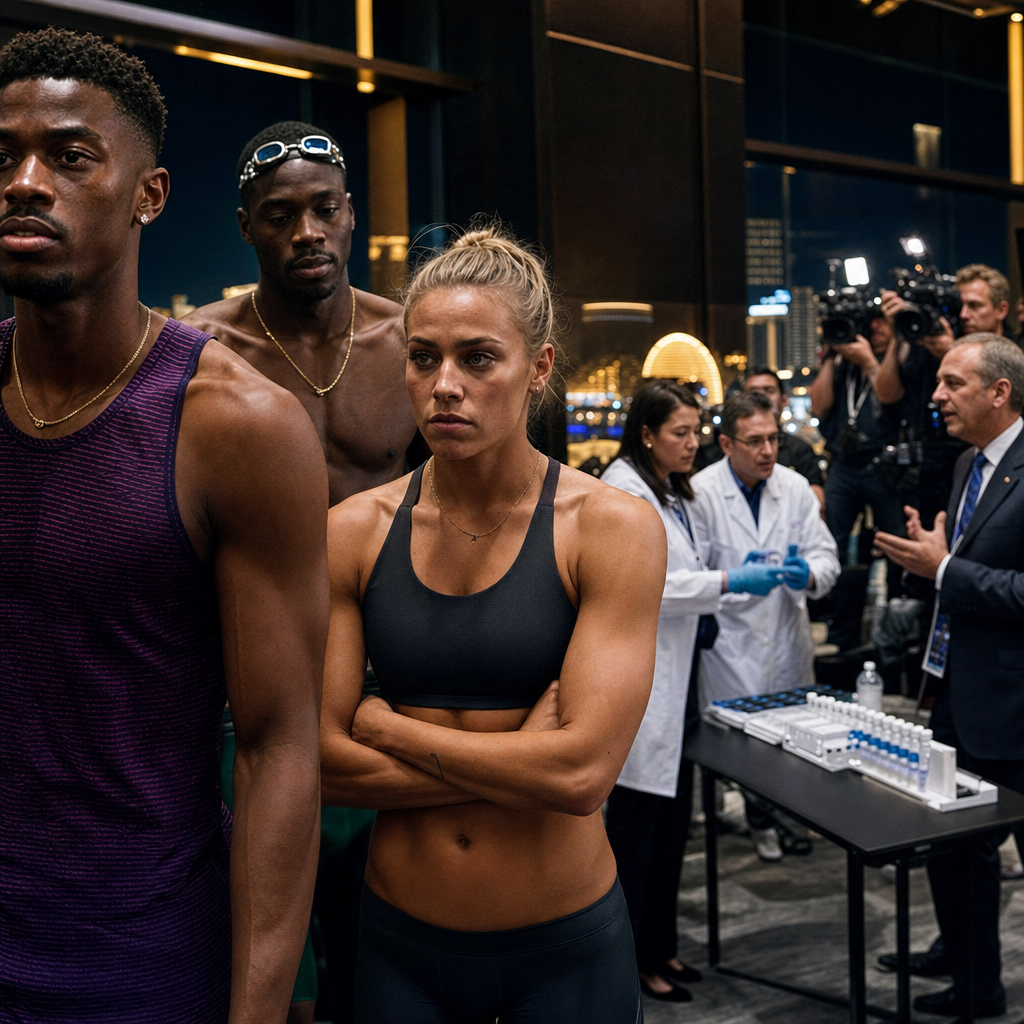
The Enhanced Games open in Las Vegas on May 24 with roughly 42 athletes competing in swimming, sprinting and weightlifting while using performance-enhancing drugs under medical supervision, according to  The Guardian and
  BBC Sport. The pitch is simple: take the taboo out of doping, wrap it in supervision, and pay enough to pull top athletes out of the mainstream system. That is why the event matters beyond sport. It is an open bid to prove that anti-doping is not just a rules regime, but a business model protecting the old Olympic order.
Money is the lever
The pull is financial, not philosophical. The Guardian reports that swimmers like Ukraine’s Andriy Govorov could take home close to $1 million if bonuses and race prizes stack up, while Britain’s Ben Proud is on a mid-six-figure salary before any performance bonus is added.  The Economist says up to $25 million in prizes is on offer overall, with world-record bonuses reaching $1 million and a 2,500-seat arena built at Resorts World Las Vegas. That is the real competitive weapon: not ideology, but compensation.
That matters because elite sport has left a gap that the Enhanced Games are exploiting. BBC Sport notes that several participants say money is their main motivation and that they feel underpaid in conventional sport, even as governing bodies insist they are defending fair competition and athlete welfare. For athletes on the margins of mainstream sponsorship, the Enhanced Games offer a payday, a platform, and a final career reroute.
The regulatory system is being tested
The bigger challenge is institutional. WADA has called the concept “dangerous and irresponsible,” while BBC Sport reports that the IOC and WADA jointly branded it “immoral” and that World Aquatics has already banned anyone involved from returning to its events. That is not just rhetoric. It is a warning that anyone who takes part may be cut off from the sanctioned circuit that still defines global prestige, funding and records.
The organizers are betting that the punishment will be survivable, and maybe even useful. The Economist reports the project has also launched a broader consumer-health and longevity business, including telehealth-style products, suggesting the Games are as much a marketing engine as a sporting event. The spectacle in Las Vegas is the ad unit; the real product is the promise that enhancement can be normalized, sold, and scaled.
For the anti-doping establishment, that is the danger. If the Games draw attention, streams and money without immediate collapse, they create a parallel market: one where records are secondary, compliance is optional, and the athlete becomes a test case for a pharmaceutical-industrial pitch. That is why  Global Politics belongs in the frame. The argument here is not only about sport; it is about who gets to set the rules when private capital, media and technology decide they can build a rival system.
What to watch next
The first test is whether the event produces credible performances that can be marketed as “progress” rather than a freak show. The second is whether any of the big names — especially Proud, Fred Kerley, or Govorov — turn the weekend into a recurring draw. The third is institutional: whether WADA, World Aquatics and UK Sport tighten sanctions on return, which would determine whether this becomes a one-off stunt or a durable shadow league. The real date to watch is the first post-event disciplinary ruling; that will tell you whether the old order still has leverage.