Kyiv's Patriot Shortage Meets NATO Summit
Ukraine's air defense struggles amid NATO talks in Ankara.
Model Diplomat7 min readEurope
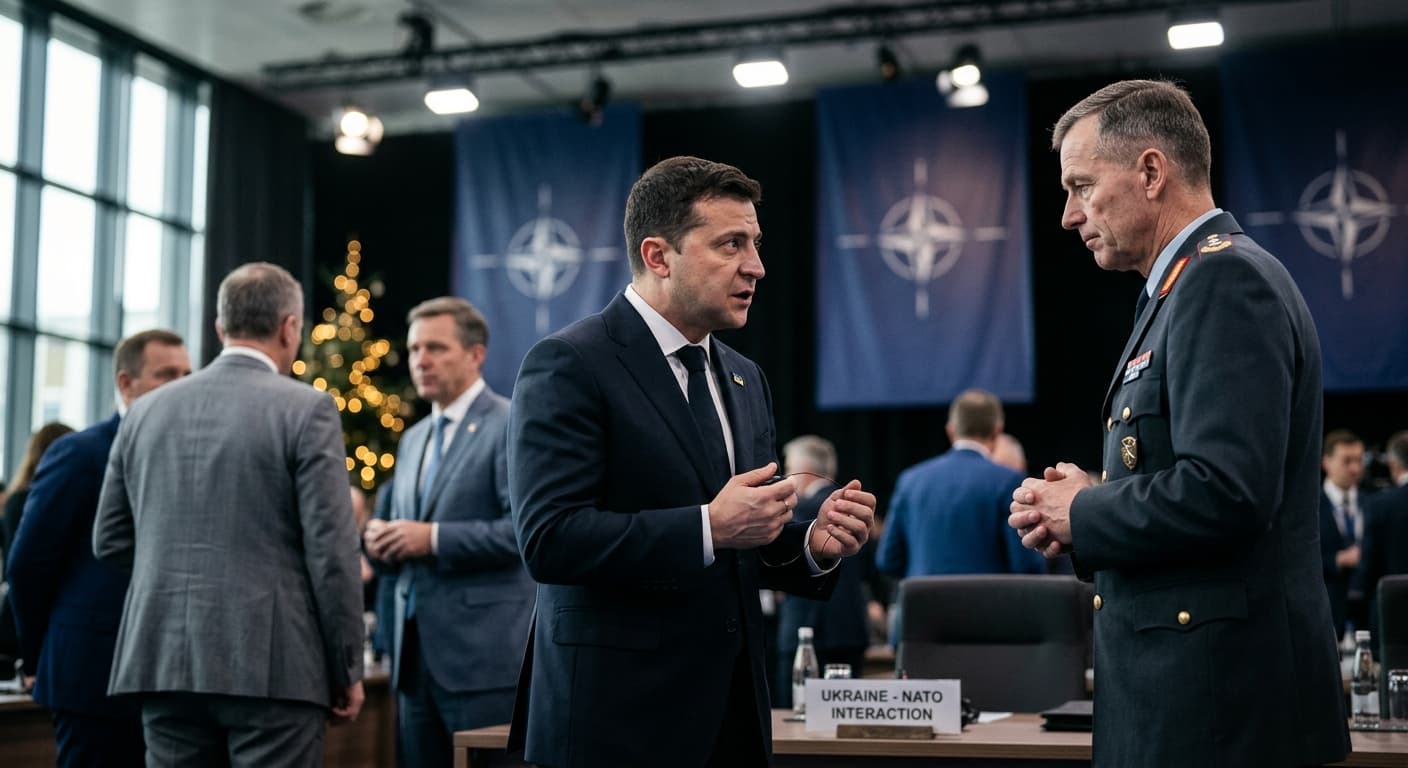
Kyiv's Patriot Shortage Meets NATO's Ankara Summit
Russia's July 6 mass strike killed at least 17 in Kyiv and exposed a widening ballistic-missile gap Ukraine's allies cannot close before 2028.
Russia fired 419 missiles and drones at Ukraine in the pre-dawn hours of July 6, 2026, killing at least 14 people in Kyiv and three in the surrounding region on the eve of the NATO summit in Ankara — and the important number in that sentence is not the death toll but the 23 Iskander-M ballistic missiles that Kyiv's air defenders could not stop. The strike, the second mass raid on the capital in five days, was designed to show NATO leaders arriving in Turkey exactly what Ukraine's Patriot shortage looks like from the receiving end. It succeeded. The alliance now faces a demand it cannot meet on the schedule Kyiv needs: enough PAC-3 interceptors to defeat a Russian ballistic salvo that the U.S. defence industrial base will not be producing at scale until 2028 at the earliest.
What actually happened overnight
Ukraine's Air Force said Russia launched 68 missiles and 351 drones in the overnight raid on July 6, striking 34 locations, according to BBC News Ukraine. Kyiv's military administration head Tymur Tkachenko put the confirmed dead in the capital at 14, with almost 60 injured, including two children. Regional governor Mykola Kalashnyk reported three more killed and 26 injured in Kyiv oblast, including a nine-month-old infant. Odesa was also struck. A separate wire-agency tally cited
by The Globe and Mail placed total casualties at "at least 20" as rescuers continued to pull people from the rubble of apartment blocks in Kyiv's Podilskyi district and the town of Vyshneve.
The breakdown of the salvo matters more than the aggregate. Ukraine's Air Force said Russia used 23 Iskander-M and S-400 ballistic missiles and six Zircon or Oniks anti-ship missiles with ballistic terminal profiles, on top of the drones and subsonic cruise missiles. Air Force spokesman Yuri Ihnat told BBC Ukraine the problem was not the launchers but the ammunition: "To shoot down ballistic missiles you need something to shoot them down with. There are enough systems. We have a serious deficit of interceptor missiles." Foreign Minister Andrii Sybiha said Ukraine had requested an emergency session of the UN Security Council.
Russia's Ministry of Defence confirmed the strike and claimed it targeted "enterprises of the military-industrial complex, fuel and energy facilities in Kyiv and Kyiv oblast, and military airfield infrastructure" — a formulation that ignores the residential buildings in central Kyiv where most of the dead were found. UN Secretary-General António Guterres had already condemned the July 2 barrage that killed 31, Al Jazeera reported, and repeated his ceasefire call after Sunday's attack.
The interception picture — and its ballistic hole
Ukraine's air defence has quietly become one of the most successful in modern warfare against low-end threats. In the July 2 raid, Ukrainian forces shot down 476 of 496 Shahed-type and decoy drones — a 96% kill rate — and 48 of 74 missiles, again according to Al Jazeera. The interceptions that failed were almost entirely ballistic. Ukraine's own Ministry of Defence has been direct about the physics: only the U.S. Patriot Advanced Capability-3 (PAC-3) missile can reliably kill an Iskander, a Kinzhal or a Zircon,
the Cabinet of Ministers noted when Germany transferred a fresh batch of PAC-3 rounds in March 2026.
That is the load-bearing constraint on Kyiv's sky. President Volodymyr Zelensky has been explicit for months about the interceptor arithmetic. After an earlier record ballistic salvo, he told NATO Secretary-General Mark Rutte that Russia had fired "43 missiles of various types that approach their targets along a ballistic trajectory and can be intercepted only by Patriot systems," according to the Ukrainian presidency. Sunday's raid was worse.
Why the alliance cannot close the gap on Kyiv's timeline
The uncomfortable truth for NATO leaders flying into Ankara is that no political decision taken this week produces more Patriot rounds this year. Lockheed Martin delivered 620 PAC-3 Missile Segment Enhancement (MSE) interceptors globally in 2025 — the only variant still in production — with roughly half going to the U.S. Army and the rest split among 17 allied operators, The War Zone reported from a congressional stockpile review. A January 2026 framework agreement with the Pentagon commits Lockheed to scaling annual output to 2,000 rounds, but only "over seven years,"
per The Aviationist. The follow-on $4.76 billion contract signed in April 2026 was funded 94% by Foreign Military Sales — meaning
allied money, not Pentagon procurement, is doing the bulk of the industrial-base financing.
That queue is already crowded. In January 2026, the U.S. State Department cleared a Saudi request for 730 PAC-3 MSE missiles worth $9 billion; the Iran war of 2025 burned through U.S. stockpiles at a rate a senior Lockheed executive publicly warned meant the company "cannot give U.S. allies any certainty over when they will receive interceptors." Ukraine sits inside that queue rather than above it. The Trump administration's June review of U.S. forces in Europe, and Defense Secretary Pete Hegseth's scathing address to NATO defence ministers, have made clear Washington now treats the Patriot line as a scarce national asset to be allocated, not a spigot to be opened.
The workaround NATO built for this problem is the Prioritized Ukraine Requirements List, or PURL — a July 2025 mechanism by which European allies and Canada pay for U.S. weapons drawn from allied stockpiles and reimbursed through future production. It is not a small program. A study by the French Institute of International Relations found PURL is now supplying 75% of all missiles for Ukraine's Patriot systems and 90% of the missiles for other Western air-defence systems. The Atlantic Council counts
more than $5.5 billion pledged in under a year, with Norway, Germany, the Netherlands, Denmark, Sweden and Canada as the largest early funders. But PURL redistributes existing rounds; it does not manufacture new ones. When Rutte tells Ankara that PURL is Ukraine's insurance policy, the fine print is that the policy pays out in interceptors already built.
What Kyiv is really asking for in Ankara
Zelensky is due to meet Donald Trump on the summit sidelines on Wednesday, July 8, NPR reported, citing the White House. Kyiv's specific ask, made repeatedly since the G7 in France in June, is a U.S. licence for domestic Ukrainian production of Patriot interceptors — a step
flagged by the Council on Foreign Relations as the single most consequential technology transfer on the table. In his June 17 statement after G7, Zelensky said the bloc had agreed to "extend to Ukraine the benefit of licences to allow for an increase in Ukraine's military production,"
Al Jazeera reported. Translating that into a signed U.S. export authorisation is the Ankara test.
The Trump-Putin call on July 4 produced no ceasefire signal; Sunday's strike is the Kremlin's answer. In his address after the attack, Zelensky said Russia was demonstrating that "violence can replace international law and that cruelty will go unpunished" — the argument Sybiha will take to the UN Security Council session Kyiv has requested.
"The Russians must not get used to believing that their missiles and 'shaheds' help them in any way. They only complicate everything and undermine what are, frankly, already limited diplomatic opportunities." —
President Volodymyr Zelensky, official address
The parallel alliance politics
Ankara is not a friendly room for a maximalist Ukraine ask. CSIS analysts previewing the summit noted that European allies had hoped to arrive with a "scorecard" showing rearmament progress — Germany at 3.5% of GDP by 2029, Poland heading to 5%, Baltic states already at 3.5% — only for the Iran war and U.S. frustration with Spain, Italy and initial British hesitation to sour the mood. U.S. reporting cited by CFR indicates the Trump administration is considering
reducing the F-16 and F-15 jets assigned to NATO by a third, halving strategic bombers, and pulling a missile submarine and carrier from the alliance's crisis pool. In that context, extracting a Patriot production licence and a firm PURL top-up for Ukraine is not a foregone conclusion — it is a genuine bargaining play against a U.S. side that wants Europe to shoulder more and Washington to be freer to withdraw.
The second-order effect worth flagging: Turkey, this year's host, has its own defence-industrial agenda — F-35 readmission and shielding its firms from EU procurement exclusion — that will compete for the summit's political oxygen. Ukraine's air-defence file will be one negotiation among several, not the marquee event European chancelleries wanted.
What to watch
- July 7–8, Ankara. The summit communique's language on PURL sustainable funding and on Patriot co-production licensing for Ukraine. Vague endorsement means no rounds; a named dollar figure and a licensing timeline mean rounds.
- July 8, Trump–Zelensky bilateral. Whether Trump commits to releasing additional Patriot batteries and interceptors from U.S. stocks, or only to accelerating deliveries already funded by allies through PURL.
- UN Security Council emergency session. Requested by Ukraine on July 6; date to be set. Expect a Russian veto on any draft, but the abstention count from China, Algeria and others is a leading indicator of Moscow's diplomatic isolation.
- Next mass strike. Zelensky and his intelligence services flagged both the July 2 and July 6 raids in advance. Air defenders expect a third wave keyed to whatever emerges from Ankara.
The Bottom Line
The July 6 strike on Kyiv is a message from Moscow priced in ballistic missiles: Russia can impose casualties at the exact moment NATO gathers, and the alliance has no near-term industrial answer. Ukraine's real ask in Ankara is not more weapons in general — it is a U.S. licence to build Patriot interceptors on Ukrainian soil, because the Lockheed line will not scale to 2,000 rounds a year until roughly 2032. If Ankara produces that licence and a multi-year PURL funding floor, the strike will be remembered as a strategic own-goal by the Kremlin. If it does not, Russia will have learned that mass raids on the capital are a cost-free instrument of alliance politics.
Related: Conflict & Security briefings on.
Read today's full |
Discover more

US Politics
SNAP Food Assistance Faces Legal Challenges
In 2026, SNAP faces stricter eligibility rules and mounting legal challenges, threatening food assistance for the millions of Americans who rely on the program.

India
Delhi CM Rekha Gupta Blasts Opposition's Delm
Delhi CM Rekha Gupta's remarks on women's quota defeat reveal BJP's strategy for the 2029 Lok Sabha elections, focusing on delimitation.
India
Congress Accuses Modi of Stalling Women's Law
Congress accuses Modi of stalling women's reservation law by linking it to delimitation, revealing a deeper electoral strategy.

Conflict & Security
Drone Warfare Killing Aid Workers at Unprec
Over 1,000 humanitarian workers killed in three years as cheap armed drones collapse legal protections. Gaza, Sudan, Ukraine, and DRC see deliberate targeting of aid convoys and hospitals with zero prosecutions.