Kyiv's Interceptor Gap: NATO's Warning Shot
July 6 barrage reveals Ukraine's missile defense crisis.
Model Diplomat7 min readEurope
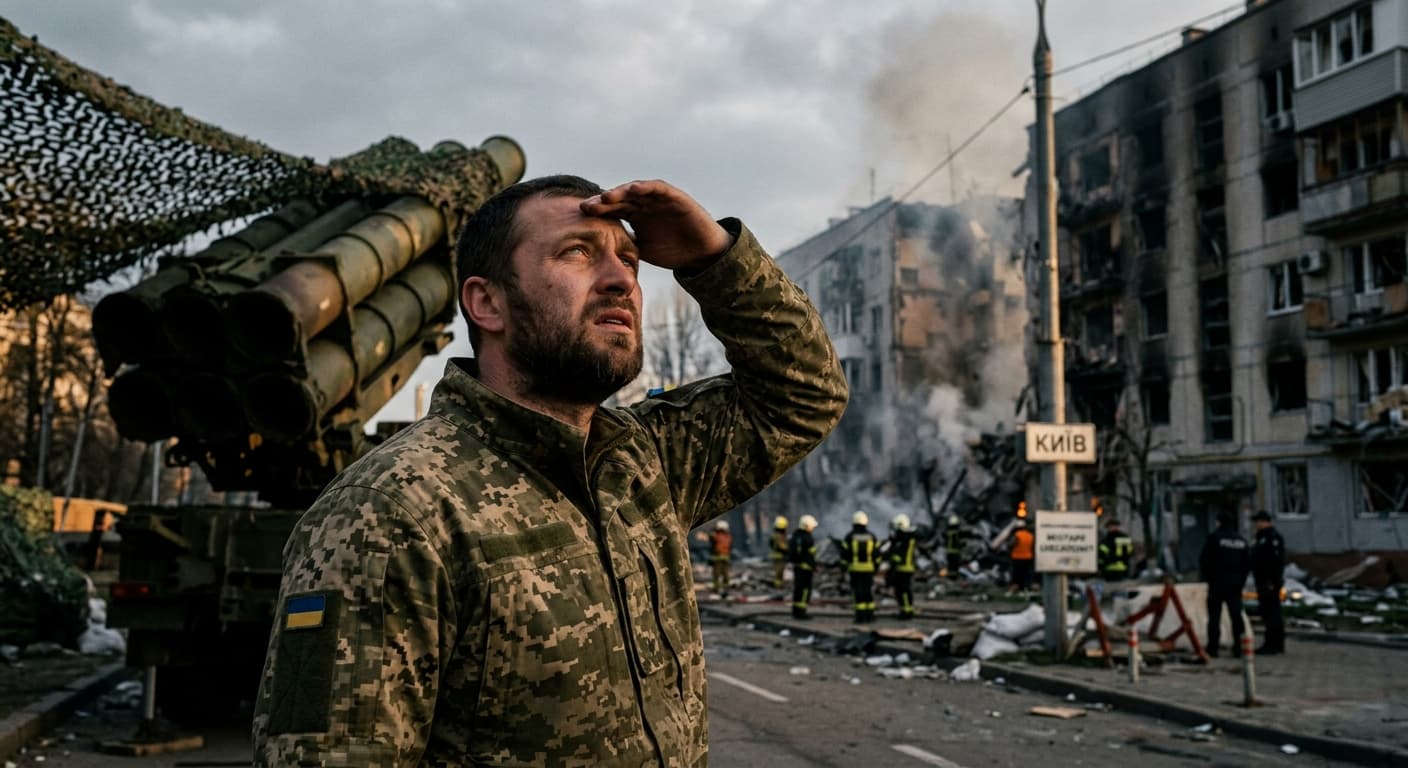
Kyiv's interceptor gap: why the July 6 barrage was a NATO warning shot
Russia's 419-weapon barrage killed at least 21 in the Kyiv region on July 6, 2026. Ukraine intercepted no ballistic missiles — exposing an interceptor shortage NATO cannot fix before 2029.
The July 6 strike on Kyiv is not a story about 21 deaths. It is a story about a math problem Washington has known about for a year and has not solved: Russia is now firing ballistic missiles faster than the United States, Israel and the Gulf combined can produce the interceptors to stop them. The strike arrived hours before the NATO summit opened in Ankara on July 7, and its message to the alliance was written in unshot-down Iskanders — 23 of them, according to Ukraine's Air Force, none intercepted.
What happened overnight
Russia launched 419 weapons at Ukraine between the evening of July 5 and dawn on July 6 — 68 missiles and 351 drones, according to a Ukrainian Air Force summary published by BBC News Ukraine. Ukrainian defences downed 363 of them: 326 drones and 37 cruise missiles. Of the 23 Iskander-M ballistic missiles and six Zircon/Oniks anti-ship missiles fired at the capital, none were shot down.
Kyiv Military Administration head Timur Tkachenko said at least 15 people were killed and 56 injured in the city itself, with rescue operations continuing in collapsed apartment blocks in the Solomianskyi and Sviatoshynskyi districts, as reported by the BBC. Kyiv regional governor Mykola Kalashnyk added three killed and 26 injured, including a nine-month-old baby and a 12-year-old child. A further wave hit Odesa. Combined with the July 2 barrage — the deadliest single strike on Kyiv this year, with 31 killed, per
Al Jazeera — Kyiv has lost more than 50 civilians to Russian aerial fire in five days.
The pattern is not random. The UN Human Rights Monitoring Mission in Ukraine reported 274 civilians killed and 1,763 injured in May 2026, the highest monthly toll since April 2022. Long-range missiles and drones accounted for 45% of casualties, with most occurring in urban centres far from the front. April 2026 was the previous record. June, when
HRMMU publishes its next figures, will almost certainly break it.
The interceptor arithmetic
Ballistics is what changed. Cruise missiles and Shaheds Ukraine can now handle at scale: it produces more than 1,000 short-range interceptor drones a day, according to BBC reporting, and in March 2026 destroyed more than 30,000 Russian drones. Zelensky has told parliament Ukraine can build up to 2,000 interceptor drones a day and now exports the technology to Gulf states hit by Iranian Shaheds, as documented by
Al Jazeera.
Ballistic missiles are a different weapon and a different economy. Only the US-built PAC-3 MSE Patriot interceptor and, to a lesser extent, the Franco-Italian SAMP/T reliably kill Iskanders in Ukrainian conditions. And the numbers are brutal. Lockheed Martin's baseline PAC-3 MSE production runs at roughly 650 interceptors a year, according to CSIS, with about half kept for the US Army. The next major replenishment — the 3,203 Patriot missiles requested in the US Army's FY 2027 budget — is not projected to begin delivery until May 2029.
Russia, in the same window, is producing about 120 ballistic missiles a month, Zelensky told the Ukraine-NATO Council in June 2026, reported by Al Jazeera. That is roughly 1,440 a year against a Western interceptor line half that size — and Ukraine competes for those interceptors with 17 other Patriot-operating nations, plus a US arsenal that CSIS analyst Tom Karako's colleague Mark Cancian
estimated at around 1,600 missiles before the Iran war depleted them.
Then came June 2025. In the first three days of the US–Israel campaign against Iran, roughly 800 Patriot interceptors were expended defending Israeli and Gulf targets, Zelensky said in an interview with the BBC — more than a full year of production, gone in 72 hours. The Pentagon paused Patriot shipments to Ukraine that July while it audited stocks, a decision that Ifri researcher Iryna Krasnoshtan documents in
a June 2026 study as the direct trigger for the PURL mechanism that now sustains Kyiv's air defence.
Who benefits, who pays
The uncomfortable second-order effect is that Ukraine's air defence has become a hostage of Gulf security. That is not rhetorical: it is procurement policy. CSIS analysis of the US Foreign Military Sales queue argues that "Europe may well receive almost no deliveries of U.S. air defense interceptors in the near term" because the Pentagon is prioritising its own stocks and Gulf partners. Saudi Arabia, the UAE, Qatar and Kuwait are now competing for PAC-3 MSE rounds — with the same suppliers, on the same production line — that Kyiv needs to keep ballistic missiles out of its apartment blocks.
The compensation mechanism is NATO's Prioritized Ukraine Requirements List, or PURL, agreed in July 2025 and operational by September that year. Under PURL, European allies and Canada pay to pull weapons out of US stocks or the US production queue and route them to Ukraine. It has become the artery. NATO Secretary General Mark Rutte told journalists in Kyiv in February 2026 that PURL has supplied 75% of the missiles for Ukraine's Patriot systems and 90% of missiles for its other air defence systems. Without PURL, Ukrainian ballistic defence collapses; with PURL, it is capped by whatever Lockheed can ship next month.
That cap is why July 6 looked the way it did. Zelensky said publicly in June that "ballistics is Putin's last argument" — the one Russian capability against which Ukraine still has no domestic answer. Volodymyr Fesenko of Kyiv's Penta Center told Al Jazeera in March that Moscow was deliberately amassing missiles for "massive raids" designed to "bleed Ukraine's stock of Patriot missiles dry." The July 2 and July 6 barrages fit the description.
What NATO can and cannot do in Ankara
Ankara opens on July 7 in the shadow of two overlapping crises: the aftermath of the US–Iran war and the Trump administration's push for a NATO in which Europe becomes the "first responder" for continental security. The White House frames this as "NATO 3.0," a formula CSIS analyses in a summit preview that argues European allies must now translate the 5%-of-GDP defence spending pledge from The Hague into "burden delivery in practice."
For Ukraine, that translation is specific and short-term: more PURL contributions, and licensing so Kyiv can build Patriot-class interceptors itself. Zelensky pledged in June to field a Ukrainian version of the Patriot by end-2027; Washington has, so far, refused co-production licences. G7 leaders at the Evian summit in mid-June committed to "increase the delivery of air defence capacities, additional systems and interceptors" and said they were "ready to consider extending to Ukraine the benefit of licences" to expand its own production — language deliberately non-committal.
The Atlantic Council's Doug Klain and Shelby Magid argue that fewer than half of NATO's European members have made meaningful PURL contributions, and that the summit is the natural moment to name and enlist the laggards. Germany and Norway have paid for three Patriot systems between them, as
BBC reporting noted last year; the UK finally began contributing to PURL only in February 2026, per the Ifri study. The gap is not analytic. It is political.
Meanwhile, the Trump administration has, according to NPR, announced a six-month review of US forces in Europe — timing that Kyiv reads as leverage. Trump meets Zelensky in Ankara on Wednesday, July 8, having spoken by phone with both Zelensky and Putin on July 4.
The historical parallel that reframes this
The interceptor squeeze is not a new problem in kind, only in scale. In 1944–45, Britain ran out of anti-aircraft shells during the V-1 and V-2 campaigns and improvised proximity fuses, radar-directed guns, and Meteor jet interceptions in parallel. The improvisation worked against V-1s. Against V-2s — ballistic, supersonic, arriving without warning — no defence worked at all. The Allied answer was to overrun the launch sites in the Low Countries.
Ukraine's answer would be the same: strike deep enough to reduce Russian ballistic production and launch capacity. Ukraine has done this against Russian oil and drone plants, but not yet at the scale that would meaningfully cut ballistic output — because Western long-range munitions are also rationed. The interceptor shortage is thus one face of a broader munitions crunch that has, more than any battlefield event, become the war's rate-limiting factor. Track the war on the conflict page for the wider pattern.
The bottom line
The July 6 strike killed 21 people because Ukraine has interceptor drones for Shaheds and cruise missiles but nothing at scale for Iskanders — and the West's ballistic-interceptor pipeline is booked out to 2029. Ankara will produce fresh PURL pledges and lofty language on co-production licences; it will not produce more PAC-3s in 2026. Until Lockheed's surge line or a Ukrainian-built equivalent comes online, Russia's ballistic missiles will keep landing where Patriots are not, and civilian death tolls in Kyiv, Dnipro and Kryvyi Rih will keep setting monthly records at the UN.
What to watch
- July 7–8, 2026 — NATO summit, Ankara. Watch for named PURL contributions (particularly from Italy, Spain and the Nordics) and any language on a US–Ukraine Patriot co-production licence.
- July 8 — Trump–Zelensky bilateral in Ankara. The specific ask is more Patriot batteries and interceptors; a public number, or its absence, will signal how far the White House will go.
- Mid-July — HRMMU June civilian-casualty report. Will formalise whether June 2026 exceeded May's post-April-2022 record of 274 killed.
- US Army FY 2027 budget markup in Congress. The 3,203-missile Patriot request drives when the interceptor bottleneck begins to ease. Delivery is projected to begin in May 2029.
Read today's full |
Discover more

US Politics
SNAP Food Assistance Faces Legal Challenges
In 2026, SNAP faces stricter eligibility rules and mounting legal challenges, threatening food assistance for the millions of Americans who rely on the program.

India
BJP's Misunderstanding of Women's Quota Needs
The BJP's linking of the Women Reservation Bill to delimitation risks delaying women's empowerment in India, misreading the aspirations of female voters.

India
Congress Accuses Modi of Stalling Women's Law
Congress accuses Modi of stalling women's reservation law by linking it to delimitation, revealing a deeper electoral strategy.

Conflict & Security
Drone Warfare Killing Aid Workers at Unprec
Over 1,000 humanitarian workers killed in three years as cheap armed drones collapse legal protections. Gaza, Sudan, Ukraine, and DRC see deliberate targeting of aid convoys and hospitals with zero prosecutions.