Kyiv's Air-Defense Gap: 23 Missiles, None St
Ukraine's air defenses fail against Russian ballistic missiles
Model Diplomat7 min readEurope
Kyiv's Air-Defense Gap: 23 Ballistic Missiles, Zero Intercepted
Russia's July 6 strike killed at least 22 in the Kyiv region and exposed Ukraine's Patriot interceptor shortfall on the eve of the Ankara NATO summit.
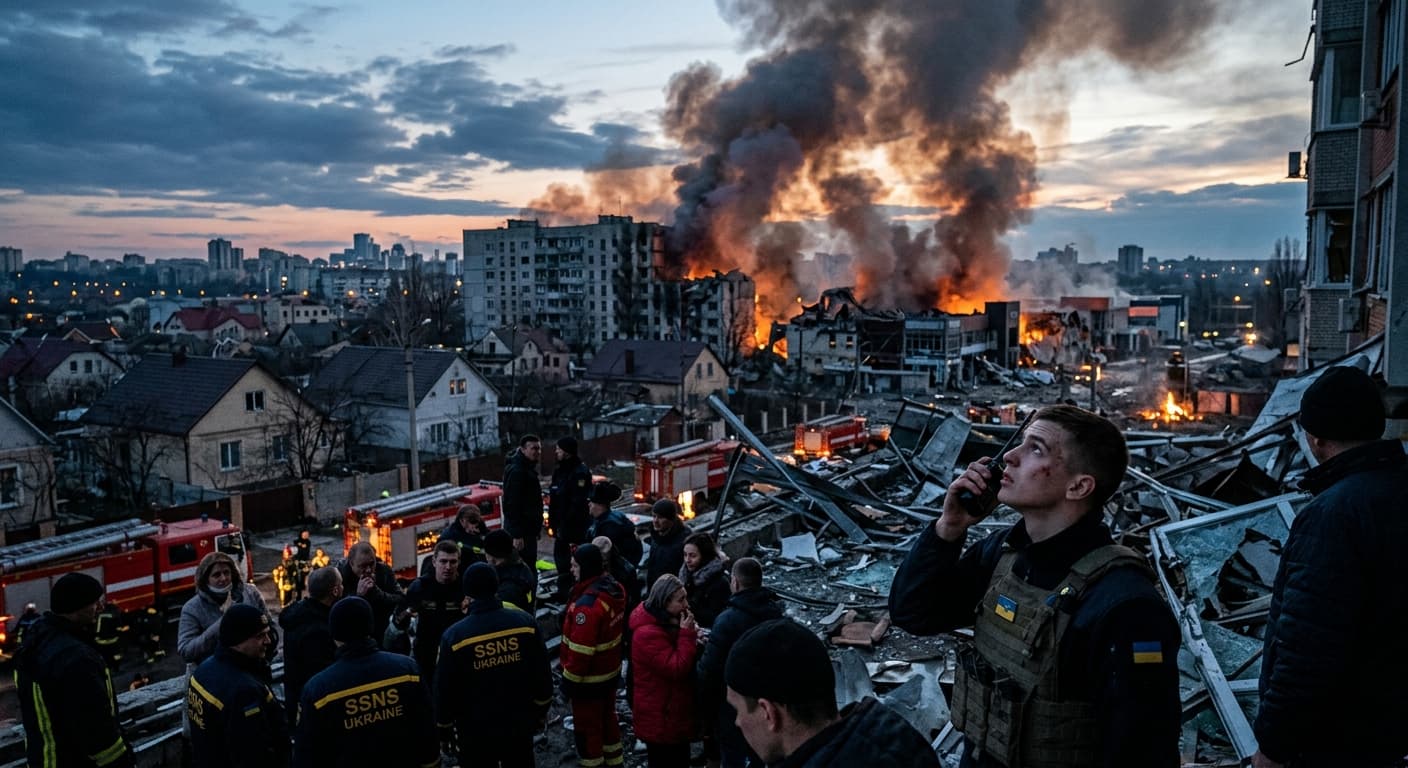
Russia fired 23 ballistic missiles at the Ukrainian capital in the early hours of July 6, 2026, and Ukraine's Air Force shot down none of them — a saturation attack that killed at least 22 people in the Kyiv region and stripped bare the single vulnerability the Kremlin now designs its air campaign around. The thesis is narrow and disturbing: Russia has learned that ballistics, not drones, break Ukrainian cities, and it is producing them faster than the West is producing the only interceptors that can stop them. Volodymyr Zelensky flies to the NATO summit in Ankara today with one demand that overrides all others — Patriot missiles, or a licence to build them.
The overnight barrage involved 68 missiles and 351 drones, according to a Ukrainian Air Force tally reported by BBC News. Ukraine intercepted 326 of the drones and 37 cruise missiles. Not one of the 23 Iskander-M and S-400-launched ballistic missiles was stopped. Fifteen were killed in Kyiv city and seven in surrounding districts,
PBS NewsHour reported, with dozens of residential blocks damaged across the Podilskyi, Solomyanskyi and Darnytskyi districts. It was the second mass strike in five days: on July 2, a barrage of 496 drones and 74 missiles killed 31 in what
Al Jazeera called the deadliest attack on the capital this year.
The interception gap is the whole story
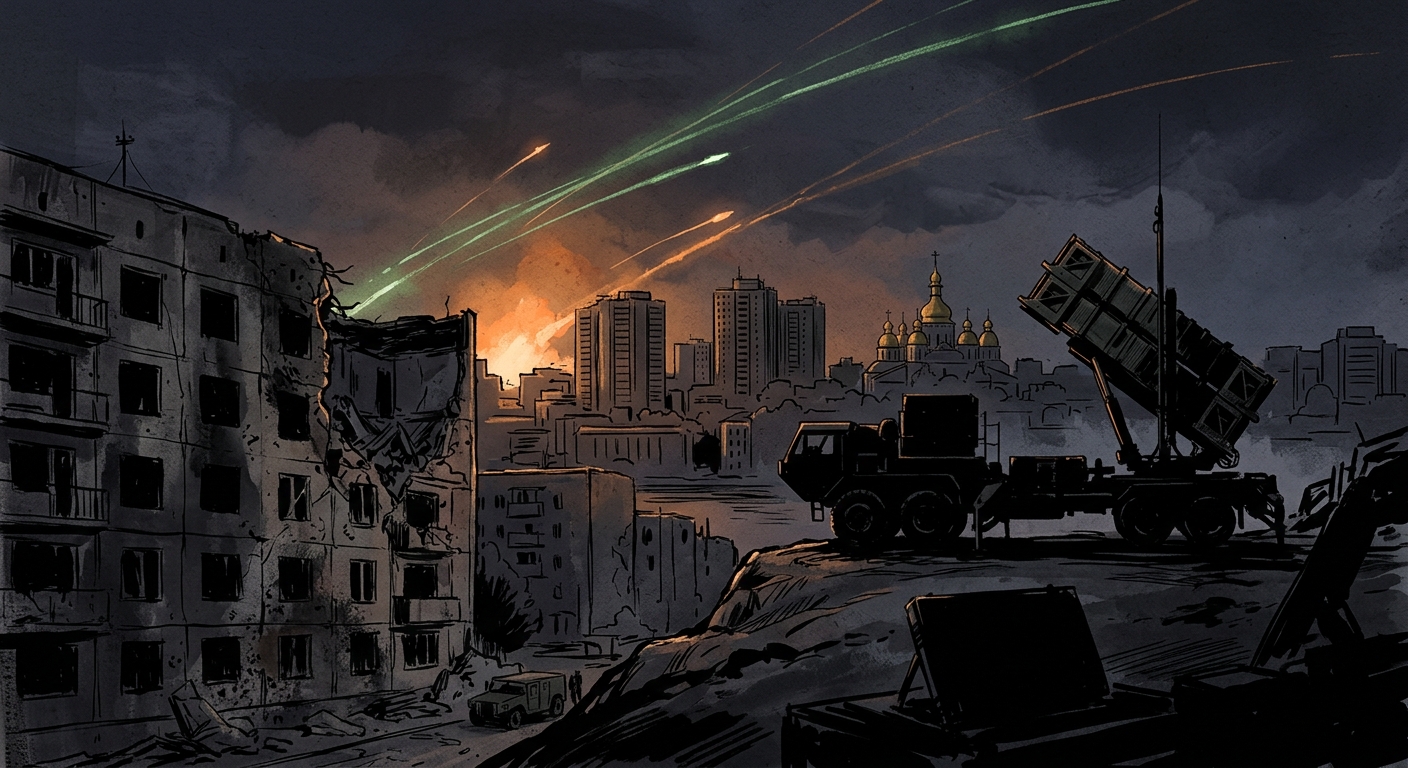
Ukraine's air defenses no longer fail broadly; they fail specifically. Cruise missiles and Shahed-type drones — which caused most casualties in 2023 and 2024 — are now knocked down at roughly 90-plus percent, thanks to F-16 patrols, IRIS-T and NASAMS batteries, and a new fleet of interceptor drones. On June 2, according to Al Jazeera, Ukraine intercepted 91.7 percent of drones and 90.6 percent of cruise missiles fired that night — but only 27 percent of ballistic missiles.
Ballistics fly at several thousand kilometres an hour and re-enter the atmosphere on unpredictable manoeuvring trajectories. Only the Patriot PAC-3 in Ukraine's arsenal can reliably reach them. Zelensky's own numbers, delivered to the Ukraine-NATO Council in June, frame the arithmetic bluntly: Russia produces roughly 120 ballistic missiles per month — "twice as many as the Patriot interceptors the United States produces." That single ratio, more than any casualty figure, explains why every Russian package now leads with Iskanders and why every Ukrainian package now leads with a request for PAC-3s.
Why the switch to ballistics — and why now
The Kremlin's decision to concentrate ballistics on Kyiv is a targeting choice, not a supply accident. Deputy Defence Minister Serhiy Beskrestnov has said Russia holds a strategic reserve of 180 to 250 Iskander missiles, distinct from other stocks that are typically expended within months of production. Combined with a monthly output that Army Recognition estimated at 40–50 Iskanders, Moscow now has the depth to sustain saturation strikes for months. The pattern is deliberate: swarms of Shahed drones and Kh-101 cruise missiles first exhaust radar operators and drain interceptor stocks; ballistics then follow into the resulting seams.
The timing is political. Russia hit Kyiv twice in the run-up to the Ankara summit, precisely when Zelensky's leverage inside the alliance depends on demonstrating that Ukraine cannot absorb further damage indefinitely. It is also retaliation. Ukrainian drones have hit Russia's Omsk refinery, 2,700 kilometres from the border, along with fuel depots in Ryazan and pipelines in Bryansk. Russian social media, the BBC reported, is now full of queues at petrol stations. Moscow's ballistic answer is designed to force a symmetric cost — and to remind Trump, Rutte and the E5 what the price of a slow decision looks like.
Ankara: what Zelensky actually wants
Zelensky is not going to Ankara to ask for solidarity. He is going for three specific asks, in descending order of urgency.
First, a US licence to co-produce Patriot missiles in Ukraine. This is the ceiling issue. Lockheed Martin's Camden, Arkansas plant is scaling to roughly 650 PAC-3 MSEs per year by 2027, and every Patriot-user in Asia and the Gulf is competing for that pipeline. A production licence — flagged by the Council on Foreign Relations as a live agenda item — would let Ukraine assemble missiles domestically and, more importantly, let European partners fund production without waiting in the American queue.
Second, immediate releases from European Patriot stockpiles. Zelensky vented that framing in a video address on Monday: "It is simply absurd that, in today's world, production has still not been scaled up to the level actually required to protect people from ballistic terror," he said, according to the BBC. He has argued repeatedly that missiles sitting in Bundeswehr or Dutch magazines are "no good to anyone in storage."
Third, expansion of the PURL initiative — Prioritised Ukraine Requirements List — the mechanism that lets NATO members buy scarce US munitions and pass them to Kyiv. Ukraine's Presidential Office confirmed that Zelensky and Rutte discussed both the licensing question and PURL expansion in Kyiv earlier this year.
"Against ballistic threats, the most effective systems — you know this — are Patriots. And this means that missiles are needed — more missiles for Patriots. And that deliveries must be fully resourced and prompt," Zelensky told Rutte, per the presidential readout.
The awkward summit
The problem is that Ankara is not, primarily, a Ukraine summit. It is a transatlantic-strain summit. According to the CFR, the Trump administration is preparing to reduce the F-16 and F-15 jets assigned to NATO by roughly a third, halve the strategic bomber pool, and pull an aircraft carrier and a missile submarine from allocated crisis assets. Defence Secretary Pete Hegseth has ordered a six-month posture review; some 5,000 US troops are already drawing down from Germany. Secretary of State Marco Rubio has called Ankara "probably the most important meeting in NATO's history" — a phrase that reads less like enthusiasm than like a warning shot.
That reframes Zelensky's Patriot ask. He is now competing not with other Ukraine aid items but with a European scramble to backfill withdrawing US capability across the whole eastern flank. Poland's air-defence needs, Romania's Black Sea posture, and Baltic integrated air defence are all queuing for the same PAC-3 pipeline. The International Institute for Strategic Studies has estimated that replacing critical US conventional capabilities in Europe would cost roughly $1 trillion and take a decade. Ukraine does not have a decade of nights like July 6.
The historical analogue is not encouraging
The closest parallel is Israel's early 1991 experience with Iraqi Scuds and the first Patriot deployments — a case study in which the interceptor became the diplomatic centrepiece and the defensive rationale for coalition unity. But there is a sharper 2024 comparison: Israeli-US-coordinated defence of Israeli airspace during the April 2024 Iranian ballistic strike, which achieved an interception rate above 90 percent thanks to Arrow-3, THAAD, and coalition assets flying alongside. Zelensky has explicitly invoked this in past addresses to the Ukrainian presidency: "What works in the skies of the Middle East and helps Israel's defence can work just as well in the skies of our part of Europe." Ukraine is asking, in effect, for the Israel treatment. Ankara will decide whether that analogy travels.
Who benefits, who loses
Russia's calculation is coherent. Every Kyiv strike that succeeds without interception widens the political price of continued Western hesitation and simultaneously validates Moscow's investment in ballistic production over cruise missiles. It also targets the population most likely to demand a settlement — urban Kyivans, not front-line villagers.
Ukraine's calculation is coherent too, but tighter. Its long-range drone campaign against Russian refineries is the only leverage it has that Moscow visibly feels. Ukraine's Air Force reported an Omsk strike this week, Al Jazeera noted, that reached 2,700 km inside Siberia. The
Ukraine country file shows a widening asymmetric campaign: cheap drones for expensive refineries, defensive interceptors for expensive apartment blocks.
The quiet loser is European air-defence industry planning. Every emergency Patriot transfer to Kyiv is a battery not covering Warsaw, Riga or Bucharest. That is why Berlin, Warsaw and The Hague have all pushed hardest for the co-production licence — it is the only path that expands the pie rather than reallocates it.
What to watch
- July 7–8, Ankara. Whether NATO's final communiqué names Ukraine's Patriot licence request explicitly, or defers it to bilateral track. Deferral is the tell.
- July 8, Trump–Zelensky bilateral. According to
NPR, the two will meet on Wednesday. Watch for any US commitment on PAC-3 delivery timelines or a Patriot co-production Memorandum of Understanding.
- The next Russian barrage. Ukrainian officials expect another salvo timed to the summit's close. A third mass strike within ten days would confirm Moscow has fully industrialised the ballistic-first playbook.
- PURL expansion. Whether Italy, Spain and non-E5 members join the Netherlands, Denmark, Norway, Sweden, Germany, Canada, Belgium, Luxembourg, Iceland, and the Baltics on the list that
Ukraine's presidency published in late 2025.
The Bottom Line
Russia's July 6 strike on Kyiv was not another atrocity in a long war — it was a targeted demonstration that Moscow has industrialised the one weapon Ukraine cannot defend against, timed precisely to shape the Ankara summit's agenda. If NATO leaves Ankara without either a Patriot co-production licence for Ukraine or a firm interceptor delivery schedule, the alliance will have conceded that the pace of Russian ballistic production now sets the ceiling on Ukrainian civilian survival. That is the calculation Zelensky is bringing to Trump on Wednesday — and the one Vladimir Putin is banking on the West failing to make.
Discover more

India
Delhi CM Rekha Gupta Blasts Opposition's Delm
Delhi CM Rekha Gupta's remarks on women's quota defeat reveal BJP's strategy for the 2029 Lok Sabha elections, focusing on delimitation.

US Politics
SNAP Food Assistance Faces Legal Challenges
In 2026, SNAP faces stricter eligibility rules and mounting legal challenges, threatening food assistance for the millions of Americans who rely on the program.

India
BJP's Misunderstanding of Women's Quota Needs
The BJP's linking of the Women Reservation Bill to delimitation risks delaying women's empowerment in India, misreading the aspirations of female voters.

Conflict & Security
Drone Warfare Killing Aid Workers at Unprec
Over 1,000 humanitarian workers killed in three years as cheap armed drones collapse legal protections. Gaza, Sudan, Ukraine, and DRC see deliberate targeting of aid convoys and hospitals with zero prosecutions.