Kyiv Under Fire: Air-Defense Gap Grows
Russia's strikes on Kyiv reveal a critical air-defense shortage.
Model Diplomat6 min readEurope
Kyiv Under Fire: The Air-Defense Gap Redrawing Russia's War
Three mass strikes on Kyiv in six days, a run-down PAC-3 stockpile, and 5,500 Shaheds a month — Russia is racing Ukraine's air defenses to exhaustion on the eve of the Ankara NATO summit.
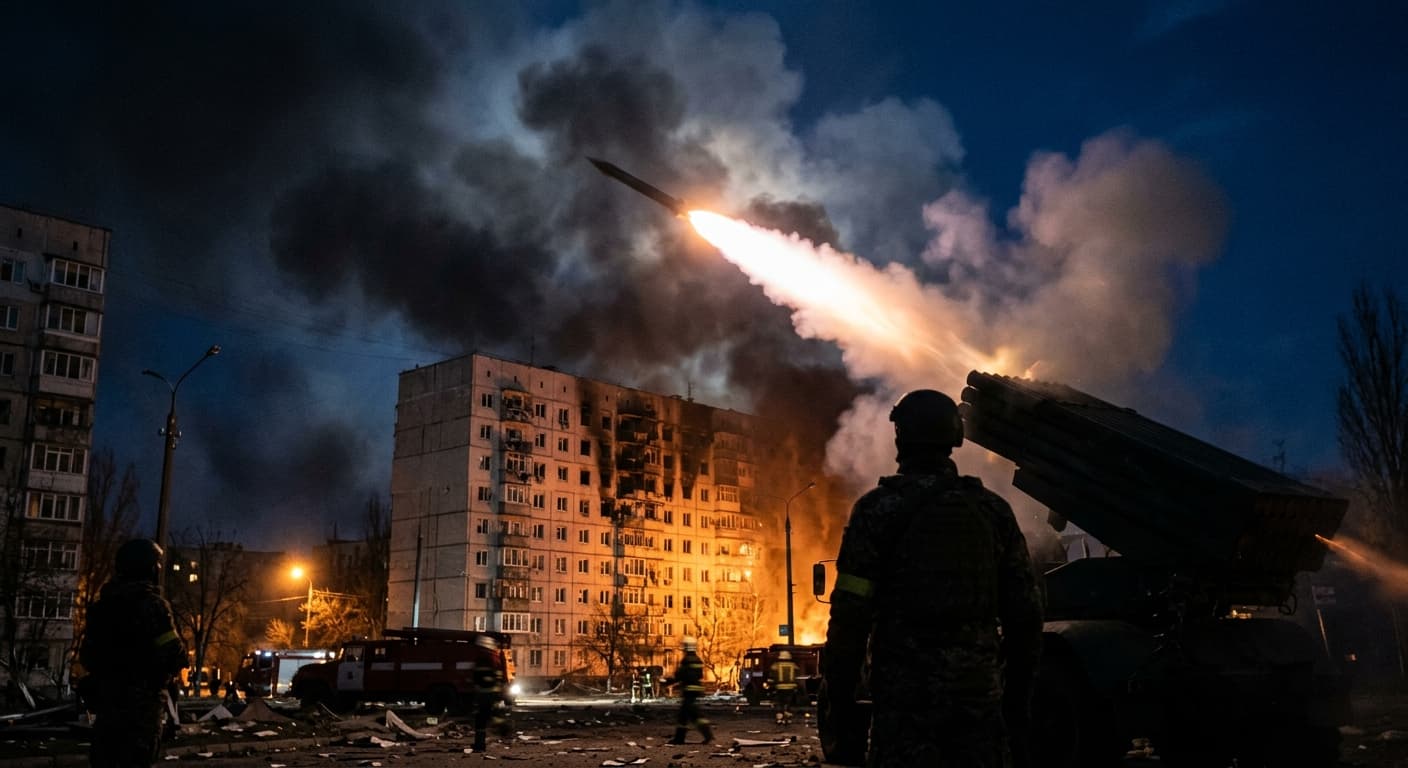
Russia launched its third mass strike on Kyiv in six days on July 7, 2026, and the pattern has stopped being random: Moscow is timing overlapping ballistic and drone salvos to burn through Ukraine's Patriot interceptors faster than Washington and Berlin can replace them, betting that the resulting gap — not any breakthrough on the ground — is what forces a settlement on Russian terms. The strikes killed at least 45 people in the capital and its suburbs across July 2–7, according to Kyiv authorities cited by Al Jazeera and
BBC News. What matters more than the death toll is the arithmetic underneath it: Russia is producing missiles and drones faster than Ukraine can shoot them down, and faster than the West is willing to backfill.
What actually happened
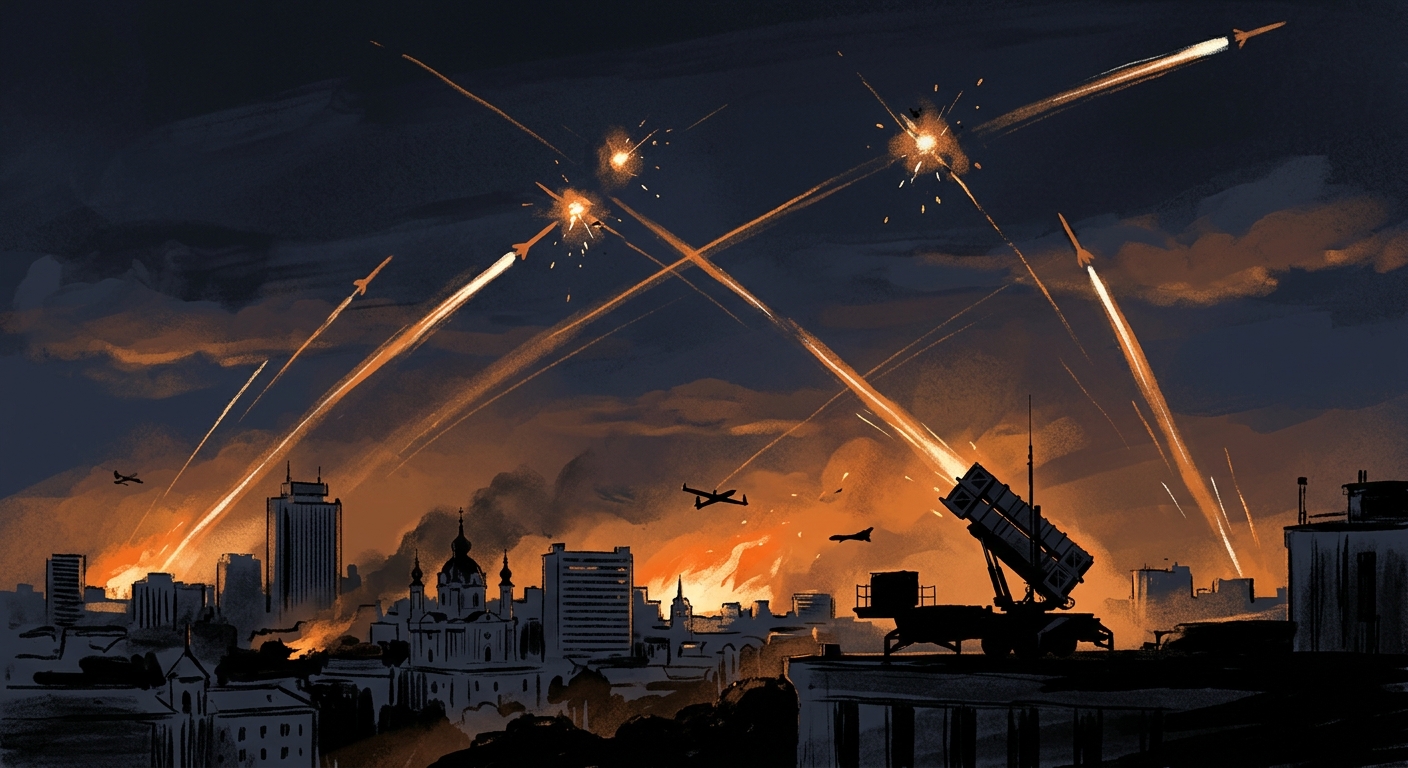
The July 2 barrage was the largest single-night raid of 2026. Ukraine's air force said Russia launched 74 missiles and 496 drones, mainly at Kyiv, killing 31 people including a child, with 476 drones and 48 missiles intercepted, per BBC News. Four days later, on the eve of the NATO summit in Ankara, a second wave of 68 missiles and 351 drones struck the capital in three phases starting at 01:40 local time, killing 14 in Kyiv and six in surrounding districts, according to
Al Jazeera. The July 7 follow-up hit two districts of Kyiv and injured 10 in Odesa,
Al Jazeera reported.
The worst physical damage was not in central Kyiv but in Vyshneve, a suburb west of the city. Prime Minister Yulia Svyrydenko said 13 hectares of residential development were destroyed there — the most extensive damage to a single Ukrainian community since the 2022 invasion — and the cabinet released reserve-fund money for reconstruction, according to a statement on the government portal.
The BBC Ukrainian service reported that after the July 6 ballistic strike, in which none of the incoming missiles were shot down, Ukrainian authorities publicly acknowledged that stocks of PAC-3 interceptors — the only munitions Kyiv operates that reliably kill Russian ballistics — had run out, per BBC News Ukraine. That admission is the story.
The math Russia is playing
Ukraine has fewer than a dozen Patriot batteries and says it needs at least 25 to defend its infrastructure, per an Al Jazeera analysis. Each battery burns through pricey PAC-3 rounds every time Moscow launches a mixed salvo. Russia has scaled the input side of that equation ruthlessly. The Alabuga plant in Tatarstan has grown from two buildings in 2021 to 116, with production capacity now estimated at up to 5,500 Shahed-type drones a month, according to CSIS Beyond Parallel satellite analysis reported by
FlightGlobal. GUR chief Kyrylo Budanov told
The War Zone in mid-2025 that Russia was building around 2,000 Shaheds a month with plans to reach 5,000; the Alabuga figures suggest that target has been met.
Ballistics are being produced at similar tempo. A RAND commentary citing Ukrainian intelligence puts Russia's long-range missile output at 115–130 systems a month — Iskanders, Kalibrs, Kh-101s — well above what Moscow expends against Ukraine each week, meaning the surplus is being stockpiled. The Votkinsk plant that builds Iskanders is expanding facilities and hiring 1,200 additional workers to serialize the new Oreshnik intermediate-range missile, according to
Carnegie's Russia analysis.
And Russia's ballistics are getting harder to intercept. A RUSI commentary analyzing Ukrainian strike data found that Patriot interception rates against the 9M723 Iskander fell to roughly 15% in defended areas in 2025, likely due to software upgrades that allow terminal-phase manoeuvres. In 72% of Iskander attacks last autumn, no Russian ballistic missile was intercepted at all.
That is the true escalation: not the raid count, but the shifting ratio of Russian throughput to Ukrainian interception.
The civilian dimension is not collateral — it is the target
The UN Human Rights Monitoring Mission in Ukraine reported at least 274 civilians killed and 1,763 injured across Ukraine in May 2026, a 93% year-on-year increase and the deadliest month for civilians since April 2022, according to the mission's May update. Long-range missiles and drones accounted for 45% of casualties, "with most occurring in urban centres, such as Kyiv and Dnipro, far from the frontline," the report noted. April had already been the deadliest month since July 2025, per an
OHCHR release.
"With more than 2,000 civilian casualties in a single month," HRMMU said in its
June 2026 statement, "May marked the highest civilian casualty toll in Ukraine since the earliest weeks of the full-scale invasion."
The trend line is unambiguous: as Ukraine's interceptor stocks thin, Russian salvos cost more lives per missile fired. The strikes on residential blocks in Kyiv's Deshnianskyi and Sviatoshynskyi districts and on Vyshneve are the direct output of that arithmetic.
Why Ankara matters more than any single strike
The mass raid on July 6 was not incidental to the NATO summit that opened in Turkey the following day — it was choreographed to it. President Volodymyr Zelensky, addressing the alliance in Ankara, told leaders: "Europe needs its own effective anti-ballistic system and missiles… and this cannot wait until 2030 or beyond," according to the BBC's summit coverage. He signed bilateral defence-production agreements with Estonia, the Netherlands, and Denmark on July 7, with further deals expected with Germany, Norway, Finland, and Canada,
Al Jazeera reported.
The pivotal ask is narrower: a US license to co-produce PAC-3 interceptors inside Ukraine, as identified in CFR's summit preview. Without it, no European rearmament plan on realistic timelines closes the interceptor gap this year or next. Jack Watling of RUSI, quoted by
Al Jazeera, put it plainly: "There is a direct correlation between the number of interceptors supplied to Ukraine and the damage that Russia can inflict with ballistic missiles."
That correlation is the leverage point. The US has begun a phased withdrawal of warplanes, destroyers, and submarines from NATO countries. President Donald Trump, meeting Zelensky on the summit sidelines on July 8, said only that he hoped the war would be "settled soon" and "I think they both want to make a deal." No public commitment on Patriot licensing has followed.
Who benefits, who loses
The immediate beneficiary of the July escalation is the Kremlin's coercive-diplomacy strategy. Ukrainian analyst Volodymyr Fesenko told Al Jazeera in March that Moscow's "most obvious actions would be to bleed Ukraine's stock of Patriot missiles dry to inflict maximal damage on us through massive missile attacks." That is now the operational reality. Every unintercepted ballistic missile that lands on a Kyiv apartment block strengthens Moscow's position at any future negotiation over territory, sanctions, and reconstruction.
The less obvious loser is European deterrence. The Council on Foreign Relations warned before Ankara that European capability gaps in "air and missile defense, long-range fires, and ISR" leave the continent exposed if Washington's drawdown outpaces European re-armament, per its pre-summit analysis. Every Iskander that lands in Kyiv is also a data point in the same escalation dominance Moscow could deploy against Warsaw or Vilnius. The BBC's Frank Gardner reported that NATO delegates in Ankara openly feared Russia could threaten alliance territory "within four years" of any ceasefire, once its stockpiles are freed.
The unexpected beneficiary: Ukraine's domestic defence industry. Faced with unreliable US supply, Kyiv is signing joint-production deals across northern Europe and pushing Ukrainian interceptor-drone and electronic-warfare programs onto the export market. That shift, quietly, is the most durable change in the transatlantic defence architecture since 2022.
What to watch
- July 8, 2026, Ankara — outcome of the Trump–Zelensky bilateral, and specifically whether the White House commits to a Patriot co-production license or a fresh interceptor tranche.
- UN OHCHR June 2026 report — expected in mid-July; if June casualties exceed May's 274 killed, the trajectory of urban-strike lethality becomes the summer's defining metric.
- Russian force posture — whether Moscow follows the July raids with a fourth wave against Kyiv or shifts to energy-grid targeting before the September heating season, a decision Ukrainian analyst Igar Tyshkevych flagged in
Al Jazeera as the Kremlin's key operational choice.
The Bottom Line
Russia is not trying to conquer Kyiv from the air — it is trying to exhaust it. The July 2026 strikes are the operational proof that Moscow's industrial base can now out-produce Western air-defence resupply, and every unintercepted ballistic missile buys the Kremlin leverage no ground offensive has delivered in two years. If the Ankara summit ends without a Patriot co-production deal or a durable interceptor pipeline, the war's next inflection point will not be a battlefield line — it will be the night Ukraine's air defence over its capital fails entirely.
Discover more

US Politics
SNAP Food Assistance Faces Legal Challenges
In 2026, SNAP faces stricter eligibility rules and mounting legal challenges, threatening food assistance for the millions of Americans who rely on the program.

India
Delhi CM Rekha Gupta Blasts Opposition's Delm
Delhi CM Rekha Gupta's remarks on women's quota defeat reveal BJP's strategy for the 2029 Lok Sabha elections, focusing on delimitation.

India
BJP's Misunderstanding of Women's Quota Needs
The BJP's linking of the Women Reservation Bill to delimitation risks delaying women's empowerment in India, misreading the aspirations of female voters.

Conflict & Security
Drone Warfare Killing Aid Workers at Unprec
Over 1,000 humanitarian workers killed in three years as cheap armed drones collapse legal protections. Gaza, Sudan, Ukraine, and DRC see deliberate targeting of aid convoys and hospitals with zero prosecutions.