Kyiv Court's Gag Order Tests Press Freedom
A court injunction silences investigation into SBI chief's brother.
Model Diplomat8 min readEurope
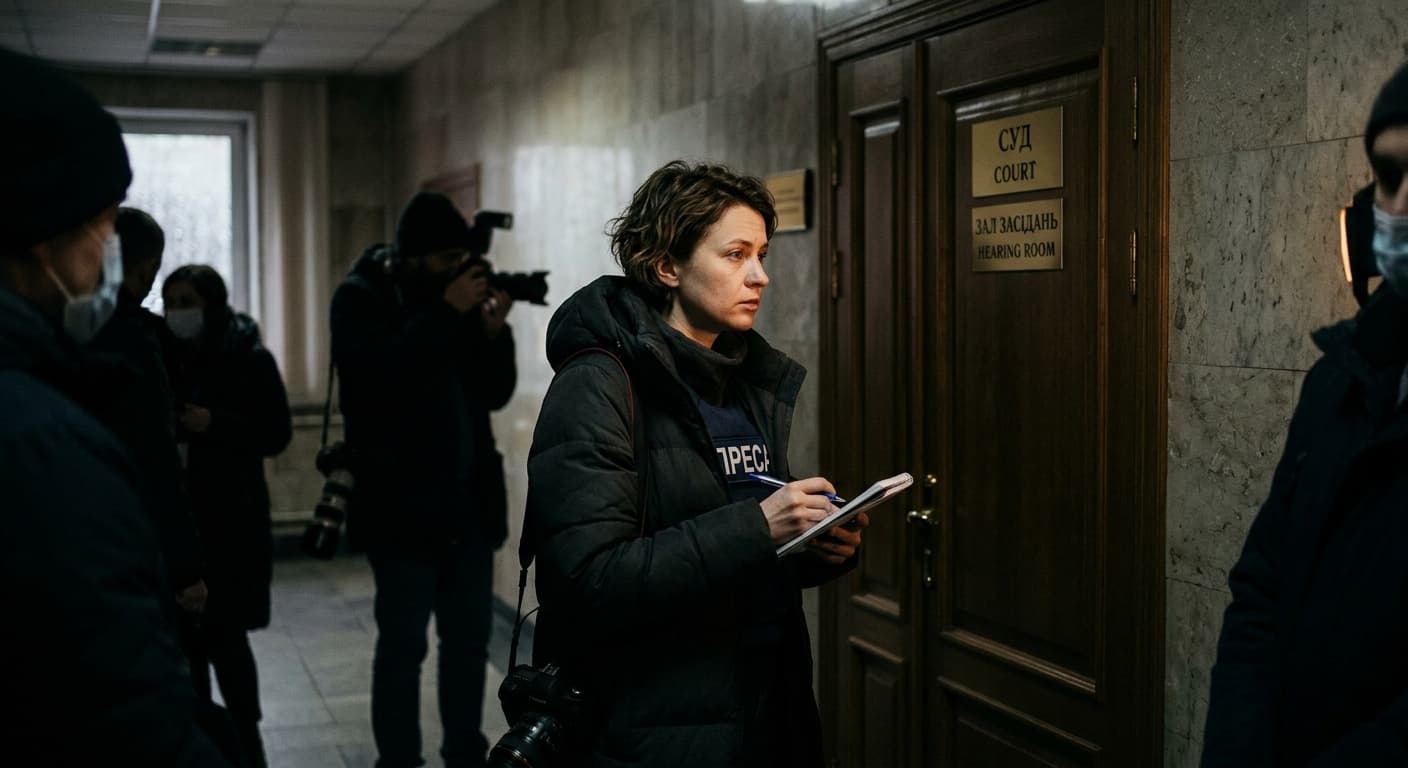
Kyiv court's pre-publication gag on Sukhachov exposé tests Ukraine's press-freedom pledge
A Pechersk District Court judge has barred two Ukrainian outlets from publishing an investigation into 143 properties tied to the SBI chief's brother — before any lawsuit was even filed.
On July 6, 2026, Judge Serhiy Vovk of Kyiv's Pechersk District Court issued a preliminary injunction barring the Anti-Corruption Action Centre (AntAC), the investigative outlet Slidstvo.Info and journalist Alina Stryzhak from publishing a report on 143 real-estate objects that reporters allege belong to Oleksandr Sukhachov, a Kharkiv businessman and brother of State Bureau of Investigation (SBI) Director Oleksiy Sukhachov. The order — reported by the Kyiv Independent on July 7 — was granted as a provisional measure before any statement of claim was lodged. It is, according to media-rights watchdog
ZMINA, the first documented case in post-2014 Ukraine in which a court has silenced an investigative report on a senior official's family in advance of publication and in advance of litigation. It arrives fifteen months before Ukraine's own EU-accession deadline to legislate against exactly this kind of abusive suit — a deadline the ruling appears designed to test.
The order, in the judge's own words
The injunction was granted at the request of Parkovy-2 LLC, a company that AntAC identifies as linked to Oleksandr Sukhachov. According to the ruling, published by AntAC and reproduced by Ukrainska Pravda, the plaintiff intends to file a lawsuit seeking to bar the two outlets not only from publishing but also from collecting information about the company or the SBI director's brother. The court accepted the applicant's argument that once "confidential information — including personal data and information constituting a trade secret — is published online, it can no longer be completely removed from the Internet."
Judge Vovk agreed that publication could cause the businessman "irreparable harm" and could disclose Parkovy-2's trade secrets. The ruling records that Oleksandr Sukhachov "did not consent" to the disclosure of information about the properties.
The scope is what alarms Ukrainian and European press-freedom lawyers. Olena Shcherban, AntAC's deputy executive director and counsel, told ZMINA that the order goes beyond a gag on publication and covers newsgathering itself.
"The court's ruling is manifestly unlawful and violates the fundamental rights of journalists and the public to gather and disseminate information of public interest that is publicly available about the country's highest-ranking officials. It is a direct violation of Article 10 of the European Convention on Human Rights, Ukraine's Law on Information, and Ukraine's Law on Media." — Olena Shcherban, Anti-Corruption Action Centre,
Kyiv Independent, July 7, 2026
Article 10 of the European Convention on Human Rights, to which Ukraine has been bound since 1997, protects the right "to receive and impart information and ideas without interference by public authority." Strasbourg case law has repeatedly held that prior restraints on the press require "the most careful scrutiny," particularly when the information concerns public officials.
Why 143 apartments in Kharkiv are a national story
Oleksiy Sukhachov has led the SBI since 2022. His appointment followed a competition that anti-corruption activists described as "fake and politicised," as reported by the Kyiv Independent. The bureau — created in 2016 to investigate crimes by senior officials, judges and law-enforcement personnel — has been accused for years of operating as a political tool of the Presidential Office; its Khmelnytsky branch was accused in 2022 by the Prosecutor General's Office of destroying secret case files immediately after Russia's invasion, including files linked to pro-Kremlin politicians.
Journalist Alina Stryzhak began her inquiry by cross-referencing public state registers. On June 24, 2026, AntAC and Slidstvo.Info sent formal comment requests to Sukhachov and to Parkovy-2 LLC about 143 apartments and office premises. Neither responded, ZMINA reports. Twelve days later, the injunction landed.
The judge is his own subplot. Serhiy Vovk sentenced Yuriy Lutsenko — opposition leader and later Ukraine's prosecutor general — to four years in prison in 2012 under President Viktor Yanukovych. The European Court of Human Rights subsequently ruled in Lutsenko v. Ukraine that the prosecution had been politically motivated. Judicial-watchdog Dejure has since documented Vovk unfreezing assets of a Russian-owned company and transferring a bribery case against Deputy Chief of Staff Oleh Tatarov away from the National Anti-Corruption Bureau (NABU). In October 2025, Vovk extended the detention of NABU detective Ruslan Mahamedrasulov in what anti-corruption activists describe as a political vendetta.
The pattern the injunction fits
The gag is not an outlier; it is a data point in a year-long campaign. The Warsaw-based OSW Centre for Eastern Studies documented in July 2025 that President Volodymyr Zelensky's Presidential Office had used the state apparatus to pressure independent institutions, culminating in a law that briefly stripped the operational independence of NABU and the Specialised Anti-Corruption Prosecutor's Office (SAPO). Street protests forced a partial reversal. But the campaign continued. In October 2025, OSW
reported that authorities were "seeking to prohibit the media from publishing any materials concerning ongoing corruption investigations."
Human Rights Watch, in a July 24, 2025 statement, warned that legislative amendments to expand the prosecutor general's authority over NABU and SAPO created "a significant loophole for removing politically sensitive cases" from independent oversight. The same month, the SBI — Sukhachov's bureau — searched the home of AntAC chairman Vitaliy Shabunin without a court warrant and served him with a notice of suspicion for alleged draft evasion and forgery. AntAC has rejected the charges as retaliation; Shabunin himself has publicly described the trajectory as the "construction of a corrupt authoritarianism," per the OSW analysis.
Freedom House's Freedom in the World 2026 report classifies Ukraine as "Partly Free" with a global freedom score of 51 out of 100 and a civil-liberties score of 29 out of 60. Its country entry, published February 2026, notes that "journalists continue to face intimidation, cyberattacks, and institutional pressure in the course of their work" — a rating that pre-dates the Sukhachov injunction. Reporters Without Borders'
2026 World Press Freedom Index, published April 30, 2026, found global press freedom at its lowest level since RSF began compiling the ranking in 2002.
The EU angle — and the deadline Kyiv is about to miss
The single most consequential fact about this ruling is not domestic. It is that Ukraine has committed, as part of its EU accession path, to legislate against precisely this category of lawsuit by 2027.
The European Union's Anti-SLAPP Directive — Directive (EU) 2024/1069, adopted April 11, 2024 — obliges member states to give courts the power to dismiss "manifestly unfounded" civil actions against journalists, NGOs and human-rights defenders at the earliest possible stage. Recital 1 identifies the directive's target as strategic lawsuits against public participation (SLAPPs) directed at persons who engage in public debate "on matters of public interest." The
Council of the EU statement accompanying its adoption specifies that courts must decide on early dismissal "in an accelerated manner" and may order abusive claimants to pay costs and damages.
Ukraine, as an EU candidate country, is bound to transpose the directive as part of Cluster 1 of the accession acquis. The European Commission's own 2025 enlargement report on Ukraine, published in autumn 2025, states plainly that Ukraine "is between having some and a moderate level of preparation regarding freedom of expression" and instructs Kyiv to "ensure the safety and independence of journalists" and to investigate "indirect forms of pressure against journalists and media outlets." AntAC argues the Vovk order "contradicts those commitments" — a legal framing that will now be tested in Brussels as well as in Kyiv's appellate courts.
The mechanism the injunction pioneers — pre-publication, ex parte, before any lawsuit is filed, with the plaintiff seeking a prospective ban on collecting information — is what EU Directive 2024/1069 Article 3 defines as an "abusive court proceeding": a claim whose "main purpose … is to prevent, restrict or penalise public participation."
Daria Kaleniuk, AntAC's executive director, framed the calculation in transactional terms. In comments reported by the Kyiv Independent, Kaleniuk said: "We believe the authorities are simply using the AntAC and Slidstvo.Info as a test case to see whether they can use this mechanism to prevent journalists from exposing corruption." If the appellate court upholds Vovk's order, every senior official's relative in Ukraine gains, in effect, a template.
Who benefits, who loses
The concrete beneficiary of the July 6 ruling is Parkovy-2 LLC and, by extension, the family of the SBI's director. The concrete losers are AntAC and Slidstvo.Info, which face fines and potential criminal liability for non-compliance, according to Kaleniuk. But the structural loser is Ukraine's negotiating position in Brussels.
The Centre for European Reform observed in a June 2025 analysis that Cluster 1 — the "fundamentals" package that covers rule of law, judiciary, anti-corruption and media freedom — "is the first cluster of issues to be opened in the accession negotiations, and the last to be closed, and progress on this cluster determines the pace of negotiations as a whole." A precedent in which a Ukrainian court silences journalists before publication, on behalf of a company linked to a senior official's brother, is precisely the kind of episode Cluster 1 assessments weigh.
The International Monetary Fund has already used its Extended Fund Facility — worth $15.6 billion over 2023–2027 — to force Kyiv to appoint a lawfully selected head of the Bureau of Economic Security in 2025 after the Cabinet of Ministers unlawfully refused, according to the CER. That precedent matters: financial conditionality is now the West's principal lever on rule-of-law backsliding in Ukraine, and the July 6 injunction adds a fresh entry to the ledger.
What to watch
- AntAC's appeal filing. The organisation has said it will appeal to the Kyiv Court of Appeal; the timing and reasoning of that ruling will determine whether the pre-publication mechanism becomes a template or a one-off.
- The lawsuit that has not yet been filed. Parkovy-2 LLC obtained a provisional order in anticipation of a claim it has not yet lodged. Under Ukrainian civil procedure, the applicant must now file the substantive case, or the injunction will lapse.
- The European Commission's next enlargement report. The Commission's annual enlargement package, expected autumn 2026, will assess Ukraine's Cluster 1 progress on freedom of expression and the independence of the judiciary. Council of Europe rapporteurs and the EU Delegation in Kyiv will be asked, formally, whether the Vovk order is compatible with Article 10 ECHR and Directive 2024/1069.
- Judge Vovk's docket. Vovk continues to sit on the Pechersk District Court despite two decades of criminal proceedings and Strasbourg findings against his rulings. The High Council of Justice has taken no action to remove him.
Human Rights Watch's January 2026 country report framed the underlying dynamic: the ongoing war has not caused Ukraine's rule-of-law backsliding, but it has provided the cover under which the Presidential Office has moved against the institutions — NABU, SAPO, and the independent press — that were built to investigate it. The Sukhachov injunction is the first known instance in which those institutional pressures have crossed into pre-publication prior restraint. The question the appellate court will now answer is whether it is also the last.
Discover more
US Politics
SNAP Food Assistance Faces Legal Challenges
In 2026, SNAP faces stricter eligibility rules and mounting legal challenges, threatening food assistance for the millions of Americans who rely on the program.
US Politics
Congress Targets AI Chatbot Access for Terror
The House passed the Generative AI Terrorism Risk Assessment Act, focusing on AI's role in terrorism and potential surveillance implications.
India
700 Activists Accuse PM Modi of MCC Breach
Over 700 activists allege PM Modi breached election code with a televised address attacking opposition parties just before state elections.

Economics
Fed's Amex AML order puts correspondent banking on notice
Federal Reserve's Amex AML order requires board-level controls and a 90-day plan; OCC fined the bank $350 million over enterprise-wide deficiencies.