Kremlin Expands Buffer Zone to Bryansk
Russia's defensive strategy shifts amid stalled offensive.
Model Diplomat7 min readEurasia
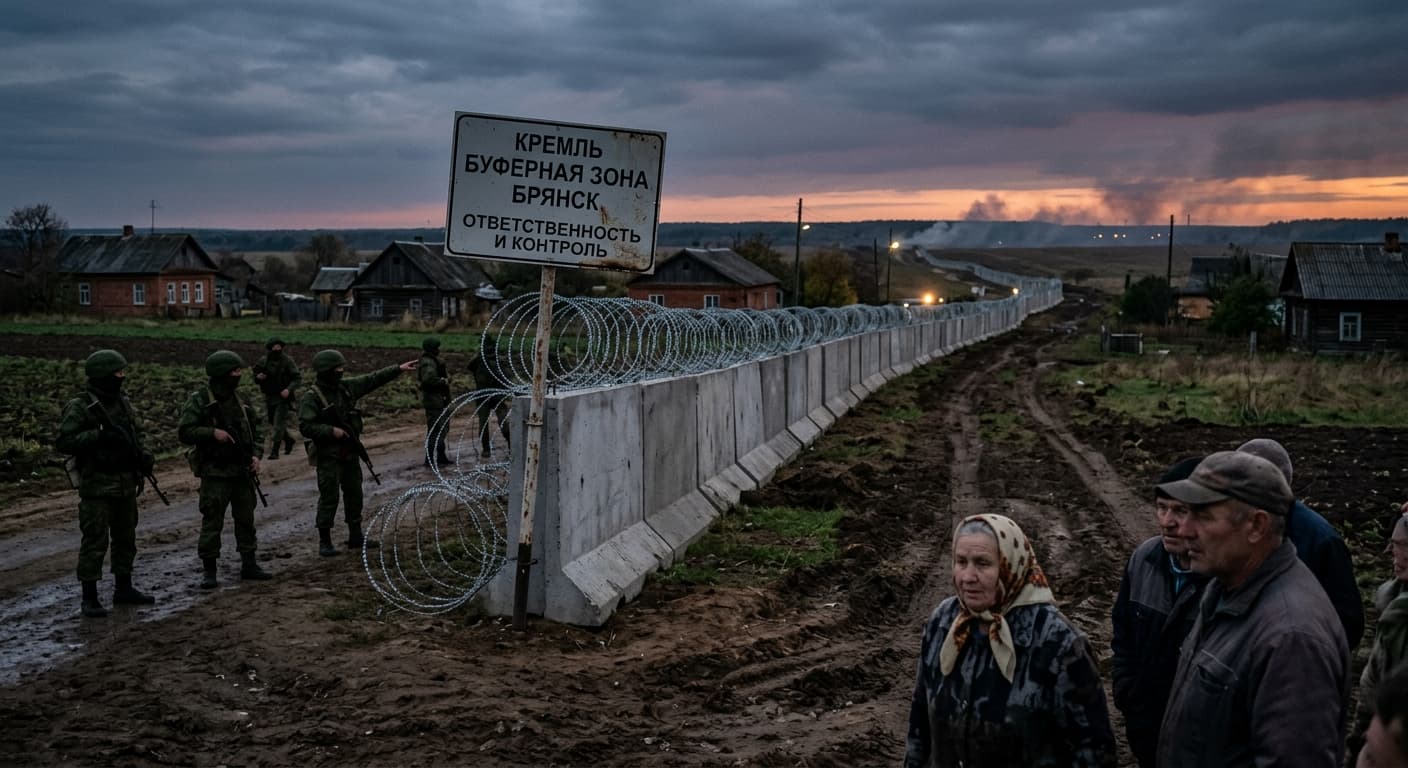
Kremlin extends buffer-zone doctrine to Bryansk as Sumy push stalls
Kremlin says work on the Bryansk buffer zone will continue after 103 drones were downed in 24 hours — signalling a defensive re-framing as Russia's summer offensive slows.
On July 7, 2026, Kremlin spokesman Dmitry Peskov told reporters that Russian forces will continue "planned, systematic work" to create a security buffer zone along the border of Bryansk Oblast, hours after acting Governor Egor Kovalchuk reported 103 Ukrainian drones downed over the region in 24 hours. The announcement matters because it quietly inverts the doctrine Vladimir Putin unveiled in April 2025: for the first time, the "buffer zone" language is being deployed to describe defence of a Russian region rather than the seizure of Ukrainian territory — a rhetorical shift that reflects a stalled offensive in Sumy, a battlefield stalemate around Kostiantynivka, and Moscow's need to reframe a war it can no longer sell as an advance.
Peskov's remarks came the same week Moscow claimed the capture of the eastern Donetsk hub of Kostiantynivka, a claim Ukraine's General Staff publicly disputed, and the same week the Institute for the Study of War (ISW) estimated Russia's net territorial gains for the first six months of 2026 at just 97 square kilometres — against Putin's public claim of 3,000,
according to Al Jazeera.
What the Kremlin actually said
The buffer-zone framing has now been applied to four discrete geographies in eighteen months. In April 2025, Putin ordered the creation of "security buffer zones" along Ukraine's Kharkiv, Sumy and Chernihiv borders — a project the Kremlin website described on July 3, 2026 as "the expansion of the security belt in the border areas of Sumy and Kharkiv oblasts of Ukraine." On July 3, Peskov told journalists the zone in Sumy and Kharkiv was being built "planomerno" — methodically, "to the depth Russia requires." Four days later, in the readout picked up by
Bryansk newsroom Newsbryansk.ru, the same language was extended to Bryansk itself.
The distinction is not cosmetic. Kharkiv, Sumy and Chernihiv are Ukrainian oblasts where the buffer zone is built by advancing Russian troops. Bryansk is a Russian oblast where, as regional authorities confirmed on July 7, civilians are told to shelter from Ukrainian missile alerts. Peskov's phrasing collapses the two into a single doctrine of border "sanitation" — offensive when Moscow crosses into Ukraine, defensive when Kyiv strikes back.
Why the framing shifted now
Three data points explain the pivot.
First, the summer offensive in Sumy has failed on its own terms. In late May 2025, Zelensky said Russia had massed some 50,000 of its "largest, strongest" troops on the Sumy axis to build a 10-kilometre buffer. By late June 2026, Ukraine's army chief Oleksandr Syrskyi declared the advance "choked off," and the
BBC's frontline analysis found the Russian penetration had stalled at 10–12 km — barely inside artillery range of Sumy city itself. Poland's Centre for Eastern Studies (OSW) reached the same conclusion in its
June 9, 2026 dispatch, which noted "Russian forces continued their offensive on most major fronts but made little progress."
Second, the arithmetic of the war has turned. Ukraine's General Staff estimates 40,000 Russian soldiers were killed in June 2026 alone — a figure reported by Al Jazeera and consistent with a slowdown so pronounced that DeepState, Ukraine's principal frontline tracker,
measured May's Russian gains at 14 square kilometres. At that pace, Russia would need roughly 14 years to seize the remaining fifth of Donetsk it does not yet occupy.
Third, the war has come to Bryansk. Ukrainian long-range drones have struck the region in waves through 2026, killing civilians in Suzemka on June 12, triggering
the Kronstadt–St Petersburg strike wave on July 4 that also killed one person in Bryansk, and forcing a public missile-alert protocol on July 7. Domestically, Peskov must offer Bryansk residents something. The "buffer zone" is that something.
The doctrine inside the doctrine
The buffer zone is the semantic architecture Moscow is building around a peace-talks endgame it does not yet control. In an address confirmed on Kremlin.ru on July 3, 2026, Putin told his Objedinennaya Gruppirovka commanders that the "Sever" group would "continue the expansion of the security belt in the border areas of Sumy and Kharkiv." That is the operational order. The political overlay came days later, when Putin
rejected two Ukrainian ceasefire proposals — one covering long-range strikes, one covering Sumy, Kharkiv, Mykolaiv and Dnipropetrovsk — precisely because those are the theatres where Russia is losing the argument militarily but can still redraw it rhetorically.
The buffer zone thus functions on three levels. It is a battlefield objective (advance 10 km inside Ukraine); a diplomatic anchor (create the frozen strip that any future settlement must legitimise); and now, with the Bryansk extension, a domestic communications frame (explain why Russian border cities are burning without conceding failure).
Ukraine has read the play. On September 6, 2025, President Zelensky publicly rejected European proposals for a 40-kilometre buffer zone, telling reporters that "only those who do not understand the technological state of today's war propose a buffer zone" — the drone war, he argued, has already created a de facto "grey zone" 10 kilometres either side of the front. Yet by late 2025, Kyiv had moved toward accepting
a demilitarised-zone framework in principle, and by early 2026
Zelensky was discussing "special economic zones" in Donetsk under US pressure. The Kremlin's Bryansk framing lands into that softening ground.
Who benefits, who loses
The immediate beneficiary is Putin's political economy. With a Duma election scheduled for September 18–20, 2026, and analysts telling Al Jazeera that partial mobilisation is being warmed up for after the vote, the Kremlin needs a story that turns 40,000 dead in a single month into "systematic work" on a defensive belt. Peskov delivered it.
The loser, at least on paper, is Ukraine's negotiating position on the northern border. Every additional kilometre of "buffer" — whether taken in Sumy or claimed rhetorically around Bryansk — establishes a precedent that any settlement should include a strip of demilitarised Ukrainian territory. That is the ISW's read: "Any success in Sumy could be used by Putin as leverage and justification for new territorial demands as part of future peace negotiations," the think tank warned in a BBC analysis.
The quieter loser is Belarus. President Zelensky's June 19, 2026 threat to strike Russian drone-relay stations in Belarus if Alyaksandr Lukashenka did not dismantle them within a week — a threat delivered after a drone strike on a Belarusian children's football team's coach in Bryansk Oblast on June 17 — shows how the buffer-zone geometry drags Minsk closer to the war. If Moscow's next move is to demand a buffer zone that touches Chernihiv, it will demand it partly from Belarusian territory.
What the primary documents show
The primary Russian record is more revealing than the diplomatic overlay. Putin's July 3 briefing at the Joint Group of Forces command post — published on Kremlin.ru — lays out the doctrine in unambiguous language:
"The 'Sever' Group of Forces, advancing simultaneously on several axes, continues the expansion of the security belt in the border areas of Sumy and Kharkiv oblasts of Ukraine. Successful progress is being made in the direction of Sumy and in the area of Bilyi Kolodyaz in Kharkiv Oblast. In June, eight settlements were brought under Russian control."
Eight villages in a month, at a cost consistent with Ukraine's 40,000-killed estimate, does not describe a breakthrough. It describes a war being converted into cartography. That is the doctrine the July 7 Bryansk statement completes.
What to watch
- September 18–20, 2026 — Russian State Duma elections. Kremlin insiders quoted by Al Jazeera indicate a partial mobilisation announcement is
being prepared for immediately after the vote. Any expansion of the buffer-zone doctrine to include a Chernihiv or northern Kharkiv push will telegraph the mobilisation scale.
- Witkoff–Kushner Moscow visit — Kremlin aide Yuri Ushakov's
July 4, 2026 readout of the Putin–Trump call confirmed the two US envoys will travel to Moscow "at a convenient time." Whether the US delegation accepts the buffer zone as a legitimate negotiating parameter is the single most consequential unknown in the peace track.
- Kostiantynivka status — Ukraine's 19th Corps still holds parts of the city that Moscow declared captured on July 4. If Kyiv confirms a full withdrawal within four to six weeks, the Kremlin will fold Kostiantynivka into a new "buffer" narrative covering the Kramatorsk–Sloviansk agglomeration, closing the eastern Donbas objective in language rather than in fact.
The Bottom Line
The Kremlin's extension of buffer-zone language to Bryansk is not a battlefield announcement — it is a diplomatic and domestic pre-positioning move for a war Russia is no longer winning at the pace it advertised. By reframing Ukrainian strikes on Russian soil and stalled Russian advances on Ukrainian soil under a single doctrine of "border sanitation," Moscow is building the semantic infrastructure for whatever partial deal Washington eventually forces onto the table. If the next US–Russia round accepts "buffer zone" as a category of settlement, Peskov's July 7 sentence will have been the paragraph that made it possible.
Discover more
India
700 Activists Accuse PM Modi of MCC Breach
Over 700 activists allege PM Modi breached election code with a televised address attacking opposition parties just before state elections.

US Politics
SNAP Food Assistance Faces Legal Challenges
In 2026, SNAP faces stricter eligibility rules and mounting legal challenges, threatening food assistance for the millions of Americans who rely on the program.

US Politics
White House Pressures Congress for Crypto Leg
The Trump administration's push for the CLARITY Act aims to reshape crypto regulation, impacting trillions in market value and the Trump family's wealth.

Conflict & Security
Drone Warfare Killing Aid Workers at Unprec
Over 1,000 humanitarian workers killed in three years as cheap armed drones collapse legal protections. Gaza, Sudan, Ukraine, and DRC see deliberate targeting of aid convoys and hospitals with zero prosecutions.