Kremlin Expands Buffer Zone to Bryansk
Russia formalizes new front in Ukraine conflict
Model Diplomat9 min readEurope
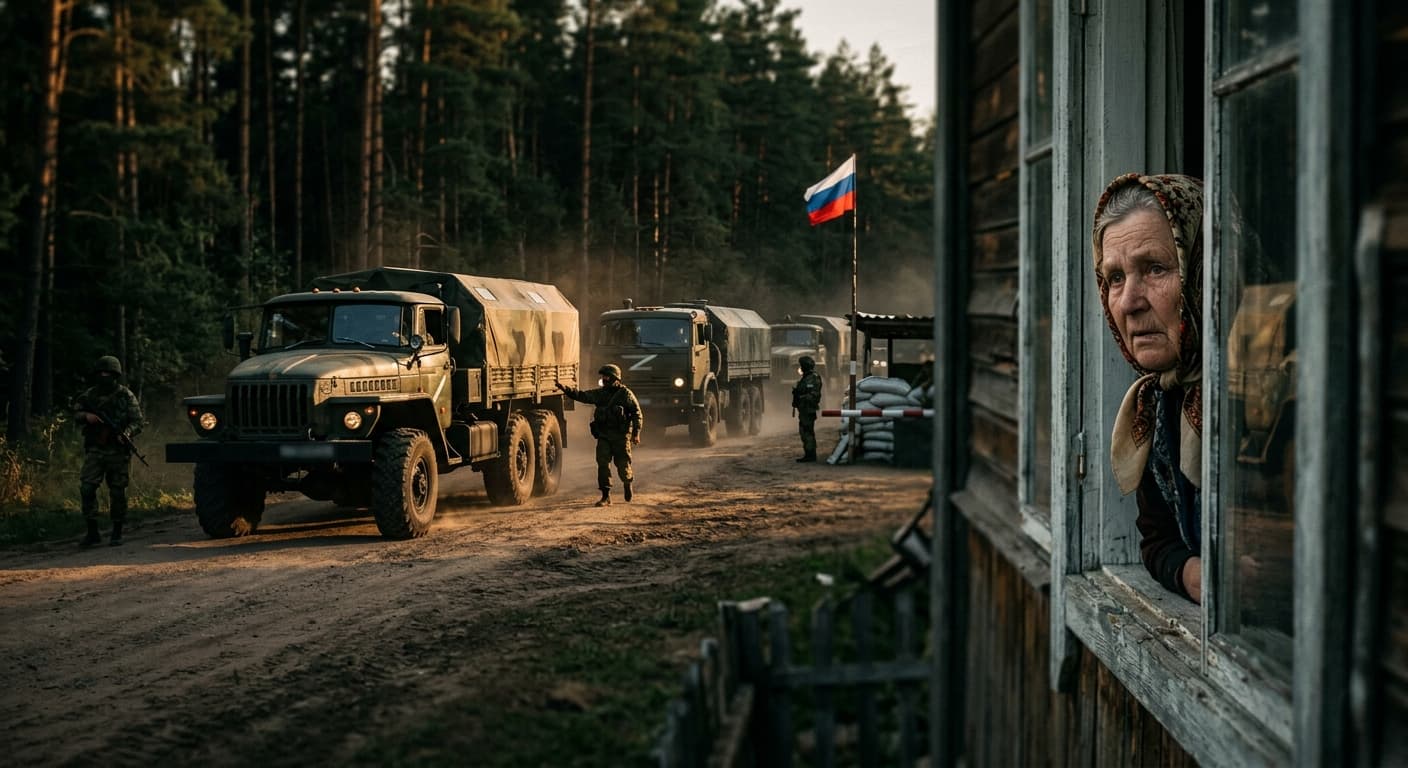
Kremlin extends "buffer zone" doctrine to Bryansk, closing Kyiv's ceasefire off-ramp
Moscow confirmed on July 7, 2026 that its buffer-zone campaign will now cover Bryansk Oblast — a move that formalises a fourth cross-border axis and pre-empts Ukraine's proposed northern ceasefire.
Dmitry Peskov's confirmation on July 7, 2026 that Russia will keep building a "buffer" or "security" zone along the Bryansk Oblast frontier is not a defensive housekeeping note — it is a doctrinal escalation. By stretching the same formula Moscow uses to justify offensives in Sumy, Kharkiv and Dnipropetrovsk to the Bryansk-Chernihiv frontier, the Kremlin has quietly moved the pre-negotiation goalposts from four Ukrainian oblasts to potentially six, and killed Volodymyr Zelensky's June proposal for a partial ceasefire across the northern regions. The immediate loser is Chernihiv; the immediate winner is Vladimir Putin's negotiating position.
What Peskov actually said — and what changed
Peskov told reporters the "work of our Armed Forces on the creation of the security zone, or buffer zone" is continuing and will continue, framing it as steady-state activity to shield border residents from Ukrainian drone and artillery fire. The Bryansk-focused wording is new. Since April 2025, when Putin first announced "security buffer zones" to shield Belgorod, Kursk and Bryansk oblasts, Moscow's public map of the zone had concentrated on advances into Sumy, Kharkiv, and — from June 2025 — Dnipropetrovsk. Kremlin.ru's own transcript of Putin's border-regions meeting listed Bryansk alongside Belgorod and Kursk as recipients of federal support packages, not as launch-pads, with Bryansk described as "stable" and averaging "80–90 shellings per week" (kremlin.ru).
The July 7 statement changes that framing. It publicly attaches Bryansk — which borders Ukraine's Chernihiv and Sumy oblasts — to the offensive doctrine, and it comes days after Peskov reiterated that "planned" work in Sumy and Kharkiv would continue until the zone reaches "the volume necessary for Russia" (Al Jazeera).
The context is intense cross-border fire. Bryansk's acting governor Egor Kovalchuk reported that Russian air defences shot down 103 Ukrainian drones over the oblast in a single 24-hour period on July 7, 2026, with a missile-danger alert triggered the same day (Лента новостей Брянска). On July 3, 2026, a Bryansk villager was killed in a Ukrainian drone strike,
Al Jazeera reported, part of a broader Ukrainian "logistics lockdown" campaign that has struck refineries, ammunition depots and the Avtovaz complex 800 km from the border. Peskov cited exactly this pattern to argue the zone must expand.
The negotiating logic: turning defence into annexation
The Kremlin's public rationale is protection. The operative logic, in Peskov's own earlier framing, is offensive. Asked in June 2024 whether the "sanitary zone" had defined borders, Peskov told TASS: "It depends on what kinds of weapons Ukraine has. The higher the tactical-technical characteristics of Ukrainian weapons, the greater this distance must be" (TASS). That elastic definition — a zone sized by enemy capability, not by geography — is what makes the Bryansk extension consequential.
By that logic, the arrival of longer-range Western systems in Ukraine automatically enlarges Russia's territorial claim. Igor Korotchenko, editor of Russia's National Defence magazine, has publicly argued the zone should stretch "70 to 120 kilometres deep inside Ukraine," per Al Jazeera. Deputy Security Council chairman Dmitry Medvedev has gone further, posting a Telegram map in mid-2025 colouring almost all of Ukraine as a potential "buffer" if Western military aid continued. Ukraine's military intelligence chief Kyrylo Budanov told Bloomberg in July 2025 that Russian troops had been tasked with a 10-km buffer inside Dnipropetrovsk Oblast — a benchmark Peskov's Bryansk statement now implicitly stretches westward, according to
Al Jazeera.
Bryansk's inclusion nudges Chernihiv into the same category — a region the Kremlin has not annexed under its 2022 constitutional amendments, has not previously claimed, and which Ukraine's chief of the general staff Oleksandr Syrskyi has called a "realistic" axis for a new Russian thrust from Bryansk territory, per BBC Ukrainian. Syrskyi told the same interview that terrain — swamps, few bridges, dense forest — makes a heavy armoured push unlikely, but leaves the door open for diversionary and drone-relay operations. The doctrinal claim is now running ahead of the tactical capability, which is precisely what makes it a negotiating instrument rather than a battlefield plan.
Russia's buffer-zone doctrine at a glance
| Ukrainian oblast targeted | Russian border oblast | Claimed depth (2026) | Status |
|---|---|---|---|
| Sumy | Kursk / Bryansk | 8–12 km | Advance halted, per Gen. Syrskyi (June 2025) |
| Kharkiv (Vovchansk) | Belgorod | Grey zone up to Vovcha River | Russia expanding control (OSW, April 2026) |
| Chernihiv | Bryansk | Not yet breached | Newly added to doctrine, July 7, 2026 |
| Dnipropetrovsk | (via Donetsk) | Up to 10 km | Small footholds; disputed by Kyiv |
| Mykolaiv | (via Kherson) | Not established | Included in Putin's rhetorical demands |
Sources: Kremlin briefings; BBC; OSW; Al Jazeera; ISW — compiled July 2026.
Why the timing matters: Zelensky's ceasefire proposal is the target
The Bryansk extension arrives exactly as Kyiv is testing a partial-truce architecture. According to Al Jazeera, Putin publicly acknowledged on July 3, 2026 that he had rejected two Ukrainian proposals — one for a ceasefire on long-range strikes, another for a ceasefire covering the northern oblasts of Sumy and Kharkiv and the southern regions of Mykolaiv and Dnipropetrovsk. Bryansk borders both Sumy and Chernihiv. Adding it to the buffer doctrine gives the Kremlin a rhetorical veto over any northern-freeze proposal Kyiv or Washington might revive, because Russian officials can now describe the same territory Ukraine wants frozen as territory Russia intends to occupy.
Zelensky himself has rejected European buffer-zone proposals, telling reporters that "only those who do not understand the technological state of today's war propose a buffer zone" and calling the drone-saturated no-man's-land a "dead zone" that already exists (BBC). His counter-offer — that if Russia wants distance, it can "retreat deep into the temporarily occupied territories of Ukraine" — was designed to invert Moscow's framing. Peskov's Bryansk extension re-inverts it: if every square kilometre of Ukrainian border land is Russia's protective concern, any concession looks like accepting the doctrine.
There is also a domestic political layer. Bryansk has been under sustained attack throughout 2026, including what the BBC called Ukraine's largest long-range operation of the war, which struck a refinery, ammunition depots and a chemical plant said to produce gunpowder and explosives up to 1,100 km from the border. Naming Bryansk explicitly gives the Kremlin a public rationale for continued operations that Russian regional constituencies — whose insurance losses the
Bank of Russia has instructed insurers to cover under personal and property policies — can accept without demanding stronger air defence they clearly are not receiving.
Bryansk under fire: Acting governor Egor Kovalchuk reported 103 Ukrainian drones downed over the oblast in 24 hours on July 7, 2026 — the operational tempo the Kremlin now cites to justify moving the war further into Ukraine.
The military reality: a distraction dressed as strategy
The battlefield does not straightforwardly support Moscow's expanding rhetoric. In May 2026, Russia posted its smallest monthly territorial gain in three years — DeepState estimated just 14 km² net in Russia's favour, while the US Institute for the Study of War tracked a Ukrainian net gain of over 250 km², according to OSW's day-1560 analysis. Ukrainian estimates cited by
Al Jazeera put Russian personnel losses in June 2026 alone at roughly 40,000 killed. Ukraine's commander-in-chief Oleksandr Syrskyi reported in July 2025 that Ukrainian forces had "choked off" the Russian summer offensive in Sumy after Russian troops penetrated only 8–12 km, per
BBC News.
Retired Ukrainian colonel Serhiy Grabskiy calls the northern axis a "zone of distraction" — a way to force Kyiv to spread reserves along the 1,200-km front while the real weight of Russia's offensive presses Pokrovsk and Kostyantynivka in Donetsk, where 111,000 Russian troops are concentrated, per BBC News. OSW's April 2026 assessment noted Russia had also opened a third border bridgehead in Sumy Oblast around Myropilske, quietly widening the "grey zone" without a headline breakthrough (
OSW). Extending the doctrine to Bryansk fits the same pattern: it obliges Ukraine to reinforce Chernihiv, where fortifications are thinner, without requiring Russia to commit fresh manoeuvre units it does not have.
The historical parallel is the August 2024 Kursk incursion. Ukraine's surprise cross-border seizure of Kursk territory embarrassed Moscow and gave Putin the political cover to reframe the war as territorial defence rather than annexationist offence. The Kremlin's own transcripts show that Kursk incursion prompting the creation of an operational headquarters, mass evacuation of 152,566 residents and, ultimately, a doctrinal shift toward "buffer zones" on Ukrainian soil (kremlin.ru). Two years on, the same trauma is being invoked to justify seizing yet another region — even as Russia's territorial gains slow to a crawl.
ISW analysts have argued for over a year that Russia's buffer talk functions primarily as leverage. As the BBC summarised the think tank's June 2025 assessment, "any success in Sumy could be used by Putin as leverage and justification for new territorial demands as part of future peace negotiations" (BBC News). Bryansk is now doing the same job in reverse: attacks on Russian territory become justification for further seizures of Ukrainian territory.
The primary document: Peskov's evolving formula
The clearest way to read the Bryansk statement is against Peskov's own record. In June 2024 he told TASS the zone's size depends on Ukrainian weapons capability. In June 2025, standing next to Putin at the St Petersburg International Economic Forum, he framed the zone as a threatened response to continuing shelling. By July 3, 2026, per novosti.ru, the same formula covered Kharkiv and Sumy "as necessary for Russia." The July 7 line extends the umbrella to Bryansk without adding a single kilometre of clarity about where the zone ends.
That ambiguity is the point. Putin has said Russia does "not have the goal of capturing Sumy, but I don't rule it out," per BBC News. Chief of the General Staff Valery Gerasimov reportedly received orders in late 2025 to expand the buffer zone further, according to Putin's New Year's Eve address recounted by
Al Jazeera. Bryansk's inclusion completes the geographic ring: every Russian oblast that borders northern and eastern Ukraine now has an official Kremlin justification for an adjacent Ukrainian buffer.
German foreign minister Johann Wadephul's July 7, 2026 comment that "the war has entered a phase where Ukraine can also deliver serious strikes against Russia" — cited by Лента новостей Брянска — is the mirror image the Kremlin is now weaponising. To Russian domestic audiences, Peskov's implicit message is: the further Ukrainian weapons reach, the deeper Russia's zone must go. To Western audiences, the same statement functions as a warning that any peace deal must accept Russian territorial control well beyond the four annexed oblasts of Luhansk, Donetsk, Zaporizhzhia and Kherson.
What to watch
- Chernihiv fortification tempo. Ukraine's response to being named — even indirectly — as the next buffer target will show in reserve movements from Donbas. Syrskyi has already publicly acknowledged the Bryansk-Chernihiv axis as "realistic." Any new brigade rotation into Chernihiv will confirm Kyiv reads Peskov the same way.
- Next Istanbul round. Russian and Ukrainian delegations have used Istanbul three times in 2025–26 without breakthrough on ceasefire terms — the last round in July 2025 lasted 40 minutes and produced only a further prisoner exchange of roughly 250 personnel per side (
Al Jazeera). Watch whether Moscow's next negotiating paper lists Chernihiv alongside Sumy and Kharkiv as "security zone" territory — the formal doctrinal marker.
- Trump-Putin cadence. Peskov reiterated on July 3, 2026 that Moscow "remains open" to US mediation. The Bryansk extension raises the price of any US-brokered freeze by widening the map of contested "buffer" territory before talks begin.
- September 1 threshold. Kremlin transcripts show internal preparations for evacuation and schooling arrangements in Bryansk, Belgorod and Kursk ahead of the school year (
kremlin.ru). A large population movement out of Bryansk border rayons this autumn would signal Moscow expects intensified fighting on that axis, not de-escalation.
The Bottom Line
The bottom line: Moscow's July 7 confirmation is not about Bryansk's safety — it is about pricing Ukraine's northern regions into any future settlement. By extending the buffer-zone doctrine to a fourth Russian oblast, the Kremlin has quietly added Chernihiv to the list of Ukrainian territories it now claims a security interest in, and has closed the door on Zelensky's proposed partial ceasefire before Washington can pick it up. The battlefield may not follow the rhetoric — but the negotiating map already has.
Discover more

US Politics
SNAP Food Assistance Faces Legal Challenges
In 2026, SNAP faces stricter eligibility rules and mounting legal challenges, threatening food assistance for the millions of Americans who rely on the program.
India
700 Activists Accuse PM Modi of MCC Breach
Over 700 activists allege PM Modi breached election code with a televised address attacking opposition parties just before state elections.

US Politics
White House Pressures Congress for Crypto Leg
The Trump administration's push for the CLARITY Act aims to reshape crypto regulation, impacting trillions in market value and the Trump family's wealth.

Conflict & Security
Drone Warfare Killing Aid Workers at Unprec
Over 1,000 humanitarian workers killed in three years as cheap armed drones collapse legal protections. Gaza, Sudan, Ukraine, and DRC see deliberate targeting of aid convoys and hospitals with zero prosecutions.