Kosovo's LVV Claims Votes but Faces Crisis
LVV insists it can govern but struggles to elect a president.
Model Diplomat8 min readEurope
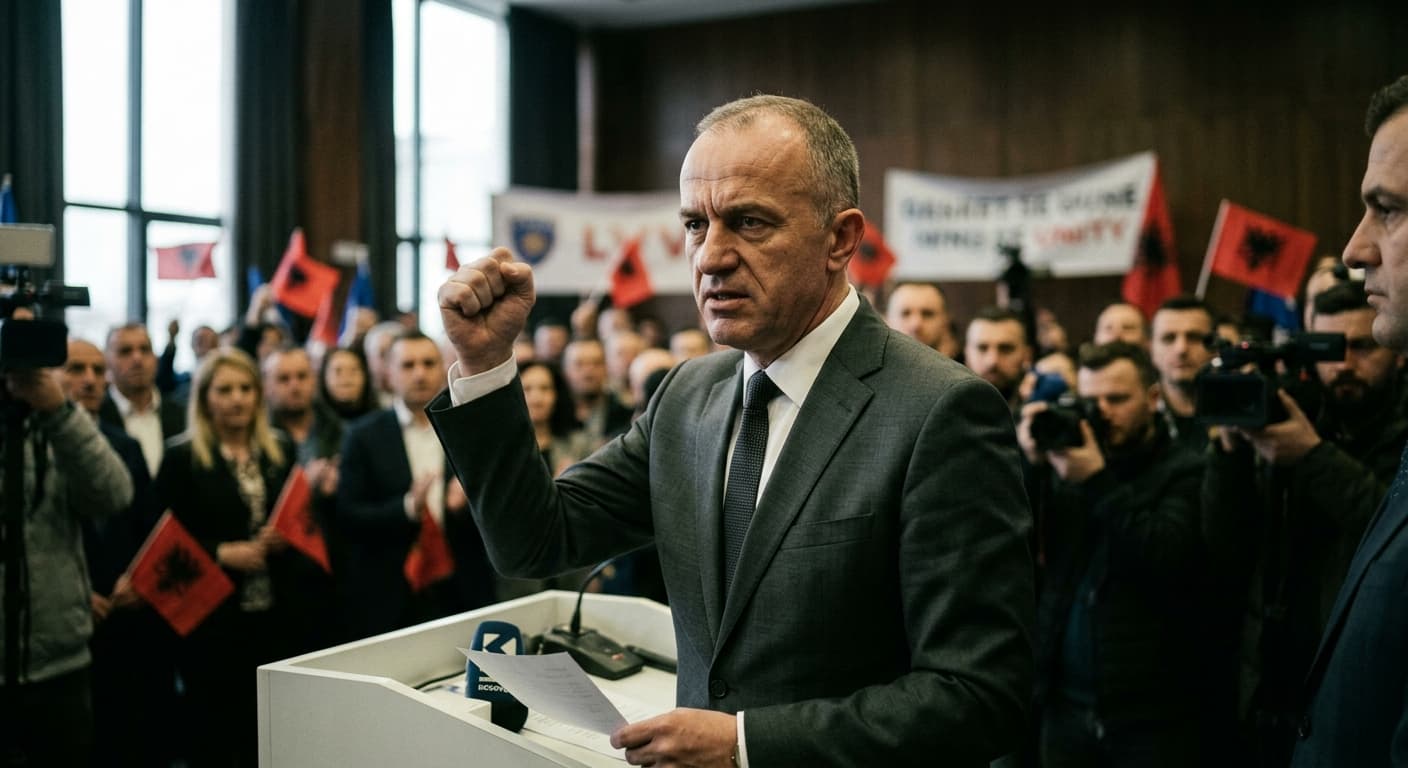
LVV Says It Has the Votes to Govern — but Not to End Kosovo's Crisis
Vetëvendosje claims the 61 votes for a fourth Kurti cabinet after the June 7, 2026 snap election, but still needs opposition MPs to elect a president — or Kosovo faces a fourth vote.
Kosovo's Central Election Commission certified the results of the June 7, 2026 snap parliamentary election on July 6, 2026, confirming Prime Minister Albin Kurti's Lëvizja Vetëvendosje (LVV) as the largest force with 47.13% and 53 of 120 seats — enough, LVV insists, to invest a new government, but eight short of the 80-MP quorum needed to elect a head of state. That gap is the entire story: LVV can form a cabinet without the opposition, but cannot end the constitutional loop that has forced three elections in 18 months without conscripting the very rivals it has spent a year refusing to bargain with. The angle that matters for the region is narrower and harsher — Pristina's arithmetic now hands the Democratic Party of Kosovo (PDK) and the Democratic League of Kosovo (LDK) a veto over EU accession money, defence-force expansion and the Belgrade–Pristina dialogue, at a moment when the EU has already suspended roughly €96 million in growth-plan disbursements.
Speaking to Radio Free Europe after the certification, LVV parliamentary figure Arbërie Nagavci framed the party's opening position, as reported by CNA: "As for the Government, we have the necessary votes. Therefore, immediately after the constitution of the Assembly, without wasting time, we must proceed" — and only then, she added, seek a presidential consensus.
The nut of it: this election was called because parliament could not elect a president in April. The June 7 vote returned an even weaker LVV plurality. Nothing about the maths has changed. Everything about the leverage has.
The arithmetic Kurti cannot solve alone
LVV's 53 seats, according to final CEC figures cited by BBC News in Serbian, represent a loss of four seats compared with the December 2025 result of 57, and an eight-point drop in vote share from 51.1% to 47.13%. PDK finished second with 19.4% and 22 seats. LDK, running with former president Vjosa Osmani as its presidential candidate, took 16.7% and 18 seats. The AAK–NISMA coalition holds seven; the Belgrade-backed Serb List holds nine of the 10 seats reserved for the Serb community, with 11 further seats going to smaller non-Serb minorities.
To invest a government under Kosovo's Constitution, LVV needs a simple majority of 61. With most non-Serb minority MPs likely to back Kurti — as they did in February 2026 when parliament approved his third cabinet in a
66–49 vote, according to Al Jazeera — LVV has a plausible path to 61–62 seats and no more. That is the ceiling of a Kurti-only majority.
For the presidency the number is different, and non-negotiable. Article 86 of the Constitution requires the presence of two-thirds of deputies — 80 — in the first two rounds of voting. On the arithmetic, LVV plus friendly minorities tops out roughly 18 seats below the quorum. Only the PDK bench, the LDK bench, or some combination of the two can supply the missing bodies. The opposition demonstrated in April 2026 that it will use that leverage: parliament failed to elect a president by the 28 April deadline set by the Constitutional Court, the Warsaw-based OSW Centre for Eastern Studies reported, because the opposition boycotted the session and denied the quorum. Dissolution followed automatically.
Why "consensus" is a euphemism for concessions
LVV's public offer — form the government first, negotiate the presidency after — is precisely the sequence the opposition has already rejected once. In April, according to OSW, Kurti made a series of overtures during the extra weeks the Constitutional Court granted: an offer to include opposition parties in government, a compromise slate, and finally a nonpartisan candidate — a doctor heading a foundation for 1990s persecution victims. PDK and LDK refused to attend the vote and put forward no candidate of their own.
Eugen Cakolli of the Kosovo Democratic Institute, one of the country's more measured election monitors, told KOHA.net that the third week of July is the optimal window for calling the Assembly's constitutive session, and that "the end of September could be the constitutional deadline" for a valid presidential election. Miss it, and the country is dragged toward a fourth parliamentary election it can neither afford politically nor administratively.
The opposition understands the arithmetic. Acting Trade Minister Mimoza Kusari-Lila, a senior LVV figure, told domestic media — as reported by Albeu — that "difficult talks lie ahead," language that in Pristina translates as: we will pay a price. LDK is the pivotal actor. It gained three seats on June 7, running Osmani, whom Kurti pointedly refused to endorse for a second term. OSW's June 11 assessment concludes bluntly that LDK "appears to be [Kurti's] only viable coalition partner," but that personal tensions between Kurti and Osmani "are likely to complicate coalition talks." The price of LDK cooperation on the presidency is either Osmani herself, a mutually acceptable non-LVV candidate, or LDK seats around the cabinet table.
What Brussels is paying attention to
The regional implication is not that Kosovo is unstable — the state has continued to function. It is that Kosovo is unable to legislate. Not a single law was passed in 2025, according to OSW; the Speaker of the Assembly was elected on the 58th attempt. That paralysis has a direct price attached to it, and it is measured in euros.
Under Regulation (EU) 2024/1449, which established the Reform and Growth Facility for the Western Balkans, Kosovo is a designated beneficiary of a €6 billion envelope disbursed twice-yearly against reform milestones. The
European Parliamentary Research Service briefing prepared for the June 2026 plenary confirms that the Kosovo Assembly ratified the framework agreement on 13 February 2026, unlocking initial access. But the second tranche — roughly €96 million — is conditional on adopting 13 reforms that Kosovo's parliament, dissolved on 28 April, did not pass. The EPRS note describes the reporting period as one of "divisive domestic politics… followed by a post-election political gridlock due to political parties' inability and lack of political will to find a way towards the formation of institutions." The EU is describing Kosovo's politics in the same clinical language it usually reserves for Bosnia.
European Council President António Costa visited Pristina days before the June 7 vote and, according to Al Jazeera, "urged Kosovo… to end the political impasse and unite over the goal of EU integration." Enlargement Commissioner Marta Kos and EU member-state embassies in Pristina have delivered the same message. That is unusual explicitness for Brussels regarding a candidate country. It reflects both the size of the frozen funding and the wider anxiety that Balkan drift — Serbia's tilt, Republika Srpska's secessionist rhetoric, Kosovo's institutional stall — is compounding at exactly the moment the EU is trying to close ranks against Russian influence.
The regional stakes: dialogue on ice, army on the agenda
Two second-order effects are already visible.
First, the Belgrade–Pristina dialogue has effectively stopped. The European Commission's 2025 Kosovo report notes that "domestic political preoccupations on both sides have hindered steps towards implementing the 2023 Agreement on the Path to Normalisation." Peter Sørensen, the EU Special Representative for the dialogue appointed on 27 January 2025, has no functioning counterpart government in Pristina to negotiate with in caretaker mode, and Serbian officials have used that vacuum to argue that no meaningful concessions are possible until Kosovo produces a stable executive. Constructive engagement with Belgrade is itself a payment condition of the Reform and Growth Facility.
Second, defence policy is being made in the shadow of the crisis. In his February 2026 policy address, Kurti made social and defence spending the twin pillars of his third-term programme, and the transformation of the Kosovo Security Force into a full army has continued through the caretaker period. Belgrade has already criticised the trajectory. A weaker LVV plurality, combined with a presidential race that requires opposition votes, means that further defence-force legislation — hitherto an LVV signature — now runs through PDK and LDK. That is a leverage transfer few observers have priced in.
The Osmani question, and the trap
The awkward fact hanging over every coalition scenario is Vjosa Osmani. She served as president from 2020 to April 2026, entered the June 7 campaign on LDK's list, and remains, on LDK's public position, its candidate for the presidency. Kurti explicitly refused to back her re-election after December 2025 — the trigger for the personal breakdown that drove the April deadlock. If LVV now needs LDK to elect any president at all, the shortest road to 80 votes runs through the candidate Kurti has personally rejected. The alternative is a jointly agreed civil-society figure of the sort LVV proposed and the opposition ignored in April.
There is one further wrinkle. BBC News in Serbian reports that a hypothetical LVV–PDK understanding, combined with non-Serb minority support, would produce roughly 85 votes — enough to elect a president comfortably. PDK's Artan Behrami has publicly questioned the certified count, which suggests PDK sees more upside in prolonging uncertainty than in cutting a deal. That leaves LDK as the mathematically necessary partner and Osmani as the politically toxic one. Kurti's choice, in blunt terms, is between swallowing Osmani, splitting LDK from Osmani, or accepting that a fourth election is coming.
What to watch
- Third week of July 2026 — the window in which President Osmani (still acting) is expected to call the constitutive session of the new Assembly, per
KOHA.net. The date fixes the clock on the presidential election.
- Cabinet investiture vote — LVV insists it has 61. First hard test of that claim will be the confidence vote following the constitutive session. A margin under 63 signals a weaker Kurti government than in February.
- End of September 2026 — Kosovo Democratic Institute's estimate for the constitutional deadline to elect a president. A failure at this stage triggers a fourth dissolution.
- Second Growth Plan disbursement — €96 million is contingent on Kosovo passing 13 reforms originally due by end-June 2026,
per the OSW analysis of the April dissolution. Watch whether the new Assembly compresses that legislative package into its first sitting weeks.
- LDK's candidate posture — if LDK signals flexibility on Osmani, a deal becomes conceivable. If it doubles down, Pristina is heading for a fourth election, and Brussels will price it accordingly.
The Bottom Line
LVV has the votes to form a government and not the votes to end Kosovo's crisis, and the distinction defines the next 90 days. Kurti's insistence on inverting the sequence — govern first, negotiate a president later — is the same tactic that produced April's dissolution, and there is no evidence PDK or LDK will let it work a second time. Unless LVV concedes either the presidency itself or cabinet seats to LDK, the most likely path forward is not consensus but a fourth election, with Belgrade watching, Brussels withholding €96 million, and the Kurti–Osmani feud once again setting the pace of Balkan politics.
Discover more
India
700 Activists Accuse PM Modi of MCC Breach
Over 700 activists allege PM Modi breached election code with a televised address attacking opposition parties just before state elections.
US Politics
SNAP Food Assistance Faces Legal Challenges
In 2026, SNAP faces stricter eligibility rules and mounting legal challenges, threatening food assistance for the millions of Americans who rely on the program.
Global Politics
Xi Jinping Calls China-Russia Ties 'Precious'
Xi Jinping's description of China-Russia ties as 'precious' reflects a strategic imbalance, with Beijing dictating terms in the partnership.

Economics
Fed's Amex AML order puts correspondent banking on notice
Federal Reserve's Amex AML order requires board-level controls and a 90-day plan; OCC fined the bank $350 million over enterprise-wide deficiencies.