Korea's Role in the AI Chip Shortage
Seoul's HBM control reshapes US-China tech dynamics
Model Diplomat7 min readAsia
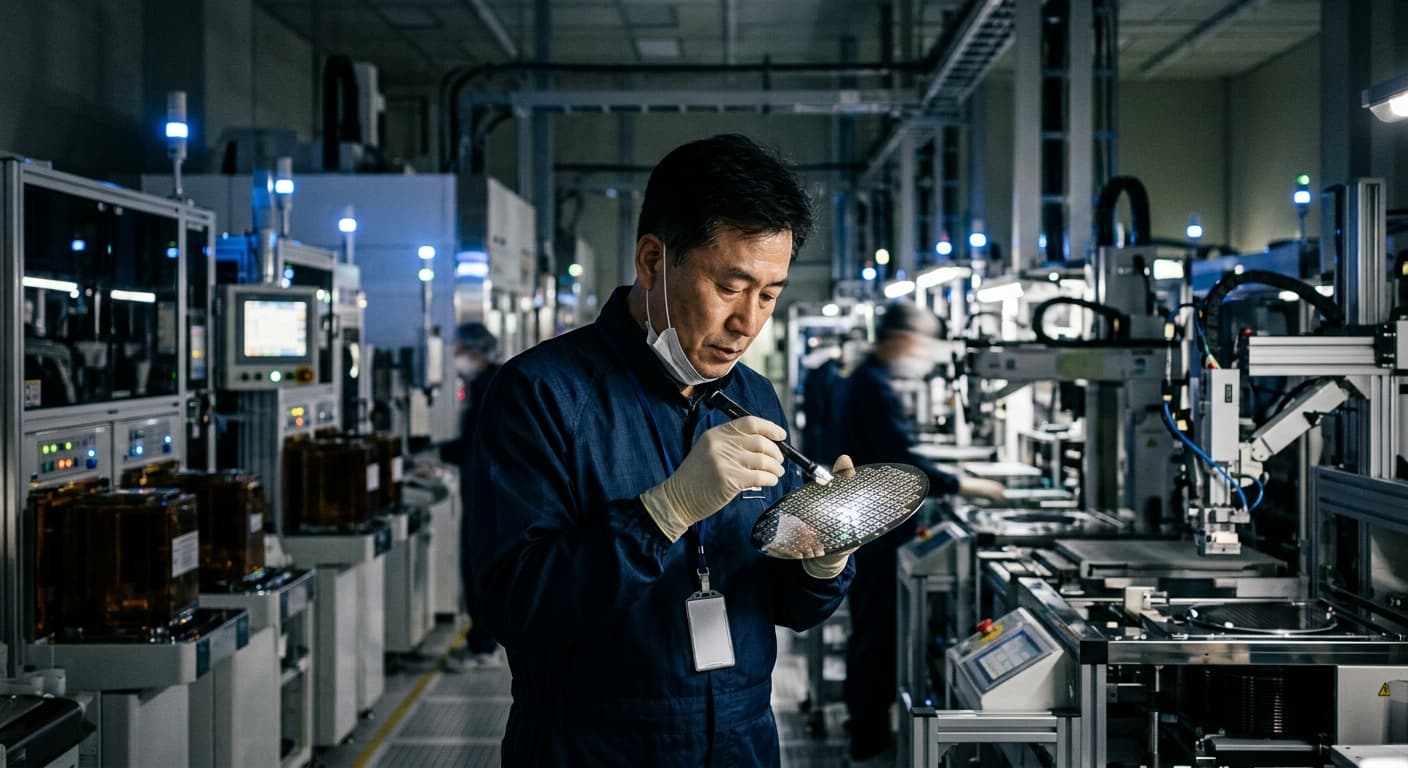
HBM Shortage Turns Korea Into the AI Chip Race's Real Kingmaker
Samsung and SK hynix control ~80% of high-bandwidth memory. With 2026 output sold out, Seoul now sets the pace of the US–China AI race.
South Korea is scheduled to book its third straight quarter of record chip profits on July 31, 2026 — Samsung's preliminary guidance points to operating profit near 86 trillion won, an 18-fold jump, according to the Financial Times. That number is not a Korean story. It is the price tag on a strategic inversion: Washington's 2024 export controls were designed to deny China high-bandwidth memory (HBM), the specialised DRAM that AI accelerators cannot run without. Two years on, with SK hynix's 2026 HBM slate sold out and Micron's fully committed, the binding constraint on American AI infrastructure is not Chinese demand — it is Korean allocation. That is why Donald Trump flew to Gyeongju in October 2025 with a $350 billion investment ask, and why Seoul, not Washington or Beijing, now holds the decisive lever over how fast the AI buildout can go.
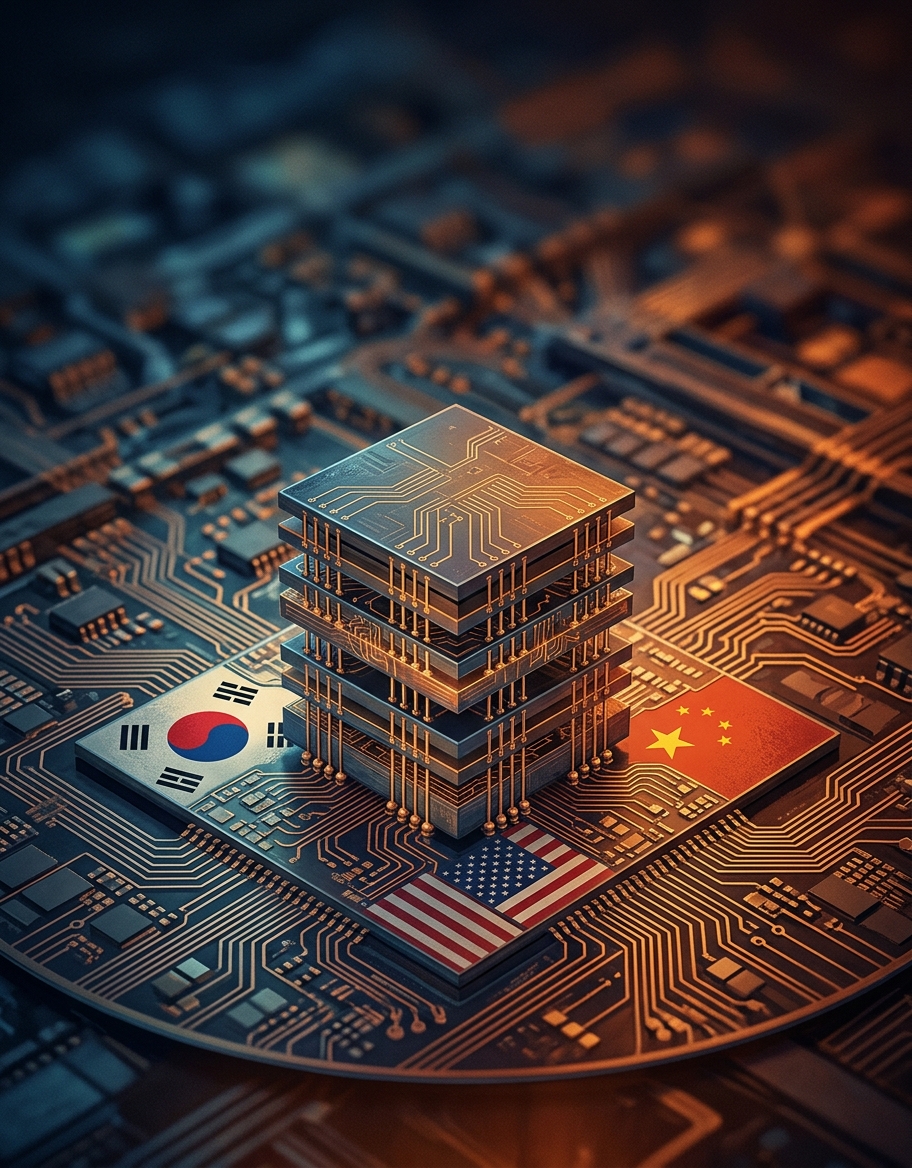
The shortage has flipped the leverage
The physical picture is unambiguous. Samsung Electronics and SK hynix together produce roughly 80% of the world's HBM and nearly 70% of DRAM, according to the Carnegie Endowment. Micron, the only US-headquartered player, holds most of the rest. SK hynix has sold out its entire 2026 HBM production and stopped taking new orders for major memory lines,
the Center for Strategic and International Studies reported in June 2026. Micron's HBM is fully committed through 2026 and even so covers only 50–66% of core-customer demand,
according to a Center for a New American Security analysis.
Prices tell the same story. Contract DRAM prices rose roughly 90% in the first quarter of 2026 versus the fourth quarter of 2025, the American Enterprise Institute wrote, citing PC-vendor complaints from Lenovo, Dell and HP. Some spot DRAM prices ran up over 600% during 2025 as HBM production cannibalised commodity wafers,
CNAS found. Micron's Sanjay Mehrotra called the imbalance "the most significant disconnect between demand and supply" in 25 years; SK hynix chief executive Kwak Noh-jung told analysts the shortage could persist until 2030.
The demand curve makes this a structural problem. Meta, Microsoft, Amazon and Alphabet will lift AI-data-centre capital spending from $217 billion in 2024 to roughly $650 billion in 2026, CSIS estimates. OpenAI reportedly locked in agreements in 2025 for up to 900,000 DRAM wafers per month for its Stargate build-out — around 40% of world output. A single new memory fab costs $15–20 billion and takes several years to reach volume. In this market, whoever ships the wafer chooses the winner.
Washington wrote the rule; Seoul cashes the cheque
The Biden administration's Bureau of Industry and Security (BIS) tried to lock in the American advantage on December 2, 2024, when it issued an interim final rule adding China-wide controls on high-bandwidth memory. The rule created a new export-control classification, ECCN 3A090.c, and imposed licensing on any HBM whose "memory bandwidth density" exceeds 3.3 GB/s/mm² — a threshold that captures every part Nvidia or AMD actually wants. It also extended the Foreign Direct Product Rule to South Korean fabs producing for Chinese customers, the Federal Register text confirms. BIS justified the move on grounds that HBM enables "advanced military and intelligence applications" and "powerful offensive cyber operations."
The corresponding License Exception at 15 CFR §740.25 authorises exports only when the chips flow through packaging sites headquartered in the United States or Country Group A:5 partners, with an audit trail delivered to
HBMReports@bis.doc.gov. The regulation, in effect, drew a bright line between an allied HBM bloc and a Chinese one.
That line has held. Huawei's Ascend accelerator programme depended on roughly 13 million HBM units it acquired from Samsung before controls tightened — enough for 1.6 million chips, the Observer Research Foundation reported. ChangXin Memory Technologies (CXMT), China's leading domestic DRAM maker, has climbed to about 5% of world share and become the fourth-largest producer by capacity,
MERICS documents, but its road map still lags global HBM standards. A Congressional Research Service brief notes Beijing has been pressing to "relax controls on HBM" in bilateral talks, calling it "a key chokepoint for China's ability to produce advanced chips,"
per Congress.gov.
The unintended consequence: by choking Chinese demand, Washington drove Samsung and SK hynix to reroute nearly every advanced wafer to American hyperscalers — which promptly outbid each other for it. The rule succeeded on its own terms and, in doing so, made the United States more dependent on two Korean fabs than at any point in the AI era.
The Gyeongju bargain
President Trump's October 29, 2025 state visit to South Korea should be read through this lens. The Joint Fact Sheet on Trump's meeting with President Lee Jae Myung, published by the White House, locked in $350 billion in Korean investment — $150 billion in shipbuilding and a $200 billion Memorandum of Understanding on strategic investments across semiconductors, AI and quantum. Critically, the deal pledges that any future Section 232 tariffs on semiconductors will treat Korea on terms "no less favorable than" any other volume partner. That is a tariff put option for Samsung and SK hynix, granted in exchange for keeping HBM allocations flowing westward.
Seoul answered on June 29, 2026 with the largest industrial commitment in Korean history: roughly 800 trillion won ($523 billion) for four new memory fabs in the country's south-west, framed by the government as a national "speed war," the BBC reported. President Lee has since ordered ministries to compress environmental reviews and land acquisition, warning that "slow permitting" could jeopardise Korea's advanced-industry lead. The world's largest planned semiconductor cluster, at Yongin in Gyeonggi Province, will alone require 16 gigawatts — roughly a sixth of Korea's peak national electricity demand,
Carnegie's assessment finds.
Micron, for its part, is being subsidised into the same club from the other direction. Its Hiroshima HBM expansion is receiving up to 500 billion yen in Japanese government support, with volume shipments to Nvidia targeted for 2028. This is the allied-only supply bloc BIS designed the 2024 rule to protect — an HBM cordon running Boise–Hiroshima–Icheon–Pyeongtaek, with China explicitly outside it.
What China is doing instead
Beijing has stopped trying to catch the leading edge and is racing to flood the trailing one. The state has unveiled roughly $47 billion in fresh subsidies for GPU and memory research, ORF reports, while CXMT expands 12-inch wafer capacity in Beijing, Hefei and now Shanghai. Yangtze Memory Technologies (YMTC), the NAND flash producer, announced two more fabs in April 2026 and expects to more than double capacity by 2027,
MERICS notes. The pitch to non-aligned markets is unsubtle: as Samsung and SK hynix divert wafers to HBM, Chinese suppliers will meet the world's demand for the DDR4 and LPDDR4 chips that go into cars, industrial equipment and medical devices.
That is where the second-order damage from the US export regime shows up. A coalition of American telecom carriers, automakers, medical-device manufacturers and retailers wrote to the Trump administration in June 2026 urging action on memory shortages, CSIS documented. Automakers are comparing conditions to the COVID-era shortage. Apple has warned it will absorb margin. If commodity DRAM continues to migrate to Chinese fabs while HBM stays locked inside the allied bloc, Beijing gains a chokehold over the industries American export controls were never designed to touch.
Antitrust waits in the wings
The other pressure the Korean duo faces is legal. A new US class-action suit alleges that Samsung, SK hynix and Micron coordinated to restrict commodity DRAM supply while pivoting capacity to HBM — the same fact pattern that in 2002 produced a $300 million Justice Department price-fixing settlement, per industry legal analysis. Prior civil cases foundered on proof problems. But with three players controlling more than 90% of DRAM and an AEI-cited "structural imbalance," discovery in this litigation is the single most under-priced regulatory risk in the sector.
Diplomat View
The consensus reading — that the AI race is a US–China contest bracketed by Nvidia at one end and Huawei at the other — mis-locates the pivot point. The decisive supplier is South Korea, and the decisive instrument is HBM allocation, not GPU export licences. Every additional wafer SK hynix or Samsung ships to Nvidia, AMD or Google is a wafer not shipped to Huawei, to CXMT's downstream customers, or to a European automaker. That is why Trump traded a Section 232 tariff carve-out for $350 billion in Korean capital, and why President Lee is willing to burn political capital on permitting reform to move the four new fabs.
The forecast: as long as SK hynix and Samsung remain sold out, Washington's leverage over Beijing runs through Seoul — and Seoul will extract price for it, on tariffs, on energy subsidies at Yongin, and on the terms of any future US-led "HBM cartel" formalised through BIS licensing. The call becomes wrong if any one of three things happens: CXMT closes the HBM specification gap before 2028; Micron's Hiroshima line ramps ahead of schedule; or a serious DRAM antitrust case forces the three incumbents to unwind capacity allocation. Absent those, Korea is the price-setter of the AI economy through at least 2027.
What to watch next
- July 31, 2026 — Samsung's detailed Q2 earnings release. If HBM revenue growth confirms the preliminary 86 trillion won guidance, expect another leg up in Korean chip capex.
- Late 2026 — BIS's next scheduled refresh of HBM export controls. Watch whether the 3.3 GB/s/mm² threshold in
15 CFR §740.25 tightens toward blocking HBM3E.
- 2027 — First production milestones from Samsung/SK hynix's new southwestern fabs and Micron Hiroshima. Any slippage extends the shortage — and Korean pricing power — into 2028.
The Bottom Line
The AI memory shortage did not just create winners in Seoul; it reordered the geopolitics of the semiconductor race. By choking China off from high-bandwidth memory, Washington made itself dependent on the same two Korean firms — and handed President Lee Jae Myung the most powerful industrial-policy lever any Korean leader has held. The country that controls the HBM allocation table controls the pace of the AI buildout, and for the next 18 to 24 months that country is South Korea.
Discover more

US Politics
SNAP Food Assistance Faces Legal Challenges
In 2026, SNAP faces stricter eligibility rules and mounting legal challenges, threatening food assistance for the millions of Americans who rely on the program.
Global Politics
Xi Jinping Calls China-Russia Ties 'Precious'
Xi Jinping's description of China-Russia ties as 'precious' reflects a strategic imbalance, with Beijing dictating terms in the partnership.

US Politics
US Launches $166B Tariff Refund Portal
The US is launching a $166 billion tariff refund portal to aid importers hit by Trump-era tariffs, with major implications for trade and supply costs.

Economics
Fed's Amex AML order puts correspondent banking on notice
Federal Reserve's Amex AML order requires board-level controls and a 90-day plan; OCC fined the bank $350 million over enterprise-wide deficiencies.