Kim Jong Un Wins Triangle Game, Peninsula
Kim leverages China and Russia to solidify two-state posture.
Model Diplomat8 min readEast Asia
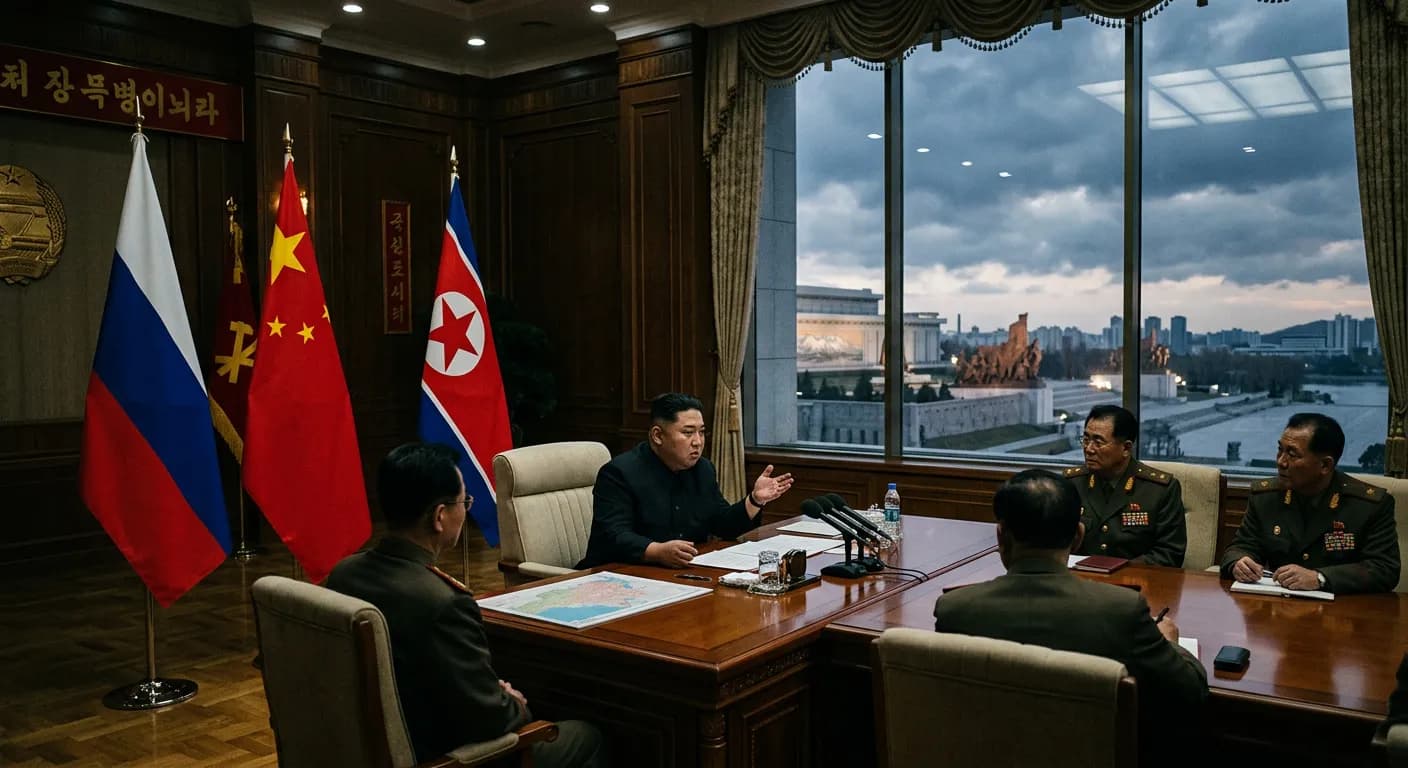
Kim Jong Un Is Winning the Triangle Game — and the Korean Peninsula Is Hardening Because of It
Kim Jong Un's simultaneous courtship of Xi Jinping and Vladimir Putin has given Pyongyang more leverage than it has held in decades, and he is converting that leverage into a permanent two-state posture on the peninsula and a nuclear program nobody is left to constrain.
On June 8, 2026, Xi Jinping landed in Pyongyang for his first visit in seven years, a trip that sealed a strategic rapprochement between China and North Korea just weeks after North Korean troops had marched across Red Square in Moscow's Victory Day parade. The two images, Xi beside Kim in Pyongyang and North Korean soldiers on Russian soil, frame the core argument of a new 38 North analysis: Kim is no longer a dependent of either patron but a balancer between two nuclear powers, and that new leverage is what enables his hardening posture toward Seoul, Washington, and Tokyo. The result is a North Korea with more room to maneuver, fewer constraints on its weapons buildup, and a constitutional commitment to a permanent two-state division of the peninsula.
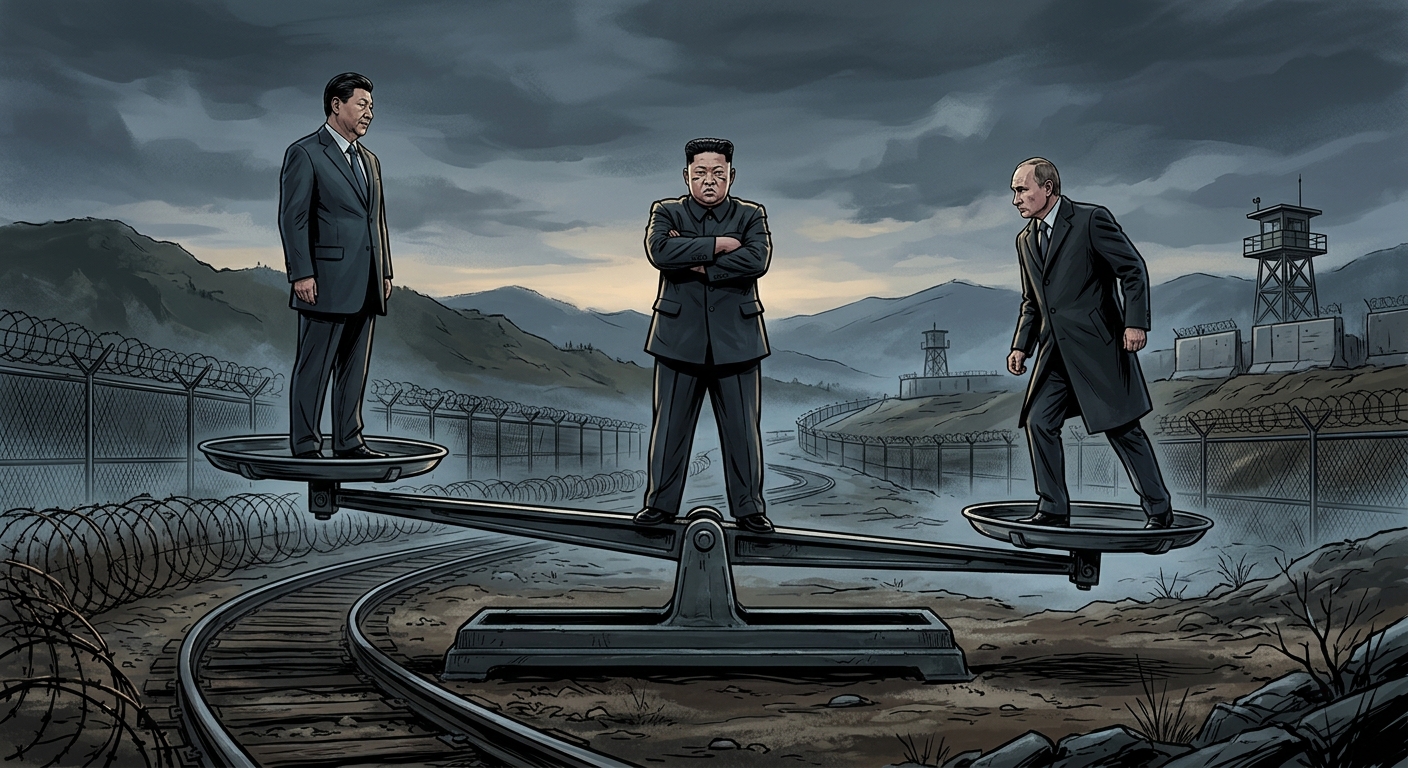
From Patron to Partner: The Structural Shift
For decades, the China–North Korea relationship was asymmetric. China was the unilateral patron, the principal external stakeholder, accounting for as much as 95 percent of North Korean trade, according to a 2022 estimate from the National Committee on North Korea cited by Al Jazeera. North Korea was a buffer state Beijing kept alive but kept dependent.
That has changed. The Ukraine war opened a second patron relationship. Since 2024, North Korea and Russia have operated under a comprehensive strategic partnership treaty with a mutual defense clause — what CSIS analysis called "a full-fledged military alliance circa the Cold War," but one based not on ideology but on shared opposition to the U.S.-led order. North Korea has deployed roughly 11,000 to 15,000 troops to Russia's Kursk region, with South Korean intelligence estimating around 6,000 killed or wounded. A BBC investigation of a Pyongyang memorial, published in 2026, calculated approximately 2,304 names engraved on the memorial walls — the closest proxy for an official death toll that Pyongyang has never disclosed.
This is the structural fact that reshapes everything: Kim now has two nuclear patrons competing for his loyalty. As the Brookings analysis of the Xi-Kim summit put it, North Korea is "the biggest beneficiary of this evolving strategic triangle," because "Kim has been able to deepen ties with Putin without sacrificing his relationship with Xi, giving Pyongyang greater diplomatic flexibility than it has enjoyed in years."
China Moves First — and Drops Denuclearization
Xi's visit to Pyongyang was not a courtesy call. It was a reclamation bid. Between 2023 and 2025, Russian and North Korean officials met 25 times, compared with eight meetings between Chinese and North Korean officials, according to Foreign Affairs. By late 2025, Beijing's pace picked up. Kim attended China's military parade in September 2025, seated beside Xi and Putin. Chinese Premier Li Qiang visited Pyongyang in October 2025. Foreign Minister Wang Yi followed in April 2026. Then Xi himself made the trip.
The most telling detail is what was absent from the agenda. Neither Chinese nor North Korean state media mentioned denuclearization. BBC reporting noted that "Xi's visit this week is likely to be less about friendship, more about leverage," with Western diplomatic sources confirming Beijing's concern about growing Russia-North Korea ties. As analyst Victor Cha of CSIS told the BBC, if China takes a strong stance against Pyongyang's nuclear program, "this would only push North Korea more into the arms of Putin."
The 38 North analysis argues this summit reflected "a shift toward strategic parity," because "China now needs the cooperation of a North Korea whose international leverage has grown." Beijing's priority has shifted from denuclearization to security alignment: a quiet but consequential change that removes the last major external pressure on Kim's weapons program.
Russia Institutionalizes the Relationship
While China plays catch-up, Russia is locking in the framework. On April 26, 2026, Russian Defense Minister Andrey Belousov stood beside Kim in Pyongyang to unveil the Memorial Museum of Combat Feats at Overseas Military Operations, honoring troops killed in the Kursk campaign. More substantively, Belousov told Kim that Moscow was "prepared to sign a Russian-Korean military cooperation plan for the 2027-2031 period," according to the 38 North analysis — a five-year framework that would institutionalize the exchange of North Korean troops and labor for Russian energy and military technology.
The visits by Russia's natural resources and defense ministers, the 38 North piece notes, "suggest the institutionalization of an exchange arrangement under which North Korea receives Russian energy and military technology in return for troop deployments." South Korean estimates cited by the Brookings Institution put the value of what Pyongyang has received from Moscow (weapons, military technology, fuel, and food) at between $7 billion and $14 billion. Russia has also provided air defense missile systems, drone capabilities, and technical guidance for reconnaissance satellites, according to South Korean intelligence cited by
NPR.
Russia's diplomatic shield is equally important. At the 11th NPT Review Conference, which ended without consensus on May 22, 2026, Russia pushed for the deletion of text on North Korea's nuclear program from the final draft outcome document, according to Chatham House. The UN Secretary-General expressed disappointment at the failure — the third consecutive NPT Review Conference to collapse without consensus, per the
United Nations. Meanwhile, North Korea's envoy to the UN declared in May 2026 that Pyongyang "will not be bound by the Non-Proliferation Treaty under any circumstances whatsoever," as reported by
Al Jazeera.
As Brookings analyst Jiyong Zheng frames it, Moscow now recognizes North Korea as a de facto nuclear weapons state and "asserts that the issue of DPRK denuclearization is now moot and has no place on the agenda of any talks on peace and security on the Korean Peninsula."
The Southern Front: Two States, One Border Hardening
The diplomatic gains with Beijing and Moscow map directly onto Kim's posture toward Seoul. In late 2023, Kim declared South Korea a "hostile state" and abandoned the long-standing goal of peaceful unification. By 2026, South Korean analysis confirmed that North Korea's revised constitution drops all references to unification and redefines its territory only as the northern half of the peninsula, as NPR reported.
On June 25, 2026, Kim observed major weapons tests and ordered the military to adopt a "deadly and destructive offensive posture," demanding that "enemies feel constant uneasiness and fear," according to Al Jazeera. The tests included a "special mission" ballistic missile warhead and an upgraded rocket launcher. South Korea's Defense Ministry responded by announcing plans to train 500,000 "drone warriors," with Defense Minister Ahn Gyu-back citing urgent need to respond to Russian technological assistance flowing to the North.
The 38 North analysis notes that Pyongyang has codified the southern border in its constitution and continues reinforcing its military presence near the Demilitarized Zone. At the Ninth Party Congress in February 2026, North Korea explicitly emphasized conventional weapons development for the first time — capabilities that, as Brookings' Andrew Yeo observes, "not only pose independent threats but also support and integrate with North Korea's nuclear forces."
Who Benefits, Who Loses
The power dynamic is clear. Kim benefits most. He has two patrons competing for his loyalty, each offering something the other cannot fully provide: economic lifeline and geographic buffer from China, military technology and diplomatic cover from Russia. As Foreign Affairs notes, "of the three leaders, Kim Jong Un has the most potential to exploit the trilateral relationship."
Xi benefits second. He reasserts China's role as indispensable partner and prevents Russia from becoming the dominant influence in Pyongyang — but at the cost of abandoning denuclearization as a policy lever, accepting a more militarily emboldened North Korea on his northeastern flank.
Putin benefits third. He gets troops and munitions for Ukraine, and a forward position in Northeast Asia. But his leverage is contingent on the war. As multiple analysts noted, when the Ukraine war ends, Russia's need for North Korean support diminishes — and Kim knows it, which is precisely why he repaired relations with Xi in parallel.
The losers are Seoul, Tokyo, and Washington. South Korea's Lee Jae Myung administration, elected in 2025, has pursued pragmatic diplomacy and a "peaceful two-state" framework, but faces a North Korea with less incentive to engage than at any point in recent memory. The Brookings analysis notes that "North Korea currently has little incentive to reengage either the United States or South Korea" because it is "receiving significant political, economic, and military support from both Russia and China." Japan faces the same calculus from a different angle. And Washington, distracted by Iran and Venezuela through 2026, has relegated Korea to the back burner.
Diplomat View
Kim Jong Un's balancing act is not a hedge against weakness: it is an exploitation of strength. For the first time since the Cold War, Pyongyang has two nuclear patrons competing for its loyalty rather than one imposing conditions. That structural shift is what makes the current hardening different from past cycles of provocation: it is backed by a five-year Russian military cooperation plan, a Chinese security alignment that has dropped denuclearization, and a constitutional commitment to permanent division.
The forecast hinges on two variables. First, the trajectory of the Ukraine war: a ceasefire or settlement would reduce Russia's dependence on North Korean troops and weaken Moscow's incentive to shield Pyongyang at the UN — forcing Kim back toward a China-centric posture and potentially reopening diplomatic space with Washington. Second, whether a Trump-Kim meeting materializes. Trump has signaled interest; Kim has so far ignored the invitations, calculating that his leverage is greater outside a negotiation than inside one. If either variable moves (Ukraine ceasefire or genuine U.S.-DPRK dialogue), the triangle compresses and Kim's room to maneuver narrows. Until then, the peninsula hardens.
What to watch:
- 2027–2031 Russia-DPRK military cooperation plan signing: Belousov's April 2026 announcement signals a framework negotiation that could be finalized at a Kim-Putin summit later this year or in early 2027.
- Ukraine war trajectory: Any ceasefire or negotiated settlement would directly test the durability of the Russia-North Korea alliance; signals from Moscow about redeployment or drawdown of North Korean forces would be the first indicator.
- NPT cycle and UN sanctions regime: The next NPT Review Conference is not until 2031, but UN Security Council sanctions renewal votes and any Russia-China veto activity in late 2026 will indicate whether the diplomatic shield around Pyongyang is hardening or fraying.
Discover more
US Politics
Congress Targets AI Chatbot Access for Terror
The House passed the Generative AI Terrorism Risk Assessment Act, focusing on AI's role in terrorism and potential surveillance implications.
India
700 Activists Accuse PM Modi of MCC Breach
Over 700 activists allege PM Modi breached election code with a televised address attacking opposition parties just before state elections.

US Politics
SNAP Food Assistance Faces Legal Challenges
In 2026, SNAP faces stricter eligibility rules and mounting legal challenges, threatening food assistance for the millions of Americans who rely on the program.

Economics
Fed's Amex AML order puts correspondent banking on notice
Federal Reserve's Amex AML order requires board-level controls and a 90-day plan; OCC fined the bank $350 million over enterprise-wide deficiencies.