Khamenei's Funeral: Oil Market Implications
Analyzing the impact of Khamenei's death on oil markets
Model Diplomat5 min readMiddle East
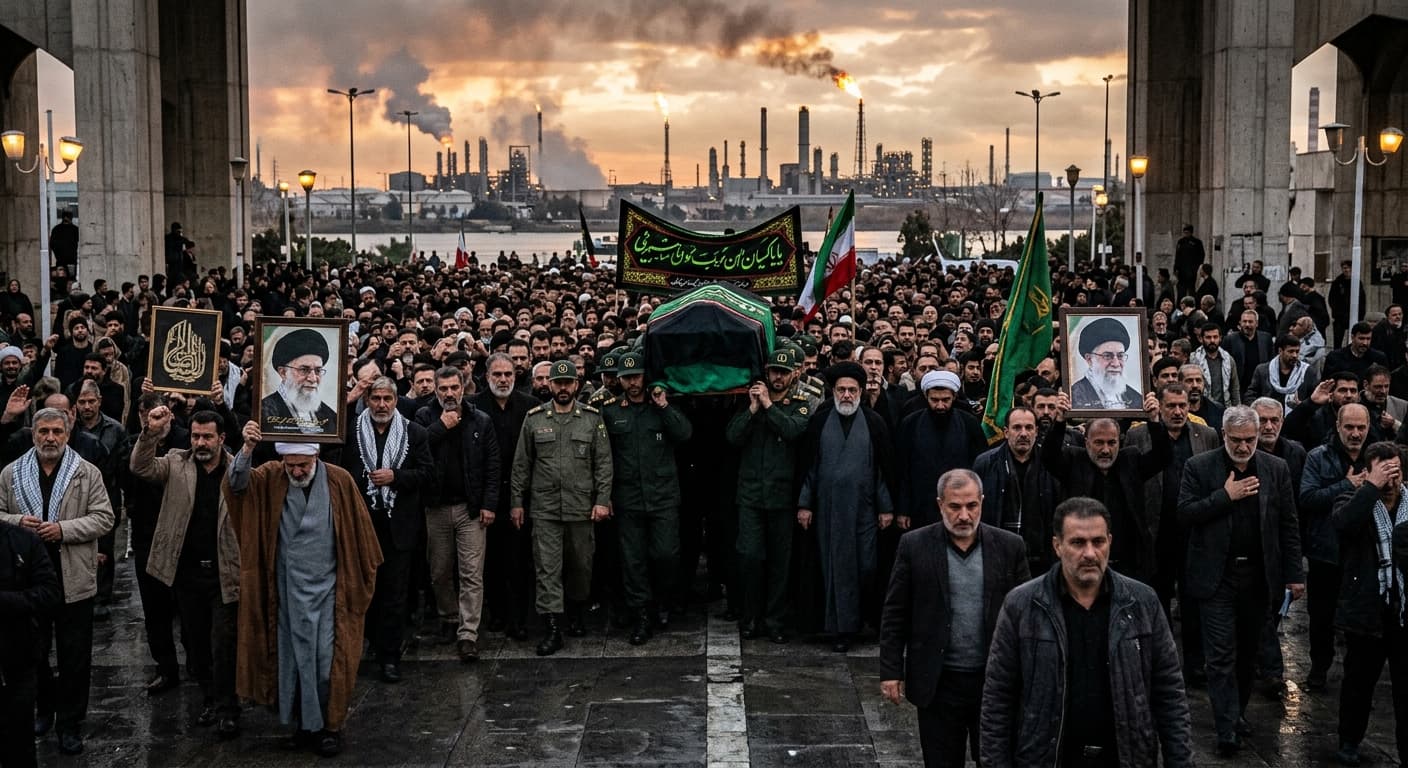
Khamenei's coffin moved through Tehran on Monday under a canopy of black flags and revenge chants — and the world's oil markets barely flinched. They should look harder. The traffic tells a different story. The vessel-tracking platform MarineTraffic recorded 38 transits through the Strait on July 2, down from 48 on July 1 and against a pre-war baseline of roughly 130 daily crossings. The Congressional Research Service confirms Iran has not lifted its formal March 4, 2026 declaration that the Strait is "closed," and its Persian Gulf Strait Authority — set up to charge tolls on vessels — remains in place. Brookings scholars Bruce Jones and Kari Heerman note the mining of the Strait has not been reversed and clearing it "will take months," even with full Iranian cooperation. Iran has kept a foot on the world's oil hose.
The primary US government analysis of the exposure — the Congressional Research Service report R45281 — describes the risk plainly:
A prolonged disruption of Middle East oil trade would create oil market conditions for which there is no historical precedent. The efficacy of emergency response measures could be tested up to their design limits.
Roughly 27% of the world's maritime crude and petroleum trade, and 20% of global LNG, transits Hormuz. The market is calm because it assumes Pezeshkian holds. The BBC's reporting from Bandar Abbas captures what analysts have told Iranian journalists on the record: if the ceasefire breaks, "Iran would close the Strait of Hormuz for sure."
Who benefits: Riyadh, not Tehran
The mourners on Enghelab Square are chanting for revenge on Trump. The winner in the room, coldly measured, is Mohammed bin Salman. Brookings analyst Jeffrey Feltman documents that Iran conducted only two attacks on Saudi Arabia in the first 48 hours of the war, versus more than 150 missiles and 500 drones against the UAE — Tehran calculated the Saudis were most likely to retaliate. That has left Riyadh with a weakened rival to its north and enormous American leverage to extract defence and civil-nuclear terms without joining the Abraham Accords.
The Atlantic Council's Jonathan Panikoff is blunt: "Saudi Arabia arguably stands to benefit the most from a weakened Iran… Saudi Arabia has long sought to become the dominant power in the Middle East, and Iran has consistently posed the greatest threat to this goal." The UAE, hit hardest, has quietly deepened military cooperation with Israel — reportedly receiving an Iron Dome battery — and, per Stimson Center
analysis, shut its Tehran embassy while Saudi Arabia and Qatar expelled some Iranian officials. The Saudi-Emirati rift Trump would need to close for a normalisation deal is wider, not narrower, than it was before February 28.
The losers are Hezbollah, Hamas (whose ceasefire announcement Israeli officials dismissed as a "diversion" per Al Jazeera live coverage), and, most importantly, the reformist current inside Iran that had bet Khamenei's death would open political space. Instead, per the
Gulf International Forum, the disappearance of the system's chief arbiter has "intensified political competition inside the regime" without producing a new one. Pezeshkian, per
BBC analyst Vali Nasr's assessment, operates under a leadership now dominated by IRGC-linked cadres in their 60s who have "shown that they're willing to engage in war in a much more aggressive way than the previous generation."
What actually breaks the deal
Three triggers could collapse the MoU, in descending order of probability.
- The August 16 MoU deadline. The 14-point document commits both sides to a final agreement in "maximum 60 days, extendable with mutual consent." If Pezeshkian cannot secure Mojtaba's public endorsement of sanctions-relief-for-nuclear-supervision, hardliners have the parliamentary vehicle to torpedo ratification: a still-largely-closed Majlis that Paydari-aligned MPs are demanding be fully reopened.
- IAEA access to Fordow, Natanz and Isfahan. Grossi has publicly staked his authority on the inspections happening. Iran's deputy foreign minister has publicly said access to bombed sites is a final-deal question. That contradiction will be tested inside 30 days. The Institute for Science and International Security
assessed that Iran retains stocks of 60%, 20% and 3–5% enriched uranium, plus uninstalled centrifuges — enough leverage to make inspection modalities the crux.
- A successful attempt on Mojtaba's life. Israel has publicly branded him a target. His absence from his father's funeral is the loudest possible signal that his security services believe that threat. An Israeli strike that kills him, or a domestic assassination attempt that succeeds, would collapse the negotiating architecture — because no faction inside Iran could sign the final deal without being tarred as complicit.
Diplomat View
The consensus reading — that Iran's funeral rites and Trump-vengeance chants signal an imminent return to war — is probably wrong, but it's wrong for revealing reasons. The regime needs the funeral's rage more than it needs a resumption of hostilities: it is the only politically usable substitute for a supreme leader who cannot show his face, and it is the maximum-pressure tool Pezeshkian can wave at Steve Witkoff in Doha to extract better sanctions-relief terms without walking away.
The base case is that the MoU is extended past August 16, IAEA inspectors get access to Bushehr and a limited set of down-blending sites but not Fordow, and Iran keeps the Persian Gulf Strait Authority in place as latent leverage — a "no war, no peace" the new leadership publicly disowns while quietly banking. That forecast breaks if Israel strikes Mojtaba, if Trump loses patience with Iranian "Persian negotiating tactics" (Vance's phrase) and unilaterally reimposes sanctions, or if a hardline coalition in a reopened Majlis passes a binding resolution rejecting IAEA supervision. Watch the July 8 processions in Najaf and Karbala: if Iranian officials use the platform to walk back the MoU rather than reaffirm it, the deal is already dying.
What to watch
- July 7–9: Funeral processions in Qom, Najaf/Karbala and burial in Mashhad. Watch for policy statements, not eulogies.
- Mid-July: Next scheduled Doha round between Iranian negotiators, Qatari mediators and the Witkoff-Kushner channel.
- August 16: 60-day MoU deadline. Extension, final deal, or collapse.
The Bottom Line
Khamenei's funeral is not a prelude to renewed war — it is a domestic negotiating position, staged for hardliners inside Iran, not for Trump. The real fight is between an invisible supreme leader, a reformist president with a ticking clock, and an IRGC-anchored coalition that would rather run a permanent "no war, no peace" than sign anything Washington calls a victory. If the August 16 deadline slips without a final deal and IAEA inspectors are still locked out of Fordow, Brent's $72 calm will be the last cheap barrel of 2026.
Read today's full | | More on conflict
Discover more
Global Politics
Xi Jinping Calls China-Russia Ties 'Precious'
Xi Jinping's description of China-Russia ties as 'precious' reflects a strategic imbalance, with Beijing dictating terms in the partnership.

US Politics
US Launches $166B Tariff Refund Portal
The US is launching a $166 billion tariff refund portal to aid importers hit by Trump-era tariffs, with major implications for trade and supply costs.
US Politics
Virginia's Redistricting Referendum
Virginia's redistricting referendum is drawing a flood of dark money, shaping future elections and the fight for congressional control amid party stakes.

Economics
Fed's Amex AML order puts correspondent banking on notice
Federal Reserve's Amex AML order requires board-level controls and a 90-day plan; OCC fined the bank $350 million over enterprise-wide deficiencies.