Khamenei Funeral Signals Iran's Hardline Succ
Gulf states shift from containment to co-management with Iran.
Model Diplomat7 min readMiddle East
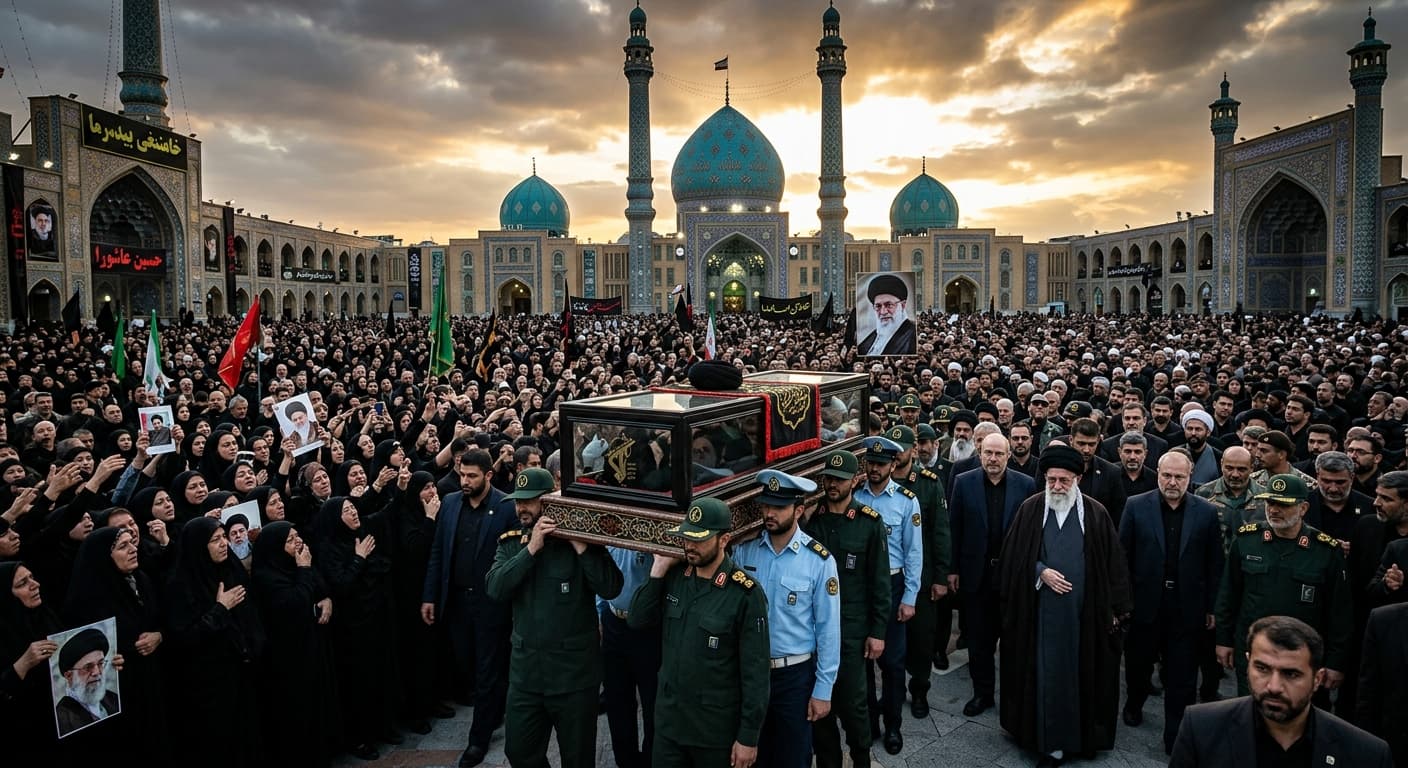
Khamenei funeral cements Iran's hardline succession — Gulf wins
Millions filled Tehran on July 6, 2026 for Ayatollah Ali Khamenei's funeral. The real story is the Gulf-Iran realignment already reshaping post-war MENA.
Iran buried the myth of its own decapitation on July 6, 2026, filling a 12-hour funeral route from Tehran's Grand Mosalla to Mehrabad Airport with a crowd Iranian state broadcaster Press TV called the largest since the 1979 revolution — and the message was not aimed at Washington. It was aimed at Riyadh, Abu Dhabi and Doha, whose envoys stood in the front rows as Israel's defence minister repeated fresh assassination threats from outside the tent. Ayatollah Ali Khamenei's assassination on February 28 has produced the opposite of what its architects intended: a hardline dynastic succession under his son Mojtaba, an IRGC-run war cabinet, and — most consequentially — a Gulf that has quietly pivoted from containment of Iran to co-management with it. The funeral is the public confirmation of a regional order Israel spent four months trying to prevent.
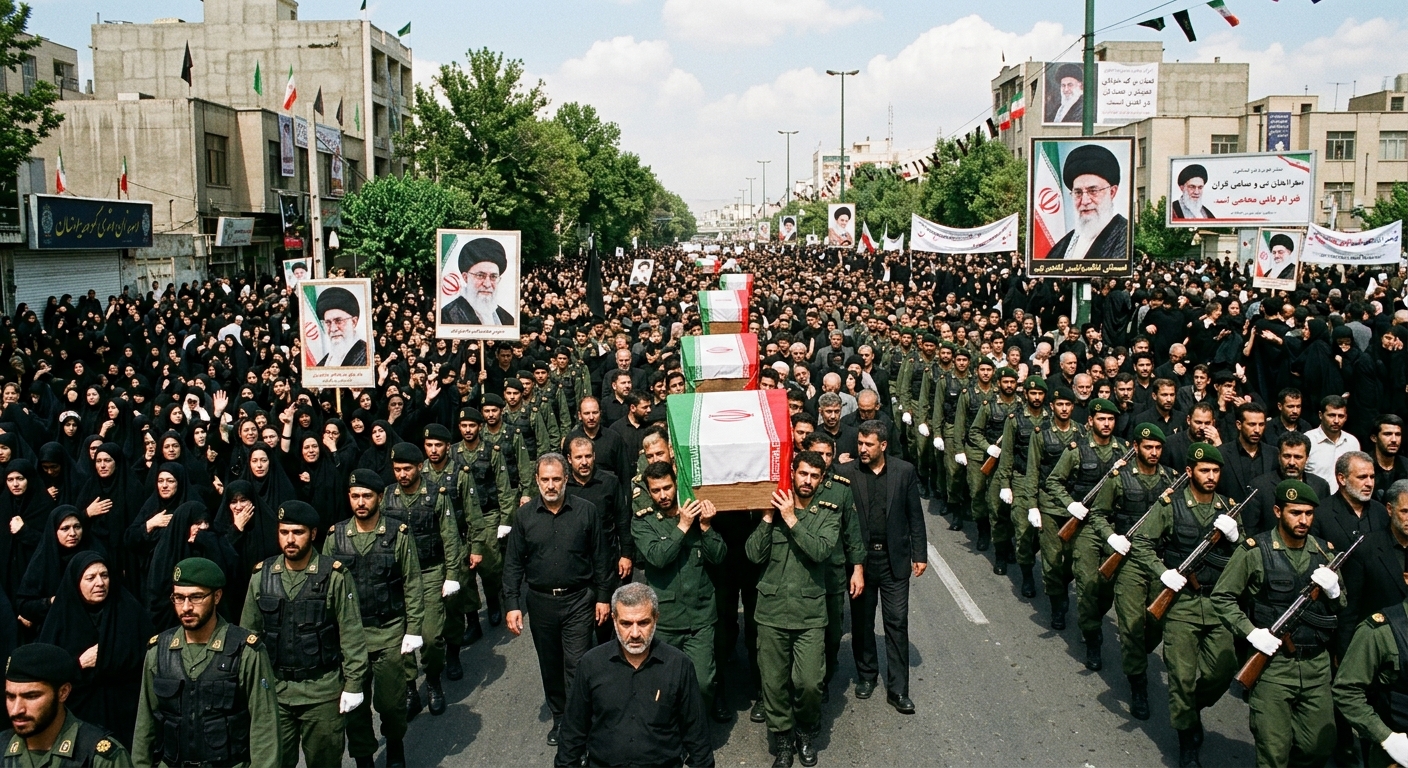
The procession as political instrument
The choreography is deliberate. Six days of ceremonies opened on July 3 with a state tribute in Tehran; Monday's procession moves the body toward Qom, then across the border to Najaf and Karbala, before burial in Mashhad on July 9, according to a running schedule maintained by BBC News. The route stitches together every node of Shia religious legitimacy Tehran can claim — a deliberate rebuke to US and Israeli suggestions that the Islamic Republic collapsed with its leader.
The crowds delivered the intended visuals. Mourners in black shouted "death to America" and "death to Israel," with poet Mohammad Rasouli telling the July 5 prayer that "Trump's murder is our responsibility," as The Hindu reported. But the operative sentence for policymakers is the one US President Donald Trump gave Axios: senior regime figures were in one place and Washington could "take them all out" with "one shot" — "but we are not going to do that because then we would have nobody to negotiate with," per the BBC's contemporaneous
funeral coverage.
That is the shape of the new equilibrium. Trump has swapped decapitation for deal-making, and the man he called "unacceptable" — the late ayatollah's second son, Mojtaba Khamenei — is now the counterparty.
The invisible supreme leader
Mojtaba Khamenei, 56, was confirmed by the 88-member Assembly of Experts on March 8, one week after his father's assassination. He has not been seen in public since. He skipped the July 5 family prayer where his three brothers — Mostafa, Meysam and Masoud — prayed over the coffins, according to BBC News. His only communication during the ceremonies has been a written text message reappointing Judiciary Chief Gholam-Hossein Mohseni-Ejei for another five-year term, disclosed by
Al Jazeera on the morning of the procession.
The absence is strategy, not weakness. Israeli Defence Minister Israel Katz on Monday repeated a public threat of "elimination" against Iranian officials, and Mojtaba was reportedly wounded in the same February 28 strike that killed his mother, wife and son. The regime is protecting its new asset while the ceasefire is negotiated.
But the invisibility also tells you who is actually running the war cabinet. The Islamic Revolutionary Guard Corps was the first institution to pledge allegiance to Mojtaba, per Al Jazeera's reporting from Tehran. The Supreme National Security Council is now chaired by former IRGC commander Mohammad Bagher Zolghadr, who replaced the assassinated Ali Larijani on March 24. "Whoever is sitting at the negotiation table will have to get Zolghadr's approval before anything passes," Al Jazeera's Ali Hashem reported from Tehran. A former CIA analyst, Afshon Ostovar, told
NPR the succession signaled "the regime wants to preserve as much of the status quo as possible." Continuity — under military layer — is the point.
The Gulf did not want this war, and it is quietly winning it
Here is where the conventional read misses. Every Gulf Cooperation Council capital was attacked during the war: at least 28 people were killed across the six GCC states in Iranian drone and rocket strikes on US bases and infrastructure, according to a June 12 analysis by Al Jazeera. By any pre-2026 doctrine, that would have hardened the anti-Iran alignment cemented by the Abraham Accords. It did the opposite.
Saudi Arabia sent its deputy foreign minister to the tribute in Tehran on July 3. Qatar, Oman, Iraq and Turkey sent senior delegations. Agence France-Presse reported Saudi Arabia is preparing a "reconciliation summit" bringing Iran together with the GCC, per a BBC analysis published this week. Qatar, alongside Pakistan, has mediated the entire US-Iran channel — and Articles 5 and 6 of the June 17 memorandum of understanding put Gulf states at the centre of the agreement, according to Mehran Haghirian of the Bourse & Bazaar Foundation, speaking to
Al Jazeera.
The GCC's calculation is cold. Rob Geist Pinfold of King's College London told the same Al Jazeera piece the Gulf states "still feel like diplomacy is better than using force to get a deal … to insulate them from Iran's destabilising actions." The four months of war proved American bases do not shield host countries — they invite Iranian fire. The Chatham House verdict, published July 1, put it more sharply: "Netanyahu's dream that Trump would provide a carte blanche for Israel in Gaza, Lebanon and Iran did not come true," analyst Yossi Mekelberg wrote, noting Trump had cursed at the Israeli prime minister on a call and pivoted to "Saudi Arabia, Qatar, Turkey and Pakistan to secure a ceasefire."
Israel spent the war fighting to prevent exactly the outcome now underway: an American deal that legitimises the Islamic Republic in its post-Khamenei form, releases $6 billion in frozen assets in a first tranche, and lifts sanctions on Iranian oil — the very revenue stream that funds the axis of resistance.
The oil market has already voted
The clearest signal that markets expect the MoU to hold sits in the price of a barrel of Brent. Oil futures closed at $70.82 on July 1, down 38% from the wartime peak of $126, according to Al Jazeera's oil desk. OPEC+ announced on July 6 it will keep expanding monthly production. The Strait of Hormuz — closed in effect since April 13, when a US blockade cut Iranian crude exports of about 2 million barrels per day, per
Brookings — is reopening. The MoU commits Iran to charge nothing for transit for 60 days, though parliament speaker Mohammad Bagher Ghalibaf has floated future tolls in comments carried by the
BBC.
That is the second-order winner nobody names: Iran's central bank. A Tehran that keeps its enrichment programme technically dormant, exports 2 mbd of crude with US sanctions waivers, and collects future Hormuz tolls has a fiscal runway its late leader never enjoyed. The Gulf gets a stable neighbour; Iran gets legitimised revenue; the US gets its "quick victory"; Israel loses the containment architecture it built for a decade.
The nuclear question is still the trap
The one variable that can blow this apart sits in Vienna. The IAEA has been locked out of every Iranian facility except the Bushehr nuclear power plant since February 2026, according to Director General Rafael Grossi's June 8 statement to the Board of Governors. The Board's June 10 resolution —
GOV/2026/40 — records that the Agency "cannot verify" whether Iran has suspended enrichment, the size of its uranium stockpile, or its centrifuge inventory. Seven declared facilities were "affected" by the June 2025 attacks, including Fordow.
In plain English: nobody knows where Iran's high-enriched uranium is. The MoU commits Iran to no nuclear weapons and a 60-day negotiating window on the programme, but Article XII.C of the IAEA Statute is already in play, opening a path to UN Security Council action if talks fail. US Vice President JD Vance told Fox News on July 1 that Washington "cannot guarantee" it will not return to combat before the MoU deadline, per Al Jazeera.
Diplomat View
The bet worth making: the MoU holds through the initial 60-day window and rolls into an extension, because Mojtaba Khamenei's IRGC-anchored coalition, the Gulf mediators, and Trump's political timetable all point the same way — and Netanyahu is now the isolated party, not Iran. What kills that forecast is specific and knowable. Watch three triggers: an IAEA report confirming undeclared HEU movements (which hands Israel a legitimate re-strike case), a targeted Israeli operation against Mojtaba Khamenei or Zolghadr (which breaks the negotiating channel), or an Iranian Hormuz toll announcement that Gulf producers read as extortion. Absent those, the trajectory is a partial sanctions unwind, a Saudi-Iran "reconciliation summit" before October, and a stabilised Iranian oil export at roughly pre-war volumes. The historical parallel is not 1989 — when Khamenei succeeded Khomeini after Iran-Iraq — but 1988's Resolution 598 acceptance: the moment Tehran swallowed a bitter deal because the alternative was collapse. Mojtaba Khamenei is doing the same thing from an underground bunker, without ever appearing in public. That is not weakness. That is the deal getting done.
What to watch next:
- Post-July 9 resumption of Doha talks: Qatar's foreign ministry said the next round will be scheduled "as soon as possible" after the funeral, per its July 1
readout. The pace of that scheduling is the first tell.
- August 16 MoU deadline (60 days from June 17): either extension or a return to combat. Trump has told the Wall Street Journal he prefers extension.
- October Israeli election: Netanyahu currently cannot form a coalition, per Chatham House polling analysis. A new government could reset Israeli redlines on both Lebanon and Iran.
- IAEA Board of Governors, September 2026: the next scheduled review. A finding of non-cooperation is the fastest legal route back to UN sanctions and, potentially, war.
Iran's regional position — see our International coverage — is stronger today than at any point since the assassination, precisely because its supreme leader has not been seen. The funeral is the ceremony. The succession happened months ago, and the Gulf already signed for the delivery.
Discover more
US Politics
Congress Targets AI Chatbot Access for Terror
The House passed the Generative AI Terrorism Risk Assessment Act, focusing on AI's role in terrorism and potential surveillance implications.

US Politics
House Ethics Committee Pushes Sexual Miscond.
The House Ethics Committee has shifted responsibility for sexual harassment settlement records to the Office of Congressional Workplace Rights, complicating disclosure efforts.
India
Congress Accuses Modi of Stalling Women's Law
Congress accuses Modi of stalling women's reservation law by linking it to delimitation, revealing a deeper electoral strategy.

Conflict & Security
Drone Warfare Killing Aid Workers at Unprec
Over 1,000 humanitarian workers killed in three years as cheap armed drones collapse legal protections. Gaza, Sudan, Ukraine, and DRC see deliberate targeting of aid convoys and hospitals with zero prosecutions.