Keiko Fujimori Retains Julio Velarde at BCRP
Fujimori's first act as president-elect ensures monetary stability.
Model Diplomat7 min readLatin America
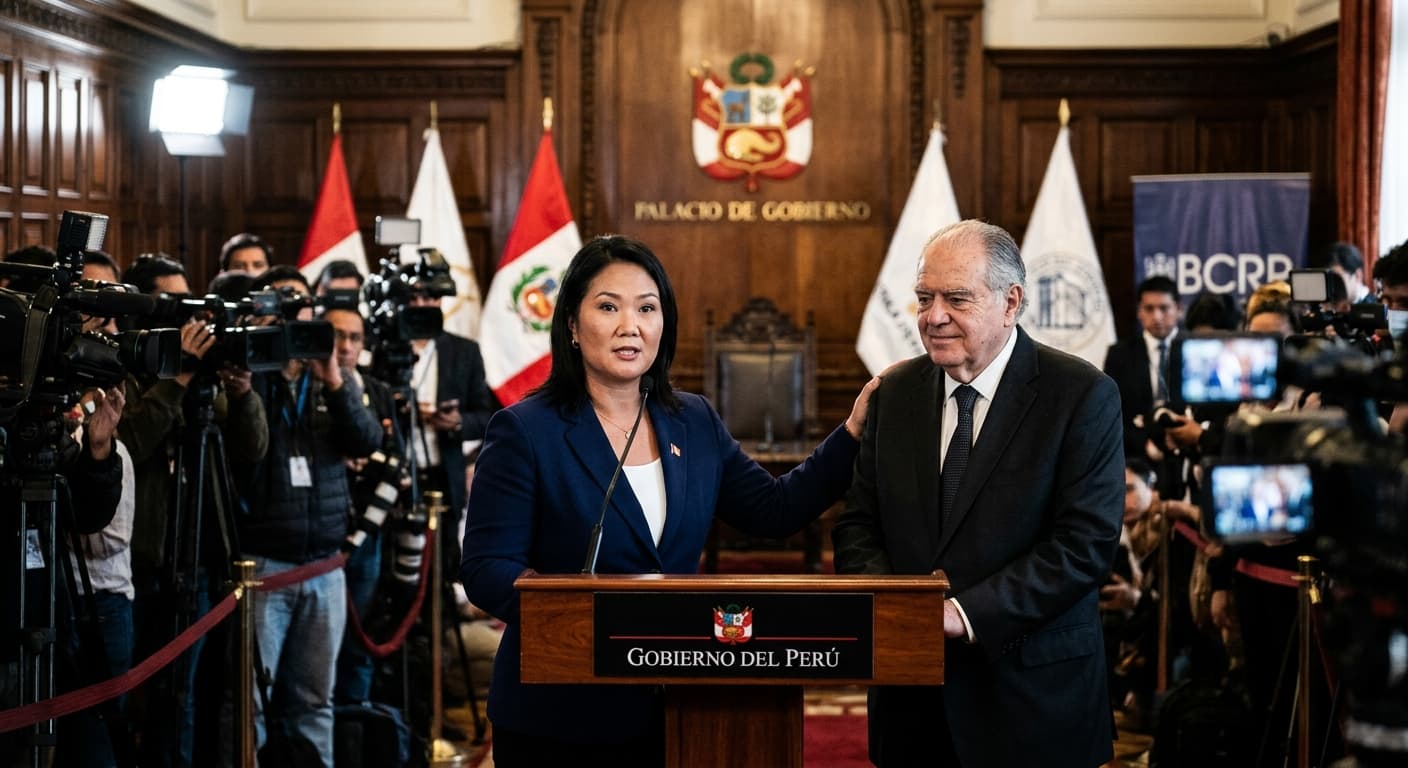
Keiko Fujimori keeps Julio Velarde at Peru's central bank
Peru's president-elect Keiko Fujimori confirmed on July 6, 2026 that Julio Velarde will lead the BCRP for a fifth term — a bet on monetary continuity as inflation breaches the target band.
Keiko Fujimori spent 15 years chasing Peru's presidency; her first act as president-elect was to hand a five-year insurance policy to the one official already there. On July 6, 2026 — the same day her left-wing rival Roberto Sánchez formally conceded — Fujimori walked into the Banco Central de Reserva del Perú (BCRP) headquarters in downtown Lima and asked its 74-year-old president, Julio Velarde, to stay through 2031. He accepted on the spot. The move locks in Peru's most durable technocrat for a fifth consecutive term across an eleventh government, and it is the single clearest signal Fujimori has sent to bondholders, ratings agencies and the mining majors about which of her two political inheritances — her father's economic orthodoxy or his authoritarian instincts — will define her presidency.
The announcement, in Velarde's own building
According to a report by Spain's EFE news agency, carried by Infobae, Fujimori told reporters at the BCRP: "He querido venir a pedirle que nos pueda acompañar cinco años más." Velarde answered in the same brief press appearance that he accepted "con el mayor gusto," adding that "in other circumstances, I would not have accepted." He is 74, has held the job since September 2006, and had publicly flirted with retirement as recently as June, when
Diario EP reported he was "no longer ruling out" continuing past July 28.
The timing is not coincidental. Peru's electoral tribunal formally proclaimed Fujimori the winner on July 3 with 50.135% of valid votes, a margin of fewer than 50,000 ballots over Sánchez, BBC News reported. Her inauguration is set for July 28 — the same day Velarde's current five-year term expires. Announcing his continuity three weeks in advance denies the interregnum any room for market speculation, which is exactly the point.
What Velarde inherits — and why he stayed
The macro picture Fujimori is buying into is unusually strong on the outside and cracking on the inside. The IMF's 2026 Article IV Staff Report, published May 29, 2026, describes Peru as "benefiting from its most favorable terms of trade since the 1950s," with public debt at roughly 32% of GDP — the lowest in Latin America — a current-account surplus of 3.1% of GDP in 2025, and a fiscal deficit that narrowed to 2.2% of GDP. IMF staff project 2.8% growth in 2026 and describe the BCRP's stance as "broadly neutral" and "appropriate."
The cracks are on prices. The BCRP's own dashboard, published on bcrp.gob.pe, showed 12-month headline inflation at 4.01% in June 2026 and core inflation (excluding food and energy) at 4.46% — both above the 1–3% target band. The
BCRP's April 2026 Monetary Program held the reference rate at 4.25%, where it has stood since February, and pledged that "the Board reaffirms its commitment to adopt the necessary actions to guarantee the return of inflation to the target band." The proximate causes are Middle East energy spillovers and El Niño Costero — Fujimori herself flagged the climate risk to reporters — but the political optics of a rate hike in the first weeks of a new government are exactly the sort of decision that requires a governor no one can accuse of playing politics.
That is why Fujimori kept him. The alternative — appointing a loyalist — would have cost her the one thing her narrow mandate cannot easily buy: credibility on the peg between the sol and price stability. The Atlantic Council noted after the runoff that Fujimori's Fuerza Popular holds enough Senate seats to avoid impeachment but not enough to govern unilaterally; every unforced concession to the technocracy widens her coalition without costing her a vote.
The institutional gamble: a Senate that no one controls
The catch is that this is not, legally, Fujimori's decision alone. Article 86 of Peru's 1993 Constitution vests the appointment of the BCRP president in the executive but conditions it on Senate ratification — a mechanism restored this cycle by the return to bicameralism. Fujimori signalled the constraint explicitly: EFE reported she will "plantear su continuidad ante el Senado que comenzará a ejercer sus funciones a fines de este mes."
The BCRP's seven-member board is split by design: four directors, including the president, are named by the executive; three by Congress. As BBC Mundo has documented, under Ollanta Humala the bank operated for nearly two years with only two of seven directors seated because the political blocs could not agree — a warning of what a hostile Senate can do without ever touching monetary policy directly. Fuerza Popular holds 22 of 60 Senate seats and 40 of 130 in the lower chamber,
BBC News Mundo reported before the runoff. Ratifying Velarde is trivial; filling the other board seats, and the second-tier deputy governors, is where the horse-trading will happen.
That matters more than the headline suggests. Peruvian scholarship on central-bank independence — including a 2007 BCRP working paper by Vicente Tuesta constructing a de facto independence index for the institution — finds that legal independence has been static since 1993, but effective independence rose sharply once inflation targeting was adopted in 2002 and a professional board coalesced around it. The person of Velarde is the visible variable; the composition of the board is the hidden one. Congress,
Luis Jácome argues in a chapter for the BCRP, is where the institutional weakness has historically lived.
Who wins, who loses
The immediate winners are Peruvian sovereign bondholders and the mining majors. Long-term sovereign yields already sit at 6.6%, among the lowest in the region per the IMF's 2025 Article IV, and analyst Eileen Gavin of Verisk Maplecroft told
BBC Mundo before the runoff that markets were pricing in "the continuity of the macroeconomic and monetary policy that has consolidated Peru as one of the most creditworthy countries in Latin America." Copper and silver exporters, whose contracts Sánchez had promised to reopen, now know the counterparty at the central bank will be the same one they briefed under García, Humala, Kuczynski, Vizcarra, Sagasti, Castillo, Boluarte, Jerí and Balcázar.
The losers are more subtle. The first is Fujimori's own populist wing. Fuerza Popular's congressional caucus has historically been the driver of the pension-fund withdrawals and untargeted expenditures that the IMF has repeatedly flagged as a risk to the fiscal rule — the bank's April 2026 note warned that the fiscal deficit will remain "above the fiscal rule targets in the medium term." A Velarde BCRP will not accommodate that fiscal drift with easier money; it will offset it. The second loser is Roberto Sánchez's Juntos por el Perú, whose late-campaign pivot toward pledging BCRP autonomy is now moot — Fujimori has taken the moderate-technocrat lane and, in the process, denied the left an obvious opposition talking point for its first hundred days.
There is also a subtler regional signal. Across Latin America, market-friendly incumbents have spent the past two years dismantling — or attempting to dismantle — the independence of monetary institutions: Argentina under Milei with dollarisation debates, Mexico with contested Banxico appointments, and Colombia with public pressure from Petro on the Banco de la República. Peru is doing the opposite, and it is doing so at the initiative of a right-wing president whose father, Alberto Fujimori, wrote the 1993 constitution that codified the BCRP's autonomy in the first place. The historical circle is closed with unusual tidiness.
What to watch next
Three catalysts will show whether the announcement holds:
- The Senate ratification vote, expected in the final week of July 2026 once the new bicameral Congress is seated. Anything short of a comfortable margin — and, more importantly, a parallel deal on the other board seats — will reveal that Fujimori's coalition management is weaker than her market messaging.
- The BCRP's next Monetary Program note, published monthly. With headline inflation at 4.01% and El Niño Costero intensifying, a rate hike in August or September would be the first substantive test of whether Fujimori tolerates tightening in her honeymoon.
- The 2027 budget submission, due to Congress by August 30 under Peru's fiscal calendar. The IMF wants a consolidation of roughly 0.4% of GDP per year through 2028; Fuerza Popular's congressional record suggests resistance. That is where Velarde's leverage — and its limits — will show.
Diplomat View
Keeping Velarde is the cheapest, highest-return decision Fujimori will make in her five-year term, and she made it in her first week. The forecast: her government will govern relatively orthodox on money and progressively less disciplined on fiscal policy, because the political economy of a fragmented Congress rewards spending and the BCRP absorbs the cost through tighter rates. Watch for the sol to strengthen modestly on the Velarde news but for Peruvian sovereign spreads to widen if the 2027 budget breaches the fiscal rule again. The forecast changes if, and only if, the Senate ratification stalls beyond mid-August, or if Fujimori's team tries to pack the BCRP board with political appointees under cover of Velarde's presence. Either would signal that the continuity announcement was theatre, not policy — and markets, which have seen this movie eleven presidencies in a row, will price it accordingly.
The bottom line
Fujimori's continuity gesture is not about Velarde; it is about buying institutional credibility she cannot generate herself from a 50.1% mandate. By locking in the BCRP through 2031 — beyond her own term — she has traded populist discretion for market trust at precisely the moment inflation, El Niño, and a hostile bicameral Senate would otherwise have punished a rookie government. The lesson for Latin America's centre-right is that the surest way to consolidate power is still to give some of it away to someone no one can fire.
Discover more
India
Rajnath Singh's Durga Squad for 2026 Polls
Rajnath Singh's Durga Squad promised women's safety in Bengal but has since disappeared from the agenda, revealing BJP's true priorities.

US Politics
House Ethics Committee Pushes Sexual Miscond.
The House Ethics Committee has shifted responsibility for sexual harassment settlement records to the Office of Congressional Workplace Rights, complicating disclosure efforts.
India
Romanian Coalition Party Demands PM Resign
Romania's Social Democrats withdrew from coalition, joining far-right AUR to topple PM Bolojan, risking €10 billion in EU funds by August 2026.

Economics
Fed's Amex AML order puts correspondent banking on notice
Federal Reserve's Amex AML order requires board-level controls and a 90-day plan; OCC fined the bank $350 million over enterprise-wide deficiencies.