Kast's Mining Reform Bets Chile's $104bn
Senate math decides fate of Chile's mining investment reforms
Model Diplomat8 min readSouth America
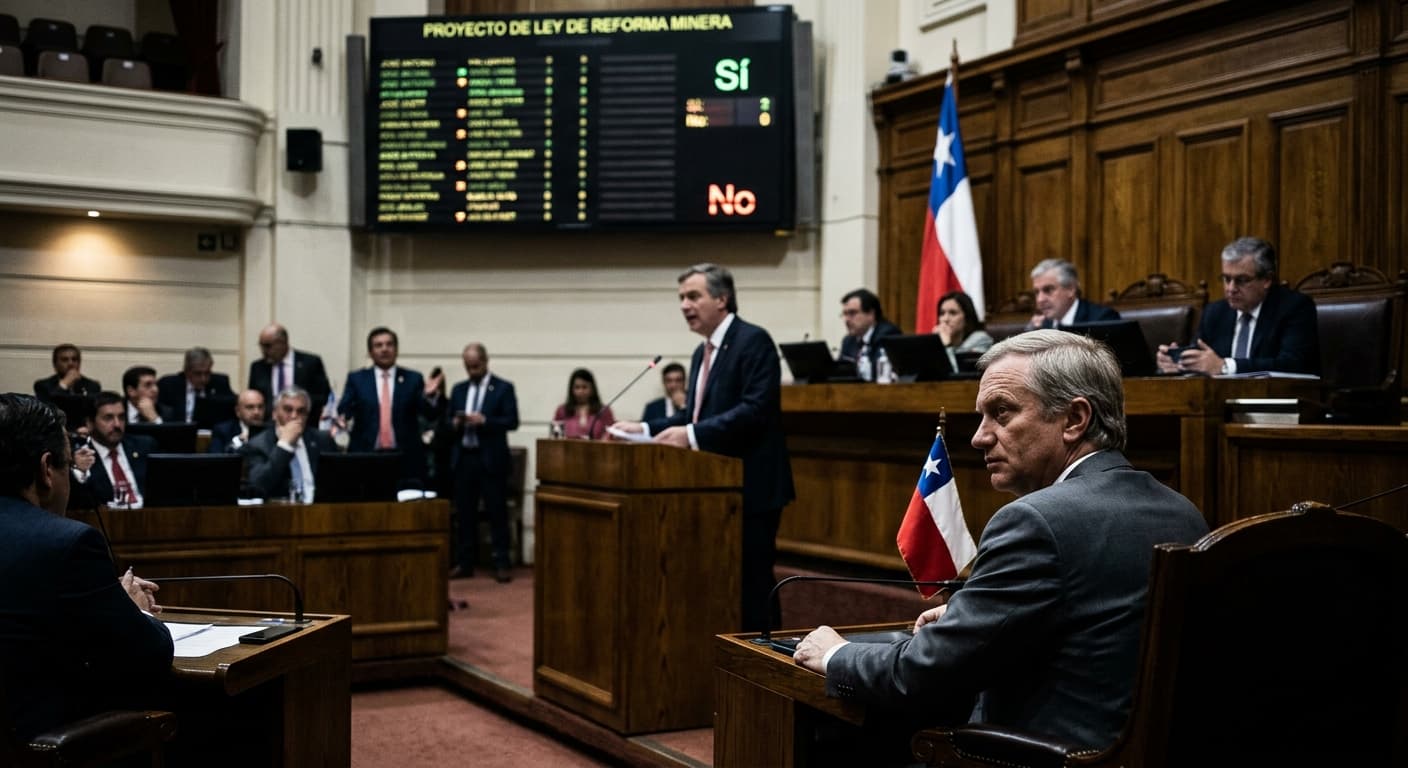
Kast's Mining Reform Bets Chile's $104bn Pipeline on the Senate
Chile's corporate tax cut and 20-year investment shield could revive mining investment — but the Senate math, not the OECD math, decides whether the pipeline moves.
President José Antonio Kast's National Reconstruction and Economic Development Bill would cut Chile's corporate tax from 27% to 23% by 2029 and freeze fiscal conditions for 20 years on any project above US$50 million — a package pitched at unlocking a US$104 billion, 64-project mining pipeline that has stalled since 2014. The tax cut is real and the invariability shield is copied from the 1990s-era Decree 600 that built modern Chilean mining. But the binding constraint on that pipeline is not the corporate rate: it is permit backlogs and Senate arithmetic. The reform tilts the field toward capital, yet leaves Chile's effective mining tax burden — 44.7% in 2024, per industry figures cited by BNamericas — above Peru, Canada and Australia. Whether copper and lithium majors write final investment decisions on Chilean projects in 2027 depends less on the OECD comparison Kast cites than on whether his coalition can secure the fourteen swing votes of the Partido de la Gente.
The bill, in one page
The so-called "megarreforma" was introduced to Congress on April 22, 2026, ten days after Kast unveiled it in a national address. According to BBC News Mundo, the package bundles more than forty measures: a gradual cut in the first-category corporate tax from 27% to 23%, full re-integration of corporate and personal income taxes, elimination of the 10% stock-market capital gains tax, exemptions on property tax for owner-occupied homes over sixty-five, a twelve-month capital repatriation window, and a hiring tax credit projected to create 180,000 formal jobs.
For mining, the operative clause is the tax invariability statute. According to the BNamericas analysis, projects above US$50 million would lock in the income tax rate, VAT, capital-goods tariff and mining royalty for up to 20 years — reviving the logic of the Foreign Investment Statute (Decree Law 600) that Michelle Bachelet's 2015 reform dismantled via Law 20.848, the current FDI framework noted in the US State Department's Chile investment climate report. Environmental permitting is separately targeted: shortening the sectoral-permit invalidation window to six months, curbing "fatal deadlines" imposed by the National Monuments Council, and shifting liability to the state when courts annul permits it granted, per Libertad y Desarrollo's
initial reading of the bill.
The angle: cost, not headline rate, is what Chile actually lost
The BNamericas piece frames the debate as tax cuts versus fiscal risk. That is the wrong frame. Chile's problem is not the 27% headline — it is the effective mining tax burden after the 2023 royalty (Law 21.591), and the multi-year permitting drag. Mining Council of Chile president Joaquín Villarino told the BNamericas-attended Marsh event that operating costs in Chile run 16% above the mining-country average, with the state's capture of mining rent rising from 35% in 2005 to 44.7% in 2024.
That number is the story. According to the IMF's March 2025 technical-assistance report on Chilean revenue projections, mining tax revenue collapsed from a 2001–2014 average of 16% of total fiscal revenue to less than 0.4% of GDP in 2016, and has remained highly volatile since. Independent studies converge on an effective mining tax rate near 40% even before Law 21.591; the Mining Council's post-royalty figure sits roughly ten percentage points above Peru, per estimates published by
Libertad y Desarrollo during the 2022 royalty debate. The Fraser Institute — mining executives' preferred barometer — showed Chile dropping from 17th globally in 2019 to 30th in 2020 as legal uncertainty compounded.
Kast's invariability clause does not lower that burden. It freezes it. For BHP, Anglo American, Antofagasta and Codelco's minority partners, that is worth more than a headline cut, because the true risk since 2014 has been the next tax change — not the current tax level. The Kast bet is that certainty of a bad regime beats uncertainty about a worse one. It is the same calculation Chile made in 1974 with Decree 600, and the reason two decades of copper investment followed.
The permitting bottleneck the tax cut cannot fix
The rate cut is the political trophy. The permitting reform is the operational one. According to a CEP Chile study by Nikolás Dejbord and Gabriel Ugarte, Chile scored 4.9 on the OECD's regulatory-complexity index in 2023 — more than double the OECD average of 2.2, and third-worst in the club. The National Productivity Commission (CNEP) counts 439 sectoral permits touching investment projects; 63 are "critical" and take an average of 17 months to process. The Committee of Experts on Fiscal Space projects that a one-third cut in processing times would lift GDP by 2.4% over ten years — a bigger number than the corporate rate cut is expected to deliver on its own.
Libertad y Desarrollo, the free-market think tank closest to Kast's economic team, estimates that permit friction cost Chile US$2.2 billion — roughly 1% of GDP — in 2024 alone. This is where the mining pipeline actually leaks: Cochilco's project catalogues have hovered near US$100 billion for a decade while realized investment stalled. BNamericas notes gross mining investment contracted from 27.5% of GDP in 2014 to 23.7% by 2025 — a four-point drop worth roughly US$14 billion a year in foregone capital formation. The World Bank's latest
Chile Macro-Poverty Outlook attributes 2025's 2.5% GDP print largely to a rebound in mining-linked capex under the previous permitting law, and expects 2026 growth of 2.4% — well below the 4% Kast promised.
The Senate math
The mining sector wants the bill. The Congress may not deliver it in the form the sector wants. According to the Atlantic Council, Kast's right and far-right bloc holds roughly seventy of 155 Chamber seats against sixty-one on the Jara-led left; Franco Parisi's Partido de la Gente (PDG) controls fourteen and is the pivot on any bill that requires a simple majority. Kast's coalition cannot reach the two-thirds threshold needed for constitutional or electoral reforms on its own — which is why his political ministers, Alvarado and García, have spent the first hundred days negotiating vote-by-vote.
The Chile 21 foundation's assessment of Kast's first 100 days — from the opposition camp — captures the drag: GDP contracted 0.5% year-on-year in his opening quarter, unemployment hit 9.1% (a five-year high), and Kast's approval fell 17 points between March and May before a partial rebound after a cabinet reshuffle. Two ministers, Sedini (SEGEGOB) and Steinert (Security), exited early. The bill advanced in the Chamber with a "circumstantial" majority but faces a tougher Senate. LyD's own analysis,
published on July 2, 2026, concedes the Chamber vote produced only a general framework and warns that the "specific-vote stage" will decide how much fuel the plan actually adds to the economy.
The distributional politics make Senate passage narrower still. Polling firm Criteria, cited by LyD's April political brief, found 73% of Chileans want higher taxes on large firms, 88% want cuts for SMEs, and 63% want the bill voted measure-by-measure rather than as a package. The Autonomous Fiscal Council (CFA) warned in
analysis distilled by CEP Chile that the bill produces a net negative fiscal effect of 0.3 percentage points of GDP annually through 2031, with the promised growth dividend materializing only after 2040. Chile 21 puts the permanent cost at US$1.8 billion a year and estimates 79.1% of the tax benefit accrues to the top 1% of taxpayers.
The IMF's split verdict
The most consequential outside voice is the IMF. According to the Fund's July 6, 2026 Article IV consultation, Chile's GDP growth will soften to 1.8% in 2026 before recovering to 2.6% in 2027 on higher copper prices — a full point below Kast's target. Executive Directors "welcomed the authorities' plans" to reduce the structural fiscal deficit to 1.5% of GDP by 2030 and hold debt below 45% of GDP, but flagged that "additional measures would be needed" and that "reforms under the National Reconstruction Plan should be carefully prioritized and sequenced, and that the fiscal costs and growth impact of tax and other reforms should be carefully considered to ensure fiscal sustainability."
That is diplomatic language for: cut too fast without offsetting revenue and the plan does not add up. The Fund's full staff report released two days later, endorsed the deregulation agenda but pushed for complementary reforms on the labor market and minimum-wage setting — items nowhere in the megarreforma.
The Heritage Foundation's 2026 Chile brief captures the market's read: business confidence "rebounded on pledges of deregulation and corporate tax cuts" following Kast's December 2025 victory. But the same document lists Chile's tax burden at 20.5% of GDP and public debt at 41.6% — leaving little cushion if the growth dividend arrives late.
Winners, losers, and the historical parallel
The clearest winners if the bill passes are the roughly 100,000 mid-sized Chilean firms that would benefit from re-integration — the same firms LyD credits with producing over half of Chilean employment. The mining majors gain fiscal certainty on the US$104 billion pipeline: BHP's Escondida expansion, Codelco's structural projects, Antofagasta's Centinela second concentrator, and lithium plays in the Atacama that have waited on legal clarity since Bachelet's 2015 FDI overhaul. Foreign investors win specifically because the invariability shield revives the treatment they had under Decree 600 — the framework that turned Chile into the world's dominant copper producer between 1990 and 2010.
The losers are Chile's tax base — at least in the short term — and the Frente Amplio and Communist Party blocs whose alternative economic agenda now runs on obstruction rather than proposal, per the Chile 21 assessment. The Central Bank sits uncomfortably in between: the Fund flagged that persistent inflation from Middle East oil prices could force tightening precisely as Kast is trying to reflate investment.
The historical parallel worth naming is 2005. That was the last time Chile debated a mining tax overhaul against a copper super-cycle. The compromise then — a moderate specific tax with invariability clauses under Law 20.026 — bought fifteen years of investment. Bachelet's 2014 reform broke that pact; the 2023 royalty finished it. Kast is not proposing anything genuinely new — he is proposing to rebuild what existed before 2014. Whether that is enough depends on whether investors believe the next left-of-center government won't tear it up again.
What to watch
- Senate general vote on the megarreforma: expected before the September fiscal-year budget debate. A defeat forces Kast into a piecemeal strategy that could strip out the invariability clause first.
- 2027 budget submission (late September 2026): the CFA's fiscal warnings will pressure Kast to identify permanent revenue offsets. If he cannot, the tax cut phases in but the invariability shield may be trimmed.
- Cochilco's mid-2026 project catalogue: the first hard read on whether declared US$104 billion pipeline projects are converting to firm capex.
- Fraser Institute 2026 mining survey (early 2027): the single number that will tell copper majors whether Chile has actually moved on legal certainty.
The Bottom Line
Kast's megarreforma is not a growth plan — it is a legal-certainty plan dressed as one. If the Senate passes the invariability statute intact, Chile could unlock the biggest slice of its US$104 billion mining pipeline in a decade, largely by promising foreign capital that the next Bachelet-style reform can't touch it. If the Senate strips that clause while keeping the corporate rate cut, Kast will have widened the deficit without buying the investment recovery — the worst of both worlds, and precisely the outcome the IMF is quietly warning against.
Discover more

India
700 Activists Accuse PM Modi of MCC Breach
Over 700 activists allege PM Modi breached election code with a televised address attacking opposition parties just before state elections.

US Politics
SNAP Food Assistance Faces Legal Challenges
In 2026, SNAP faces stricter eligibility rules and mounting legal challenges, threatening food assistance for the millions of Americans who rely on the program.

US Politics
House Ethics Committee Pushes Sexual Miscond.
The House Ethics Committee has shifted responsibility for sexual harassment settlement records to the Office of Congressional Workplace Rights, complicating disclosure efforts.

Conflict & Security
Drone Warfare Killing Aid Workers at Unprec
Over 1,000 humanitarian workers killed in three years as cheap armed drones collapse legal protections. Gaza, Sudan, Ukraine, and DRC see deliberate targeting of aid convoys and hospitals with zero prosecutions.