Karandlaje: Congress Betrays Women, South
Analyzing the political fallout of the 131st Amendment Bill's failure
Model Diplomat7 min readIndia

Karandlaje's "Betrayal" Charge Masks a Deeper Southern Revolt
Why the BJP is prosecuting a women's reservation defeat it engineered — and how Congress converted a losing vote into a southern shield.
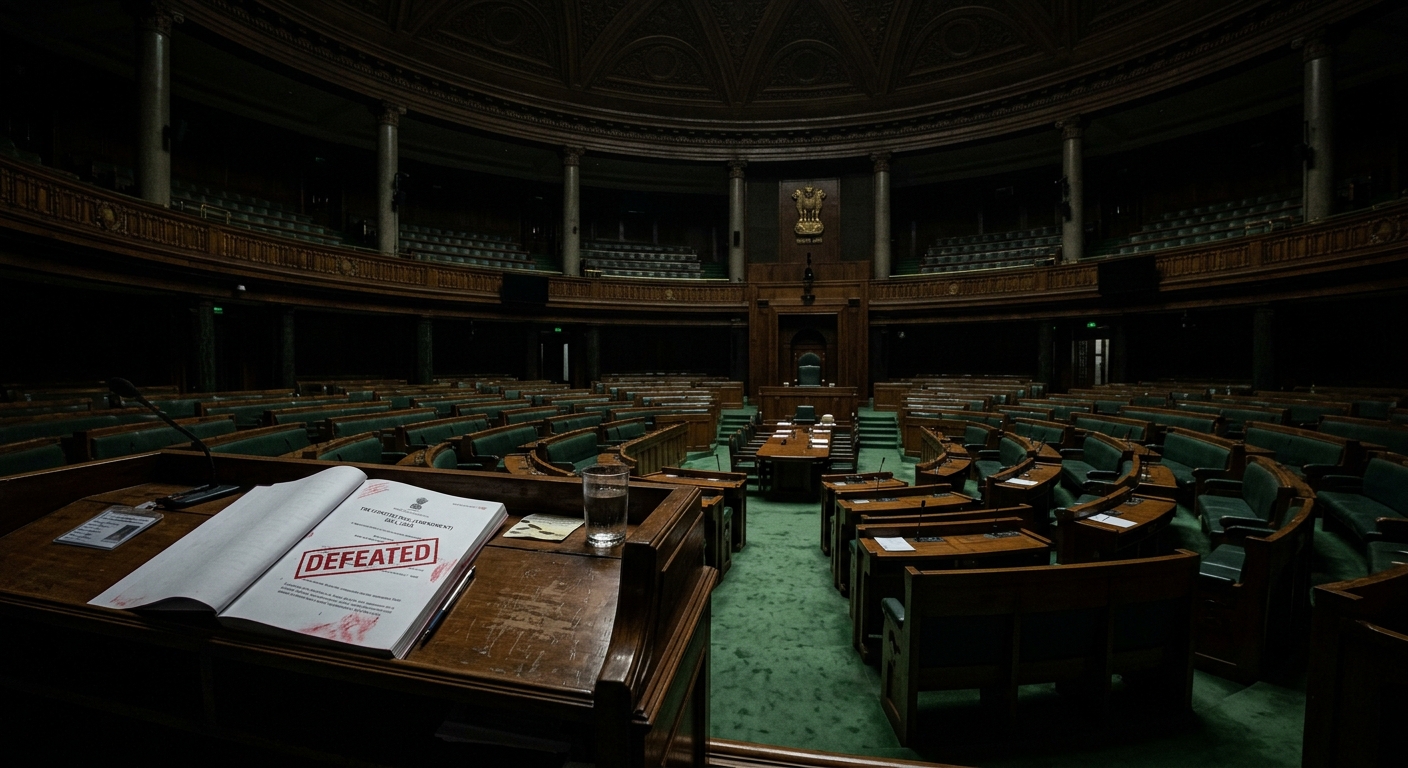
The Constitution (131st Amendment) Bill fell in the Lok Sabha on April 17, 2026, by 298 votes to 230 — the first constitutional amendment to be defeated in Narendra Modi's eleven years as prime minister, and the reason a Union minister from coastal Karnataka is now touring Hyderabad calling it a "black day for women." Shobha Karandlaje's charge that the Congress and the INDIA bloc "betrayed women and the South" is not a lament. It is the opening salvo of a two-election political campaign designed to convert the BJP's own legislative miscalculation into a wedge across the states it has spent a decade failing to crack.
The bill she is defending would have expanded the Lok Sabha from 543 to 850 seats and used the 2011 census as the basis for redistributing them — the same census that, on every serious projection, transfers power decisively from a slower-growing south to the Hindi belt. That contradiction — a "women's" bill whose real payload is delimitation — is the story behind the story.
What actually happened on April 17
The Modi government called a three-day special session between April 16 and 18, 2026, and introduced three linked bills: the Constitution (131st Amendment) Bill, the Delimitation Bill, and the Union Territories Laws (Amendment) Bill. As the Press Information Bureau confirmed in its end-of-session note, the constitutional amendment "could not have the required majority as per Article 368(2)" and the two dependent bills were consequently "not proceeded further" (Press Information Bureau).
The arithmetic was never comfortable. Modi's National Democratic Alliance holds 293 Lok Sabha seats; a two-thirds majority of those present and voting required roughly 360, as Al Jazeera noted at the session's opening. The government got 298. The Institute of South Asian Studies at NUS calls it the first time under Modi that "a constitutional amendment bill failed to receive the required numbers" (
ISAS-NUS).
The core objection from the opposition, articulated on the floor by Leader of the Opposition Rahul Gandhi, was that a 33% women's quota — already legislated as the Nari Shakti Vandan Adhiniyam in 2023 — did not require any expansion of the House. "This has nothing to do with empowering women," Gandhi said during the debate. "It is an attempt to change the country's electoral map, using and hiding behind India's women" (ISAS-NUS).
The Karandlaje pivot
Two days after the vote, Karandlaje — the Union Minister of State for Labour and Employment and MSME, and a two-time MP from Udupi-Chikmagalur in coastal Karnataka — chose Hyderabad, the capital of a Congress-run state, to open the counter-offensive. She accused the INDIA bloc of "betraying" women and, in the same breath, of "blocking the proposal to increase the number of parliamentary seats in the southern States" (The Hindu,
The Hans India).
That is a striking framing. It is precisely the linkage between women's reservation and delimitation — not the quota itself — that Congress, the DMK, the Left, and much of the south rejected. Karandlaje's argument inverts the objection: by voting down the composite bill, the opposition denied the south the additional seats that would have accompanied the expansion. She termed April 17 a "black day for women in India" and accused Rahul Gandhi's INDIA alliance of stalling the Women's Reservation Bill 2026 (The Hans India).
The choreography is telling. Amit Shah, on the floor of the House and in a Home Ministry release the same evening, warned that opposition parties would face "the anger of women" not only in 2029 but "at every level, in every election" (Press Information Bureau). Modi, in an April 18 televised address, called the vote a "sin" and used the word "foeticide" to describe it (
ISAS-NUS). Karandlaje's Hyderabad presser is the field-level implementation of that line: a Kannada-speaking southern minister in a Telugu-speaking state, addressing a Kannada-influential media audience.
The math the BJP is not showing
The delimitation numbers explain the southern resistance better than any speech. According to modelling published by the Carnegie Endowment for International Peace in May 2026, an 850-seat Lok Sabha apportioned strictly on 2011 census figures would push Uttar Pradesh from 80 seats to roughly 140, and Bihar from 40 to about 60. The five southern states — Andhra Pradesh, Karnataka, Kerala, Tamil Nadu and Telangana — would collectively "lose a collective twenty-seven seats" compared to their strictly proportional entitlement, even as absolute counts rose (Carnegie Endowment).
Takshashila Institution's own extrapolation is starker: projecting 2011 census figures forward, the north (Bihar, MP, UP and Rajasthan) gains up to 22 seats, while Tamil Nadu, Kerala, Andhra Pradesh and Telangana could lose 17 seats in relative weight (Takshashila). BJP MP K. Laxman told the BBC the delimitation would be conducted on a "pro-rata" basis — but as Arghya Sengupta of the Vidhi Centre for Legal Policy pointed out, the "basis for this number [850] is unclear and does not appear to be proportionate to population growth recorded in the 1971 and 2011 census," and the bill's text contained no legal guarantee protecting southern share (
BBC).
That absence — a political promise not written into statute — is what southern chief ministers seized on. Tamil Nadu's M.K. Stalin publicly burned a copy of the bill; MPs from Tamil Nadu, Kerala and Karnataka appeared in Parliament in black. Congress floor manager Gaurav Gogoi called it delimitation "through the backdoor" (Al Jazeera).
The sequencing trap the BJP built for itself
Here is the piece of the story most Delhi-datelined coverage has missed. The 2023 Nari Shakti Vandan Adhiniyam — the 106th Amendment — already reserves one-third of Lok Sabha and state assembly seats for women. But it was drafted, at the BJP's own insistence, to take effect only after a fresh census and a subsequent delimitation. Carnegie's analysts note bluntly that "women's reservation — despite being formally enacted — cannot take effect until after the 2027 census is completed and a new delimitation is carried out" (Carnegie Endowment).
That sequencing was a political choice in 2023. It bound a broadly popular gender reform to a divisive federal one, precisely so the second could not be dropped without abandoning the first. The 131st Amendment was the attempt to cash that political cheque before the census results made the federal argument uglier. ISAS-NUS put the counter-question sharply: if the government wanted the women's quota, why not "delink it from expansion of the Lok Sabha and delimitation and test the opposition's resolve?" (ISAS-NUS). Most opposition parties, including the Communist Party of India (Marxist)'s John Brittas, are on record backing a 33% quota on the current 543-seat house (
BBC).
The BJP declined to run that test. That decision — not the opposition's vote — is what left women's reservation frozen. And it is what makes Karandlaje's "betrayal" charge a campaign line rather than a policy argument.
The April verdict the BJP is trying to reverse
The state election results announced on May 4, 2026 explain the urgency. In Tamil Nadu, the BJP–AIADMK alliance was reduced to a single seat as film star C. Joseph Vijay's Tamilaga Vettri Kazhagam won 108 of 234 seats, later forming government with Congress and Left support (BBC). In Kerala, the Congress-led United Democratic Front took 101 of 140 seats. The BJP retained Assam, added West Bengal in a landslide, and returned to power in Puducherry (
Al Jazeera).
Read together, the map is unambiguous. The BJP now controls eastern India and the Hindi belt, but the four Dravidian states plus Kerala — 129 of the current 543 Lok Sabha seats — have moved further out of reach. Karnataka, the party's only historical southern beachhead, remains under Congress rule since 2023. That is the electoral geometry into which Karandlaje's Hyderabad speech has to be read: a Kannada minister trying to convince southern women voters that Congress cost them representation, at exactly the moment those voters have re-elected or newly elected non-BJP governments in every state south of the Vindhyas.
Diplomat View
The BJP's "Congress betrayed women" line is a real campaign asset for the north, and a political dead-end in the south — and Karandlaje is being deployed to disguise that split. The party's own 2024 nomination data undermines the sincerity claim: only 16% of BJP Lok Sabha tickets went to women, well below the 33% threshold the party demands its rivals accept (ISAS-NUS). The government could implement a voluntary 33% party quota tomorrow; it has chosen not to.
The falsifiable call: if the Modi government reintroduces women's reservation in the monsoon session as a stand-alone bill on the current 543-seat house, decoupled from delimitation, Karandlaje's charge acquires substance and Congress loses its shield. If, as we expect, it does not, then the "betrayal" argument is a delimitation campaign wearing a gender mask — and the April 17 vote will be remembered as the moment the south forced the BJP to choose between its women's-empowerment narrative and its Hindi-belt reapportionment agenda. Revision trigger: a delinked women's reservation bill listed on the Lok Sabha's monsoon-session business paper.
What to watch
- Monsoon session (late July 2026): Whether the government reintroduces the 131st Amendment, splits off a stand-alone women's quota, or lets the file die. The Business Advisory Committee's list is the first tell.
- Census 2027 field operations: House-listing began April 2026. The Registrar General's timeline for publication — currently indicative of a 2028 release — sets the earliest legal moment women's reservation can take effect under the 2023 Act.
- Karnataka assembly election (2028): The next real test of whether Karandlaje's southern-women framing travels beyond BJP-friendly media. If the BJP cannot recover coastal Karnataka's women vote against a Congress incumbent, the "betrayal" line is finished as a southern strategy.
Discover more
India
Lipulekh Pass Reopens: India-China Trade
India and China reopen the Lipulekh Pass for cross-border trade, signaling a cautious thaw in relations after years of frozen frontier and diplomatic tensions.

India
India, South Korea Forge Five-Year Plan
India and South Korea have agreed on a five-year partnership plan to deepen trade and defense cooperation, strengthening strategic and economic regional ties.

India
India Rebukes Pakistan at UNSC on Kashmir
India's UN envoy sharply rebuked Pakistan for politicizing a UN Security Council meeting on Kashmir, accusing Islamabad of diverting attention with rhetoric.
India
Doval's Message: India Signals Sensitivity
India's Doval signals sensitivity to core national interests in talks with China, stressing mutual respect on border tensions to steady the wider relationship.