Japan's Bond Yield Shock and Global Impact
Japan's rising bond yields reshape global markets.
Model Diplomat7 min readAsia
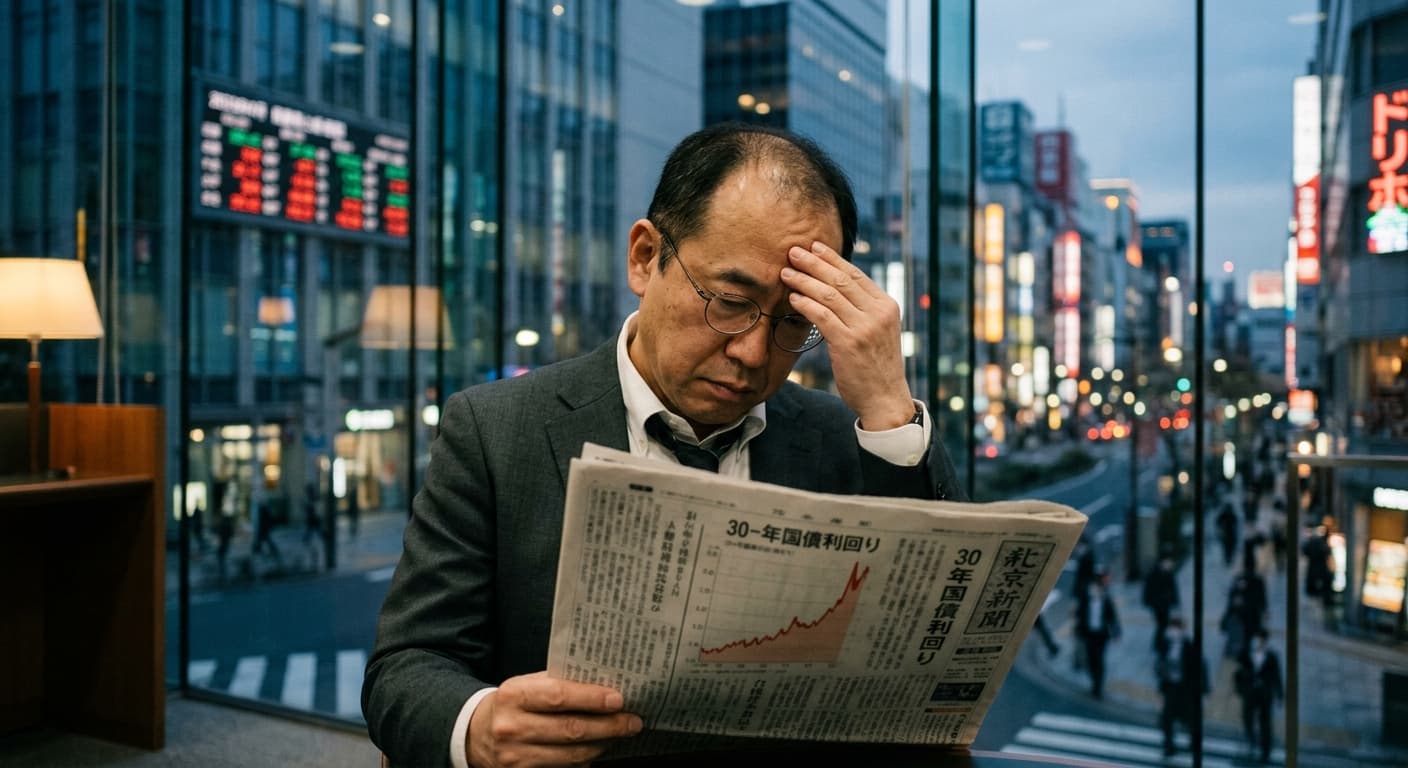
Japan's 30-Year Bond Yield Shock Puts the Global Carry Trade on Notice
Japan's 10-year JGB yield hit 2.828% on July 7, 2026 — a 30-year high forcing a rethink of the yen carry trade, US Treasury demand, and crypto's macro backdrop.
The market story of July is not the Federal Reserve. It is Tokyo. Japan's 10-year government bond yield climbed to 2.828% on July 7, 2026 — its highest level since 1999 — three weeks after the Bank of Japan raised its policy rate to 1%, the loftiest since 1995. The thesis is simple and consequential: the world's largest creditor nation is now paying real yields at home for the first time in a generation, which mechanically reprices every risk asset funded on cheap yen — from US Treasuries, where Japanese institutions hold roughly $1.2 trillion, to bitcoin, whose July rally stalled the moment the JGB curve steepened. Japan is no longer the world's monetary shock absorber. It is now the shock.
The trigger: a fiscal-monetary collision Takaichi cannot resolve
The proximate cause is a clash between Prime Minister Sanae Takaichi's spending agenda and the BOJ's normalization path. Since her February 8 landslide, Takaichi has pledged to suspend the 8% consumption tax on food for two years — a package the Economist estimates would cost roughly ¥5 trillion ($32 billion) a year, or about 6% of expected tax receipts, according to the Economist's Jan. 21 analysis. The bond market's answer arrived on January 20, when the 30-year JGB yield jumped a quarter point in a single session — the sharpest daily move since 1999 — and the 40-year pierced 4% for the first time on record, as
Al Jazeera reported.
The BOJ hiked into that storm. On June 16, the Policy Board voted 7-1 to lift the benchmark to 1%, citing pass-through from the US-Israel-Iran oil shock — Japan imports roughly 95% of its crude from the Middle East — and warning of "risk of underlying CPI inflation deviating upward" above target, per Al Jazeera's account of the meeting. Governor Kazuo Ueda missed the vote from a hospital bed, treated for an infected liver cyst,
the BBC reported — a communication vacuum at exactly the moment markets needed clarity. In the same meeting, the BOJ committed to continue tapering JGB purchases by about ¥200 billion per quarter, reaching roughly ¥2 trillion monthly from April 2027, according to
the BOJ's official plan document.
Takaichi wants a weaker yen and cheaper debt service. The BOJ, under Ueda's deputies, is walking the other way. In an environment where the IMF's neutral-rate estimate for Japan sits between 1.1% and 2.2%, per its 2026 Article IV staff report, that leaves at least another 25–125 basis points of hiking priced in. The bond market has decided not to wait.

Why crypto flinched — and why it will flinch again
The transmission from a Tokyo JGB auction to a bitcoin order book runs through one channel: the yen carry trade. Borrow cheaply in yen, swap into dollars, buy anything with a positive expected return — Treasuries, Nasdaq, gold, BTC. When Japanese yields rise and the yen threatens to strengthen, that trade turns negative-carry and negative-convexity at once. The August 2024 mini-crisis — when a modest BOJ hike to 0.25% helped drive a 12.4% one-day drop in the Nikkei on August 5, the steepest since 1987 — remains the template, and the IMF's 2025 Article IV report documents the mechanics in detail: forced deleveraging in FX metastasized into equity vol, options gamma, and cross-asset margin calls.
The scale is not trivial. The Center for Strategic and International Studies puts pure yen-funded positions at roughly ¥80 trillion (about $500 billion) before the August 2024 unwind, with total global carry exposure across yen, franc and euro funding at more than $3.6 trillion — about 3.5% of global GDP, according to CSIS's 2025 systemic-risk analysis. The April 2026 Global Financial Stability Report flagged the same vulnerability, warning that "an unwinding of yen carry trades could affect global capital flows," per
the IMF GFSR chapter 1 text.
Crypto sits at the leveraged end of that chain. Each BOJ hike cycle since 2024 has coincided with a 20–30% bitcoin drawdown inside the following weeks, and the pattern held this month: bitcoin's 8% seven-day rally on softer US rate expectations stalled almost exactly when the 10-year JGB pierced 2.80%. This is not because Japanese pension funds trade coins. It is because the marginal risk-asset dollar is levered, and its funding cost is set in Tokyo.
The bigger loser is the US Treasury market
The angle most crypto-focused coverage misses: the deeper wound is in Washington, not on-chain. Japanese investors held roughly $1.2 trillion in US Treasuries as of November 2025 — more than any other foreign group — a figure cited in Al Jazeera's global-jitters explainer. When domestic 30-year JGBs yield 4% currency-unhedged, the calculus for a Japanese life insurer or pension fund flips. Repatriation is now the base case, not the tail scenario. The Financial Times has reported fund managers explicitly
betting on JGB-driven Treasury outflows since the January selloff, when 30-year US Treasury yields hit their highest since September in sympathy with the Tokyo move.
Auction data tell the same story from the other side. A June 40-year JGB sale drew the weakest demand in 10 months, with a bid-to-cover ratio of 2.127 — the lowest for that tenor since 2011 — per Financial Times coverage. Foreign investors expanded their share of JGB auctions substantially through 2025, offsetting a structural retreat by domestic buyers, according to
the IMF Article IV staff analysis — but that shift has also made the market "more sensitive to fiscal news and global developments," in the IMF's language. The 30-year-to-two-year JGB spread has widened to levels not seen in a quarter century.
Winners and losers, named. Winners: Japanese banks and insurers, whose net interest margins have expanded materially — the IMF puts the total capital adequacy ratio for internationally active Japanese banks at 17.1% as of March 2025, up from 16.5% a year earlier. Domestic savers, finally paid on deposits. And, over time, the yen itself, once positioning cleans out. Losers: the US Treasury (higher term premia on a $37 trillion debt stock), leveraged macro funds still short vol, emerging-market sovereigns paying dollar coupons, and crypto's marginal buyer — the one funded on cheap yen through a prime broker in Singapore.
The historical parallel that reframes this
The comparison analysts keep reaching for is August 2024. The better one is 1998–1999. In 1998, a sudden yen appreciation from ¥147 to ¥112 in two months blew up Long-Term Capital Management, forced the Fed into emergency cuts and reset global risk pricing for a year. Today's yen sits near four-decade lows against the dollar, positioning is arguably more crowded than 1998, and the leveraged asset universe is larger by orders of magnitude — with crypto, private credit and passive equity flows all layered on top. The IMF's own staff note that a "large portion of yen movements since mid-2025 cannot be accounted for" by fundamentals like rate differentials or oil, and has instead co-moved with futures-market positioning, per the 2026 Article IV report. Translation: the yen is being driven by leverage, not economics. That is exactly the setup that snaps.
There is one crucial difference from 1998: Japan's debt stock is now 230–250% of GDP, the highest in the advanced world, as Cryptobriefing's coverage of the yen slide notes. That constrains both fiscal and monetary tools. Every 100 basis points of higher long-end yield adds structural interest expense that the Takaichi government must either finance, monetize, or offset with cuts she has explicitly ruled out. This is why the BOJ's Naoki Tamura dissented on June 16, arguing long-term rates should be left to the market, per the
BOJ's own vote record — he understands the corner the central bank is being maneuvered into.
What to watch next
Three concrete catalysts sit on the calendar.
- July 29, 2026: BOJ inflation-linked bond auction and next quarterly purchase schedule announcement (August dates published July 31). Any surprise reduction beyond the ¥200 billion quarterly taper accelerates the selloff.
- July 30–31, 2026: BOJ Monetary Policy Meeting. Market pricing implies roughly a 55% probability of a further 25bp hike, per pre-meeting positioning reported by
BitRss. A hike at 1% → 1.25% would be the fastest cumulative tightening in Japan since 1990.
- Autumn 2026 supplementary budget: Takaichi's food-tax suspension is expected to move to legislation. Bid-to-cover ratios at 30- and 40-year JGB auctions in the two weeks after tabling are the single cleanest signal of fiscal credibility.
Diplomat View
The consensus reading — "Japan hikes, crypto wobbles" — misses the structural shift. Our call: the yen carry trade is being dismantled in slow motion, and the repricing is not finished. The 10-year JGB has another 40–80 basis points to travel before it clears the IMF's neutral-rate midpoint, and the 30-year is likely to remain above 4% through year-end unless the Ministry of Finance restructures issuance toward the belly of the curve — which it began doing in June 2025 and will likely accelerate. The forecast changes on two conditions: (1) a coordinated US-Japan FX intervention that includes explicit swap-line activation — the New York Fed inquiry reported in January was a rehearsal, not the play — or (2) a fiscal reversal by Takaichi, which her two-thirds Diet majority makes politically unnecessary. Absent those, expect Treasury term premia to grind higher, the yen to strengthen in fits toward ¥145, and risk assets — including bitcoin — to trade the JGB tape more closely than the FOMC's. The last time Tokyo mattered this much to a New York crypto desk was never. That is the story.
The Bottom Line
Japan's 30-year borrowing-cost high is not a local bond story — it is the slow-motion end of the world's cheapest funding source, and the repricing will be paid for in US Treasury term premia, EM dollar debt, and the leveraged tail of crypto. The BOJ's July 30-31 meeting and Takaichi's autumn budget are the two dates that decide whether this is an orderly transition or the 1998 rerun that macro funds have been quietly hedging for a year.
Discover more

US Politics
SNAP Food Assistance Faces Legal Challenges
In 2026, SNAP faces stricter eligibility rules and mounting legal challenges, threatening food assistance for the millions of Americans who rely on the program.
India
Rajnath Singh's Durga Squad for 2026 Polls
Rajnath Singh's Durga Squad promised women's safety in Bengal but has since disappeared from the agenda, revealing BJP's true priorities.

India
Delhi CM Rekha Gupta Blasts Opposition's Delm
Delhi CM Rekha Gupta's remarks on women's quota defeat reveal BJP's strategy for the 2029 Lok Sabha elections, focusing on delimitation.

Economics
Fed's Amex AML order puts correspondent banking on notice
Federal Reserve's Amex AML order requires board-level controls and a 90-day plan; OCC fined the bank $350 million over enterprise-wide deficiencies.