Japan's 30-Year Bond Yield High Is a Global
Market signals loss of faith in Japan's fiscal policy.
Model Diplomat8 min readAsia
Japan's 30-Year Bond Yield High Is a Global Warning Shot
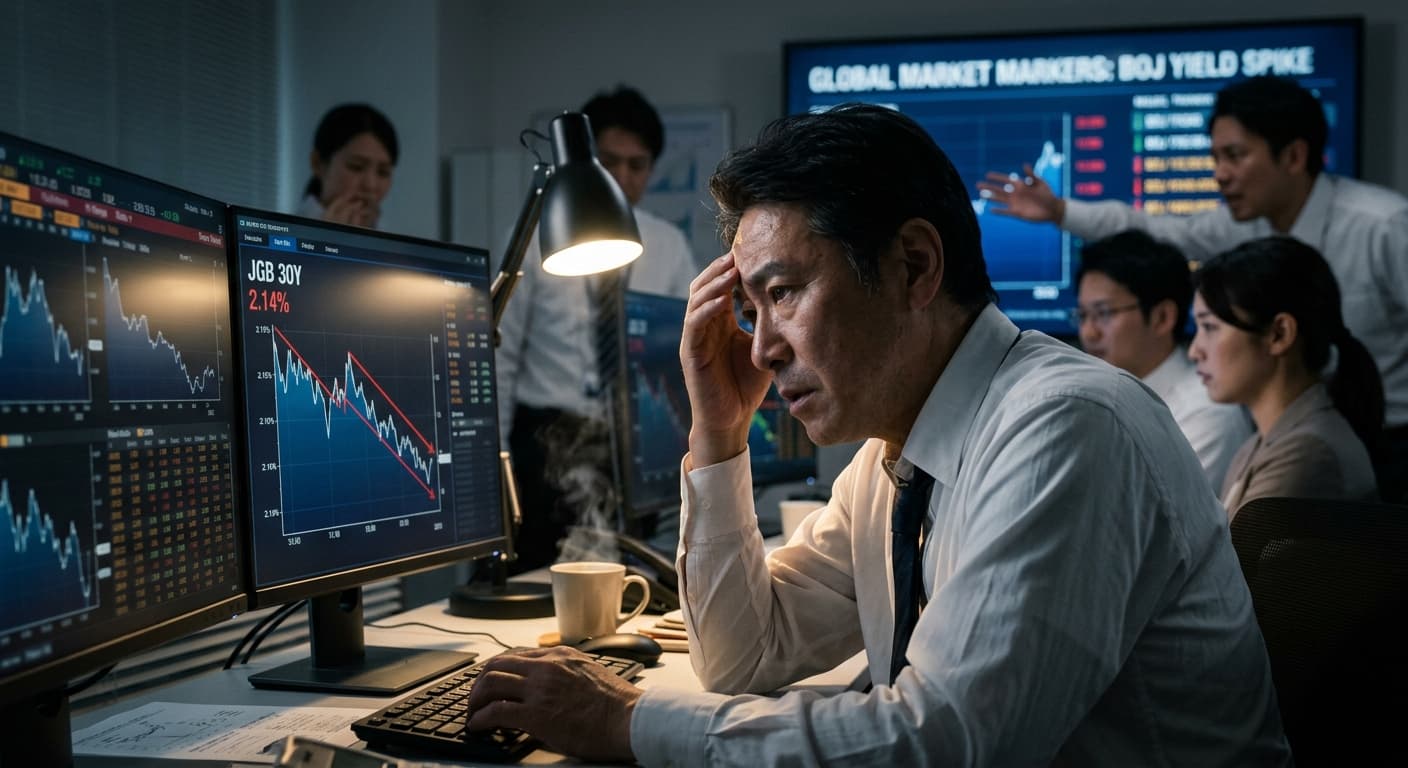
Japan's 10-year JGB hit 2.88% on July 9, 2026 — a 30-year high. The message: markets no longer trust Tokyo's fiscal or inflation math, and the shock will not stay local.
Japan's benchmark 10-year government bond yield hit 2.88% on Thursday, its highest since September 1996, and the spread over 2-year paper blew out to 143 basis points — the widest since 2004. That combination is the signal that matters: investors have stopped believing that the Bank of Japan can normalise policy at the pace Prime Minister Sanae Takaichi's ¥370 trillion spending programme now requires. Because Japan is the world's largest net creditor and the anchor of the global carry trade, that loss of faith does not stay in Tokyo — it lifts term premia everywhere.
According to Channel NewsAsia, citing Reuters, the 10-year JGB has now risen for nine straight sessions — the longest streak in 19 years — while a sale last week saw demand fall to its weakest since April. Yields at multi-decade highs are, for the first time in a generation, failing to attract buyers.
What broke this week
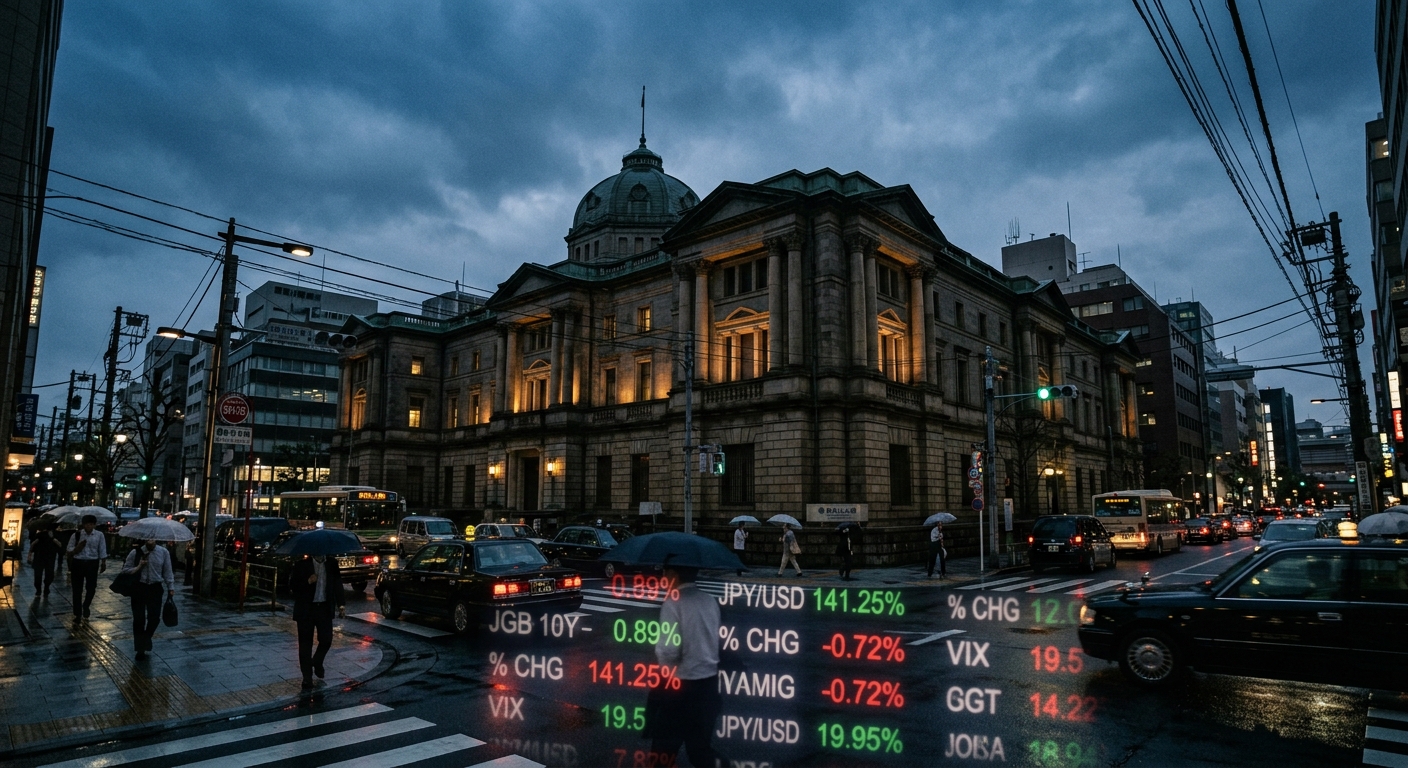
The immediate trigger is a policy mismatch investors can no longer ignore. On June 16, 2026, the Bank of Japan raised its policy rate to 1%, the highest since 1995, in a 7–1 vote citing imported inflation from the U.S.–Israel war on Iran, as Al Jazeera reported. Core inflation excluding food and fuel is running at 3% — a full point above target — and swap markets now price an 87% probability of another 25-basis-point hike at the BOJ's December meeting, according to LSEG data cited by Reuters.
Yet Takaichi's cabinet unveiled an economic blueprint last month that markets read as a pre-emptive constraint on the central bank. Mizuho Securities analysts told Reuters the document reinforced the impression that the government treats accommodative monetary policy as a prerequisite for its public-private growth programme and would be "unlikely to look favourably" on further rate hikes. Tokyo is now reportedly considering revising the language of the blueprint to calm the selloff.
That is the fiscal-monetary clash in a sentence. The BOJ is trying to hit inflation, and the government's spending arithmetic requires that it not.
The number that alarms the IMF
The IMF's 2026 Article IV Consultation on Japan, published in April, put a precise floor and ceiling on where BOJ policy is supposed to go: the neutral nominal rate is estimated at 1.1% to 2.2%. At 1%, the policy rate is still below the low end of neutral. That is why long yields keep rising — the market is doing the tightening the BOJ is not.
The Fund's staff was blunt about the fiscal side. "Near-term fiscal policy should refrain from further loosening," it warned, and "the authorities should avoid reducing the consumption tax, an untargeted measure that would erode fiscal space and add to fiscal risks." Yet the LDP won a supermajority in February 2026 precisely on a pledge to suspend the 8% consumption tax on food for two years — a measure that, according to Japanese government estimates cited by Al Jazeera, would blow a ¥5 trillion (~$32 billion) annual hole in revenue.
The IMF also flagged the structural shift under the surface: "Foreign investor participation in JGB auctions expanded substantially in 2025, helping to offset the structural decline in domestic investor demand… Their growing participation may be making the bond market more sensitive to fiscal news and global developments." Translation: Japan's domestic buyer base is thinning, and the marginal buyer is now a foreign investor who does not distinguish JGBs from any other advanced-economy sovereign trade.
Why this leaves Japan and hits everyone else
Japan is not a normal sovereign borrower. It is the world's largest net creditor — a $3.2 trillion net foreign asset position, per an IMF Selected Issues paper — and its institutions have spent two decades exporting savings into U.S. Treasuries, European sovereigns and dollar credit. When JGB yields rise, that capital has less reason to leave home.
The empirical link is well documented. The IMF's spillover work finds that a 100-basis-point rise in the JGB yield curve slope lifts the U.S. Treasury curve slope by roughly 10 basis points on average within six months. Bond-purchase spillover research collected by the IMF shows one-third to two-thirds of Fed-driven yield shocks pass through to other mature markets — and the reverse channel operates in Japan's direction too. In January 2026, when 40-year JGB yields pierced 4% for the first time on Takaichi's tax-cut announcement, U.S. 30-year Treasury yields promptly rose to their highest level since September,
Al Jazeera reported.
Sayuri Shirai, professor of economics at Keio University and a former BOJ policy board member, put the mechanism plainly in that piece: "If Japanese government bond yields rise, Japanese investors can earn more at home, potentially reducing demand for foreign bonds; that can nudge global yields and risk pricing."
That is the transmission belt now moving. The Financial Times reported RBC Capital Markets analysts arguing that "for the first time since 2020, Japanese investors will soon have yields high enough to stay at home" — a "moment of pivotal change" in global capital allocation. If the Government Pension Investment Fund, Japan Post Bank, life insurers and Norinchukin all repatriate at the margin, the buyer of last resort in dozens of foreign fixed-income markets thins simultaneously.
The Abenomics compact is dead — Takaichi has not replaced it
Takaichi campaigned as Shinzo Abe's political heir, but the macro backdrop she inherited inverts Abe's problem. Abe faced deflation, a strong yen and a smaller China; Takaichi faces 3% core inflation, a yen roughly 25% below its 2021 real effective level (per the IMF), and a China that is now Japan's largest trading partner. Brookings analysts Christopher Johnstone and Adam Liff called the resulting "Sanaenomics" a mix of "fiscal spending and industrial policy" that has already "rattled the bond market with her campaign proposal to freeze the food consumption tax for two years," in their post-election analysis.
The finance ministry has tried to buy time. Its FY2026 debt management plan cut super-long-term bond issuance — 40-, 30- and 20-year tenors — by ¥100 billion per month, while holding medium-term issuance steady, an explicit response to weak demand at the ultra-long end. Total FY2026 issuance is set at ¥180.7 trillion, down ¥8.9 trillion from the supplementary FY2025 plan. That worked briefly in May, when 30- and 40-year yields subsided. It is not working now, because the mistrust has migrated from the 40-year to the 10-year — the benchmark the BOJ cannot easily paper over without abandoning normalisation entirely.
The BOJ's own balance-sheet retreat compounds the problem. Under its extended purchase plan, the pace of balance-sheet reduction rises from about 7% of GDP in 2025 to close to 9% in 2026, according to the IMF, with JGB holdings projected to fall to 69% of GDP by March 2027 — a cumulative 22-percentage-point reduction. IMF staff estimate that pace alone adds about 9 basis points of term premium to JGB yields in 2026. The state buyer that absorbed a decade of issuance is walking away as the state's issuance needs rise.
Who wins, who loses
The winner is the domestic saver. For the first time since the 1990s, a Japanese household or life insurer can earn a positive real return on a domestic government bond without currency risk. Bank net interest margins are widening — the IMF notes major banks' total capital adequacy ratio rose to 17.1% by March 2025 — and insurer investment margins are improving.
The losers cluster in three places. First, the Ministry of Finance itself: every 100-basis-point rise in the average yield on Japan's ¥1,200-trillion-plus debt stock adds structural interest expense on a base where debt-to-GDP already exceeds 200%. Second, leveraged carry-trade positions in dollar credit, emerging-market local-currency bonds and gold, all of which have been implicitly funded by cheap yen. Third, foreign sovereign issuers that have relied on the marginal Japanese bid — the U.S. Treasury included.
The Brookings analyst Robin Brooks argued in an earlier piece that Japan's high debt "forces the Bank of Japan to cap long-term government bond yields… In effect, this transfers weak debt dynamics from the bond market to the currency." That trade-off is now reversing in real time: with the BOJ hiking and the MOF unable to cap, the pressure is moving back from the yen to the bond market. Which is exactly what a 143-basis-point 10-2 curve is telling you.
What to watch
- August 2026 auctions. Demand at the 20- and 30-year tenors will show whether foreign buyers step in at these yields or whether the MOF has to cut super-long issuance again.
- BOJ December 18–19, 2026 meeting. Swaps price 87% odds of a hike to 1.25%. A hold — under political pressure from Takaichi — would be the more destabilising outcome, confirming the market's suspicion that the government has captured the policy path.
- Cabinet blueprint revision. Tokyo is reportedly redrafting the language investors read as fiscal-first. Watch for whether the ¥370 trillion FY2040 investment envelope is retained without a specified funding source.
- The food consumption tax bill. The two-year suspension, if introduced without an offset, is the ¥5-trillion-a-year test of the "responsible and proactive" framing.
Diplomat View
The right frame for this week is not a Japanese bond wobble. It is a regime change in the world's largest creditor economy — from an exporter of duration and volatility suppression to a net importer of both. That change is not reversible on any horizon Takaichi controls, because it flows from three structural facts converging at once: inflation running 100 basis points above target, a domestic buyer base that has aged out of JGBs, and a government whose electoral mandate is to spend more than the fiscal arithmetic supports. Our call: 10-year JGB yields settle in a 2.6%–3.1% range through year-end, with the risk skewed higher if the BOJ blinks in December. The base case flips only if two conditions are met — the Takaichi cabinet formally attaches a funding offset to the food-tax cut, and the BOJ hikes to 1.25% on schedule. Absent that pairing, expect a further 5–10 basis-point rise in U.S. Treasury term premia through Q4 as Japanese institutional demand rotates home. The Abenomics compact has been quietly buried; nothing coherent has replaced it.
The Bottom Line
Japan's 30-year yield high is not a domestic story. It is the market pricing the end of a two-decade arrangement in which the world's largest creditor kept global yields down by keeping its own yields flat. With the BOJ boxed in between 3% inflation and a fiscally expansive Takaichi government, that arrangement is over — and the term premium is coming back into every major bond market that ever benefited from it.
Related: Global Politics
Discover more
US Politics
SNAP Food Assistance Faces Legal Challenges
In 2026, SNAP faces stricter eligibility rules and mounting legal challenges, threatening food assistance for the millions of Americans who rely on the program.

India
Delhi CM Rekha Gupta Blasts Opposition's Delm
Delhi CM Rekha Gupta's remarks on women's quota defeat reveal BJP's strategy for the 2029 Lok Sabha elections, focusing on delimitation.
India
Rajnath Singh's Durga Squad for 2026 Polls
Rajnath Singh's Durga Squad promised women's safety in Bengal but has since disappeared from the agenda, revealing BJP's true priorities.

Economics
Fed's Amex AML order puts correspondent banking on notice
Federal Reserve's Amex AML order requires board-level controls and a 90-day plan; OCC fined the bank $350 million over enterprise-wide deficiencies.