Japan's $2.3 Trillion Bond Market Stress Test
Takaichi's $2.3 trillion plan shatters the yen-bond inverse
Model Diplomat9 min readEast Asia and Pacific
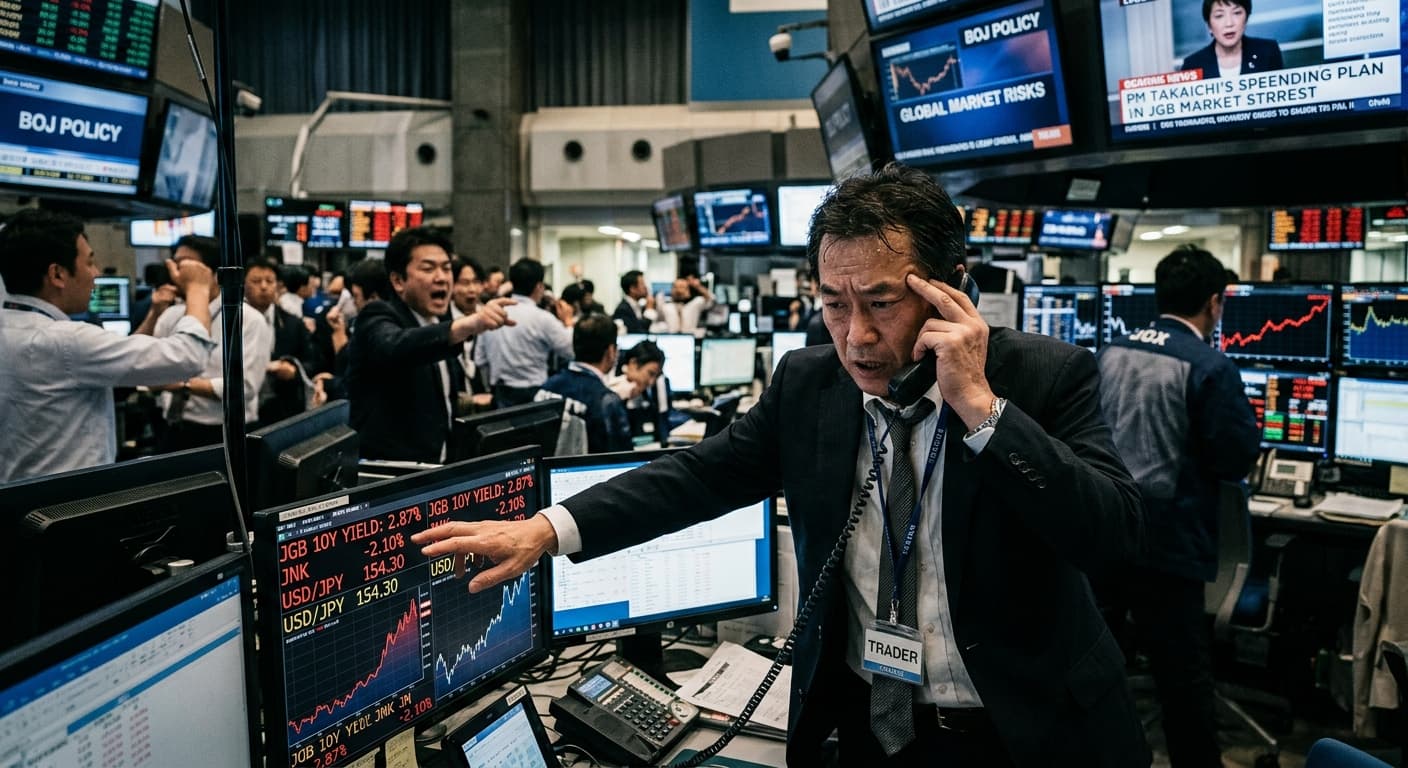
Japan's $2.3 Trillion Gamble Is Breaking Its Bond Market
Japan's bond yields surged to multi-decade highs as Takaichi's $2.3 trillion spending plan breaks the yen-bond inverse, threatening global spillover through Japanese-held US Treasuries.
Japan's 10-year government bond yield climbed to 2.87% in July 2026, the highest since 1996, as Prime Minister Sanae Takaichi's $2.3 trillion, 14-year spending plan shattered the decades-old inverse relationship between the yen and Japanese government bonds. The break creates a stress test that runs through the world's second-largest sovereign debt market and $1.2 trillion of Japanese-held US Treasuries.
For decades, Japan's financial system operated on a simple duality: the Bank of Japan kept interest rates near zero, the yen stayed weak, and bond prices stayed stable. Investors could treat currency frailty and bond-market strength as two sides of the same policy coin. That relationship is now broken. The yen and JGB prices are falling together, and when bond prices fall, yields rise. The 10-year yield recently reached 2.87%, its highest since 1996, while the 30-year climbed above 4%, according to Altimetry.
The trigger is Takaichi's plan to spend $2.3 trillion over 14 years, targeting semiconductors, AI, healthcare, and defense. This comes on top of a ¥21.3 trillion ($137 billion) stimulus approved in November 2025 and a campaign pledge to suspend the food consumption tax for two years, creating an estimated ¥5 trillion ($31.7 billion) annual revenue shortfall, Al Jazeera reported.
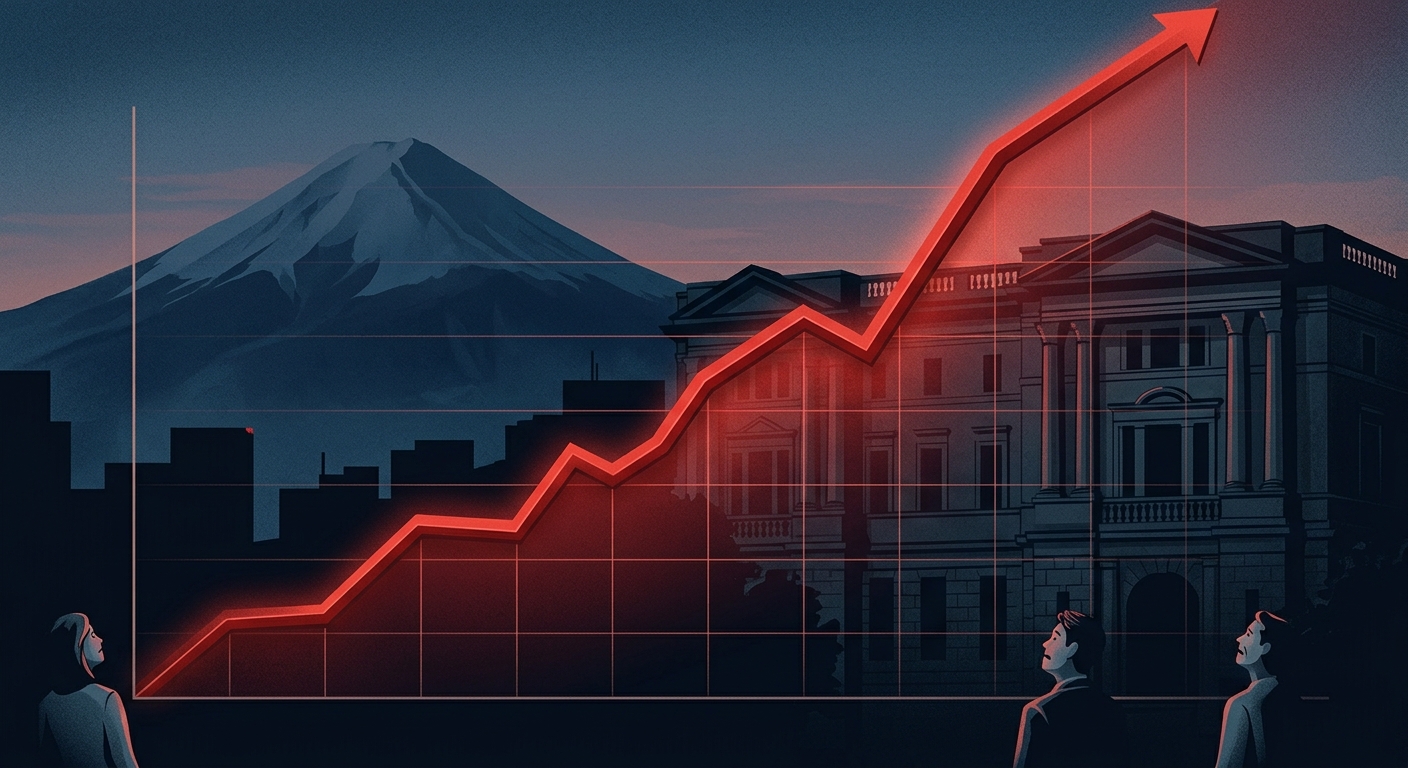
The Broken Inverse
The yen-bond inverse was the load-bearing pillar of Japan's financial architecture for two decades. Low rates made the yen unattractive, pushing capital abroad in search of yield — the so-called carry trade — while the BOJ's bond purchases kept JGB prices elevated. The yen absorbed the pressure; the bond market didn't have to.
That mechanism is now in open failure. On January 20, 2026, the 30-year JGB yield rose by a quarter percentage point in a single day, the largest move since 1999, and the 40-year yield pierced 4% for the first time on record, The Economist reported. The sell-off reflected investors' recognition of a clash between the central bank, which was preparing to raise rates, and a government whose spending plans signaled fiscal expansion.
Robin Brooks of the Brookings Institution argues that yen weakness was never simply about monetary policy divergence. It was a symptom of Japan's debt burden forcing the BOJ to cap long-term yields, effectively transferring weak debt dynamics from the bond market to the currency. The BOJ and the Ministry of Finance were, in his words, "canceling each other out," with the central bank's bond buying undermining the MOF's yen-intervention purchases, according to Brookings.
The BOJ has been scaling back bond purchases as part of its exit from ultra-loose policy, with holdings falling from 91% of GDP in June 2024 to roughly 80% by early 2026, according to the IMF's 2026 Article IV Staff Report. That reduces the central bank's capacity to cap yields and leaves the market to price fiscal risk on its own.
The Interest-Bill Arithmetic
Japan's gross government debt stands at approximately 228% of GDP — the highest among major economies — though the IMF projects it will decline to roughly 203% by 2026 and 193% by 2031, supported by nominal growth that exceeds the effective interest rate, the IMF estimated in its April 2026 Article IV consultation.
The debt trajectory turns upward again from the mid-2030s as interest payments and age-related spending accelerate. Interest expenditure is projected to rise by about 0.3% of GDP per year as old debt is refinanced at higher yields, from 1.5% of GDP in 2025 to roughly double by 2031 and above 4% of GDP by 2036, according to the IMF.
The IMF's forecast assumes a favorable maturity structure — average residual maturity of 9.5 years — that slows the pass-through from market yields to government interest payments. The FY2026 budget features the lowest Bond Dependence Ratio in years at 24.2%, and the primary balance turned to surplus for the first time in 28 years, according to the IMF's 2026 Article IV.
But Takaichi's spending plans threaten that improvement. The IMF projects the primary deficit will widen from 0.9% of GDP in 2025 to 1.5% in 2026, reflecting the supplementary budget and an assumption that supplementary spending will continue. The fund recommends fiscal adjustment of 0.2% of GDP per year in 2026-2027, rising to 0.3% from 2028, to keep debt on a downward path.
The bond market is pricing the risk that Takaichi's agenda overwhelms that adjustment. Goldman Sachs expected the BOJ to raise its policy rate to 1.5% by 2027 and the 10-year yield to reach 2% by end-2026, according to the Financial Times. The yield has already blown past that forecast, and the market is now testing whether 3% becomes the new ceiling.
The $2.3 Trillion Industrial Bet
Takaichi's $2.3 trillion plan is not indiscriminate stimulus. It is an industrial-policy program aimed at sectors where Japan has fallen behind the United States and China — semiconductors, AI, healthcare, and defense — and where the government believes targeted spending can generate the growth needed to outpace the rising debt burden, according to Altimetry.
The semiconductor push is the centerpiece. Japan invested $27 billion in its chip industry between 2020 and early 2024 — a larger commitment relative to GDP than the US CHIPS Act — and unveiled a $65 billion AI and semiconductor package in late 2024, BBC News reported. The Government has invested $12 billion in Rapidus, a consortium of Japanese firms including Toyota, Sony, Softbank, and NEC, which is building a cutting-edge 2-nanometer foundry in Hokkaido with technology licensed from IBM.
The scale is significant: Japan's semiconductor support amounted to 0.71% of GDP between 2022 and 2025, compared with 0.21% for the US and 0.41% for Germany, according to Brookings. METI has called the effort a "national project" to ensure Japan "remains strategically essential and strategically independent amid the conflict for technological hegemony between the United States and China."
Takaichi's economic strategy — dubbed "Sanaenomics" — differs from predecessor Shinzo Abe's Abenomics in one critical respect: it operates in an inflationary environment, not a deflationary one. The fiscal-spending thrust is similar, but the context means bond investors are far less tolerant of expansion, according to Brookings. The line between economics and security is also blurring: Takaichi is targeting the defense sector as part of "crisis-management" industrial policy, and Japan is moving toward defense spending of 2% of GDP,
CSIS noted.
Corporate Japan is confirming the investment cycle. Private bank lending has been growing at 4.5-5.5% year over year, and corporate bond issuance has risen approximately 7%, even after the BOJ raised its policy rate to 1% in June 2026 — the highest since 1995, according to Altimetry and
BBC News. The IMF's estimate of the neutral nominal rate sits between 1.1% and 2.2%, meaning monetary policy is still accommodative even at 1%, the
IMF assessed.
The Global Spillover Channel
The bond sell-off is not Japan's problem alone. Japanese investors held $1.2 trillion in US Treasuries as of November 2025 — more than any other foreign group of buyers — and the sell-off in JGBs has already reverberated through global markets, with yields on 30-year US Treasuries rising to their highest level since September, Al Jazeera reported.
US Treasury Secretary Scott Bessent expressed concern about the impact of Japan's bond market on US Treasury prices and said he anticipated Japanese counterparts would "begin saying the things that will calm the market down," according to Al Jazeera. The Federal Reserve Bank of New York inquired about the cost of exchanging yen for dollars — a signal of intervention coordination.
The mechanism is straightforward: as JGB yields rise, Japanese investors can earn higher returns at home, reducing demand for foreign bonds. Sayuri Shirai, a professor of economics at Keio University, told Al Jazeera that "Japan matters globally through flows. If Japanese government bond yields rise, Japanese investors can earn more at home, potentially reducing demand for foreign bonds; that can nudge global yields and risk pricing."
The Council on Foreign Relations estimates that Japanese institutional investors — led by Japan Post Bank, with over $1.5 trillion in retail deposits, and the Government Pension Investment Fund — still hold more than $2 trillion in foreign bonds. A forced unwind, driven by capital losses on JGB holdings coinciding with income losses on hedged foreign bonds, would be the "truly catastrophic scenario," CFR warned.
An IMF working paper on the "decoupling of dollar and Treasury privilege" found that the convenience yield on US Treasuries has turned negative across all maturities for G10 currencies except Japan, suggesting that the special status of US government bonds is eroding as relative supply shifts, according to the IMF.
Who Wins, Who Loses
The winners of this stress test are Japanese domestic corporates — particularly semiconductor equipment makers, automation firms, defense contractors, and advanced manufacturers — who benefit from government spending and a weaker yen. Rapidus consortium members Toyota, Sony, Softbank, and NEC are direct beneficiaries of the $12 billion government investment, according to BBC News. Japanese banks are also winning: the IMF reports that gradual rate hikes have lifted net interest margins, with the total capital adequacy ratio for internationally active major banks rising to 17.1% as of March 2025, according to the
IMF's 2026 Article IV.
The losers are holders of long-dated JGBs — particularly domestic institutions with mark-to-market exposure. The IMF's 2024 Financial Sector Assessment identified sizable security holdings under mark-to-market accounting as a key vulnerability, with updated stress tests indicating "pockets of vulnerability" among smaller regional banks, the IMF FSAP found. The TOPIX rose 23% and the Nikkei 225 rose 27% in 2025 on strong corporate earnings, but equity gains mask accumulating paper losses in bond portfolios.
The global bond market is also a loser if Japanese demand fades. Japanese investors have already turned into net sellers of long-term government bonds, and the large flow into global fixed income from Japanese institutional investors over the last decade is expected to dwindle, CFR assessed.
Key Takeaways
- Japan's 10-year JGB yield reached 2.87% — the highest since 1996 — and the 30-year topped 4%, as the yen and JGB prices fall together for the first time in decades.
- Takaichi's $2.3 trillion, 14-year spending plan targets semiconductors, AI, and defense, aiming to outrun a rising debt burden that the IMF projects will consume 4% of GDP in interest by 2036.
- The BOJ raised its policy rate to 1% in June 2026 — the highest since 1995 — but the neutral rate is estimated at 1.1-2.2%, meaning policy remains accommodative.
- Japanese investors hold $1.2 trillion in US Treasuries; rising JGB yields could trigger repatriation, pushing global borrowing costs higher.
- The stress test's outcome hinges on whether nominal GDP growth outpaces the effective interest rate — a condition the IMF projects will hold through 2031 but reverse after 2035.
Diplomat View
The bond market is right to stress-test Takaichi's fiscal gamble but likely wrong about the probability of a near-term crisis. Japan's domestic investor base, long debt-maturity profile of 9.5 years, and the FY2026 primary-balance surplus provide buffers that make a disorderly unwind unlikely in the next 12-18 months. The real risk is slower-burning: if nominal GDP growth fails to outpace the rising effective interest rate by 2028-2030, the debt trajectory reverses and the market loses patience — at which point the BOJ has limited room to intervene without re-igniting the yen-bond clash.
The historical parallel is the US Federal Reserve's yield-curve control during World War II, abandoned in the 1951 Treasury-Fed Accord because capping yields was fueling inflation. Japan's March 2024 exit from YCC was its version of that Accord — and the bond market is now discovering what unpegged yields look like after decades of suppression.
What to watch:
- BOJ Monetary Policy Meeting, July 30-31, 2026: The key question is whether the BOJ adjusts its JGB purchase reduction plan. Governor Kazuo Ueda was hospitalized in June with an infected liver cyst and missed the June meeting,
BBC News reported, so communication from the deputy governor will be scrutinized.
- FY2027 budget draft, December 2026: The first full test of whether Takaichi's "responsible and proactive public finances" framework includes credible revenue offsets for the $2.3 trillion plan.
- 10-year JGB yield sustained above 3%: A sustained break above 3% would signal the market has lost confidence in the debt trajectory and would likely trigger coordinated intervention. The next 90 days will determine whether Takaichi's gamble is a calculated bet or a miscalculation.
Discover more
Economics
Japan's $2.3 Trillion Bond Market Revolt
Japan's 10-year JGB yield hits 2.87% as PM Takaichi's $2.3 trillion fiscal plan triggers bond sell-off, with spillovers to US Treasuries and yen carry trade.

Economics
Fed's Amex AML order puts correspondent banking on notice
Federal Reserve's Amex AML order requires board-level controls and a 90-day plan; OCC fined the bank $350 million over enterprise-wide deficiencies.

Conflict & Security
Guatemala: El Niño 2026–27 becomes regional security test
UNICEF: 25.8M children face El Niño risks in Latin America; Guatemala maps 188 municipalities for drought and food insecurity amid regional security test.

Economics
Fed's stress-test overhaul is a capital-smoothing exercise
Federal Reserve finalized stress-test overhaul: two-year averaging for bank capital buffers and public input, expected to halve volatility.