Japan's $2.3 Trillion Bond Market Revolt
PM Takaichi's fiscal expansion triggers bond sell-off, global spillovers.
Model Diplomat12 min readEast Asia
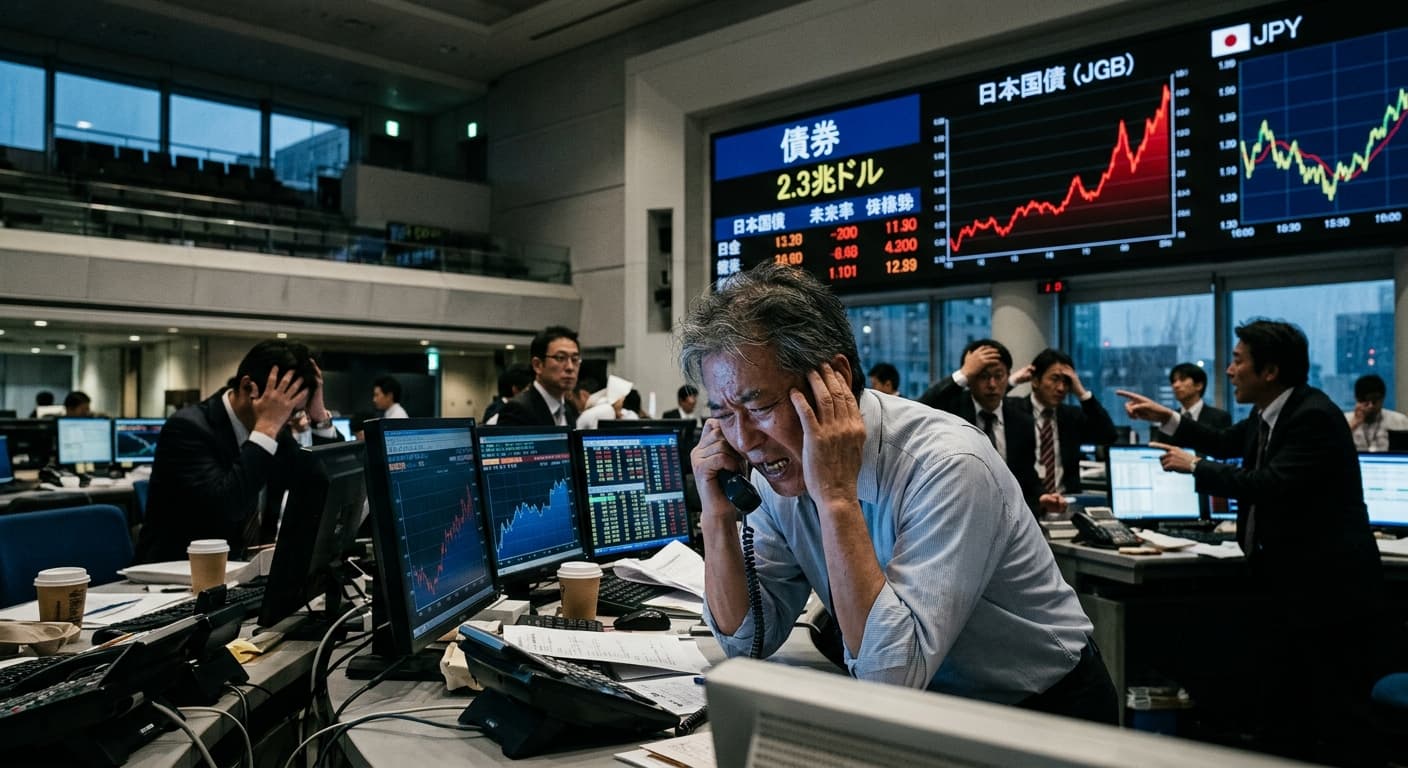
Japan's $2.3 Trillion Gamble: A Bond Market Revolt With Global Ripple Effects
Japan's historic fiscal expansion under PM Sanae Takaichi is colliding with a bond market repricing that threatens to end Tokyo's role as the world's cheapest source of funding — with spillovers from US Treasuries to the yen carry trade.
On July 16, 2026, Altimetry's Daily Authority framed the question bluntly: Japan is facing a $2.3 trillion stress test. Prime Minister Sanae Takaichi's plan to spend that sum over 14 years on semiconductors, AI, defense, and healthcare has triggered a bond-market revolt that has pushed the 10-year Japanese government bond yield to 2.87% — its highest level since 1996 — and the 30-year above 4%. The real stress test is not whether Japan can borrow the money; it is whether the global financial system can absorb the unwinding of Japan's three-decade role as the world's cheapest funding source.
The last time 10-year JGB yields sat near 3%, Bill Clinton was running for re-election and Japan's government debt was 64% of GDP. Today it is roughly 230% — the highest among advanced economies — and the yield is back at that 1996 level. The gap between then and now is the entire accumulated weight of three decades of deficit spending, quantitative easing, and yield-curve suppression. Takaichi is betting that another $2.3 trillion on top of that pile will generate enough nominal growth to compress the ratio back toward 170%. Bond investors are betting it will not — and they are pricing that scepticism in real time.
The Inverse Relationship Breaks Down
For decades, Japan's financial system operated on a stable duality. The Bank of Japan kept rates near zero, making the yen a funding currency for global carry trades. Low rates kept the yen weak and the bond market stable; investors could treat currency frailty and bond strength as two sides of one policy coin. That inverse relationship is now breaking — the yen and JGB prices are falling together, a signal that both markets are losing confidence in the same policy framework simultaneously.
Since March 2024, when the BOJ ended yield curve control, the 10-year JGB yield has roughly tripled from 0.75% to near 2.9% (AEI). The 30-year has climbed above 4%. The 40-year breached 4% for the first time on record in November 2025, as investors exited Japanese government debt en masse (
Al Jazeera). The sell-off accelerated after Takaichi unveiled plans to pause the country's consumption tax, a move the Japanese government's own data estimates would result in a revenue shortfall of roughly ¥5 trillion ($31.7 billion) each year.
The trigger is Takaichi's fiscal pivot. Elected in October 2025 with a mandate to end austerity, she unveiled the largest supplementary budget since the COVID-19 pandemic in November 2025. The package, worth ¥21.3 trillion ($137 billion), included one-time cash handouts of ¥20,000 per household (Al Jazeera). She then won a historic two-thirds super-majority in the February 8, 2026 lower-house election — the first single-party super-majority since the postwar parliament's establishment in 1947 (
Asia Pacific Foundation). Her platform promises consumption-tax relief, strategic industrial investment, and defense spending rising to 2% of GDP as early as 2026 (
IFRI;
European Parliamentary Research Service).
The super-majority means Takaichi faces no effective legislative constraint. The binding constraint has migrated from the Diet to the bond market itself. As State Street Investment Management's Stephen Loo told Al Jazeera, the turmoil reflects "a communication gap around fiscal sustainability and policy coordination" rather than solvency — but he added that "markets are likely to continue testing the feasibility of the agenda" (Al Jazeera).
The IMF's Modest-Risk Verdict vs. the Bond Market's Verdict
The IMF's April 2026 Article IV staff report assessed the overall risk of sovereign debt distress as "moderate," citing Japan's favorable maturity structure (average residual maturity of 9.5 years), deep domestic investor base, the yen's reserve-currency status, and a large stock of public-sector financial assets. The IMF projects debt falling to 203% of GDP in 2026 and 193% by 2031, as nominal growth exceeds the effective interest rate (IMF Country Report No. 26/75).
"The fiscal stance is expected to turn expansionary in 2026. Following five consecutive years of improvement, Japan's primary deficit is expected to rise from 0.9 percent in 2025 to 1.5 percent in 2026, reflecting a larger supplementary budget approved in December 2025."
The IMF also noted that sovereign bond yields have climbed rapidly, particularly at long maturities, with the 10-year JGB yield increasing by around 100 basis points in 2025 to reach 2.1% by year-end. By July 2026 it had climbed another 80 basis points. The IMF's stress-test analysis, based on the October 2025 Global Financial Stability Report's "stagflationary" scenario, found that while the Japanese banking system remained resilient in aggregate, "results vary across institutions, with some banks — including both smaller regional banks and larger institutions — experiencing sizable capital impacts under the scenario" (IMF).
The bond market is pricing something less benign than the IMF's moderate-risk assessment. An April 2026 Bruegel working paper on debt sustainability finds that under plausible baseline scenarios, Japan's debt does not stabilize without sustained primary surpluses. The required structural primary balance adjustment is 1.5 to 3.5% of GDP depending on growth assumptions — a wide band that hinges almost entirely on whether Takaichi's industrial bets generate enough nominal GDP growth. Compared to the current structural primary balance of -1.0% of GDP, this implies a fiscal reversal of dramatic proportions. The paper's central finding: "debt dynamics are highly sensitive to Japan's projected GDP growth" — and small differences in growth assumptions translate into large differences in required fiscal adjustment.
The IMF itself estimates Japan spent 1.5% of GDP on interest payments in 2025, a figure expected to more than double by 2031 as old debt is refinanced at higher rates (Altimetry;
IMF). That creates a fiscal feedback loop: higher yields raise interest costs, which widen the deficit, which pushes yields higher still.
A 2025 paper by Yili Chien, Wenxin Du, and Hanno Lustig, published in the Journal of Economic Perspectives, frames Japan's consolidated public sector as a "sovereign wealth fund fueled by borrowed money" — one that has harvested excess returns by funding long-duration risky assets with short-term liabilities. They estimate the return on Japanese government debt is at least 180 basis points per annum lower than what risk warrants, a "government debt subsidy" that is now eroding as yields normalize (RePEc/JEP;
NBER). The risk, they conclude, falls on Japanese bondholders, depositors, and taxpayers. The consolidated public sector earned an average excess return of more than 6% of GDP annually in the post-2012 period — a cushion that narrows with every basis-point increase in the funding cost.
The Global Transmission: Yen Carry Trade and US Treasuries
Japan's stress test is not contained. Japanese financial institutions hold $1.2 trillion in US Treasuries — more than any other foreign group (Al Jazeera). As domestic JGB yields rise, Japanese investors can earn more at home, potentially reducing demand for foreign bonds. Sayuri Shirai, a former BOJ board member, told Al Jazeera that "Japan matters globally through flows. If Japanese government bond yields rise, Japanese investors can earn more at home, potentially reducing demand for foreign bonds; that can nudge global yields and risk pricing."
The November 2025 JGB sell-off already reverberated overseas, with yields on 30-year US Treasuries rising to their highest since September. US Treasury Secretary Scott Bessent, in a January 2026 Fox News interview, expressed concern about the impact of Japan's bond market on US Treasury prices and said he anticipated Tokyo would "begin saying the things that will calm the market down" (Al Jazeera). The New York Fed reportedly inquired about the cost of exchanging yen for dollars — a signal that currency-market stress had reached the level of bilateral central-bank coordination.
The Bank for International Settlements estimates the yen carry trade at anywhere from $261 billion in direct cross-border bank borrowing to around $1 trillion when off-balance-sheet derivatives are included, and as much as $11.3 trillion when broader speculative short positions are counted (Atlantic Council). Desmond Lachman at the
American Enterprise Institute argues that a sustained narrowing of the US-Japan interest-rate differential, combined with yen appreciation, could trigger an unwinding that "could contribute to a rise in US government bond yields, that could be a trigger for the bursting of the artificial intelligence bubble."
The mechanism is clear and already partially operational. For years, global investors borrowed in yen at near-zero rates to finance higher-yielding dollar, euro, and emerging-market assets. As the BOJ normalizes — it raised the policy rate to 1% on June 16, 2026, a 31-year high, by a 7-1 vote (BBC;
Al Jazeera) — while the Federal Reserve cuts, the rate gap narrows. The carry trade becomes less profitable. Capital repatriates. Global yields rise.
The Atlantic Council notes that Japan posted a record current account surplus of ¥34.4 trillion ($219 billion) in FY 2025, up 15% year over year. The BOJ has intervened in FX markets to the tune of $73 billion in recent months, yet the yen remains near multi-decade lows. Bessent has ruled out joint intervention — which would likely be more effective — stressing instead the need for the BOJ to tighten further (Atlantic Council). The structural yen weakness, combined with US dollar strength, is a persistent irritant in US-Japan economic relations, with Washington keeping Japan on the Treasury's 2026 monitoring list.
The IMF's own working paper on BOJ unconventional monetary policy confirmed that BOJ policy shocks produce measurable spillovers to sovereign bond yields in other countries, with the strongest effects in markets where Japanese investors have larger participation. The unwinding of those policies produces the mirror image.
Takaichi's Industrial Bet: The Growth Case
The bullish counterargument is that Takaichi's spending is not consumption stimulus but strategic industrial investment aimed at sectors where Japan has fallen behind. The goal is to bring debt-to-GDP down to roughly 170% by the end of the spending plan through higher corporate profits and nominal growth (Altimetry).
The investment cycle is already underway. Private bank lending is growing at 4.5% to 5.5% year over year, and corporate bond issuances have risen about 7%, even after the BOJ's June rate hike to 1% (Altimetry). The
Economist reports that Rapidus — the government-backed consortium partnered with IBM to build 2-nanometer fabs in Hokkaido — has its first fabrication plant targeted for startup in 2026–2027. The consortium includes Toyota, Sony, NTT, NEC, Kioxia, SoftBank, Denso, and Mitsubishi UFJ Bank — major chip consumers expected to constitute an initial domestic market. The project has received roughly ¥330 billion ($2.5 billion) in initial government support and will require an estimated ¥5 trillion ($35 billion) to reach mass production (
CSIS).
Japan's semiconductor industry accounted for over 50% of world production at the end of the 1980s; by 2022 that share had fallen to 9%, with the domestic industry lagging global leaders by an estimated 10 years. The CSIS analysis notes that Japan has set aside longstanding postwar practices — including limits on foreign investment and aversion to foreign-owned manufacturing — to pursue this revival. Takaichi's government is also planning a "Japanese version of CFIUS" to screen foreign capital investment in sensitive sectors, modelled on the US Committee on Foreign Investment (EPRS).
The IMF's Article IV broadly endorses the growth thesis. It estimates Japan's neutral nominal policy rate at 1.1% to 2.2%, meaning the current 1% rate remains accommodative. Staff recommend continued gradual hikes toward neutral by 2027, supporting the convergence of inflation to target (IMF). Japan's spring 2026 wage negotiations yielded increases exceeding 5% for a second consecutive year, with the IMF's Article IV noting that the Cabinet Office expects real wage growth to rise to around 1% in FY 2026 as inflation gradually moderates (
IMF).
The Sceptics' Case: Demographics and the Arithmetic of Compounding
The bear case rests on demographics and the arithmetic of compounding interest. Japan's long-run potential growth is generally estimated below 1% due to a shrinking workforce (AEI). The Bruegel analysis finds that debt stabilization requires a structural primary surplus of 0.5% to 2.5% of GDP — the opposite of Takaichi's current -1.0% stance (
Bruegel).
A Peterson Institute working paper by Kenneth Rogoff and Takeshi Tashiro examines Japan's "exorbitant privilege" — its ability to borrow at yields lower than its debt profile would predict because of the safety and liquidity premium investors attach to JGBs. They find that while the bond-income wedge (foreign bond yields minus yen funding costs) remains meaningfully positive, the safe-asset/liquidity channel "appears more fragile in the tails for JGBs than for US Treasuries." In other words, Japan's borrowing advantage is more vulnerable to a confidence shock than America's.
The IMF's Article IV flagged this vulnerability, noting that "a clearly communicated policy response function is helping to avoid the sudden repricing of the yield curve and mitigate spillovers to foreign asset markets" — a statement that functions as both reassurance and warning. Should communication falter, the repricing would be sudden (IMF).
The BOJ also faces an impossible trinity of its own: raise rates to defend the yen and fight inflation, which raises government borrowing costs and deepens the fiscal hole; cut rates to support bond prices and fiscal sustainability, which weakens the yen further and imports inflation; or hold steady, which satisfies neither bondholders nor currency markets. Governor Kazuo Ueda missed the June meeting due to hospitalisation for an infected liver cyst, complicating communication around the landmark 1% decision (BBC).
Winners and Losers
The winners from this repricing are clear and specific. Japanese major banks — Mitsubishi UFJ, Sumitomo Mitsui, and Mizuho — benefit from rising net interest margins as lending rates pass through faster than deposit rates. The IMF's Article IV noted that internationally active major banks saw their total capital adequacy ratio rise to 17.1% as of March 2025, up from 16.5% a year earlier (IMF). Companies in the strategic sectors Takaichi is targeting — semiconductors (Rapidus, Tokyo Electron), defense (Mitsubishi Heavy), shipbuilding, and advanced manufacturing — stand to capture the fiscal spending directly.
The losers are equally specific. Smaller regional banks, which hold proportionally larger JGB portfolios and lack the diversified earnings of the majors, face "sizable capital impacts" under the IMF's stress scenario. Business failures among smaller firms remain elevated and near multi-year highs amid rising operating costs, labor shortages, and trade uncertainty, with defaults concentrated among SMEs and firms with stagnant sales (IMF). Japanese bondholders sitting on unrealised mark-to-market losses — particularly institutions like Norinchukin Bank, which the
CFR flagged as holding a significant portion of its bond portfolio under water at current market prices — face a slow erosion of capital. Foreign holders of US Treasuries and other sovereign debt, indirectly, face a world where the largest foreign bid for their bonds is quietly disappearing.
The Bottom Line
Japan's $2.3 trillion stress test is a wager that fiscal expansion can outrun the compounding cost of the world's largest sovereign debt pile — and the bond market is openly sceptical. The IMF says the risk is moderate; the 30-year JGB yield at 4% says otherwise. The decisive variable is nominal GDP growth: if Takaichi's industrial bets generate enough of it, the debt ratio compresses and the repricing was a rough but necessary adjustment. If they do not, Japan enters a fiscal doom loop where higher interest costs widen the deficit, which pushes yields higher, which widens the deficit again. The global transmission channel — through ¥1.2 trillion in US Treasury holdings and a yen carry trade the BIS estimates at up to $11.3 trillion — means this is not Japan's problem alone. A sustained JGB sell-off would push up borrowing costs from Washington to Frankfurt, and the unwinding of the carry trade could be the trigger that punctures risk-asset valuations globally.
What to watch:
- September 2026 BOJ policy meeting: The first rate decision after the June hike to 1%. Governor Ueda's communication on the path to neutral — the IMF estimates 1.1% to 2.2% — will determine whether the yield curve reprices orderly or violently.
- FY 2026 supplementary budget: Takaichi's first full-year budget under the super-majority, expected autumn 2026. The size and composition will signal whether the $2.3 trillion plan is front-loaded or back-loaded — and how much debt issuance the market must absorb.
- Rapidus fab startup, 2026–2027: The Hokkaido 2nm fabrication plant's pilot production timeline is the earliest concrete test of whether Japan's semiconductor revival can attract private capital beyond government subsidies. Failure to secure follow-on investment would undermine the growth thesis at the core of Takaichi's fiscal gamble.
- US-Japan bilateral engagement: Bessent's pressure on Tokyo to "calm the market" and Washington's refusal to join FX intervention put the burden of yen stabilization entirely on the BOJ — a configuration that raises the odds of faster tightening and sharper carry-trade unwinding.
Discover more

US Politics
SNAP Food Assistance Faces Legal Challenges
In 2026, SNAP faces stricter eligibility rules and mounting legal challenges, threatening food assistance for the millions of Americans who rely on the program.

India
Women’s Reservation Bill 2026
The Constitution (131st Amendment) Bill, 2026 was defeated in Lok Sabha, revealing deeper political conflicts over women's reservation and delimitation.
Global Politics
Trump's Conflicting Messages on Iran War
Trump's mixed messages on Iran reflect a strategy of audience management, benefiting Tehran amid a complex geopolitical landscape.

Economics
Fed's Amex AML order puts correspondent banking on notice
Federal Reserve's Amex AML order requires board-level controls and a 90-day plan; OCC fined the bank $350 million over enterprise-wide deficiencies.