Japan's 10-Year Yield Hits 29-Year High
Fiscal expansion and inflation drive bond yields up.
Model Diplomat7 min readAsia
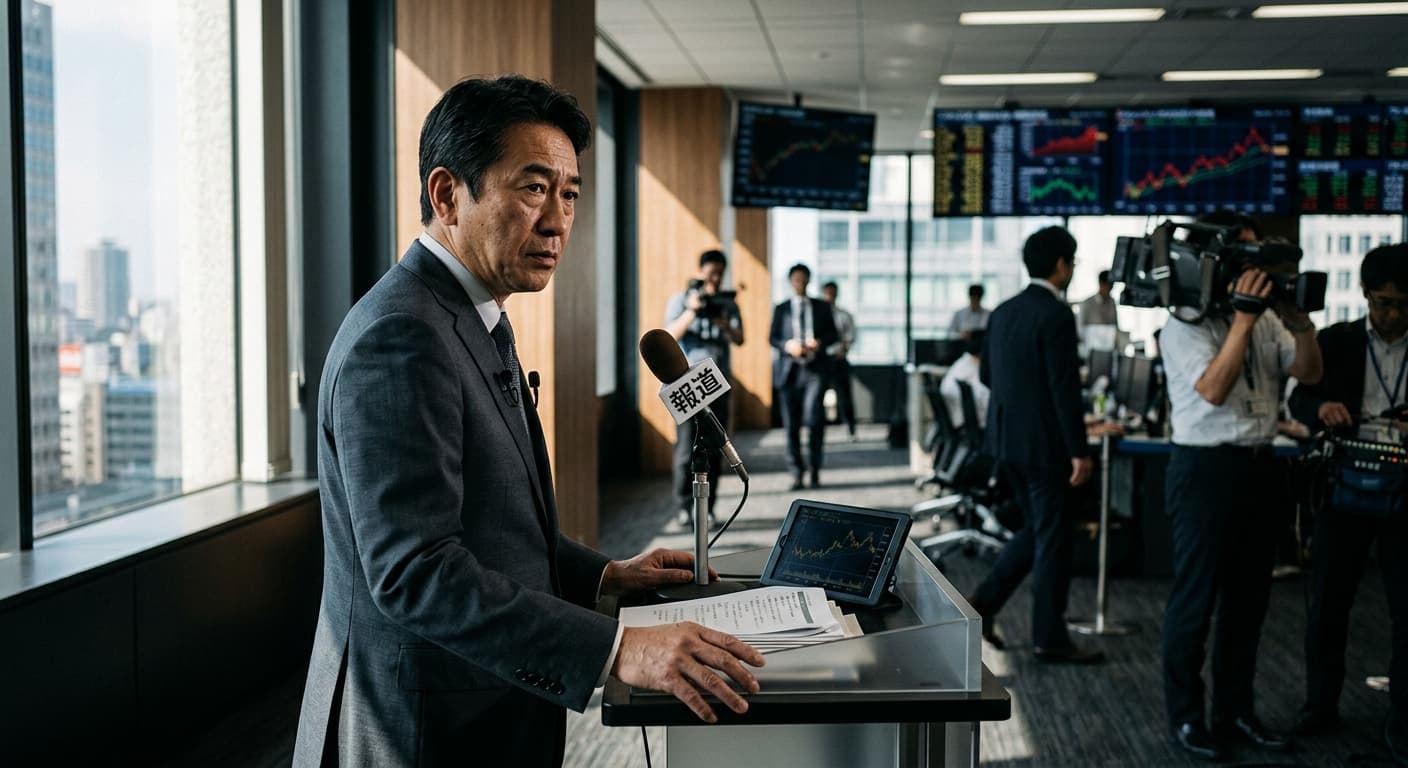
Japan's 10-Year Yield Hits 29-Year High as Takaichi Trade Bites
Japan's benchmark bond yield reached 2.88% on July 9, 2026 — a 29-year high — as fiscal expansion, oil-shock inflation and a BOJ finally out of yield-curve control collide.
The Bank of Japan spent a decade proving that a government could borrow at zero without consequence. That era is now officially closed: on July 9, the 10-year Japanese Government Bond (JGB) yield touched 2.880%, its highest print since September 1996, according to Reuters. The move is not a technical blip. It is the market pricing the collision between Prime Minister Sanae Takaichi's "responsible yet aggressive" fiscal expansion, an oil-driven inflation impulse from the renewed U.S.–Iran confrontation, and a central bank that — for the first time in three decades — has neither the tools nor the political cover to cap long-end yields. The real story is that Japan's currency is now absorbing what its bond market no longer can.
What happened, in numbers
The 10-year JGB rose 1.5 basis points on the session to 2.880%. The 2-year, most sensitive to BOJ policy expectations, climbed to 1.44%; the 5-year to 1.995%, per the same Reuters report. The 40-year yield had already pierced 4% on January 20, 2026 — a record — after Takaichi's dissolution of the House of Representatives and her pledge to suspend the food consumption tax, as Al Jazeera reported at the time. The Ministry of Finance was set to auction ¥2.5 trillion ($15.4 billion) of 5-year notes into that market on July 9, testing whether the demand narrowing the negative 5-year swap spread over the past month was real.
The trigger this week was external. U.S. President Donald Trump publicly said he believed a tentative deal to end the U.S.–Israel war with Iran was "over," pushing Brent and U.S. Treasury yields higher, per Reuters. Japan imports roughly 90% of its energy; a $10 move in Brent flows almost directly into core CPI within two quarters. That is precisely the pass-through the BOJ cited on June 16 when it voted 7–1 to raise the policy rate to 1%, its highest since 1995, per
Al Jazeera.
The Takaichi trade meets the fiscal-monetary clash
Yields have been on this trajectory since Takaichi's LDP landslide on February 8, 2026. Her government's June "big-boned" policy blueprint (honebuto) unveiled a long-dated public–private investment envelope exceeding ¥370 trillion through 2040 and explicitly called on the BOJ to "align monetary policy with growth efforts" — language markets read as pressure to keep real rates negative. Reuters reported on July 9 that the Cabinet is now considering revising that monetary-policy passage, an implicit acknowledgment that the wording itself lifted term premia.
Brookings' Christopher Johnstone and Adam Liff describe the pivot as "Sanaenomics" — a departure from Abenomics that trades deflation-fighting for industrial-policy activism at a moment when Japan is decisively inflationary. The Economist put it more bluntly in January: investors have "cottoned on to a clash between the central bank and Takaichi Sanae's government," and the
bond market is now the pressure valve. The IMF's April 2026
Article IV report is the primary document that anchors the diagnosis: the 10-year JGB yield rose "around 100 bps in 2025" driven by "higher expected policy rates and higher term premia, with the latter reflecting heightened geopolitical tensions, perceptions of domestic political uncertainty and market perception of higher fiscal risk."
Why this is a currency story now, not a bond story
Here is where consensus is quietly wrong. Most wires framed today's move as a bond selloff. The more important signal is the yen.
From early 2025 through end-June, the dollar-yen appreciated by as much as 9% on broad dollar weakness. Since then, per the IMF, the yen has "steadily depreciated despite the 10-year yield differential narrowing by over 100 bps to its lowest level since early 2022." Fund staff went further: "a large portion of yen movements since mid-2025 cannot be accounted for by yield differentials or other fundamentals," and the yen has become "less responsive to narrowing differentials between US–Japan term premia" — the classic textbook relationship has broken. Reuters' cross-rate on July 9 sat at ¥162.55/$.
The plainest interpretation comes from Brookings' Robin Brooks: Japan's debt burden forces a policy tension in which "the Bank of Japan and Ministry of Finance are canceling each other out," transferring fiscal-risk stress from the bond market into the currency, per his analysis. With yield-curve control gone, that shock absorber is no longer available. The MOF's intervention record — some ¥25 trillion deployed under Masato Kanda in 2024, per
BBC — offers only a floor, not a fix; the FT's own review of intervention efficacy
concluded that unilateral action reliably sets floors but rarely reverses trends.
The fiscal arithmetic that keeps analysts up at night
Bruegel's April 2026 working paper on Japanese debt sustainability puts numbers on the risk. Gross general government debt was 222% of GDP in 2024. Under plausible baseline growth, stabilising the debt ratio requires a structural primary surplus of roughly 2.5% of GDP — versus the current deficit of about 1% — an adjustment of 3.5 percentage points. Even under optimistic growth assumptions, a surplus of about 0.5% of GDP is required. Japan is nowhere near either.
That is the arithmetic behind the AEI economist Desmond Lachman's warning, in an October 2025 note, that Takaichi risks becoming Japan's Liz Truss — forced by the bond market to abandon her platform. Carnegie's Ken Jimbo argues in a
March 2026 analysis that the fiscal ceiling is now a national-security ceiling: even doubling defense spending toward the U.S.-demanded 3.5% of GDP core requires roughly ¥22 trillion by FY2036, an amount hard to reconcile with a food-consumption-tax cut that costs ¥5 trillion a year.
The counter-case is not empty. Rogoff and Tashiro at PIIE argue in a December 2025 paper that Japan retains a genuine "exorbitant privilege" — foreign investors still pay a safety premium for JGBs, and non-resident holdings have risen to about 24% of GDP without triggering repricing on the scale a naive model would predict. Their caveat matters: the privilege is "conditional on avoiding an inflation overshoot, renewed financial fragility, or a debt event that forces Japan into financial repression." Today's yield print is a test of exactly that condition.
Who benefits, who loses
Japanese banks and life insurers are the clearest domestic winners. The IMF notes that gradual policy rate hikes have "lifted net interest margins owing to a faster pass-through to lending rates," with major banks' total capital adequacy at 17.1% as of March 2025. Regional banks holding legacy JGB portfolios face mark-to-market pain, but their business models have starved on zero rates for a generation.
The U.S. Treasury market is a quieter loser. Japanese investors hold roughly $1.2 trillion in U.S. Treasuries, the largest foreign position. The FT's Colby Smith has flagged that record-high JGB yields are triggering repatriation bets — precisely the flows that would matter as the Fed under new chair Kevin Warsh navigates its own inflation reset. When Japanese yields moved on January 20, U.S. 30-year Treasuries rose to their highest since September, per
Al Jazeera. This is the global transmission channel Washington has spent a decade underestimating.
Takaichi herself is the biggest political loser if the trajectory continues. CSIS's Nicholas Szechenyi observes that jittery long-term yields already forced her to refrain from mentioning the consumption-tax cut during the campaign homestretch. The bond market has become the effective opposition.
What to watch next
- BOJ July meeting (July 30–31, 2026): Governor Kazuo Ueda's summary of opinions from June
showed support for further hikes but no majority for acceleration. A hawkish surprise — or explicit endorsement of a September move — could break the yen weakness that hedge-fund positioning is now betting on.
- MOF issuance calendar: After the June 2025 shift toward shorter maturities noted in the IMF Article IV, watch whether the ministry adds 20- and 30-year issuance to fund Takaichi's ¥370 trillion envelope. Auction tails on super-long paper are the leading indicator of a real buyers' strike.
- Cabinet revision of the honebuto language on monetary policy: Reuters reported a draft revision is under review. A softening of the "align with growth" wording would remove the most direct source of political pressure on the BOJ and could pull term premia back 10–20 bps.
- U.S.–Iran developments and Brent above $90: Every $10 sustained move in Brent adds an estimated 0.2–0.3 points to Japanese core CPI within two quarters, forcing the BOJ's hand.
Diplomat View
The 2.88% print is not a crisis — yet. It is the price the market is charging Japan for trying to run Abenomics-scale fiscal policy in a post-yield-curve-control world. Our call: the 10-year JGB reaches 3.25% before year-end and the yen tests ¥165/$ absent a MOF-BOJ coordinated move, with a BOJ hike to 1.25% in October the base case. The forecast is falsifiable on three conditions. First, a clean walk-back of the honebuto monetary-policy language would pull long-end yields lower and validate the "clash" thesis in reverse. Second, sustained Brent below $75 removes the inflation impulse and lets the BOJ pause. Third, a credible independent fiscal council — the institutional fix Bruegel recommends — would tighten term premia by re-anchoring credibility. Absent those, the market is now setting policy in Tokyo. Takaichi's political capital, not her mandate, is what will determine whether she governs to the bond market or against it. Liz Truss governed against it for 45 days.
The bottom line: Japan's 29-year-high 10-year yield is not really about bonds — it is the fiscal-monetary clash of the Takaichi era pricing itself into the currency because the BOJ can no longer absorb it. If the yen breaks ¥165, the story becomes a G7 policy problem, not a Tokyo one.
Discover more
Economics
Japan's $2.3 Trillion Bond Market Stress Test
Japan's 10-year bond yield hits 2.87% as PM Takaichi's $2.3 trillion spending plan breaks the yen-JGB inverse, threatening global markets via $1.2 trillion in Japanese-held US Treasuries.
Economics
Japan's $2.3 Trillion Bond Market Revolt
Japan's 10-year JGB yield hits 2.87% as PM Takaichi's $2.3 trillion fiscal plan triggers bond sell-off, with spillovers to US Treasuries and yen carry trade.

Economics
Dangote's Dollar Pricing Exposes Nigeria's Cr
Dangote Refinery switched fuel pricing from naira to dollars on July 13, 2026, exposing a structural crude supply gap that undermines Nigeria's naira-for-crude framework and threatens currency stability.

Economics
Dangote Dollar Pivot Breaks Nigeria's Naira-C
Dangote refinery ends naira pricing for fuel, exposing Nigeria's crude supply gap. The shift breaks Tinubu's currency stability policy and threatens inflation as NNPC fails to deliver enough domestic crude.