Japan's 10-Year Yield Hits 2.88% Amid Clash
Investors doubt BOJ's ability to manage inflation and debt.
Model Diplomat8 min readAsia
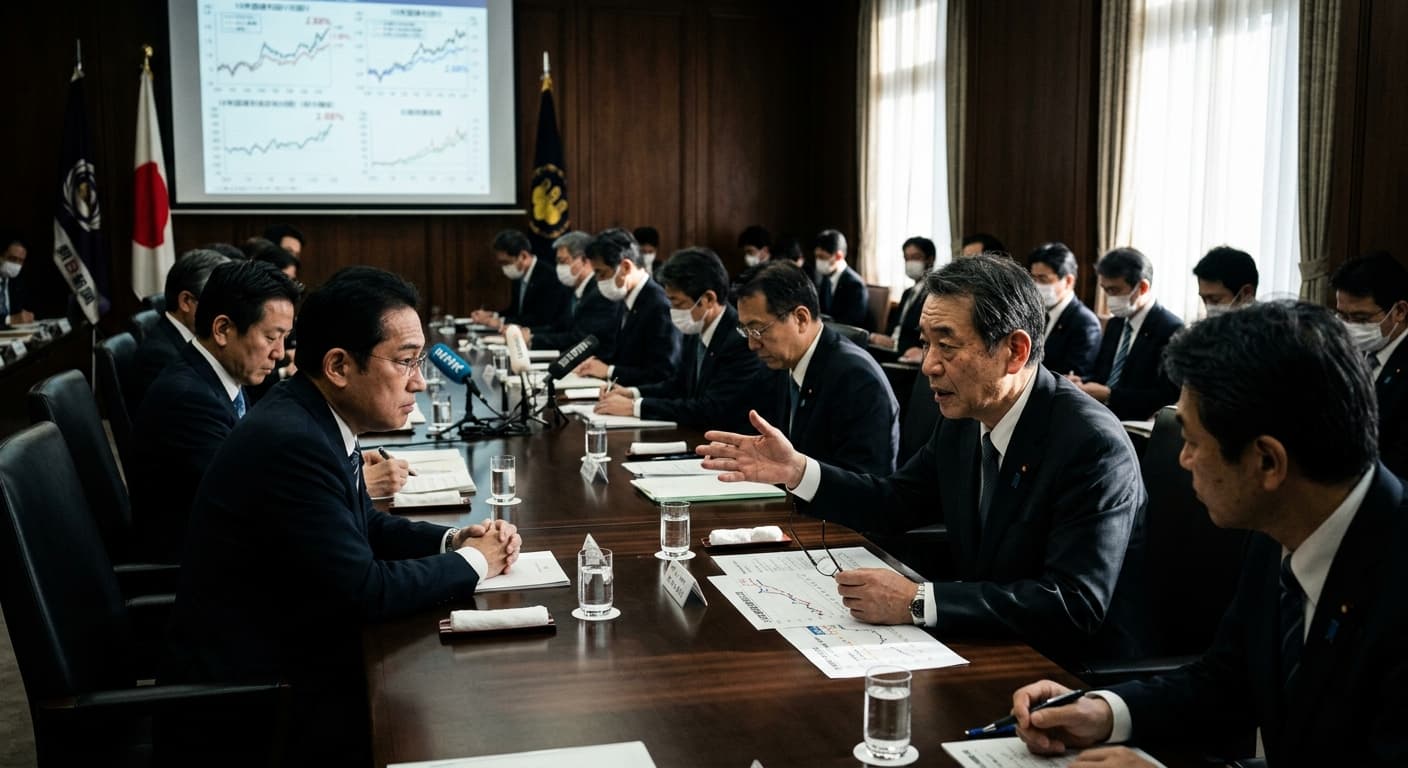
Japan's 10-Year Yield Hits 2.88%: A Fiscal-Monetary Clash Comes Due
Japan's 10-year JGB yield hit a 30-year high of 2.88% on July 9, 2026, as bond markets punish PM Takaichi's 370-trillion-yen spending plan and doubt the BOJ can hike.
Japan's 10-year government bond yield reached 2.88% on July 9, 2026 — its highest since September 1996 — and the message from the world's second-largest sovereign debt market is unusually blunt: investors no longer believe the Bank of Japan can raise rates fast enough to contain inflation, and they no longer believe Prime Minister Sanae Takaichi's assurance that a 370-trillion-yen ($2.28 trillion) investment blueprint will be funded without more debt. The result is a curve steepening (10s-2s spread 143 basis points, the widest since 2004) that is the clearest signal yet of a fiscal-monetary clash the government can no longer paper over — and, because Japanese institutions still hold about $1.2 trillion in US Treasuries, one that quietly resets the price of duration everywhere.
The steepener is the story
The eye-catching print is the 10-year at 2.88%, up 20.5 basis points in July alone and rising for nine consecutive sessions — the longest streak in 19 years, according to Channel News Asia. But the more informative move is on the curve. The 2-year yield, the tenor most sensitive to BOJ policy, rose just 8.5 bp over the same window. That divergence — long-end selling off while the front end stays anchored — is textbook loss-of-credibility trade: investors are pricing more inflation and more issuance, not more hikes.
"The latest steepening of the curve is a warning bell from investors," Daiwa Securities senior economist Kento Minami told Reuters. "There is a gap between the risk the market weighs and the government's fiscal and monetary policy."
That gap has a specific shape. The Bank of Japan raised its policy rate to 1% on June 16, 2026 — the highest since 1995, in a 7-1 vote — citing higher oil prices from the US-Israel-Iran war and rising medium-term inflation expectations, per Al Jazeera. Swap markets now price an 87% probability of another 25 bp hike at the December meeting. Yet the long end is selling as if that path is too slow — because it probably is.
Sanaenomics collides with the debt stack
Takaichi's "responsible and proactive fiscal policy," inherited from mentor Shinzo Abe's playbook and rebranded as "Sanaenomics," was designed for a deflationary economy that no longer exists. Headline CPI averaged 3.2% in 2025 and has now run above the BOJ's 2% target for more than three and a half years, according to the IMF's April 2026 Article IV report. Wholesale prices rose more than 6% year-on-year in May 2026, the fastest in three years,
the BBC reported. The macro backdrop is inflationary; the policy stance is expansionary.
Two specific triggers reopened the bond rout after a brief May calm. First, the government's June economic blueprint disclosed public and private investment of more than 370 trillion yen through fiscal 2040, framed as "crisis-management" industrial policy centered on defence, semiconductors, AI and energy. Second, an unresolved intra-coalition debate proposes cutting the 8% consumption tax on food to 1% — with no clear funding mechanism. A Brookings analysis by Christopher Johnstone and Adam Liff described the pivot bluntly: "Rhetoric aside, her economic strategy differs in fundamental ways from Abenomics… the thrust of Sanaenomics — fiscal spending and industrial policy — is not without risk or controversy."
The maths is unforgiving. Japan's gross debt-to-GDP exceeds 230%, the highest in the developed world. The Ministry of Finance's FY2026 JGB Issuance Plan set gross issuance at 180.7 trillion yen; a June 2026 supplementary budget raised that by another 3.1 trillion yen, per the
MoF's alteration notice. In an attempt to head off a super-long buyers' strike, the MoF cut monthly issuance of 20-, 30- and 40-year bonds by 100 billion yen each and introduced a "mid-year hearing" mechanism to react to market stress. It worked briefly in May. By July, it hadn't.
The IMF's staff report is unusually pointed about why: "Rising yields through January 2026 have been driven by higher expected policy rates and higher term premia, with the latter reflecting heightened geopolitical tensions, perceptions of domestic political uncertainty and market perception of higher fiscal risk." Foreign participation in JGB auctions "expanded substantially in 2025," the Fund noted, "though their overall holdings remain low… their growing participation may be making the bond market more sensitive to fiscal news and global developments."
Translation: the marginal buyer of Japanese debt is now a price-sensitive foreigner, not a captive domestic institution — and the marginal buyer wants to be paid.

The BOJ is boxed in — deliberately
Here is the trap the market has diagnosed. The BOJ needs to keep hiking to defend its inflation credibility. Takaichi needs low rates to finance industrial policy without a debt spiral. Her June blueprint, according to a Mizuho Securities note cited by Reuters, suggests her administration would be "unlikely to look favourably" on rationales for hikes. Tokyo is reportedly redrafting the document's language to calm bond investors — a tacit admission that the original text was read as political pressure on Governor Kazuo Ueda.
The BOJ's balance-sheet retreat compounds the squeeze. Under its June 2025 plan, monthly gross JGB purchases will fall from 3.3 trillion yen in December 2025 to 2.1 trillion by March 2027. The Fund estimates that pace will raise term premia on JGB yields by roughly 9 basis points in 2026 alone and reduce BOJ JGB holdings by around 22% of GDP by March 2027. In September 2025 the BOJ also began selling its ETF and J-REIT holdings. Every one of those levers points to higher yields — precisely what the Takaichi fiscal expansion cannot afford.
The government's own resistance to hikes is the tell. NPR's The Indicator captured the contradiction bluntly: "Takaichi wants lower interest rates than the central bank does. Lower interest rates would be the opposite of what's needed to curb inflation." Bond desks noticed, and stopped bidding.
A 10-year auction last week saw demand fall to its lowest since April. "The 10-year bond yield is low relative to the nation's inflation," Mitsubishi UFJ Asset Management executive chief fund manager Masayuki Koguchi told Reuters. "And as prices are set to rise further, the yield would have to rise."
The spillover no one is pricing
For non-Japanese investors, this is not a curiosity — it is a repricing of the anchor. The JGB market, at roughly 1,223.6 trillion yen ($8.5 trillion) at end-September 2024, is the world's second-largest sovereign debt market, IMF Working Paper WP/25/227 documents. Its yield curve is a global term-premium reference point. Two channels transmit shocks abroad.
Channel one is portfolio reallocation. Japanese institutions held $1.2 trillion in US Treasuries as of November 2025 — more than any other foreign group, according to Al Jazeera. As JGB yields rise, hedged and unhedged carry into foreign bonds deteriorates. When Takaichi's tax pledge rattled the market in January 2026, 30-year US Treasury yields promptly rose to their highest level since the previous September. US Treasury Secretary Scott Bessent went on Fox News to signal his Japanese counterparts should "begin saying the things that will calm the market down." The Federal Reserve Bank of New York, per the New York Times and Wall Street Journal, inquired about the cost of exchanging yen for dollars — the plumbing of an intervention.
Channel two is term-premium co-movement. IMF research finds that a 100-basis-point increase in the JGB yield curve slope is associated with about a 10 bp increase in the US Treasury slope, and that BOJ balance-sheet shocks lowering the 10-year JGB yield by 10 bp are associated with roughly 5 bp declines in foreign 10-year sovereign yields — spillovers "comparable" to Federal Reserve shocks, per the IMF's 2025 spillover paper. Symmetrically, a JGB sell-off tightens global financial conditions without any central bank in Washington, Frankfurt or London lifting a finger.
CFR's Rebecca Patterson captured the mechanism on The Spillover podcast: "There are hundreds of billions of dollars, maybe over a trillion dollars in yen carry trades around the world. Not that they'll all get unwound immediately, but there's that risk there." The last time the BOJ surprised markets with a hike, in July–August 2024, the yen strengthened sharply and everything from the Turkish lira to US stocks got hit as leveraged trades unwound. The market memory is short but not that short.
What to watch
- BOJ policy meeting, December 18–19, 2026. Swaps price an 87% probability of a 25 bp hike to 1.25%. Anything less would be read as capitulation to Takaichi and further steepen the curve.
- FY2027 JGB Issuance Plan, late December 2026. Watch the super-long allocation: another cut in 30- and 40-year issuance is the MoF's only quick lever if the long end breaks 3.5%.
- Food consumption-tax bill. A cut to 1% without offsetting revenue would cost roughly 5 trillion yen a year, per
Al Jazeera. If it clears the Diet unfunded, expect a repeat of the January 40-year blowout.
- US-Japan FX line. Any repeat of the January 2026 New York Fed swap-line inquiry would confirm the spillover is being managed at the G7 level, not just in Tokyo.
Diplomat View
The Takaichi trade — buy Japanese equities, sell JGBs and the yen — was coherent for six months because the market gave her the benefit of the doubt on funding. It no longer does. The specific claim to test now is whether the BOJ hikes 25 bp in December: if it does, and Takaichi does not publicly protest, the fiscal-monetary contradiction narrows and the 10-year retraces toward 2.4–2.5%. If the BOJ blinks, or the food-tax cut passes unfunded, the 10-year breaks 3% and drags the 30-year US Treasury with it — the second-order effect that matters most to non-Japanese portfolios.
The historical parallel bond desks keep citing — Liz Truss's 2022 gilt crisis — is imperfect but instructive. Japan's debt is domestically held, yen-denominated, and rolled by a central bank that owns 69% of GDP in JGBs. Truss's UK had none of that. What Japan does share with 2022 Britain is a government proposing large unfunded fiscal loosening at exactly the moment monetary policy is trying to normalise. Markets discipline that combination regardless of who holds the paper. The forecast changes if either Takaichi credibly funds the 370-trillion-yen blueprint through tax reform (not efficiency handwaving) or the BOJ pre-commits to a hiking path independent of the cabinet's blueprint. Absent one of those, the July 9 print is not the peak — it is the mid-point.
The bottom line: Japan's bond market has decided that Sanaenomics is Abenomics without the deflation to justify it, and it is pricing that mistake into the world's second-largest sovereign curve. The next date that matters is December 19 in Tokyo — but the price will be paid in New York, London and Frankfurt too.
Discover more
US Politics
SNAP Food Assistance Faces Legal Challenges
In 2026, SNAP faces stricter eligibility rules and mounting legal challenges, threatening food assistance for the millions of Americans who rely on the program.
India
Rajnath Singh's Durga Squad for 2026 Polls
Rajnath Singh's Durga Squad promised women's safety in Bengal but has since disappeared from the agenda, revealing BJP's true priorities.
India
Congress Accuses Modi of Stalling Women's Law
Congress accuses Modi of stalling women's reservation law by linking it to delimitation, revealing a deeper electoral strategy.

Conflict & Security
Drone Warfare Killing Aid Workers at Unprec
Over 1,000 humanitarian workers killed in three years as cheap armed drones collapse legal protections. Gaza, Sudan, Ukraine, and DRC see deliberate targeting of aid convoys and hospitals with zero prosecutions.