Ivory Coast Frees Gbagbo-Era Defense Chief
Kouassi's release signals a strategic political move by Ouattara.
Model Diplomat7 min readSub-Saharan Africa
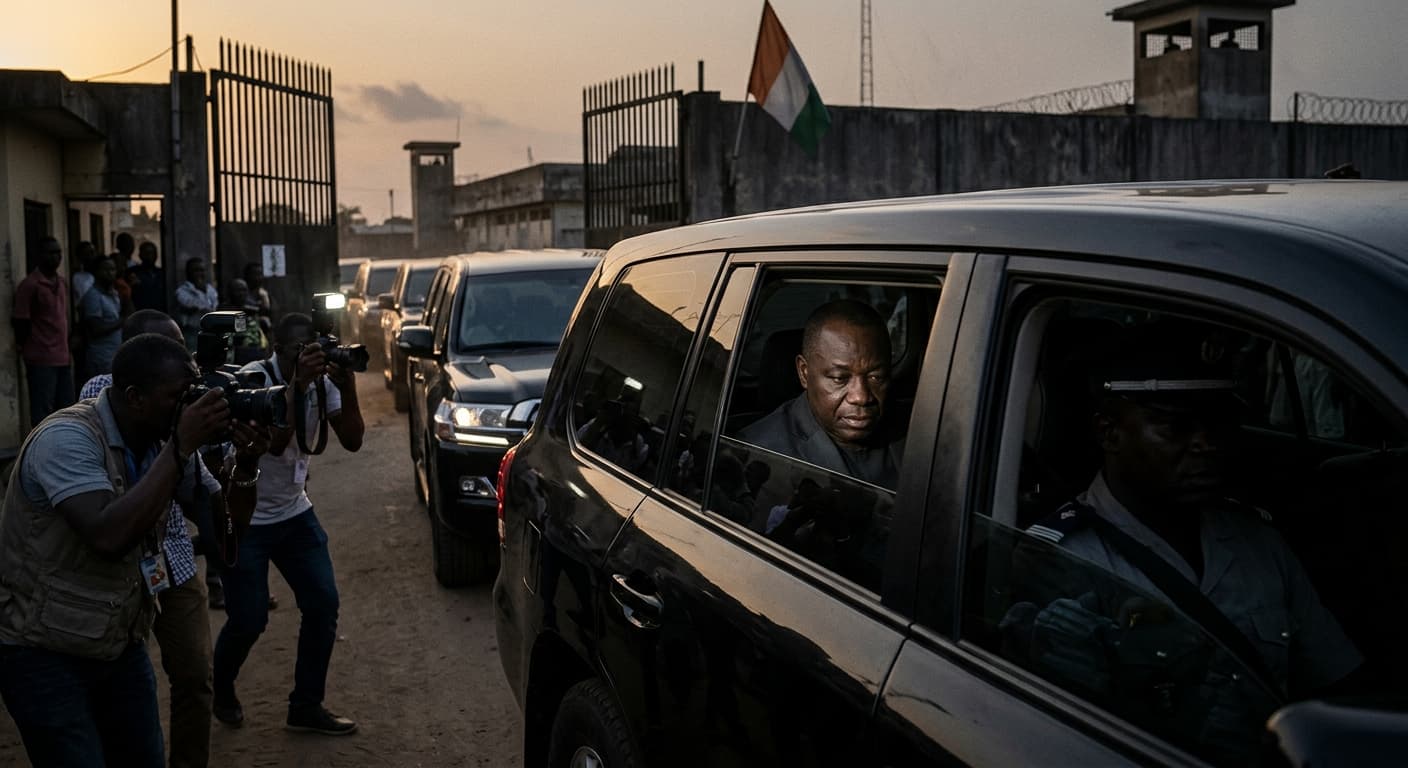
Ivory Coast Frees Gbagbo-Era Defense Chief as Ouattara Consolidates Power
Moïse Lida Kouassi's July 2026 release after 11 months on 'terrorism' charges signals a calibrated de-escalation — not a thaw — as President Ouattara enters his contested fourth term.
Ivory Coast's authorities released former defense minister Moïse Lida Kouassi on July 6, 2026 after nearly 11 months in pre-trial detention on "terrorism"-linked charges, placing him under judicial control rather than dropping the case. The release, confirmed by his lawyer Roselyne Seripka and his opposition African Peoples' Party (PPA-CI), is not a political opening: it is a low-cost concession by a government that already has what it wanted. Alassane Ouattara secured a fourth term in October 2025 with the two candidates who could have beaten him — Laurent Gbagbo and Tidjane Thiam — struck from the ballot, and the opposition boycotting December's legislative election. Kouassi walks out of prison into an Ivorian political landscape in which the argument he was jailed for making has already been lost.
What the case was really about
Kouassi, 79 and in poor health according to his party, was arrested in August 2025 in the wake of a night of vandalism in Yopougon, the working-class Abidjan neighbourhood that is the historic bastion of Gbagbo's base. Ivorian news site KOACI reports that his indictment traced to the burning of a SOTRA public bus and the destruction of a police vehicle on the night of August 1, 2025. Prosecutors charged him with "conspiracy against the authority of the state" — the same offence for which an Abidjan court sentenced him to 15 years in 2018 in the long tail of the 2010–11 post-election crisis, as reported at the time by
BBC Afrique.
The label mattered. By reaching for "acte terroriste," prosecutors invoked the wave of legal instruments hardened after jihadist incursions from the Sahel — a category that carries longer detention, restricted bail and reputational costs abroad. It was the same playbook Abidjan used in 2020, when more than a dozen opposition figures including former prime minister Pascal Affi N'Guessan were charged with terrorism and sedition for setting up a rival "transitional council," as Al Jazeera reported at the time. The message to the PPA-CI in 2025 was unmistakable: street action tied to the electoral dispute would be prosecuted as security crime, not as protest.
Kouassi's release under contrôle judiciaire — passport surrendered, movements restricted, silence on the file — leaves that message intact. He is free, but leashed. His co-accused remain in custody. According to the PanAfrican bulletin that first flagged the arrest, former ambassador Boubakar Koné was detained in the same operation.
The pre-election crackdown that made this "concession" possible
To read the release, read the numbers around it. The Amnesty International 2026 country report documents that between the ban on opposition marches on October 11, 2025 and mid-November, the National Security Council reported 1,658 arrests and 11 deaths, with more than 80 protesters sentenced to three years in prison, most for "disturbing public order." A separate
Amnesty statement in March 2026 named passersby and pregnant women among those handed three-year terms after summary hearings without counsel. The government deployed 44,000 security personnel across the country in the days before the vote.
Against that backdrop, Kouassi's release is not evidence of restraint. It is the reward for a coercion strategy that has already worked. The Constitutional Council invalidated Gbagbo's and Thiam's candidacies in September 2025 — Gbagbo over his 2018 BCEAO conviction, Thiam over a 1987 acquisition of French citizenship, as documented by
BBC News. Ouattara, 83, then took 89.77% of the vote on October 25, 2025 in what the PPA-CI and the PDCI jointly denounced as a "civilian coup d'état," according to the
BBC.
The opposition then chose withdrawal over risk. The PPA-CI called a boycott of the December 27, 2025 legislative elections; the Konrad-Adenauer-Stiftung's post-election analysis notes that low turnout — driven by the boycott, the Africa Cup of Nations and holiday timing — left the ruling RHDP a "formally strong" majority in the 255-seat National Assembly built on a "thin participation base." The
Council of Ministers dissolved the Independent Electoral Commission on May 7, 2026 — a move the government framed as reform, and that the opposition read as a re-engineering of the machinery ahead of the 2028 electoral cycle.
By July 2026, in other words, the risk that Kouassi personified — a Gbagbo-era security figure mobilising a Yopougon street base against an unconstitutional fourth term — has been neutralised at the ballot box, in parliament and in the streets. Letting him out is cheap.
Who benefits
The primary beneficiary is Ouattara himself. His fourth-term legitimacy problem is not domestic — he controls the courts, the electoral machinery and the security apparatus — but international. The IMF's June 25, 2026 executive board release unlocked roughly US$843.9 million on completion of the sixth EFF/ECF and fifth RSF reviews, and the
Fund's staff-level agreement in April forecast 6% growth in 2026 and a fiscal deficit at 3% of GDP, at the WAEMU convergence norm. Ivory Coast remains a favoured Sub-Saharan credit story with roughly US$3.5 billion drawn since 2023 and a National Development Plan for 2026–2030 in motion. That story cannot afford a Gbagbo-era ex-minister dying in pre-trial detention on terrorism charges.
The International Crisis Group noted before the vote that Ouattara's fourth term revived the same succession problem that followed the death of founding president Félix Houphouët-Boigny in 1993 and helped tip the country into a decade of conflict. Rinaldo Depagne, the ICG's deputy Africa director, warned that failure to designate a successor could reproduce that trajectory. Selectively releasing high-profile prisoners — while keeping charges and other cadres in custody — buys Ouattara room to manage that succession on his own timetable without an opposition martyr in prison hospital.
Gbagbo's PPA-CI is a secondary, symbolic beneficiary. Kouassi's freedom is a talking point that the party can use to claim its pressure is bending the state. But the party's Front Commun coalition with Thiam's PDCI, formed in mid-2025 to fight candidate exclusions, has no elected leverage after the boycott. Its route back into institutional politics runs through the same Constitutional Council and re-engineered electoral body that shut it out in 2025.
The historical parallel that reframes this
Ivory Coast has done this dance before. After Ouattara's contested third-term election in 2020, terrorism and sedition charges against the opposition were used as bargaining chips: N'Guessan was arrested in November 2020, then released under judicial control the following month, and the PPA-CI's predecessor FPI ended its decade-long election boycott in December 2020 and contested the March 2021 legislative vote. The pattern — mass pre-election arrests, high-profile detentions, then a de-escalation choreography of releases as the opposition returns to institutional politics — is now on its second run.
The tell is what the government does not do. In 2018, Ouattara amnistied Simone Gbagbo, as reported by BBC Afrique, erasing her 20-year sentence. Kouassi has not been amnistied. His 2018 conviction stands. He walks free on the state's sufferance and can be re-detained if he speaks. That is the design.
What the U.S. and regional context add
Ouattara's fourth-term Ivory Coast is also the West African security anchor France, the United States and the EU can least afford to lose. Jihadist violence from Jama'at Nusrat al-Islam wal-Muslimin (JNIM) and the Islamic State in the Greater Sahara has spilled south from Mali and Burkina Faso; Al Jazeera's October 2025 election report noted Abidjan has boosted defence spending, deployed troops to the northern regions and bought armoured vehicles from China since 2022. A
January 2026 BBC report that a Malian junta lawmaker was jailed in Abidjan for three years for calling Ouattara a "tyrant" captures how much bilateral friction now surrounds the country. Ivory Coast is the last major Francophone West African partner that has not fallen to a coup or turned toward Moscow. Western capitals will treat a modest political relaxation in Abidjan as sufficient. Kouassi's release is priced accordingly.
Diplomat View
The release of Moïse Lida Kouassi is best read not as the beginning of reconciliation but as the visible end of a coercive cycle Ouattara has already won. He extracted a fourth term without his two toughest opponents on the ballot, absorbed a boycotted legislative election that entrenched his majority, dissolved the electoral commission on his own terms, and kept the IMF, Paris and Washington aligned throughout. Freeing an ailing 79-year-old under judicial control — charges preserved, silence enforced — costs him nothing and buys diplomatic goodwill.
The forecast: this is the first of a small tranche of selective releases over the next 6–12 months, calibrated to precede an IMF Article IV mission, an EU delegation, or the seating of a new electoral body. The forecast would change if Kouassi is re-arrested, if the charges are formally dropped rather than paused, or if the Constitutional Council rehabilitates Gbagbo's or Thiam's civic rights. Absent one of those three moves, the Ivorian opposition's next window is not the courts or the streets — it is a succession fight inside the RHDP that Ouattara has so far refused to arbitrate.
What to watch next
- The remaining PPA-CI detainees, including former ambassador Boubakar Koné and cadres arrested after August 2025 Yopougon unrest: further releases would confirm the choreography; a hardening would signal the opposite.
- The replacement for the dissolved CEI, promised by the Council of Ministers in May 2026 but unnamed as of July 8, 2026 — the institutional shape will define the 2028 municipal and 2030 presidential cycles.
- The IMF's next Article IV consultation for Côte d'Ivoire, following the April 30, 2026 staff-level agreement and June 25, 2026 board completion — the first external check on whether the political de-escalation matches the fiscal narrative Abidjan is selling.
Related: Côte d'Ivoire country coverage.
Discover more
India
Rajnath Singh's Durga Squad for 2026 Polls
Rajnath Singh's Durga Squad promised women's safety in Bengal but has since disappeared from the agenda, revealing BJP's true priorities.
US Politics
Next Generation Republicans
A leaked survey shows 39% of Republicans under 30 do not identify as MAGA, revealing a split in the GOP's future leadership.
US Politics
SNAP Food Assistance Faces Legal Challenges
In 2026, SNAP faces stricter eligibility rules and mounting legal challenges, threatening food assistance for the millions of Americans who rely on the program.

Conflict & Security
Drone Warfare Killing Aid Workers at Unprec
Over 1,000 humanitarian workers killed in three years as cheap armed drones collapse legal protections. Gaza, Sudan, Ukraine, and DRC see deliberate targeting of aid convoys and hospitals with zero prosecutions.