Iran's Hormuz Crisis
Tehran's control over Hormuz strengthens post-war.
Model Diplomat9 min readMiddle East
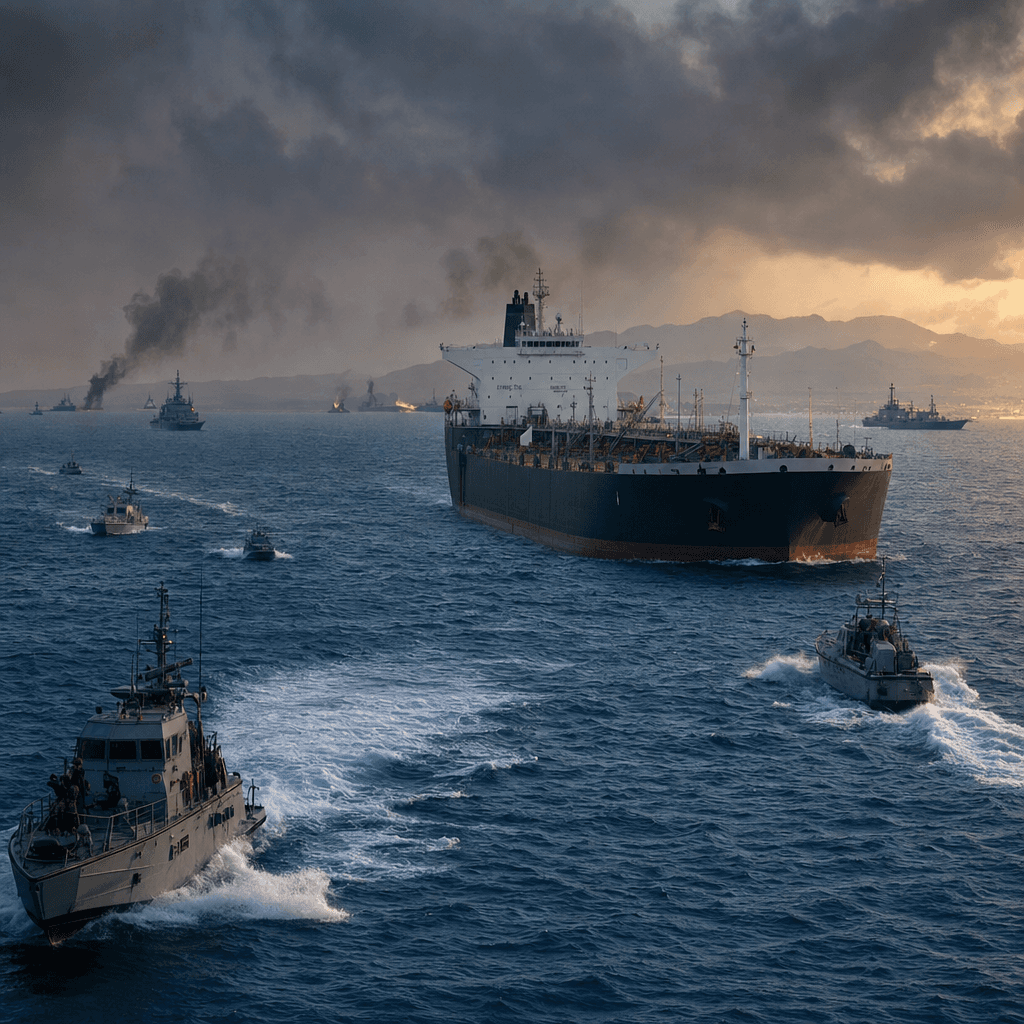
Iran's Hormuz Crisis: Tehran's Tollbooth Survives the War
Iran lost the war but won the Strait. As the July 2 Doha talks end and Khamenei's funeral closes, Tehran's permit-and-fee regime for Hormuz is hardening into fact.
Iran renewed its threat of a "forceful response" against tankers straying from state-approved routes on July 2, 2026 — the same day US and Iranian negotiators wrapped a fifth technical round in Doha with what Qatar's foreign ministry called "positive progress." The juxtaposition is the story. Four months after US and Israeli air strikes killed Ayatollah Ali Khamenei and destroyed much of Iran's declared nuclear infrastructure, the Islamic Republic has ended the war weaker militarily but in operational control of the world's most important oil chokepoint — and is quietly converting that control into a revenue stream priced in Chinese yuan. The June 17 memorandum of understanding froze Tehran's tolls for 60 days; it did not abolish the tollbooth. When that clock runs out on August 16, the question is not whether Iran resumes charging, but whether Washington can find a formula that lets it.
The stakes are set out in the plainest terms by the US government's own analysts. According to the Congressional Research Service, approximately 20 million barrels per day of oil moved through Hormuz in calendar 2024 — roughly 27 percent of global seaborne oil trade and one-fifth of world petroleum consumption. Available bypass pipelines through Saudi Arabia and the UAE offer only
about 2.6 million barrels per day of spare capacity. That gap is Iran's leverage. It is why Brent crude peaked near $120 a barrel in the spring, why Iranian negotiator Mohammad Bagher Ghalibaf openly says the post-war order in the Strait "will never return" to pre-war norms, and why two senior Iranian officials
told Reuters that Tehran will win recognition of its Hormuz control "even if it has to do so by force."
What the MoU actually says — and what it doesn't
The interim deal signed in Switzerland on June 17, 2026 was billed by President Donald Trump as reopening the Strait. Read closely, it is narrower. The text commits Iran to using its "best efforts for the safe passage of commercial vessels with no charge for 60 days," and pledges Tehran and Muscat to jointly "define the future administration and maritime services" of the waterway, according to text quoted by BBC News. Two features of that language matter.
First, "no charge for 60 days" is a suspension, not a repeal. Iran's Persian Gulf Strait Authority (PGSA), a body stood up in May under the Islamic Revolutionary Guard Corps, published its transit terms on June 20: "No vessel is permitted to pass through the Strait of Hormuz without a valid passage permit issued by the PGSA." Fees are paused; permitting is not. Mostafa Khoshcheshm, an Iranian professor of applied sciences,
told Al Jazeera the domestic reading is unambiguous: "According to the MoU, Iran is not going to charge service fees for 60 days, but afterwards, Iran is definitely going to do that."
Second, the "future administration and maritime services" phrase is the diplomatic escape hatch. Under UNCLOS, coastal states cannot levy tolls for passage through international straits — but they can charge for genuine services rendered such as pilotage, mine-clearance and inspections. That distinction is the space Tehran is drilling into. As legal scholars Benny Spanier, Orin Shefler and Elai Rettig note in a 2024 SSRN paper on UNCLOS and maritime chokepoints, the transit-passage regime is precisely the sort of hard-fought balance that erodes when a coastal state builds a permitting apparatus around it. Neither the United States nor Iran has ratified UNCLOS, complicating any legal challenge; the classic study of this legal grey zone by James Kraska,
Legal Vortex in the Strait of Hormuz, lays out how each side has invoked customary international law selectively for decades.
The IRGC is not waiting for the legal argument to be settled. Iran's joint military command warned on July 2 that any tanker deviating from the corridor it has designated will face "forceful response," the Associated Press reported. The Joint Maritime Information Center — a multinational body including the US Navy — has issued advisories directing vessels into a southern corridor "confirmed clear of mines," effectively closer to the Omani coast. Traffic remains a fraction of pre-war levels:
172 transits over the first week after the MoU, against a pre-war baseline of roughly 138 crossings a day.
The quiet winner is Beijing
The financial architecture of Tehran's tollbooth is the least-reported part of the story and the most consequential. Multiple Iranian and Chinese reports indicate that transit fees collected during the March–May peak were denominated in yuan, not dollars, according to Al Jazeera's economic coverage. On July 5, Iran's ambassador to Beijing
publicly promised "special" Hormuz treatment to "friendly" states — a formulation whose primary addressee is unambiguous. China already buys roughly 80 percent of Iran's crude and settles those purchases in yuan.
The second-order effect for Washington is severe. The US Treasury's Office of Foreign Assets Control warned in April that shipping companies paying Iranian government entities for Hormuz transit could face "significant sanctions risk" — and that payments in "digital assets, offsets, informal swaps, or other in-kind payments" would not evade designation. Treasury Secretary Scott Bessent went further in May, threatening
sanctions against Oman itself if Muscat helped administer any toll system. Trump publicly warned Oman that it "will behave just like everybody else, or we will have to blow them up."
The result is a two-tier Strait. Vessels linked to Western owners, insurers or flags face compounded sanctions and insurance risk if they seek Iranian permits. Chinese, Russian and select regional operators — many already operating outside the dollar-clearing system — do not. Al Jazeera's investigative unit tracked 200 transits during the war and found that 61 vessels appeared on international sanctions lists, including US-sanctioned tankers that moved freely under IRGC guidance even during the American blockade. The shadow fleet did not just survive maximum pressure; it now has a legal address in Tehran.

The economics that make the tollbooth stick
The reason the toll regime is unlikely to collapse under its own weight is arithmetic. During the peak of the crisis, war-risk insurance premiums for a single Hormuz transit rose from a pre-war ~0.25 percent of hull value to as high as 5 percent, according to figures shared with Al Jazeera by NSI Insurance Group and the Norwegian Shipowners' Association. For a $100 million VLCC carrying 2 million barrels of crude, that is a $5 million single-voyage insurance line — before hull, cargo and P&I coverage. Iran's mooted service fee of roughly $1 per barrel, or $2 million per vessel to be shared with Oman, is materially cheaper than the war-risk premium it would displace. That is why analysts describe the arrangement as
a "de facto toll booth regime" that shippers will quietly accept if Washington gives them room to.
Ian Ralby of Auxilium Worldwide flagged the counter-risk to NPR: paying the PGSA — an IRGC-linked entity under US, UK and EU sanctions — could expose a shipowner and its entire fleet to terrorist-financing designations. That is the balancing act every underwriter and charterer is now running: cheaper voyage insurance versus catastrophic sanctions exposure. For a Greek tanker owner with US bank facilities, the math points to waiting. For a Chinese buyer using yuan and a state bank, it does not.
Brent crude has now fallen back below $73 — lower than before the war began — as Middle East supply resumes and US Energy Secretary Chris Wright says 20 million barrels are again moving daily through the Strait. That price signal is why Washington's leverage is bleeding away by the week. With oil markets calm, the political cost of a US military option to force the tollbooth shut has risen sharply.
Succession as strategy
The other reason Tehran can afford to hold its position is that the succession has, so far, held. Mojtaba Khamenei, installed by the Assembly of Experts on March 8, 2026, has not appeared in public since — reportedly wounded in the strike that killed his father, and communicating through written messages. Yet the regime used the funeral week to demonstrate continuity. On July 6, in a text-message directive attributed to the new Supreme Leader, Iran reappointed Gholam-Hossein Mohseni-Ejei as chief justice for a second five-year term — a signal, Al Jazeera's Maziar Motamedi noted, of "a lack of appetite to undertake a reshuffling amid a war partially aimed at regime change."
That matters for Hormuz because it means Iran's negotiating team — Ghalibaf, Foreign Minister Abbas Araghchi and their hardline lawmaker overseers — enters the next round with the domestic political cover to hold the line. Hardliners like Mahmoud Nabavian are already publicly pressing to purge JCPOA-era diplomats from the delegation. First Vice President Mohammad Reza Aref told state media that Hormuz control is now Iran's principal tool to "counter sanctions imposed by the US." Tehran, in short, is treating the tollbooth not as a bargaining chip to be traded for sanctions relief, but as the sanctions relief.
The historical parallel that keeps recurring in Iranian rhetoric is not the 1980s Tanker War but Rafsanjani's much older doctrine, recirculated by state media during the war: "If the Persian Gulf is unusable for us, we will make the Persian Gulf unusable for others." Rafsanjani framed closure as deterrence. Mojtaba Khamenei's team has flipped it into a business model.
What Washington is actually negotiating
Behind Rubio's public line that "no country is allowed to charge tolls or fees on an international waterway," according to Al Jazeera reporting, the US position is quietly more flexible. Envoys Steve Witkoff and Jared Kushner spent three days in Doha at the end of June trying to define — through Qatari and Pakistani mediators — what Article 5 of the MoU on "safe passage" actually requires. The technical talks, per Al Jazeera,
focus on the "nuts and bolts" of implementation, including what "services" Iran and Oman may or may not legally price.
The likely landing zone, if a deal is reached at all: a jointly administered Iran-Oman "maritime services" body that charges regulated, published fees for pilotage, mine clearance and inspection, paid to a non-sanctioned entity in a currency other than yuan, with the PGSA formally dissolved on paper. That would let Washington claim the tollbooth is gone; it would let Tehran claim it has locked in recognition of its sovereignty and revenue. Vice President JD Vance, asked on June 30 whether the US would return to combat before the MoU deadline, would not rule it out.
What to watch
- August 16, 2026 — expiry of the 60-day MoU window. If no follow-on agreement is signed, Iran's Persian Gulf Strait Authority is expected to reactivate its fee schedule, testing whether the ceasefire holds.
- The next Doha round, scheduled to resume shortly after the Khamenei funeral concludes on July 9. Iran has
asked for the release of $6 billion in frozen assets held in Qatar as a first step; Washington has not confirmed.
- The next OFAC action. Treasury's May designations of Shamkhani-network vessels and Iraqi oil officials suggest an ongoing pressure campaign; a designation of a first non-Chinese firm paying PGSA fees would be a major escalatory signal.
Diplomat View
The bottom line: Iran lost the shooting war and won the waterway. The MoU pauses Tehran's tollbooth for 60 days, but it also does something more consequential — it commits Washington to negotiating the "future administration" of the Strait rather than restoring the status quo ante. That is a strategic concession, and it is why the durable winner of this crisis is neither Trump nor Mojtaba Khamenei but Xi Jinping, whose yuan-denominated shadow-fleet arrangement with Iran has been effectively grandfathered into the post-war order. Expect a face-saving formula by early autumn that dissolves the "PGSA" in name, preserves an Iranian-Omani "maritime services" fee in substance, and lets Washington declare Hormuz reopened while quietly accepting a two-currency Strait. The forecast changes if OFAC designates a major non-Chinese shipping line for paying PGSA fees, if Israeli strikes resume against Iranian naval assets, or if Mojtaba Khamenei is confirmed dead or incapacitated — any one of which would restart the shooting portion of a war that never truly ended.
Read the wider Global Politics coverage for context on how the Hormuz settlement is reshaping US-Gulf relations.
Discover more

Global Politics
US Seizes Iranian Ship, Tensions Surge
The US seizure of the Iranian ship Touska highlights a shift in control over the Strait of Hormuz, favoring Iran's strategic position.

Conflict & Security
Drone Warfare Killing Aid Workers at Unprec
Over 1,000 humanitarian workers killed in three years as cheap armed drones collapse legal protections. Gaza, Sudan, Ukraine, and DRC see deliberate targeting of aid convoys and hospitals with zero prosecutions.

Global
World Normalises Taliban as Afghan Women Eras
UN data shows Afghan women erased from public life as Russia recognises the Taliban, EU hosts officials in Brussels, and ICC warrants for gender persecution go unenforced.
Conflict & Security
West Africa Food Crisis: Three Shocks in 2026
Conflict, climate extremes, and the Strait of Hormuz closure drive a severe food crisis in West and Central Africa, with fertilizer prices surging 80% and millions displaced.