Iran's Control Over Strait of Hormuz
Iran's permit regime reshapes Gulf oil transit dynamics.
Model Diplomat9 min readMiddle East
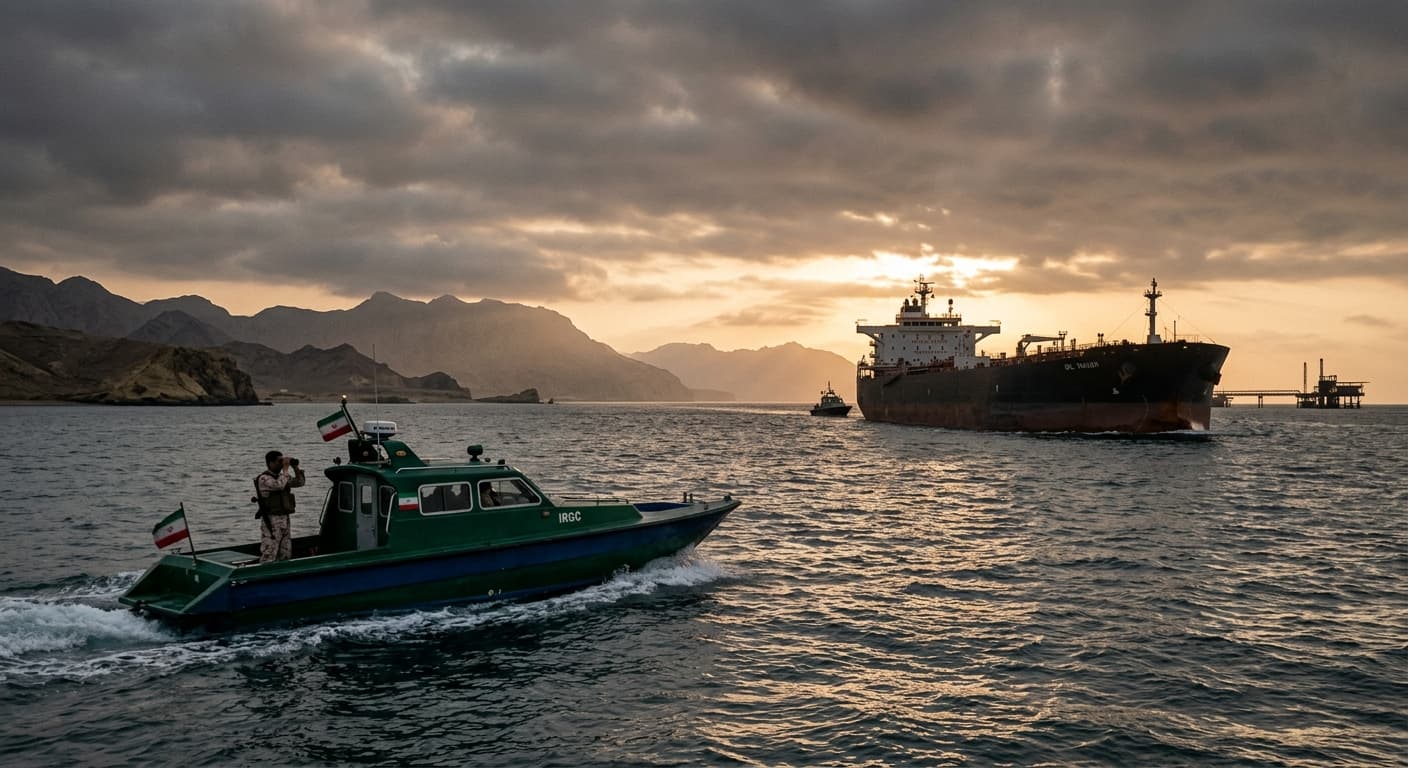
Hormuz Reopened on Paper. Iran Still Runs the Toll Booth.
Iran's Persian Gulf Strait Authority, a 60-day US MoU, and a $73 Brent price have replaced open transit with a permit regime — reshaping Gulf diplomacy.
The Strait of Hormuz is not closed and it is not open. Four months after Iran mined the channel and shut in roughly a fifth of seaborne oil, the June 17 US–Iran memorandum of understanding has produced something more consequential than a ceasefire: a functioning Iranian permit-and-fee system over the world's most important oil chokepoint, tacitly accepted by shippers and, for 60 days, by Washington. The strait has been "reopened" as a tolled Iranian corridor — and Gulf capitals, having watched the US, Russia and China all decline to force it back open, are now building around Tehran rather than through it. That is the story the price collapse to $73 Brent is hiding.
A ceasefire that legalised the leverage
The specifics of the 100-day disruption are on the record. According to the Foley & Lardner energy briefing published July 6, Iran's Revolutionary Guard Corps Navy blocked traffic on February 28, shut in an estimated 14 million barrels per day of output, and drove Brent to $114 on March 27 — the largest single-month rally in oil-market history. Vessel traffic fell more than 90%. Some 2,000 ships were stranded in the Gulf.
The June 17 MoU — signed by Donald Trump and Iranian President Masoud Pezeshkian in Switzerland — obliged Iran to use its "best efforts for the safe passage of commercial vessels with no charge, for 60 days only" while Washington lifted its naval blockade of Iranian ports, according to text quoted by Al Jazeera. Demining, the MoU says, would begin within 30 days. Talks on the "future administration" of the strait would run in parallel with Oman.
Read the operative verbs: "best efforts," "for 60 days only," "future administration." Iran did not concede the principle. It conceded a pause.
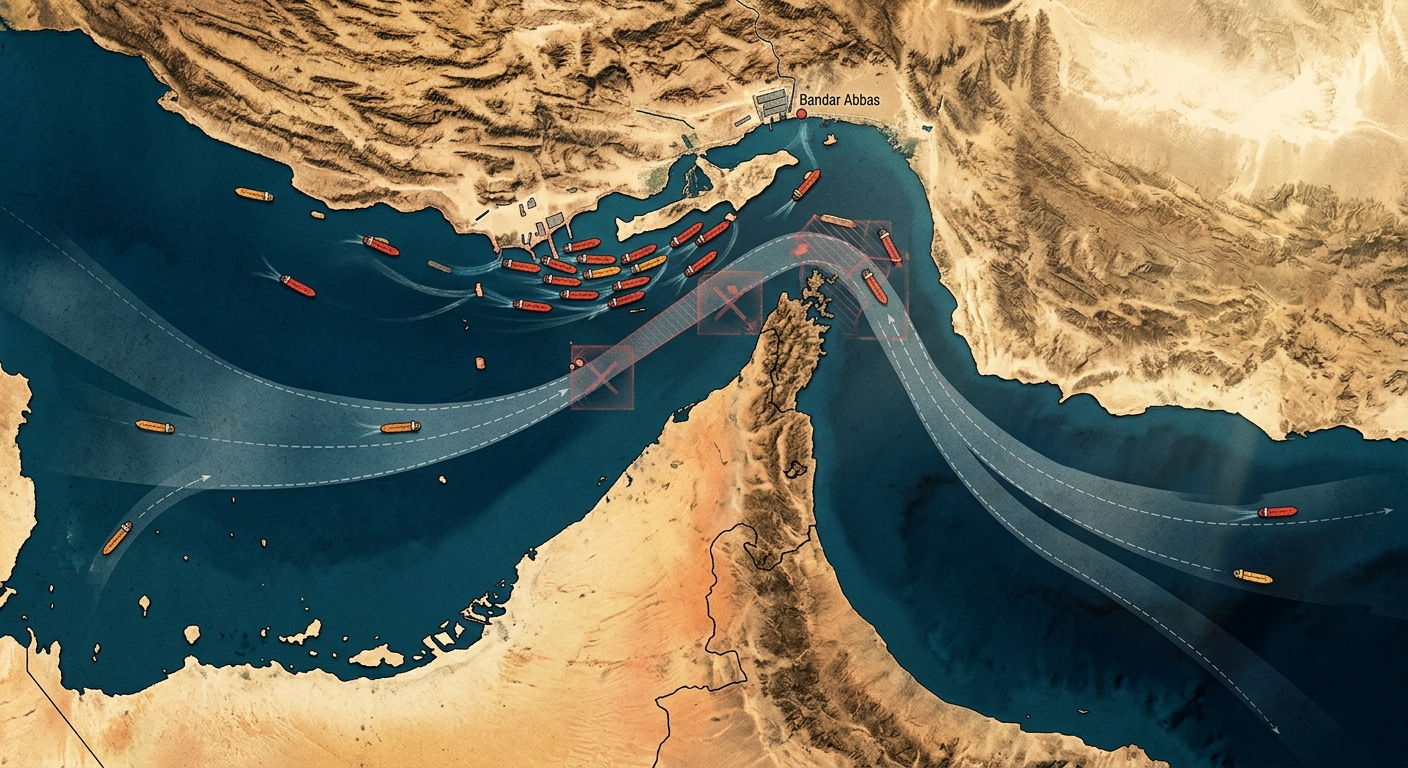
Within 72 hours of signing, the IRGC declared the strait closed again on June 20, citing Israeli strikes in Lebanon — while Tehran's foreign ministry told state media shipping was normal, per BBC ship-tracking analysis. The BBC counted 172 vessels transiting between June 18 and the following week, against a pre-war baseline of roughly 138 crossings per day. A cargo ship was struck by an unidentified projectile off Oman on June 25. On July 2,
MarineTraffic counted 38 confirmed transits, down from 48 the day before.
Traffic returned to roughly a quarter of pre-war levels. Prices fell to pre-war levels. The gap between those two numbers is the trade.
The permit regime Iran is monetising
The load-bearing fact of this crisis is not the ceasefire — it is the Persian Gulf Strait Authority (PGSA), an Iranian body created on May 5, 2026, that now claims exclusive licensing power over transits. According to a Crisis Group explainer, Iran published a "maritime control area" on May 4 stretching from Qeshm to a point east of the UAE's Fujairah port; on May 18 it launched a national insurance scheme, "Hormuz Safe," layered on top of the toll.
Tehran waived the fees for 60 days under the MoU. It did not dismantle the authority. In the Brookings episode of The Current on June 25, senior fellow Bruce Jones said the PGSA "has not been taken down" and that Iran's national insurance company had opened a policy that "countries transiting the strait are going to be required to apply for," per Brookings. Reported per-voyage tolls run up to $2 million, according to a
Brookings analysis by Samantha Gross and Ryan Beane, with vessel details — flag, owner, crew nationality — required for permission.
The precedent is what matters. As Gross and Beane put it, "once access becomes politically conditioned, states can use it to pressure adversaries, reward partners, generate economic rents, and strengthen aligned commercial networks." Iran has reportedly favoured Russian, Chinese, Indian and Pakistani-linked hulls. The strait is being reorganised around alignment, not law.
That the reorganisation is illegal under prevailing doctrine is not seriously disputed outside Tehran. On March 11, the UN Security Council adopted Resolution 2817 (2026), which the UN press office records as condemning Iran's attacks on GCC territory and reaffirming navigational rights through Hormuz. At an April 27 emergency session, Secretary-General António Guterres told the Council to "let ships pass" and "let the global economy breathe," per
UN Meetings Coverage.
But when the US and Bahrain circulated a follow-up resolution authorising an escort coalition, Russia and China vetoed it on April 7 — 11 in favour, two vetoes, Colombia and Pakistan abstaining. Russian ambassador Vassily Nebenzia said the draft ignored "illegal attacks" by the US and Israel. Iran's own delegate told the Council in April that "the Strait of Hormuz lies within Iran's territorial waters" and that Tehran "is not a party to the 1982 Convention and is not bound by its provisions."
Iran's legal position is thin — the INSS legal team notes that transit passage in international straits is "considered to reflect customary international law binding on all states" and cannot be suspended in wartime. But thin positions become thick when Beijing and Moscow are willing to veto for them.
The price collapse is not a peace dividend
Brent's fall to roughly $73 by early July looks like markets pricing in resolution. It is not. It is markets pricing in the release of stored oil. According to Foley & Lardner, some 35 million barrels stuck inside the Gulf have exited since June 17. Saudi Arabia "has more than doubled the shipping volume since June 17 than the prior three months combined," Sparta analyst Yip Ching-hei told
Al Jazeera, and Iran has moved close to 50 million barrels since Washington's blockade lifted.
That is a destocking rally, not a return to normal. StoneX told TankTerminals on June 30 that global inventories are running roughly one billion barrels short of pre-crisis levels — a hole that "will require at least six months of active resupply to resolve." OPEC+ output collapsed from 42.77 million bpd in February to 33.13 million bpd in May, per
OPEC's own figures. Middle East production remained more than 11 million bpd below pre-conflict levels as of May, per the US Energy Information Administration.
The EIA had assumed Brent would average around $105 through the summer. It missed by $30 in the opposite direction — because diplomacy moved faster than mines. The same forecast expects full pre-war traffic to return only in early 2027.
Refined products carry the sharper mark. The EIA's June short-term energy outlook projects wholesale diesel prices up more than 60% and jet fuel more than 40% versus its pre-conflict February forecast, per Foley & Lardner. That is where consumers and industrial buyers actually feel a Hormuz risk premium — even at $73 Brent.
Gulf diplomacy has quietly changed its mind
The most durable consequence of this crisis is not the MoU. It is the strategic realignment of the six Gulf Cooperation Council states, which spent the past decade pursuing rapprochement with Iran and are now abandoning it in specifics if not rhetoric.
GCC Secretary-General Jasem Albudaiwi disclosed in a June televised address, reported by Annahar, that Iran directed roughly 85% of its wartime missile fire at GCC territory, and demanded Gulf inclusion in any US–Iran final settlement. The 50th extraordinary GCC ministerial, convened March 1, invoked the bloc's Joint Defence Agreement — the collective-defence clause — for the first time in response to Iranian attacks that began February 28, per the official
Bahrain News Agency readout. Oman, historically Tehran's back-channel, unilaterally coordinated a southern shipping corridor with the IMO on June 24 — a corridor the IRGC then declared "unacceptable," per
Al Jazeera.
Structurally, the shift is in steel. Saudi Arabia has restored its East–West Pipeline to full 7 million bpd capacity after Iranian strikes on pump stations, according to a Saudi Ministry of Energy statement carried by Al Jazeera; Kpler data show throughput jumping from a 770,000 bpd Jan–Feb average to 2.9 million bpd by late March. The UAE announced on May 15 it was accelerating the West–East pipeline expansion to double Fujairah's export capacity by 2027, per
Al Jazeera. Even Riyadh's think tanks — see the July 2
Gulf International Forum — are openly arguing for overland routes to Red Sea and Indian Ocean markets.
Combined non-Hormuz pipeline capacity is roughly 9 million bpd against a 20 million bpd pre-war strait flow, per Al Jazeera. It does not replace Hormuz. It insures against it. That is the point.
On the ground: Bandar Abbas and the seized ships
The reality inside the strait is that Iranian sovereignty over the waterway is a fact on the water, not a legal claim. A BBC crew that reached Bandar Abbas last week found the MSC Francesca (Panama-flagged) and Epaminondas (Liberia-flagged) still held by the IRGC, months after their April seizures, despite the ceasefire. ACLED counted at least 96 US strikes in and around Bandar Abbas between February 28 and April 8. The Joint Maritime Information Centre still warns commercial ships to use the Omani southern corridor because of confirmed mines in the central channel.
And US Treasury policy tracks the strategic ambiguity. OFAC issued General License U on March 20 authorising delivery of Iranian-origin crude already loaded on vessels, per Treasury records; on May 1 it published an alert titled "
Sanctions Risks of Iranian Demands for Strait of Hormuz Passage," warning industry that paying PGSA fees could expose shippers to sanctions liability. Washington is simultaneously easing sanctions to get Iranian oil to market and telling firms not to pay the transit fees that Iran will demand once the 60-day waiver expires.
Companies cannot serve two policies at once. Most are quietly opting for the southern Omani route and switching off their AIS transponders in the middle of the channel — which is why commercial tracker counts and US CENTCOM counts diverge. The strait is running on informal accommodations because the formal ones have not yet been written.
Diplomat View
The MoU is not a peace deal. It is a 60-day option Washington bought to preserve $73 Brent through the summer, at the cost of legitimising an Iranian licensing regime over an international waterway. Once the option expires in mid-August, one of three things happens: Iran phases in tolls under a "future administration" framework Oman is pressured to co-sign; the US walks and re-imposes a blockade, and Brent revisits triple digits; or the parties extend the fudge indefinitely, and Hormuz becomes the Suez Canal — priced, permitted, politicised.
The base case is the third. It is cheapest for everyone in the room. It is also the outcome that quietly ratifies Iran's core claim: that access to a fifth of the world's seaborne oil is a sovereign asset, not a global commons. What would falsify this call: a genuine Iranian teardown of the PGSA or a Russian–Chinese vote to enforce Resolution 2817 with escorts. Neither is on any current agenda.
What to watch:
- August 2: OPEC+ meeting to review production, per
Al Jazeera. Signals whether Riyadh believes the strait is functionally normal.
- Mid-August: 60-day MoU window closes. Iran's fee waiver expires. Watch for PGSA rate cards and OFAC's response.
- Autumn 2026: European mine-clearing contribution — Brookings' Jones puts it at "months" — must be operational for the central corridor to reopen.
The Bottom Line
Iran lost the war and won the strait. The June 17 MoU did not restore freedom of navigation to Hormuz; it converted an Iranian wartime blockade into a peacetime permit regime that Washington has bought time to accept and Gulf states have concluded they must route around. If the arrangement holds past mid-August, the precedent — that a coastal state can monetise transit through an international waterway when a P5 veto shields it — will outlast this administration, this ceasefire, and this oil-price cycle.
Discover more
US Politics
House Ethics Committee Pushes Sexual Miscond.
The House Ethics Committee has shifted responsibility for sexual harassment settlement records to the Office of Congressional Workplace Rights, complicating disclosure efforts.
US Politics
Congress Targets AI Chatbot Access for Terror
The House passed the Generative AI Terrorism Risk Assessment Act, focusing on AI's role in terrorism and potential surveillance implications.
India
700 Activists Accuse PM Modi of MCC Breach
Over 700 activists allege PM Modi breached election code with a televised address attacking opposition parties just before state elections.

Economics
Fed's Amex AML order puts correspondent banking on notice
Federal Reserve's Amex AML order requires board-level controls and a 90-day plan; OCC fined the bank $350 million over enterprise-wide deficiencies.