Iran's $6 Billion Oil Windfall During US Truc
Iran exploited a 30-day US sanctions pause to move 70 million barrels of crude toward China.
Model Diplomat7 min readMiddle East
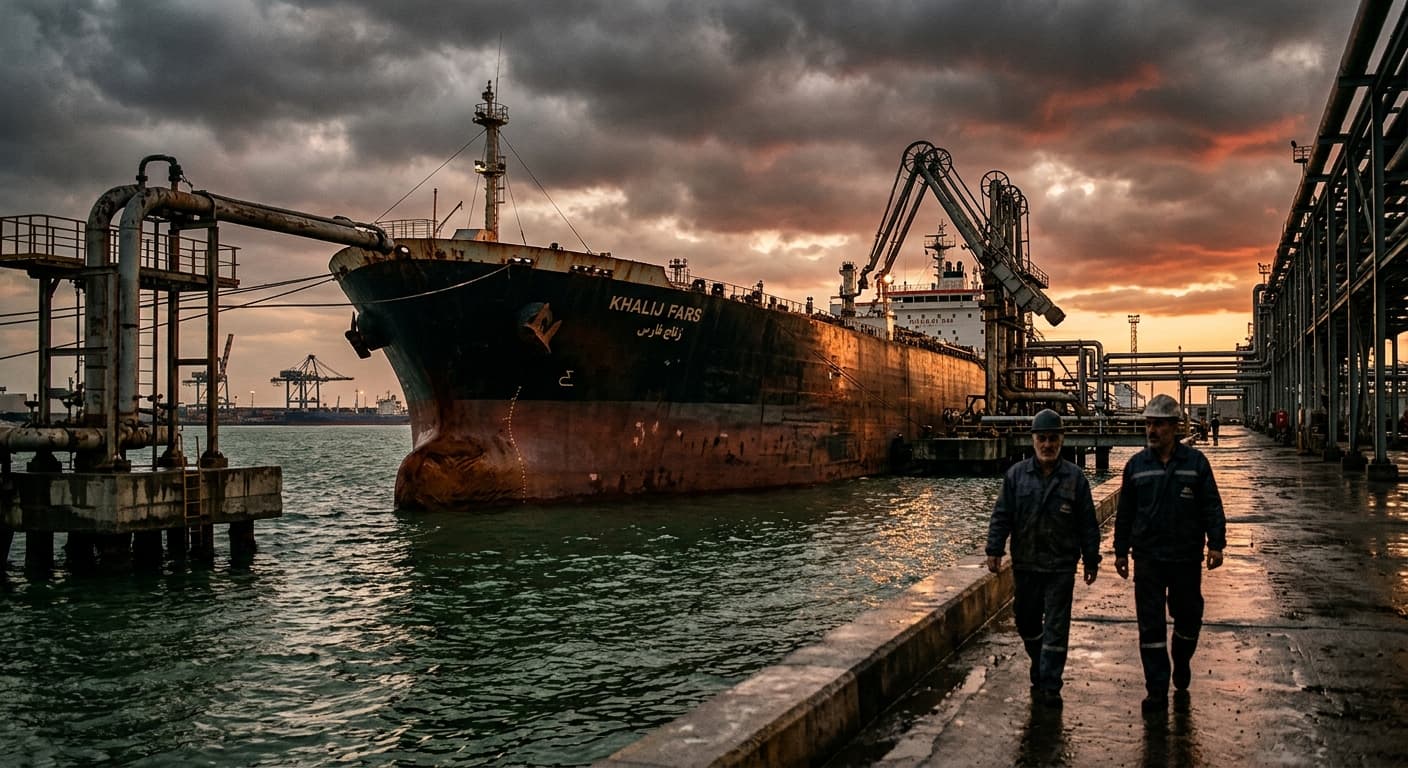
The Ceasefire Was Never a Peace Deal — It Was a $6 Billion Refueling Stop
Iran exploited a 30-day US sanctions pause to move 70 million barrels of crude toward China. The renewed blockade will take months to bite — and that gap is the story.
When the US and Iran signed their 14-point memorandum of understanding on June 17, 2026, Washington framed it as a path toward peace. Tehran saw something else: a one-month export window. In the four weeks that followed, Iran shipped roughly 70 million barrels of crude oil worth an estimated $5 billion to $6 billion toward China, according to estimates compiled by the advocacy group United Against Nuclear Iran and oil analysts The Wall Street Journal. Some 50 million barrels departed in the second half of June alone — equivalent to a full month of pre-war Iranian exports to China.
The shipments did not stop when the truce collapsed. Already at sea — much of it positioned off Malaysia's east coast for ship-to-ship transfers that obscure its origin — the oil will generate revenue for Tehran over the coming months even as the restored US blockade halts new exports. The truce, in effect, built Iran a $6 billion financial buffer precisely when economic pressure was about to become acute.
"If they had left the blockade on, the pinch would likely have hit about now," Charlie Brown, a Singapore-based analyst with United Against Nuclear Iran, told the Journal. Once the blockade was lifted, Iran "quickly surged more oil… so there is a big buffer again" The Jerusalem Post.
How Many Days Were Left Before Iran Cracked
To understand what happened in June and July, you have to rewind to May. The first US naval blockade — imposed on April 13, 2026 — had reduced Iranian crude exports from roughly 1.84 million barrels per day in March to below 300,000 bpd, according to trade intelligence firm Kpler Al Jazeera. At conservative pricing of $90 per barrel, that meant daily oil revenue collapsed from $166 million to roughly $27 million.
Iran's parliament speaker and chief negotiator, Mohammad Bagher Ghalibaf, later acknowledged the blockade's severity in a television interview: "We did not export even one barrel" during the blockade Al Jazeera. The rial, meanwhile, had cratered to an all-time low of 1.93 million against the US dollar
Al Jazeera. The International Monetary Fund projected Iran's real GDP would shrink by 6.1 percent in 2026
Al Jazeera.
But the most urgent pressure was physical, not financial. Iran was running out of places to put its oil. Storage tanks on Kharg Island — the export terminal through which 90 percent of Iranian crude flows — were filling fast. The Columbia Center on Global Energy Policy reported that between April 13 and April 21, Iranian crude stocks rose by more than 6 million barrels Al Jazeera. By late April, analysts at Kpler estimated Iran could run out of onshore crude storage in 12 to 22 days. Production shut-ins — damaging wells that could cost years and billions to restore — were imminent.
The June 17 MoU changed all of that. The US agreed to lift the blockade and, on June 22, the Treasury Department's Office of Foreign Assets Control issued General License X, a 60-day authorization "for the production, delivery and sale of crude oil, petrochemical products, and petroleum products of Iranian-origin" OFAC. For the first time since the war began, Iran could sell oil without the shadow fleet vanish-and-reappear routine. The rial rose 15 percent on the day of the agreement
Al Jazeera.
The tankers that had been floating inert off Iranian ports for nine weeks began moving. About 20 vessels — including the Diona, the Hero II, the Sonia 1, and the Stream — arrived in waters off Malaysia's east coast. According to BBC reporting citing United Against Nuclear Iran and shipping data firm TankerTrackers.com, Iran exported at least 74 million barrels between the end of the blockade and its July 14 reimposition BBC.
The China Circuit: Teapots, Ghost Tankers, and a Beijing Blocking Order
None of this would matter without the buyer. And the buyer — overwhelmingly — was China.
China purchased more than 80 percent of Iran's shipped oil in 2025, according to Kpler Al Jazeera. But the oil doesn't flow to Sinopec or PetroChina. It goes to "teapot refineries" — small, privately owned facilities concentrated in China's Shandong province, nicknamed for their squat, kettle-like shape. These independents buy Iranian crude at a discount and have been the backbone of Beijing's sanctions-evasion architecture for years.
The US House Select Committee estimated that by early 2026, China had assembled a strategic petroleum reserve of roughly 1.2 billion barrels — approximately 109 days of seaborne import cover — "at well below market cost from the very barrels Western sanctions were designed to strand" Al Jazeera.
The tankers that left Iran during the June–July window headed not for Chinese ports but for the Eastern Outer Port Limits off Malaysia — an unregulated anchorage approximately halfway between Iran and China. There, they conduct ship-to-ship transfers using large hoses, pumping crude from Iranian-flagged or shadow-fleet vessels onto receiving tankers. The receiving vessels then proceed to Chinese refineries with cargo whose origin is laundered through the transfer The Jerusalem Post.
Beijing reinforced this architecture in May, when it invoked its anti-sanctions statute for the first time. The Ministry of Commerce issued a "prohibition order" stipulating that US sanctions on Hengli Petrochemical (Dalian) Refinery and four other teapot refineries "shall not be recognized, enforced, or complied with" Al Jazeera. The order had no immediate material impact, analysts noted, but it signaled to Chinese firms that Beijing would shield them from the binary choice of complying with US sanctions or facing Chinese countermeasures.
The Dollar Paradox Inside GL X
An underappreciated feature of General License X was its requirement that Iranian oil sales be settled in US dollars. Treasury Secretary Scott Bessent publicly stated that "Iranians will be invoicing in dollars" — a provision that, if enforced, would give Washington unprecedented visibility into Iranian oil transactions Atlantic Council.
But that visibility depended on major US banks re-entering Iranian trade — and most remained reluctant, fearing compliance violations and steep fines. As the Atlantic Council noted, "issuing a sanctions waiver that authorizes oil sales is one thing; persuading banks, shipping companies, and insurers to reengage with Iran within sixty days is another" Atlantic Council.
The result: a significant share of the June–July transactions likely flowed through alternative payment systems — yuan-denominated settlements routed through ICICI Bank's Shanghai branch, as Indian refiners did during a March waiver — or through the same barter arrangements and "trustee" networks Iran has operated for years Al Jazeera. The dollar-invoicing provision was a lever Washington could not fully pull.
On July 7, 2026 — the day after Iran attacked commercial vessels in the Strait of Hormuz — OFAC revoked General License X and replaced it with General License X1, authorizing only a brief wind-down OFAC. By then, the 70 million barrels were already in transit or transferred.
What the Blockade Cannot Undo
The renewed blockade, ordered by President Trump on July 14, has restored the physical barrier that crushed Iranian exports in April and May. CENTCOM has redirected vessels, disabled non-compliant ships, and struck Iranian coastal defense systems around Greater Tunb Island, Ahvaz, Bandar Abbas, Konarak, Sirik, and Qeshm The Jerusalem Post. Maritime traffic through the strait has collapsed: only six vessels were recorded transiting on July 12, the lowest number in five weeks.
Energy analyst Hamidreza Shokouhi told Al Jazeera that the renewed siege means at least 1.5 million bpd of Iranian oil exports will be taken off the market, pushing oil prices toward $90 per barrel Al Jazeera. The rial hit a new record low above 1.93 million per dollar on July 19.
But the blockade now faces a problem it did not face in April: the revenue from 70 million barrels is already working its way back to Tehran.
"Iran's economy is in its worst shape since the revolution, so every dollar of revenue matters," Jonathan Panikoff, a Middle East expert at the Atlantic Council, told the Journal. He assessed that the Iranian government would probably prioritize the revenue for its strategic objectives, particularly its ongoing confrontation with the US The Jerusalem Post.
The CFR flagged the same paradox in its analysis of the earlier March waiver: "The administration's stated objective was to drive down Iranian oil exports to zero through maximum pressure sanctions, and yet Iran found ways to sell its oil on the black market anyway. Now the United States has issued sanctions relief that might deliver Tehran a windfall to fund the very war machine it is fighting against" Council on Foreign Relations.
This is not a replay of April. Then, the blockade caught Iran with storage capacity nearly full, production heading toward shut-ins, and a currency in freefall. That pressure took nine weeks to build. The buffer Tehran has now — in floating storage already dispatched, in payment pathways already activated, in oil that has already completed its ship-to-ship transfer — means the fiscal squeeze the US counted on will take months to reproduce.
The Bottom Line
The 70 million barrels Iran moved during the June–July truce is not proof that sanctions failed. It is proof that a temporary sanctions pause, layered on top of a sanctions-evasion infrastructure Beijing spent years building, can reverse months of pressure in weeks. Every day the June 17 MoU remained in effect, Iran earned roughly what it would have earned in a week of pre-blockade exports. The cash now landing in Tehran — whether routed through yuan-denominated channels, barter arrangements, or the shadow fleet's commercial networks — will blunt the renewed blockade's fiscal impact until late 2026 at the earliest. Washington's military pressure on Iranian ports has never been matched by its control over the payment architecture that makes oil revenue useful to Tehran, and that gap — not the tankers — is the strategic failure.
The bottom line: Washington seized the chokepoint but gave Tehran a one-month cash-out window, and Beijing made sure the money got through. The blockade is back, but the economic pressure it took nine weeks to build the first time will take just as long to build again — and Iran now has a $6 billion reason to wait.
Discover more
US Politics
House Ethics Committee Pushes Sexual Miscond.
The House Ethics Committee has shifted responsibility for sexual harassment settlement records to the Office of Congressional Workplace Rights, complicating disclosure efforts.
India
Romanian Coalition Party Demands PM Resign
Romania's Social Democrats withdrew from coalition, joining far-right AUR to topple PM Bolojan, risking €10 billion in EU funds by August 2026.

International Relations
Pakistan's Key Role in US-Israel-Iran Meddle
Pakistan is seeking to mediate the US-Israel-Iran conflict, balancing high-stakes diplomacy against severe economic pressures and steep regional challenges.

Conflict & Security
Drone Warfare Killing Aid Workers at Unprec
Over 1,000 humanitarian workers killed in three years as cheap armed drones collapse legal protections. Gaza, Sudan, Ukraine, and DRC see deliberate targeting of aid convoys and hospitals with zero prosecutions.