Iran Strikes Qatari LNG Tanker Amid Talks
Iran attacks Qatari vessel as negotiations falter.
Model Diplomat7 min readMiddle East
Iran Extracts a Toll: Qatari LNG Tanker Hit as Hormuz Talks Fray
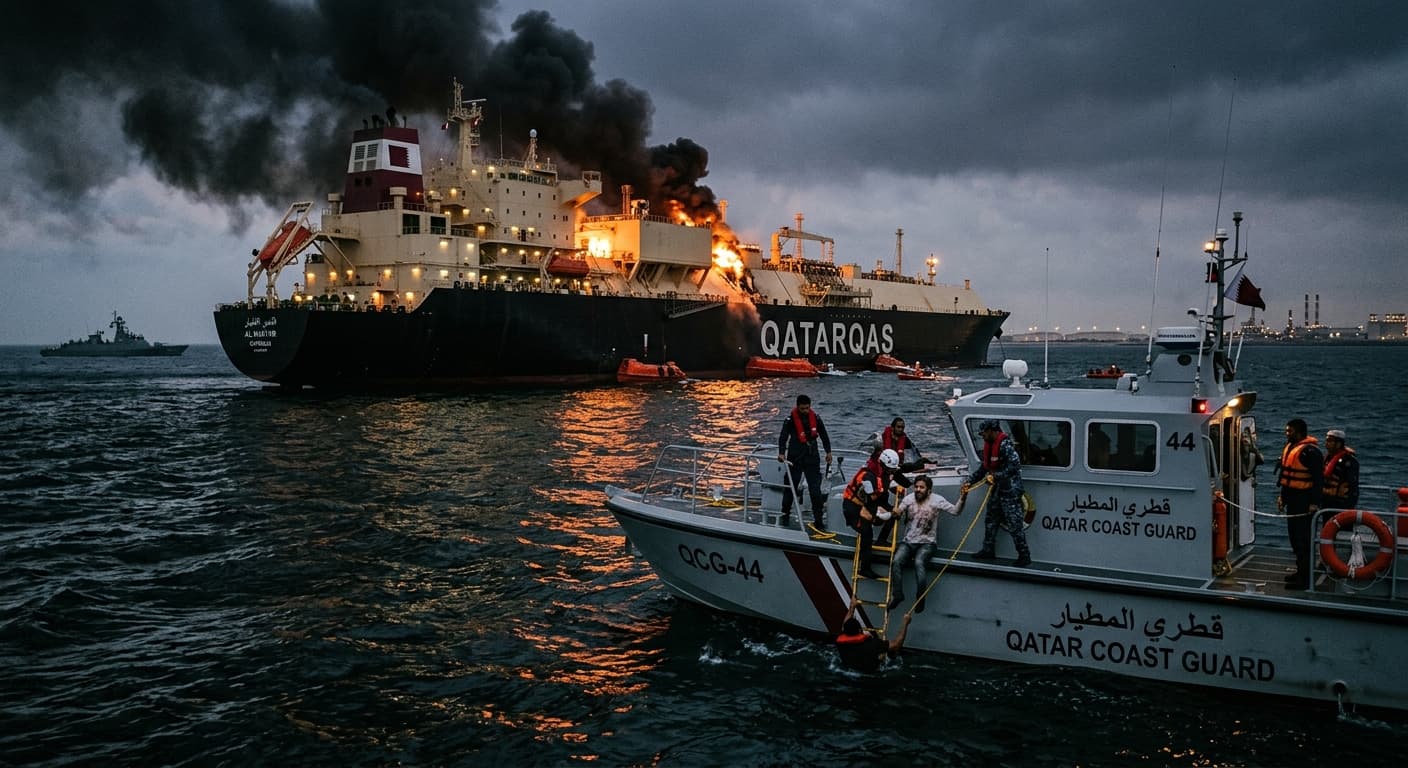
Iran struck a Qatari LNG tanker near Oman on July 7, 2026, three weeks into the US-Iran MOU. The attack is not sabotage — it is negotiation.
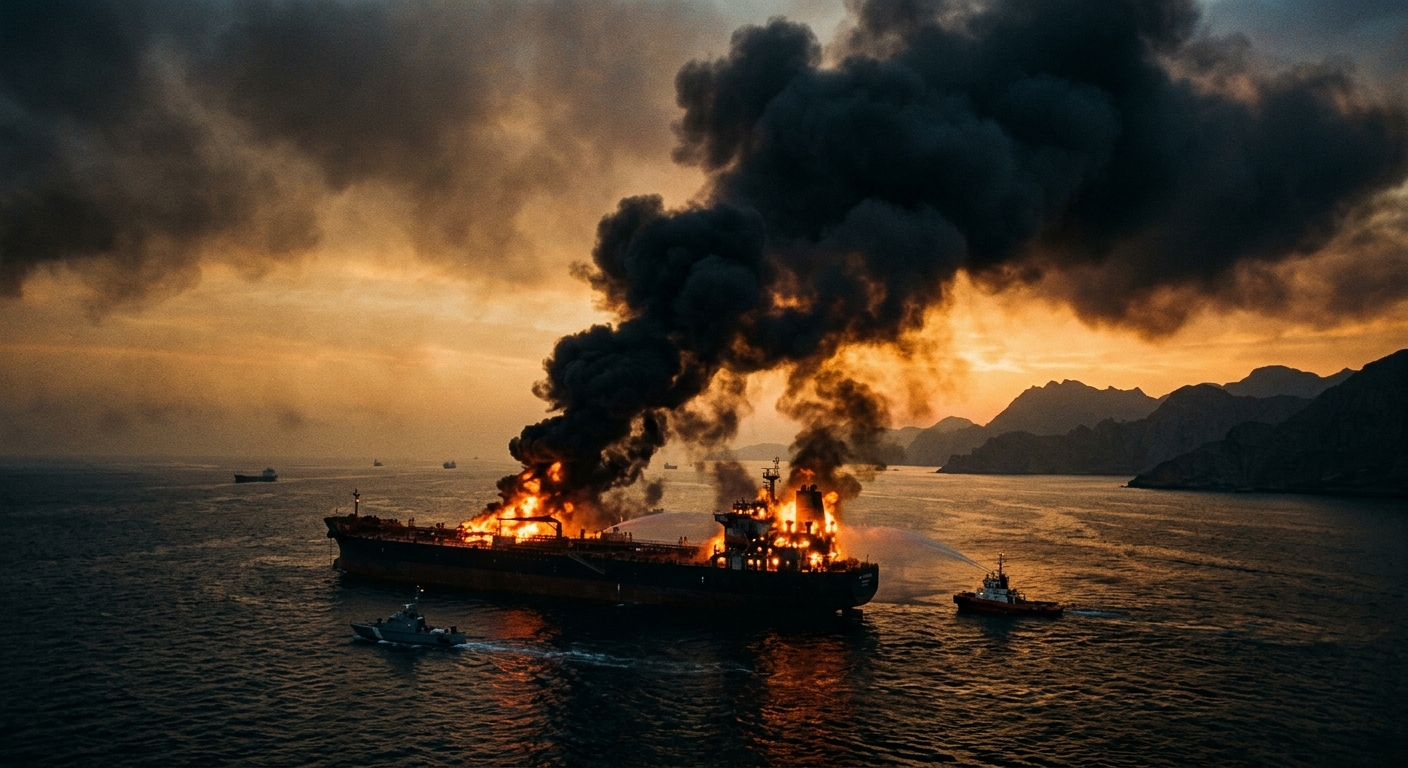
An Iranian-fired projectile hit the Qatari-flagged LNG tanker Al Rekayyat eight nautical miles off Limah, Oman, in the early hours of July 7, 2026, setting its engine room ablaze; a second Saudi-flagged crude tanker was struck the same night, according to two US officials cited by Axios and confirmed by the UK Maritime Trade Operations centre. Iran denied direct responsibility but told state television the vessels had "ignored warnings." The strike is not a rupture of the June 17 Memorandum of Understanding that paused the US-Israel war on
Iran — it is Tehran's method of enforcing its preferred reading of that document, using ordnance to fill in what Point 5 left blank. The immediate loser is not Washington. It is Qatar, the state mediating the deal Tehran just used a missile to renegotiate.
The MOU's load-bearing ambiguity
The 14-point MOU signed by Presidents Donald Trump and Masoud Pezeshkian at the Palace of Versailles on June 17 is a ceasefire, not a settlement. Paragraph three of the text released by the White House gives negotiators "maximum 60 days, extendable with mutual consent" to conclude a final deal. Point 4 obligated the United States to lift its naval blockade within 30 days — done by June 19, when
US Central Command confirmed the blockade's end.
The load-bearing ambiguity sits in Point 5. According to the verbatim account of the memorandum read to reporters by a senior US official, Iran commits to using its "best efforts for the safe passage of commercial vessels with no charge for 60 days only from the Persian Gulf to the Sea of Oman, and vice versa," and to "conduct dialogue with the Sultanate of Oman to define the future administration and maritime services in the Strait of Hormuz."
Read that clause carefully. Nothing in it grants freedom of navigation as understood under Article 38 of the UN Convention on the Law of the Sea. It grants a 60-day fee holiday on a passage Iran now claims to administer. On June 18, Iran's chief negotiator Mohammad Bagher Ghalibaf told state media the Strait "will not return to pre-war conditions" and that Iran will "receive a fee for services" — a position Foreign Minister Abbas Araghchi has since defended by insisting the MoU "gives Tehran control of the waterway" for the first 30 days, according to reporting from Al Jazeera.
That reading is inadmissible in Washington. On July 6, Trump told reporters in the Oval Office: "We're either going to make a deal or we're going to finish the job. And it won't be tough to finish the job. I'd rather make a deal, because I don't want to affect 91 million people." Hours later the Al Rekayyat was on fire.
Qatar, the mediator getting shot at
The July 7 target selection is the most revealing detail of the operation. The Al Rekayyat is registered to a Qatari state-linked operator, hauling Qatari LNG. Qatar, alongside Pakistan, is the mediator that produced the June 17 MOU and the Doha technical talks that concluded July 2 with no breakthrough. Doha has spent five months absorbing Iranian projectiles aimed at Israel while trying to broker a war exit.
Qatari Foreign Ministry spokesman Majed Al Ansari's response was sharper than any prior statement from Doha during the war. On X, Al Ansari called the strike "an unacceptable assault on the security and safety of international navigation," a "grave and blatant violation of international law," and — the phrase that matters — held "Iran fully legally responsible for this assault and any resulting damages or consequences." That is state-level attribution from the Gulf capital that Iran can least afford to alienate.
The message from Tehran to Doha is straightforward: mediation does not confer immunity, and the mediator is not a neutral space. It is also a message to the $6bn in Iranian assets held in Qatari escrow. Iran wants those funds released faster than Washington has signalled. Firing at a Qatari hull concentrates the mediator's mind on Iran's implementation grievances more effectively than another Doha communiqué.
Mojtaba Khamenei's IRGC calculus
The projectile has a political author. Iran's new Supreme Leader Mojtaba Khamenei — installed after his father Ali Khamenei was killed in the February 28 opening strikes — did not build his authority on clerical seniority. He built it on the Islamic Revolutionary Guard Corps, which, as the Gulf International Forum has argued, "emerges as the core arbiter of power" in the post-war order and pushed his succession precisely because he was "a pliable and reliable figure capable of preserving internal cohesion while maintaining a hard external line."
That structural fact governs what Tehran can concede at the table. Ali Khamenei's public endorsement of the deal on June 19 came with the phrase that he had approved it "despite having a different view," per BBC News — a formulation that reserves the right to renegotiate through the IRGC. The Guards have used that reservation twice since: in the June 25 strike on the Ever Lovely that halted the UN's evacuation of 11,000 stranded sailors, and again on July 7.
The Carnegie Endowment's succession analysis warned in March that a Mojtaba-led system would "further entrench the IRGC and Basij within a state already dominated by the clerical and security establishment." That entrenchment is now visible in operational tempo. On July 3, Iran's ambassador to Beijing publicly promised "special" Hormuz treatment for "friendly" countries — a tolling scheme dressed as discount pricing — despite Washington's explicit rejection of any fee regime.
The oil market is calling Iran's bluff
Here is the analytical inversion the wire coverage misses: Iran is losing the very leverage it is trying to weaponise.
Brent crude for September delivery closed at $72 a barrel on July 6 — below the $72.48 settlement on February 27, the day before the war began — even after the Al Rekayyat strike. OPEC+ announced on July 5 that seven members, led by Saudi Arabia and Russia, would raise output by 188,000 barrels per day from August. Saudi shipping volumes have more than doubled since June 17. Iran itself has pushed roughly 50 million barrels of stored crude to market since the US blockade lifted, according to Sparta senior analyst Kai Yip's estimate cited by Al Jazeera.
Traffic through Hormuz averaged 36 transits per day on July 3–5 — a quarter of the pre-war baseline of about 130 — but the global market has adapted. Buyers have drawn on strategic petroleum reserves. Producers are routing through the Saudi East-West Pipeline, the UAE's Abu Dhabi Crude Oil Pipeline, and the Iraq–Türkiye line. Combined pipeline capacity falls short of Hormuz throughput, but is now sufficient to prevent a supply-shock spike.
The consequence: Tehran's implicit threat — that closure of Hormuz drags Washington and its Gulf partners back to the table — no longer prices in. That is why the Iranian escalation ladder has narrowed to attacks on individual hulls, not general closure. It is also why Iran is charging fees rather than closing the strait. The tolling regime is a monetisation strategy for leverage that is quietly bleeding out.
The mission Europe finally sent
The other under-noticed development is the joint UK-France statement of July 3, in which Prime Minister Keir Starmer and President Emmanuel Macron announced that Oman had agreed to work with London and Paris to secure its territorial waters, and that both countries "stand ready to deploy the wider Multinational Military Mission to support freedom of navigation in the Strait of Hormuz."
This is what Trump asked NATO for in March and did not get during the war. He is getting it now — after the ceasefire — from Britain and France, not from the alliance as a whole. The NATO Ankara summit opened on July 7 with Bahrain, Kuwait, Qatar and the UAE sending ministers as observers, a first for the alliance's engagement with the Gulf. CSIS's analysis of the summit calls it "NATO 3.0" — a division of labour in which Europe handles Middle Eastern maritime security while the US retains extended deterrence.
That is a structural shift. If it holds, Iran's tolling scheme will be enforced against not a US-Emirati task force but a European-Omani one, backed by UNCLOS Article 38 and framed as a defence of an existing US-Iran agreement. Tehran cannot easily paint that as American aggression.
Diplomat View
The July 7 attack does not kill the MOU. It clarifies what the MOU actually is: a phased renegotiation in which Iran, having lost the war militarily, is using the ceasefire's ambiguous language to recover position at sea. The 60-day clock runs to August 16, 2026, and both sides now have an incentive to extend rather than collapse it — Trump because a "finish the job" bombing campaign against a rebuilt Iranian air defence would be politically expensive; Mojtaba Khamenei because the alternative to talks is a strike campaign his regime survived once and cannot obviously survive twice.
The falsifiable call: no return to full-scale war before September 30, 2026. Iran will continue targeting individual hulls to enforce its tolling claim, absorbing US retaliatory strikes on IRGC coastal assets as the price of the leverage. What would revise this forecast: a mass-casualty incident on a US-flagged or US-crewed vessel; an Israeli strike on Iranian soil independent of Washington; or a public Iranian repudiation of the MOU's nuclear paragraphs, which — unlike Point 5 — Trump treats as non-negotiable. Watch Araghchi's language, not Ghalibaf's: the foreign minister's July 7 warning to "honor your signature" is the last off-ramp Tehran has offered.
What to watch
- July 8, 2026 — NATO Ankara summit closes; final communiqué on Multinational Military Mission and Gulf-partner integration.
- July 15, 2026 (approx.) — Next scheduled round of Doha technical talks, contingent on end of Ali Khamenei mourning rites and Iranian de-escalation.
- August 16, 2026 — 60-day MOU deadline expires unless renewed by mutual consent; final deal must include nuclear framework, sanctions calendar, and Hormuz administration.
Discover more

US Politics
House Ethics Committee Pushes Sexual Miscond.
The House Ethics Committee has shifted responsibility for sexual harassment settlement records to the Office of Congressional Workplace Rights, complicating disclosure efforts.
India
Congress Accuses Modi of Stalling Women's Law
Congress accuses Modi of stalling women's reservation law by linking it to delimitation, revealing a deeper electoral strategy.

US Politics
SNAP Food Assistance Faces Legal Challenges
In 2026, SNAP faces stricter eligibility rules and mounting legal challenges, threatening food assistance for the millions of Americans who rely on the program.

Conflict & Security
Drone Warfare Killing Aid Workers at Unprec
Over 1,000 humanitarian workers killed in three years as cheap armed drones collapse legal protections. Gaza, Sudan, Ukraine, and DRC see deliberate targeting of aid convoys and hospitals with zero prosecutions.