Iran Strikes Bahrain and Kuwait, Ceasefire F
US-Iran ceasefire collapses after missile strikes
Model Diplomat9 min readMiddle East
Iran Strikes on Bahrain and Kuwait Bury US Ceasefire — and the Gulf's Security Bet
Trump declared the US-Iran ceasefire "over" on July 8, 2026 after Iran hit 85 sites in Bahrain and Kuwait. The Gulf's security model, not the truce, is what actually broke.
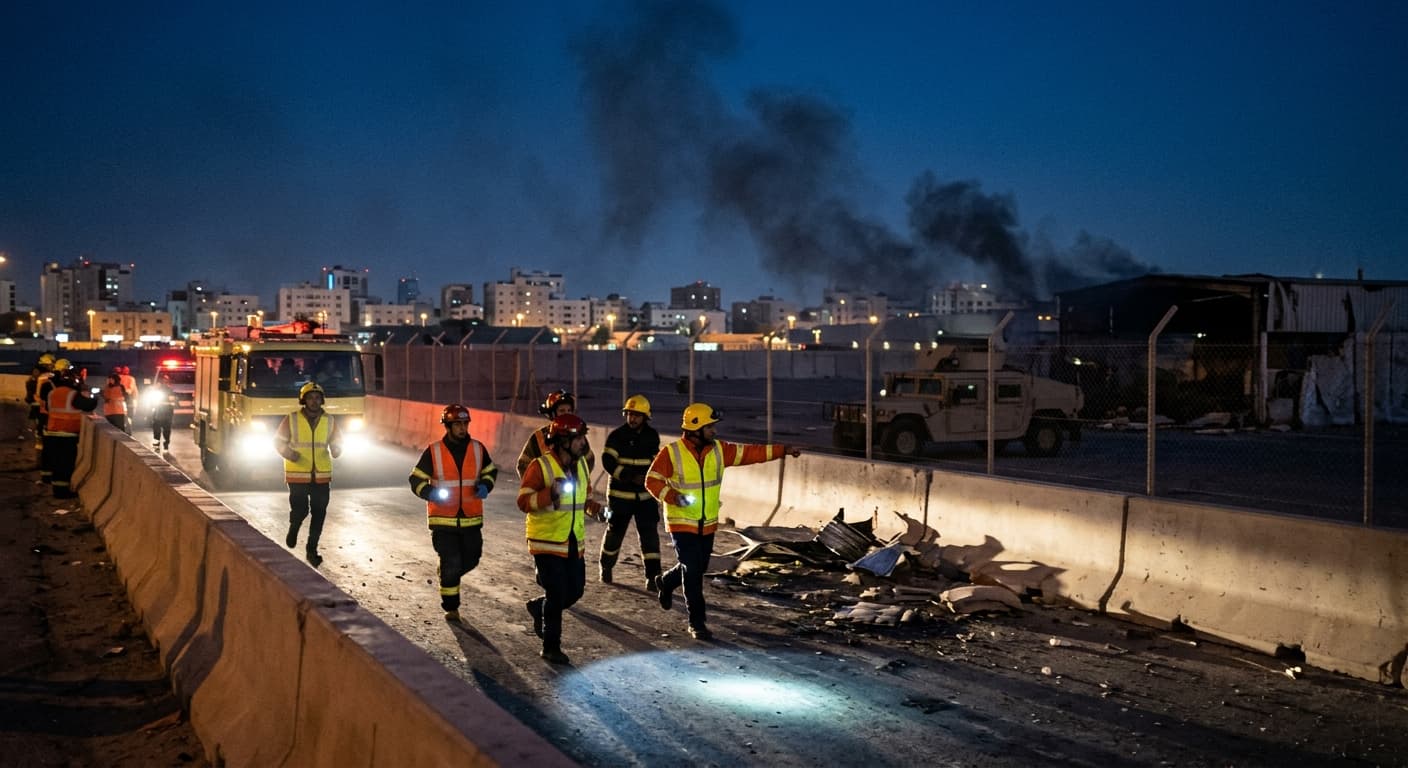
Iran fired ballistic missiles and drones at what it says were 85 US military facilities across Bahrain and Kuwait overnight on July 7–8, 2026, and by mid-morning US President Donald Trump had told reporters at the NATO summit in Ankara that the memorandum of understanding underwriting the ceasefire was "over," according to UPI. The strikes — the second such exchange in ten days — did not merely puncture a fragile truce. They confirmed the working thesis inside Riyadh, Abu Dhabi and Doha since February: that the US-Gulf security architecture is now a liability the Gulf hosts rather than a shield they enjoy, and that whatever comes next will be built to hedge against that fact.
What happened on July 7–8
US Central Command said it struck "over 80 targets with precision munitions" in southern Iran — air defence radars, coastal surveillance, anti-ship cruise missile sites, IRGC fast boats and drone launchers around Sirik, Qeshm Island and Bandar Abbas — in retaliation for projectile attacks on three tankers transiting the Strait of Hormuz the day before, according to Al Jazeera. Iranian state media confirmed damage at Sirik's commercial pier and four civilians wounded by shrapnel. The
BBC reported that hours later the Islamic Revolutionary Guard Corps fired at 85 US-linked sites, including the US Fifth Fleet headquarters at Bahrain's Naval Support Activity and the Ali Al Salem airbase in Kuwait.
Kuwait's army said it intercepted two ballistic missiles and 13 drones and briefly closed its airspace. Bahrain's interior ministry reported that falling shrapnel damaged homes and vehicles in Manama and Hamad Town, BBC reported in its follow-up on the second consecutive day of strikes. There were no reported casualties in the Gulf host countries — a pattern that has held through repeated Iranian salvos since February, thanks largely to US-supplied Patriot batteries and integrated air defence coordination.
The US Treasury simultaneously revoked the waiver it had issued in mid-June allowing Iran limited oil sales — a core deliverable of the 14-point MoU signed in Switzerland on June 14. Nikkei Asia reported that the sanctions reinstatement and the military strikes together represented the sharpest unraveling of the truce since it was signed. Iran's chief negotiator and parliament speaker Mohammad Bagher Ghalibaf called both moves "major MoU violations."
Standing beside Trump in Ankara, NATO Secretary-General Mark Rutte said the US action was "absolutely necessary" because Iran was "basically violating the ceasefire," per Al Jazeera's live blog. French President Emmanuel Macron called Iran's retaliation a "mistake" but said negotiations should continue. Brent crude jumped above $78 a barrel — a two-week high — while Iran's foreign minister Abbas Araghchi warned on X: "Negotiations on final Deal will not commence if threats continue. Honor your signature,"
Al Jazeera reported.
The scale of what Iran has been doing to the Gulf
The public choreography from Manama, Kuwait City, Riyadh, Doha and Abu Dhabi reads like previous rounds of condemnation. The private conversation is different. Since the war began on February 28, roughly 83% of Iran's missiles and drones have been aimed at GCC countries — not at Israel or US warships at sea — according to Atlantic Council MENA director Kirsten Fontenrose, who wrote that the UAE has taken more strikes than any other single country in the conflict, including Israel itself.
That reallocation of Iranian fire is deliberate strategy, not opportunism. As the BBC reported from the Gulf in early July, Tehran's calculation is to raise the political cost of hosting American forces until host governments push Washington to end the war. Qatar's foreign ministry spokesman Majed al-Ansari put it bluntly at a press briefing: "All the red lines have already been crossed."
The strategy is also backfiring. Iran's own record makes rapprochement politically impossible for regimes whose citizens are now flinching at air-raid sirens. Saudi Arabia's UN representative told the Human Rights Council in Geneva in March that "to target a mediator betrays all efforts aimed at peace," and Kuwait's ambassador described the situation as "an existential threat to international and regional security," per Al Jazeera. Carnegie's Perry Cammack observed that the war has produced "a collective Gulf anger directed toward Iran and the United States — and, at least at the popular level, against Israel as well,"
Carnegie wrote.
The historical parallel — and why it doesn't quite hold
The obvious analog is the 1984–88 "Tanker War" phase of the Iran-Iraq conflict, when Iranian mines, gunboats and Silkworm missiles put roughly 400 vessels at risk in the Gulf, culminating in the US Navy's Operation Praying Mantis in April 1988. Then, as now, Washington reflagged Kuwaiti tankers and escorted them under fire. Then, as now, Iran discovered it could impose global oil-market costs from a chokepoint it could not fully close.
But the geometry has shifted. In 1988, Gulf states had almost no alternative security suppliers, Iran was economically isolated from Asia, and China imported almost no oil. In 2026, Brookings' Jeffrey Feltman argues, Gulf states "will accelerate their efforts to diversify their defense and export routes and hedge against U.S. unpredictability." The 1988 crisis ended with UN Resolution 598 and an Iranian capitulation. The 2026 crisis is producing something different — a UN framework the Gulf itself sponsored, and a rearrangement of who Riyadh and Abu Dhabi buy weapons from.
Saudi Arabia sealed a defence pact with Pakistan eight days after Israel's September 2025 strike on Doha, according to the Quincy Institute, and is in talks to add Turkey and Egypt. Ankara now captures 65% of the global drone market, per Atlantic Council reporting. Riyadh has already bought a $3.2 billion South Korean medium-range air-defence system and is in talks to acquire Sino-Pakistani JF-17s. That is not the shopping list of a client state; it is a hedging portfolio.
The Gulf's real conclusion
The March 5, 2026 GCC-EU joint statement, signed by Bahraini Foreign Minister Abdullatif bin Rashid Al Zayani, pointedly notes GCC states' "commitment that their territories would not be used to launch attacks against Iran" — a diplomatic reminder that the US used Gulf-hosted assets over Gulf objections. That single sentence contains the war's central grievance.
On March 12, the UN Security Council passed Resolution 2817 condemning Iran's Gulf attacks by 13 votes to zero, with China and Russia abstaining rather than vetoing, and 135 co-sponsors — the largest number ever recorded for a Security Council draft, according to Al Jazeera's UN correspondent. That resolution is now the doctrinal backbone the UK invoked when Chargé d'Affaires James Kariuki told the Council on July 2 that Iran's attacks were "directly contrary to resolution 2817,"
per GOV.UK.
But Gulf governments have not embraced maximalism. Kuwait, Qatar and Oman kept back-channels open to Tehran even during the worst salvos, Al Jazeera reported. The Atlantic Council captured the underlying logic bluntly: "The term for such an arrangement, where one party bears the risk while another claims the credit, is asymmetric dependence. It's not an alliance,"
it wrote. The Gulf's demand is not to leave the US umbrella — it is to be consulted before the strikes rather than briefed after.
The chokepoint everyone is fighting over
The tactical objective on both sides is the Strait of Hormuz, and the fight is over who administers it. Under Article 5 of the MoU, Iran and Oman were to open talks with other Gulf states on "the future administration and maritime services" of the strait during the 60-day truce. Tehran read this as a mandate to establish a "Persian Gulf Strait Authority" that would issue "safe passage permits" — potentially charging tolls of up to $2 million per ship, a fee some operators reportedly paid at the peak of the war, according to Al Jazeera. Washington read the same article as an Iranian obligation to guarantee free passage on a US-preferred southern route.
The stakes are enormous. A Congressional Research Service brief puts 2024 transit at approximately 20 million barrels per day — 27% of global maritime oil trade and 22% of world LNG trade — and notes that more than 90% of the world's spare oil production capacity sits in Gulf countries that ship through the strait. There is no rerouting solution that survives a real closure. The
WTO has stood up a dedicated Hormuz Trade Tracker and warned that world trade will slow in 2026 with further Middle East disruption, an unusually direct WTO forecast.
Who benefits from the collapse
If the MoU is genuinely dead, three actors gain leverage and one loses.
China gains most. Beijing bought roughly 90% of Iran's pre-war crude and quietly kept sanctioned tankers moving during the blockade. More significantly, the Atlantic Council observes that Beijing is studying the precedent of "sovereign toll collection over a global chokepoint" for potential future application in the Taiwan Strait. Every additional month of US-Iran conflict strengthens the case, in every Gulf capital, that reliance on Washington needs a hedge — one Beijing is happy to help construct while never offering the military guarantee Washington still provides.
Turkey and Pakistan gain regionally. The Saudi-Pakistan defence pact and the mooted Turkish accession make Riyadh less dependent on an F-35 pipeline Trump has dangled and withdrawn twice. Pakistan gets Gulf capital and diplomatic weight; Turkey gets a market for the drones its industry can already produce at scale.
Oman gains quiet centrality. Muscat is written into MoU Article 5 as Iran's counterparty on Hormuz administration and hosts the most durable US-Iran back channel. Even a collapsed deal leaves Oman as the single Gulf state Tehran will still speak with — which is why every mediation now runs through it.
Israel loses the strategic prize. Prime Minister Benjamin Netanyahu's stated aim was regional integration on the back of Iran's defeat. Instead, the war has produced Gulf publics that will not tolerate Israeli normalisation and Gulf leaders who see Israeli militarism as its own regional threat. Crown Prince Mohammed bin Salman's refusal in November 2025 to join the Abraham Accords, Quincy notes, signalled Washington's waning leverage.
What to watch next
- Iran's next salvo. The IRGC's Khatam al-Anbiya command has warned that any support for US action is a legitimate target — doctrinal cover for hitting bases in Qatar, the UAE and Jordan. Watch Al Udeid in Qatar, which absorbed what the US Department of War called "the largest single Patriot engagement in US military history" during the June 2025 exchange, per
Defense.gov.
- The oil waiver. Treasury's revocation is reversible in a day. If back-channel talks via Oman produce even a face-saving text by mid-July, expect the waiver reissued and Brent below $75. If not, the ratchet keeps turning and oil markets price in a longer war.
- Saudi-Pakistan-Turkey pact. A formal Turkish accession would be the clearest signal that the Gulf's diversification is structural, not tactical.
- UN follow-through. A second Security Council resolution, or an Article 51 self-defence invocation by Bahrain or Kuwait, would tell you whether the Gulf will spend diplomatic capital or prefers informal pressure.
Diplomat View
The ceasefire was already dead; Trump's Ankara statement was the death certificate, not the cause. The real story is that Iran has spent 2026 teaching Saudi Arabia and the UAE that hosting the US Fifth Fleet no longer buys immunity, and Washington has spent 2026 teaching the same governments that hosting the Fifth Fleet no longer buys consultation. Base case: a second MoU by autumn 2026, brokered through Oman and Qatar, that quietly formalises Iranian influence over Hormuz transit in exchange for Iran halting fire on Gulf capitals — a deal Washington will call victory and Riyadh will call a floor to build on. The forecast changes if Iran hits a target with mass casualties (which would push at least Bahrain toward explicit US treaty language) or if Trump orders strikes on Iranian power or nuclear infrastructure (which would end Chinese tolerance for US Gulf primacy in a way that reshapes the decade). Absent one of those triggers, the trajectory is not war or peace but a permanent low-grade contest in which the Gulf states pay the physical price while shopping, aggressively, for alternatives. That shopping is the story worth tracking — see the Diplomat's conflict coverage for the running thread.
The Bottom Line
The bottom line: Iran's July 8 strikes on Bahrain and Kuwait did not just kill the US-Iran ceasefire — they finished a slower kill of the postwar assumption that American basing in the Gulf equals Gulf security. Riyadh, Abu Dhabi and Doha will not leave the US umbrella, but they will spend the next decade insuring against it, and the winners of that hedging — Pakistan, Turkey, South Korea and above all China — will find themselves welcomed into a region that once treated them as second-tier partners.
Discover more

US Politics
House Ethics Committee Pushes Sexual Miscond.
The House Ethics Committee has shifted responsibility for sexual harassment settlement records to the Office of Congressional Workplace Rights, complicating disclosure efforts.
India
700 Activists Accuse PM Modi of MCC Breach
Over 700 activists allege PM Modi breached election code with a televised address attacking opposition parties just before state elections.
India
Congress Accuses Modi of Stalling Women's Law
Congress accuses Modi of stalling women's reservation law by linking it to delimitation, revealing a deeper electoral strategy.

Conflict & Security
Drone Warfare Killing Aid Workers at Unprec
Over 1,000 humanitarian workers killed in three years as cheap armed drones collapse legal protections. Gaza, Sudan, Ukraine, and DRC see deliberate targeting of aid convoys and hospitals with zero prosecutions.