Iran Ceasefire Collapse: A Succession Crisis
Why the US-Iran ceasefire collapsed — and who really runs Tehran now
Model Diplomat9 min readMiddle East
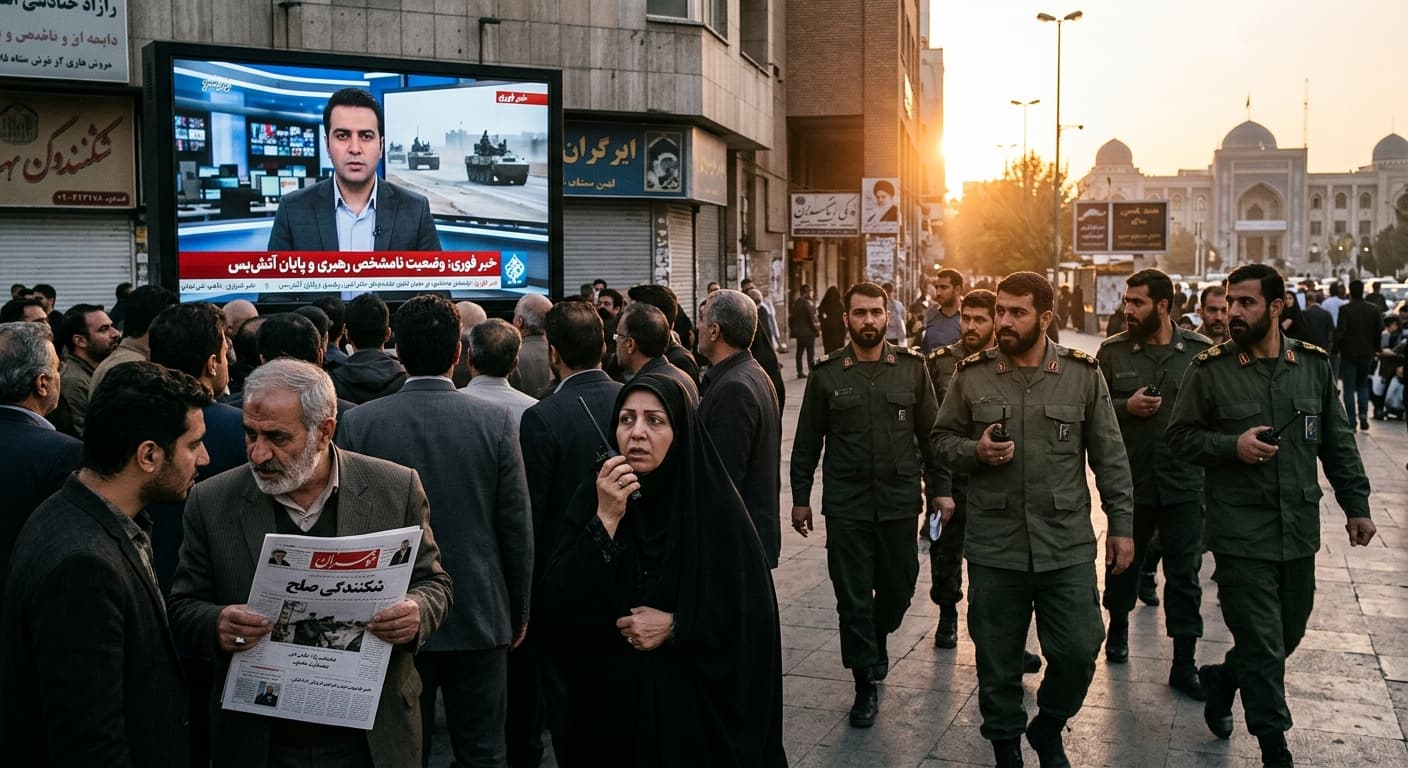
The Ceasefire Didn't Collapse Over Control of the Strait — It Collapsed Because Iran's Supreme Leader Never Showed Up
The US-Iran ceasefire's collapse on July 8, 2026, is not a military story — it is a succession story. A supreme leader invisible for five months created a power vacuum that the IRGC's war faction filled, and the only peace-deal backers left standing are President Masoud Pezeshkian and Foreign Minister Abbas Araghchi, who had rocks thrown at him.
Six weeks after Iran and the United States signed the most consequential diplomatic agreement since the 2015 nuclear deal, the memorandum of understanding, negotiated by Parliament Speaker Mohammad Bagher Ghalibaf, lies in ruins. The eighth consecutive night of American airstrikes hit Iranian coastal surveillance and air-defence sites on July 18, 2026 Al Jazeera. Two US soldiers were killed in Jordan. Iran retaliated against Kuwait, Saudi Arabia, and Bahrain. The Strait of Hormuz is functionally closed again. But the proximate cause, Iranian attacks on commercial shipping and the US reimposition of the blockade, obscures the deeper rupture. The ceasefire collapsed because Mojtaba Khamenei remains unable or unwilling to appear in public, and the military-security clique that installed him has no incentive to end a war that consolidates its grip on the state.
That is the argument this piece makes, and it is the prism through which every subsequent escalation — every missile strike, every oil-price spike, every chant of "death to the compromiser" — must be read.
The deal was built to fail
The 14-point Islamabad Memorandum of Understanding, signed on June 17, 2026, was an audacious document. It mandated an immediate and permanent ceasefire on all fronts, a 60-day window to negotiate a final settlement, a phased withdrawal of the US naval blockade within 30 days, $300 billion in reconstruction and development financing for Iran, and the termination of sanctions, including UN Security Council measures, on a mutually agreed timetable BBC News. It also contained, in Article 5, an ambiguity that proved fatal: language empowering Iran to manage shipping through the Strait of Hormuz while simultaneously guaranteeing free passage for all commercial vessels
NPR.
That ambiguity was not accidental. It reflected a fundamental disagreement that no piece of paper could bridge. Washington insisted the strait must be open to all traffic unconditionally. Tehran, with its back against the wall after four months of war that had killed its previous supreme leader, insisted on recognition of its de facto control over the waterway — control it had achieved by closing it and mining it at the start of the conflict.
On June 25, an Iranian drone slammed into the Cyprus-flagged cargo ship MV GFS Galaxy transiting what Iran considered the wrong lane through the strait Al Jazeera. The US launched retaliatory strikes the following day. Within 48 hours, Iran had struck supertankers, US bases in Kuwait and Bahrain, and declared the strait closed "until further notice." On July 8, at the NATO summit in Ankara, Donald Trump declared the MoU "over," reimposed the naval blockade, and revoked the sanctions waiver that had allowed Iran to export oil for the first time in years
BBC News.
The speed of the collapse is instructive. It took just 21 days from signature to formal termination. But the deal was hollowed out long before any drone left Iranian territory.
The invisible leader
Mojtaba Khamenei has not been seen or heard since February 28, 2026, the day an Israeli airstrike killed his father, Ayatollah Ali Khamenei, his wife Zahra Haddad-Adel, his sister, his brother-in-law, and his 14-month-old granddaughter Al Jazeera. People close to his inner circle told Reuters that he suffered serious injuries, including facial damage and significant harm to one or both legs. He communicates only through written statements read aloud on state television. He missed his wife's funeral. He missed his father's six-day, five-city funeral procession in early July, even as his three brothers — Mostafa, Meysam, and Masoud — stood beside the coffin at Tehran's Grand Mosalla
BBC News.
Officially, the Islamic Republic attributes Mojtaba's absence to assassination threats. Israel's defence minister, Israel Katz, explicitly threatened him during the funeral, saying any Iranian leader who pursues plans to destroy Israel "will be killed as well" Al Jazeera. But the regime's own base is unconvinced. "It seems that there is a conspiracy at work and that the government is still not honest and transparent with the people," a 47-year-old Tehran resident named Somayeh told Al Jazeera.
The absence matters materially, not just symbolically. Ali Khamenei ruled for 37 years as the ultimate arbiter of all state decisions. Mojtaba, elevated by the IRGC precisely because he was seen as pliable, does not wield anything close to that authority. Analysts speaking to France 24 described a power structure in which Mojtaba's "weakened" position has effectively subordinated the supreme leader's office to the Revolutionary Guards and their ideological arm, the Paydari Front France 24.
In Mojtaba's own written statement on June 18, he acknowledged approving the MoU despite holding "a different view" — and then took the extraordinary step of naming President Masoud Pezeshkian as the official who had "explicitly accepted responsibility" for whatever the outcome might be Al Jazeera. The statement did not mention Mohammad Bagher Ghalibaf, the parliament speaker and IRGC-linked figure who actually negotiated the deal. As Kayhan Valadbaygi wrote in Al Jazeera, the Iranian presidency has been "rewired as a circuit breaker: installed to absorb the surge if the deal fails, bypassed entirely if it succeeds."
Who wins, who loses
The internal logic is stark. If the MoU had held and sanctions were lifted, the beneficiaries would have been Pezeshkian's government, the Iranian private sector, and the millions of Iranians crushed by an inflation rate that had already tripled the price of eggs, chicken, and cooking oil compared with a year earlier Al Jazeera. The losers would have been the hardline Paydari Front, whose political identity depends on permanent confrontation with the "Great Satan," and the IRGC's economic empire, which thrives on sanctions-busting, black-market trade, and wartime command of national resources.
With the MoU dead, the winners and losers invert. The military-security elite — Ahmad Vahidi at the IRGC, Ali Abdollahi at the wartime joint command, Ali Azmaei at the IRGC Navy — are now the undisputed power centre. They appear in public, they issue threats, they define red lines. Pezeshkian, by contrast, had rocks thrown at him at Khamenei's funeral and was forced to leave the procession as mourners chanted "death to the compromiser" Outlook India. Foreign Minister Abbas Araghchi was similarly mobbed and called a "traitorous sellout"
CNN.
Ghalibaf occupies a more ambiguous space. His negotiating team delivered sanctions relief that allowed Iran to export at least 74 million barrels of oil worth up to $6 billion during the 21-day window before sanctions were reimposed BBC News. Iran was selling that oil at prices roughly 20% higher than before the war, Ghalibaf himself claimed. The hardliners cannot easily attack him because he carries IRGC lineage and institutional backing that Pezeshkian entirely lacks. But as the conflict escalates, even Ghalibaf's protective cover frays. On July 15, he declared that Iran was in "an essential and existential war with America" and that the armed forces had "complete freedom of action," effectively aligning his rhetoric with the hardliners he had just months earlier outmanoeuvred to secure a ceasefire
Al Jazeera.
The paradox is that no single actor in Tehran can end this war even if they wanted to. The supreme leader is too weak to overrule the IRGC; the president is a hostage; the parliament is dominated by the Paydari Front; and the negotiators have been discredited by their own success — the $6 billion windfall now looks, to hardliners, like proof that concessions produce only humiliation.
The oil weapon and November math
The Strait of Hormuz, through which roughly one-fifth of the world's seaborne oil passes, has been transformed from an economic chokepoint into the war's central battlefield. Before the conflict, roughly 130 vessels transited daily. By July 14, that number had collapsed to six — a 95% decline Al Jazeera. Brent crude, which had returned to pre-war levels in the brief interlude after the MoU's signing, rose 19% above its pre-February-28 price by mid-July, hitting $85.92 a barrel
Al Jazeera. Bart Melek, global head of commodity strategy at TD Securities, told Al Jazeera that "a move to $100 is quite possible, should it become apparent that physical shortage risks are real."
That number — $100 — is not just a market threshold. It is a political threshold. Donald Trump is facing midterm elections in November 2026, and his presidency has been defined, from the opening of Operation Epic Fury on February 28 Congressional Research Service, by a bet that overwhelming military force could deliver a quick victory without sustained economic pain at home. That bet is failing. Diesel markets are especially tight because Middle East refineries are offline and Russian refineries are under sustained Ukrainian drone attack
Al Jazeera. The IEA's executive director, Fatih Birol, warned on July 17 that the world has "weeks, not months" before the Hormuz closure inflicts serious damage on the global economy — a timeframe that lands squarely in the autumn campaign season
OilPrice.com.
Trump's reimposition of the naval blockade, paradoxically, makes his political problem worse. By cutting off Iranian oil exports — which the previous blockade had already reduced from roughly 1.5 million barrels per day to zero — and simultaneously failing to restore safe passage for Gulf Arab crude through the strait, the administration is restricting supply while threatening further escalation that drives up the risk premium on every barrel. The result is a president bombing Iran to lower oil prices, while his own blockade pushes those prices toward $100.
For Tehran, the calculation is different but equally painful. The Iranian rial hit a new all-time low of over 1.93 million to the US dollar on July 18 Al Jazeera. Power blackouts are sweeping the country as a heatwave collides with infrastructure battered by US strikes on power plants and desalination facilities
Al Jazeera. At least 50 Iranians have been killed and more than 500 wounded in US strikes in the past three weeks alone
Al Jazeera. The Iranian Health Ministry released those figures on July 18. And yet the IRGC leadership shows no sign of backing down, because backing down would mean ceding the institutional dominance it has accumulated since February.
What to watch
Three dates matter most in the near term.
Late July 2026: The IEA's Birol set a "weeks" deadline for restoring Hormuz traffic. If the strait remains closed by August 1, expect emergency SPR releases, coordinated Asian reserve draws, and potentially a G7 foreign ministers' statement — none of which will reopen the waterway but all of which will signal a market in crisis.
September 2026: The unofficial start of the US midterm campaign season. If Brent is above $90 and retail gasoline is climbing, Republican incumbents in competitive districts will face the same headwinds that sank Democratic majorities in 2022. Trump's escalation calculus will shift sharply.
Any Mojtaba appearance: A single verified public sighting of the supreme leader — or a credible report of his incapacitation or death — would instantly reshuffle Iran's internal power structure. Hardliners who benefit from his invisibility would lose their cover. Moderates might find space to reopen back-channel negotiations. No other single event would change the strategic landscape faster.
Diplomat View
The conventional reading of this war is that the Strait of Hormuz is the prize and the MoU was a framework for who controls it. That reading gets the cause and effect backwards. The strait is not the prize — it is the theater. The real contest is inside Tehran, and it has been since Ali Khamenei's death vacated the only chair that could arbitrate between factions. Mojtaba's invisibility is not a security precaution; it is a structural fact that makes durable peace impossible, because every deal requires a sovereign who can enforce it against domestic spoilers, and Iran currently has no such figure.
The MoU collapsed not because either side violated it, but because it was signed by a president who could not deliver his own state — and ratified by a supreme leader who could not even attend his father's funeral. Until that succession crisis resolves, every ceasefire will follow the same arc: signed by diplomats, disowned by the supreme leader, exploited by hardliners, and buried by the next drone strike. The only question is how many more nights of bombing it takes before Washington accepts that it is not fighting a nation — it is fighting a power vacuum.
The bottom line: The US-Iran ceasefire collapsed not over the Strait of Hormuz, but over a throne that has been empty since February 28. Mojtaba Khamenei's absence handed Iran's war to a military-security elite whose political survival depends on permanent confrontation — and no amount of American firepower can fix a succession crisis it helped create. Until the invisible leader appears or is replaced, every peace deal will be a scapegoat's signature on a death warrant.
Discover more

US Politics
House Ethics Committee Pushes Sexual Miscond.
The House Ethics Committee has shifted responsibility for sexual harassment settlement records to the Office of Congressional Workplace Rights, complicating disclosure efforts.
India
BJP's Misunderstanding of Women's Quota Needs
The BJP's linking of the Women Reservation Bill to delimitation risks delaying women's empowerment in India, misreading the aspirations of female voters.
India
Congress Accuses Modi of Stalling Women's Law
Congress accuses Modi of stalling women's reservation law by linking it to delimitation, revealing a deeper electoral strategy.

Economics
Fed's Amex AML order puts correspondent banking on notice
Federal Reserve's Amex AML order requires board-level controls and a 90-day plan; OCC fined the bank $350 million over enterprise-wide deficiencies.