IPAC's Kinmen Patrol Exposes Beijing's Tactic
International lawmakers join Taiwan Coast Guard patrol to counter China.
Model Diplomat8 min readAsia
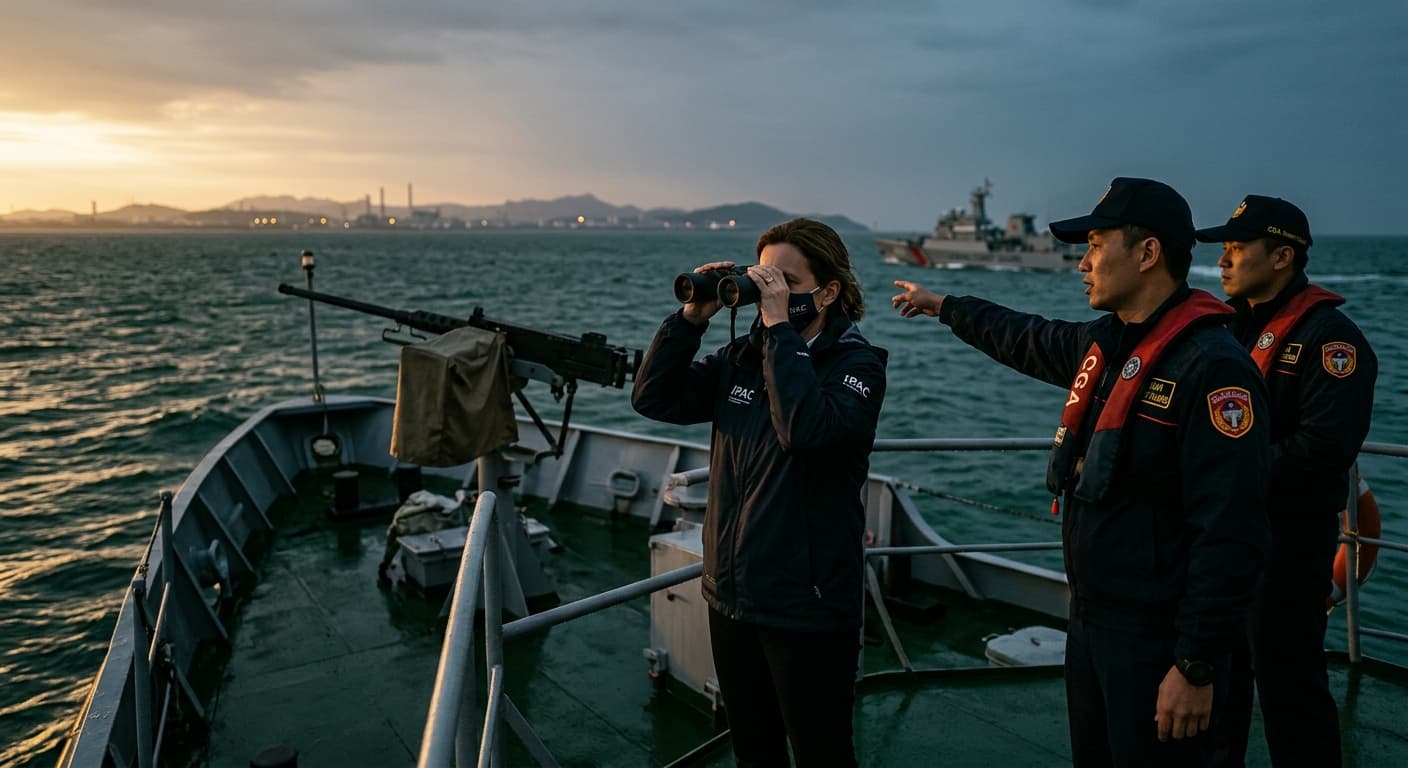
IPAC's Kinmen Patrol Exposes Beijing's Gray-Zone Playbook
Six-nation IPAC delegation joins Taiwan Coast Guard patrol off Kinmen on July 9, 2026 — internationalizing evidence of China's "Kinmen model" as the Xiang'an airport nears opening.
Taiwan on July 9, 2026 put seven foreign lawmakers on a 100-ton Coast Guard Administration cutter and pointed it at the Chinese coastline — the first international parliamentary delegation ever embedded on a Taiwanese coast guard patrol, and the sharpest signal yet that Taipei intends to internationalize the evidence trail on Beijing's slow-motion campaign to erode its control of the Kinmen archipelago. The Inter-Parliamentary Alliance on China (IPAC) delegation, drawn from the United Kingdom, New Zealand, the Czech Republic and Ukraine, sailed from Shuitou Port aboard vessel PP-10081, past the Kinmen Bridge, and within sight of the Chinese-built Xiang'an International Airport rising from reclaimed land less than three kilometres from Taiwanese territory. The visit is Taipei's answer to a strategic problem it has been losing on the water for two years: Beijing's "Kinmen model" is now a template being exported eastward, and Taiwan needs foreign witnesses on the record before the template hardens into fact.
What actually happened on the boat
The delegation was small but deliberately chosen. Alongside IPAC executive director Luke de Pulford, it included UK Conservative MPs Alicia Kearns and Tom Tugendhat — a former chair and a former minister with security portfolios — and Labour MP Tris Osborne, per the Central News Agency's on-board pool report published by Focus Taiwan. New Zealand's Helen White and lawmakers from the Czech Republic and Ukraine rounded out the group, escorted by Taiwan's IPAC co-chairs Fan Yun of the ruling Democratic Progressive Party and Chen Gau-tzu of the Taiwan People's Party.
The patrol sailed clockwise past the North Kinmen sea area and returned to Liaoluo Port around noon, Taiwan's Central News Agency reported. No Chinese Coast Guard (CCG) vessels appeared during the roughly 90-minute voyage — Typhoon Bavi had driven them back to Xiamen and Quanzhou. In a pool dispatch filed from PP-10081,
Reuters reported that the CGA briefed the delegation on what Taipei classifies as "gray-zone" incursions before the group held a closed-door session with the CGA's Ninth Fleet Branch.
De Pulford framed the mission plainly: "This is the first ever visit to be able to come on a coast guard patrol… the fact that they want to do it shows you how great the concern is about cross-strait peace around the world," he told CNA. Osborne, the British Labour MP, called Kinmen "a potential flashpoint" and said the delegation was there "to ensure that we protect their territorial integrity from encroachment from Chinese aggression."
The "Kinmen model" is the story — and it is spreading
The strategic backdrop matters more than the itinerary. Since the February 14, 2024 capsizing of a Chinese speedboat during a Taiwanese coast guard pursuit — an incident that killed two Chinese fishermen — Beijing has used the "Kinmen model" as legal cover for regularized incursions into waters Taipei classifies as prohibited or restricted. Chinese state-linked social media account Yuyuan Tantian coined the phrase and, according to AEI's China–Taiwan tracker, is now floating a "nearshore governance" doctrine extending eastward, beyond Kinmen, toward waters east of Taiwan's main island — where CCG vessels have patrolled almost continuously since June 1, 2026.
The scale of the shift is measurable. The Asia Maritime Transparency Initiative, using automatic identification system tracks, found that Taiwan's CGA faced an average of 13 CCG entrances per week into Kinmen and Matsu prohibited/restricted waters in 2024 — more than triple the 2022 baseline, and a likely all-time high, AMTI reported. In May 2024, a record 11 Chinese government vessels entered Kinmen's waters simultaneously; in October, CCG ships joined a PLA rehearsal of a blockade around Matsu.
The broader trend is starker. Between January 2020 and December 2025, the daily average of distinct CCG vessels entering Taiwan's near waters rose more than 500 percent, and daily incursions into Taiwan's second maritime security ring more than quadrupled, according to the CSIS "Geometry of Coercion" report. CSIS's follow-on Futures Lab analysis identified 128 likely gray-zone actors among 315 Chinese-flagged fishing vessels operating near Taiwan in 2024 — dual-use hulls being used to surveil, harass and normalize presence under a fishing pretext, per the
CSIS "Signals in the Swarm" study.
What the delegates saw: the airport that halves the distance
The most consequential thing the IPAC lawmakers physically observed was not a coast guard cutter — it was concrete. The Xiang'an International Airport on Dadeng Island, expected to open in 2026, has been built on land reclaimed since 2013 between the Dadeng and Xiaodeng islets. That reclamation has halved the distance between Chinese territory and Kinmen to under two miles (three kilometres), according to an American Enterprise Institute study mapping a PRC short-of-war coercion scenario. The AEI paper notes Xiang'an sits roughly six miles from Kinmen's Shangyi Airport, with the two facilities sharing around 70 percent of their airspace — a level of overlap that will require constant bilateral coordination Beijing has never shown willingness to provide.
The International Institute for Strategic Studies has traced Xiang'an's role in Beijing's "peaceful reunification" experimentation: paired with a planned Xiamen–Kinmen bridge, it is designed to replace Shangyi as Kinmen's principal air link and route air travel to the Taiwanese islands through PRC-controlled infrastructure. That is the significance of what the delegates saw from the water — a functional piece of the "one-city life circle" Beijing announced in its September 2023 Fujian integration plan, which vice chair Cong Liang of the National Development and Reform Commission publicly tied to Kinmen's access to Xiamen's new airport,
Al Jazeera reported.
The historical parallel — and who benefits from the visit
The Kinmen–Xiamen bridge project has drawn open comparison to the Kerch Strait Bridge that connected occupied Crimea to Russia; Taiwan's own Institute for National Defense and Security Research argued in a 2024 brief that if a Taiwan Strait conflict erupted, a completed bridge would serve as a "vital logistical supply route for the PLA" and risk turning Kinmen's ports and airport into forward bases. That is the parallel policymakers in Taipei want European and Ukrainian legislators to internalize firsthand — which is why a Ukrainian MP was on PP-10081.
Who benefits from Thursday's optics: Taiwan's Ministry of Foreign Affairs, the Ocean Affairs Council and, tactically, President Lai Ching-te's push for a NT$1.25 trillion (roughly US$40 billion) special defence budget currently in front of the Legislative Yuan. That proposal, which Taiwan's ruling DPP argues is essential to close capability gaps identified against a PLA readiness target of 2027, was directly urged on Taiwanese leaders by a US Senate delegation led by John Curtis and Jeanne Shaheen in March 2026, per a Senate press release. A second bipartisan Senate group under Elissa Slotkin, meeting Speaker Han Kuo-yu in late June, publicly linked the budget vote to a stalled US$14 billion in already-approved arms sales the Trump administration has yet to release,
Slotkin's office announced. The IPAC visit adds European and Commonwealth political weight to the same message.
Who loses: Beijing's plausible-deniability buffer. As long as CCG incursions were a bilateral Taiwan–PRC narrative, Beijing could frame them as "normal law enforcement." Putting British, New Zealand, Czech and Ukrainian legislators on the water forces a wider audience to characterize the same behaviour. It also complicates a key Chinese lawfare goal identified by Taiwan's Prospect Foundation: Beijing's long-term effort to have the Taiwan Strait recognized internationally as PRC "inland waters" rather than an international waterway, and to reject the concept of Taiwan-drawn prohibited and restricted zones around Kinmen and Matsu.
The second-order effects
Three consequences follow from the July 9 patrol that are worth watching.
First, the pattern will replicate. The "Kinmen model" is already being reproduced at Pratas Island, 450 kilometres southwest of Taiwan proper, where the CCG began regular incursions in February 2025 and where "dark" AIS-off patrols coincided with Taiwan's Han Kuang exercises, AEI reported. If Beijing normalizes gray-zone presence around Pratas, Matsu and now the waters east of Taiwan, the CCG's expanding jurisdiction will free PLA Navy hulls for longer-range missions beyond the first island chain — the exact power-projection effect Chinese planners want.
Second, coast-guard militarization is now the escalation ladder. The Atlantic Council has documented that the CCG's 3,800-ton Type-818 cutters are built on PLA Navy Type-054 frigate hulls and that the CCG is operationally controlled by the People's Liberation Army — the "white hull" is a legal veneer over a paramilitary force, Atlantic Council analysts argued. The prescription — joint US-led coast-guard patrols inside Taiwan's contiguous zone — is politically fraught but suddenly less unthinkable in a year when the Hudson Institute has publicly discussed the deployment of US special forces to Kinmen as a broken taboo, per a
Hudson commentary.
Third, the domestic politics on Kinmen itself remain fragile. Reporting from the archipelago has captured a local population culturally and commercially entangled with Xiamen and unwilling to treat the patrols as an existential threat, NPR found in 2024. That gap between Taipei's threat perception and Kinmen residents' calm is precisely the wedge Beijing's "one-city life circle" is engineered to widen — and the reason IPAC's British and Ukrainian MPs were photographed on a Taiwanese hull, not a Kinmen quayside.
Diplomat View
The Kinmen tour will not change the tempo of Chinese coast guard patrols in the coming weeks; Typhoon Bavi will do that, briefly. Its significance lies in evidentiary standing. For two years, Beijing's core lawfare argument has been that CCG operations near Kinmen are routine domestic policing and that Taiwan's prohibited-waters regime is a legal fiction. Putting foreign lawmakers on a CGA hull, on the record, in view of Xiang'an airport, is Taipei's structured rebuttal. Expect Taipei to repeat the format — probably with US, Japanese and European Parliament delegations before year-end — and expect Beijing to respond either by staging a demonstrative CCG "law enforcement" incident during a future foreign visit, or by accelerating civilian integration signals from the Xiamen side. The forecast changes if the Legislative Yuan blocks Lai's special defence budget, if Xiang'an's opening is delayed past 2026, or if a fatal encounter at sea forces both sides into another negotiated pause of the type reached after the February 2024 capsizing, as the BBC reported that July.
What to watch next
- August 2026: Taiwan's Han Kuang 42 live-fire exercises, expected to again feature Kinmen and Matsu island-defence scenarios.
- Legislative Yuan autumn session: votes on President Lai's US$40 billion special defence budget and on release of US$14 billion in stalled US arms transfers.
- Xiang'an International Airport commercial opening: scheduled for late 2026; the first joint-airspace incident with Kinmen's Shangyi Airport will be the real test.
The Bottom Line
The bottom line: IPAC's Kinmen patrol matters not because it deters a single Chinese Coast Guard cutter — none turned up — but because it strips Beijing of the ability to keep the "Kinmen model" bilateral. Taiwan has borrowed a page from Manila's South China Sea transparency playbook: put foreign witnesses on the water, make gray-zone behaviour narratable in European and Commonwealth parliaments, and force Beijing to pay a political price it has so far avoided. If the model spreads to Pratas, Matsu and the waters east of Taiwan, expect Thursday's voyage to be remembered as the first time the Taiwan Strait's contested waters were formally entered into the parliamentary record of a democracy other than Taiwan's own.
Discover more

US Politics
US Launches $166B Tariff Refund Portal
The US is launching a $166 billion tariff refund portal to aid importers hit by Trump-era tariffs, with major implications for trade and supply costs.

India
Women’s Reservation in India
India's 33% women's reservation law is enacted but won't take effect until after 2029 due to political setbacks and census delays.

India
Women's Reservation Bill 2026: A Political Sh
India's Lok Sabha rejected the Women's Reservation Bill, exposing a political maneuver to redraw electoral maps favoring the north over the south.

Conflict & Security
Drone Warfare Killing Aid Workers at Unprec
Over 1,000 humanitarian workers killed in three years as cheap armed drones collapse legal protections. Gaza, Sudan, Ukraine, and DRC see deliberate targeting of aid convoys and hospitals with zero prosecutions.