Indonesia's Legal Bet on Palestine
Jakarta backs UNGA resolution against Israel's occupation
Model Diplomat8 min readMiddle East
Indonesia Bets on a World Court Ruling Israel Ignored
Indonesia backs UNGA resolution ES-10/24 and the 2024 ICJ advisory opinion demanding Israel end its occupation of Palestine — a legal architecture Israel has openly defied.
Indonesia's endorsement of the United Nations General Assembly resolution demanding Israel end its "unlawful presence" in the Occupied Palestinian Territory within 12 months is less a diplomatic gesture than a wager: that a non-binding ruling from the International Court of Justice, ratified by 124 states, can be converted into hard consequences even after Israel has ignored the September 18, 2025 deadline. Jakarta is aligning itself with a legal instrument whose enforcement now depends entirely on how many governments treat compliance with the ICJ as a threshold obligation, not a diplomatic option. The stakes are larger than the resolution: this is the test case for whether the World Court's authority over occupation law survives the Gaza war.
The resolution Indonesia signed on to
On September 18, 2024, the General Assembly adopted resolution A/RES/ES-10/24 by a vote of 124–14, with 43 abstentions, according to the UN's official record of the tenth emergency special session. The operative text does not merely condemn — it prescribes. It demands that Israel "brings to an end without delay its unlawful presence in the Occupied Palestinian Territory… and do so no later than 12 months from the adoption of the present resolution," cease all new settlement activity, evacuate settlers, return seized property, and pay reparations.
The resolution derives its legal weight from the International Court of Justice's advisory opinion of July 19, 2024. In that ruling, a 15-judge panel found that Israel's occupation since 1967 is unlawful, that its settlement regime violates international law, and — critically — that all states are obliged not to "render aid or assistance in maintaining" the occupation. The BBC reported that the court framed the obligation to end the occupation as one Israel must fulfil "as rapidly as possible," according to a BBC dispatch from The Hague.
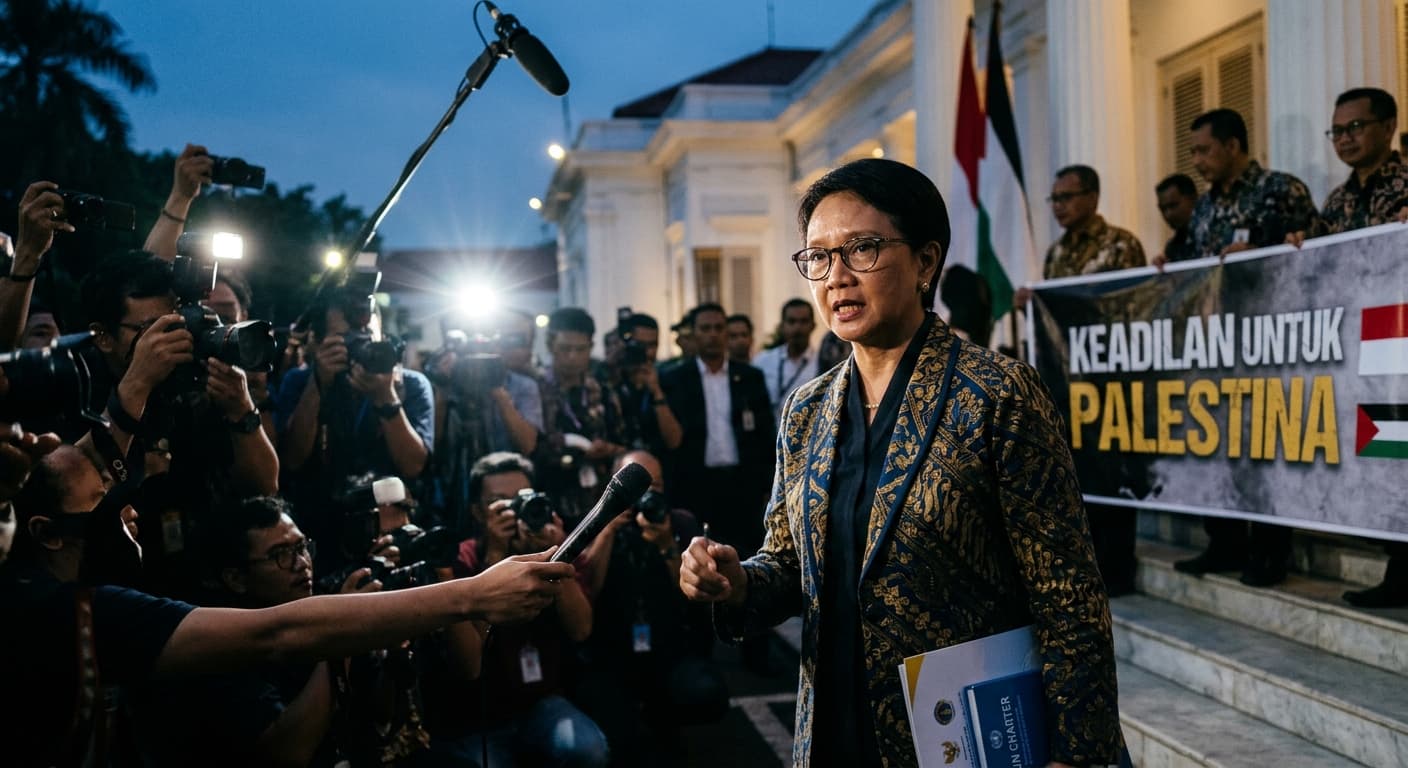
Indonesia was among the resolution's most vocal backers. Foreign Minister Retno Marsudi's ministry issued statements welcoming both the ICJ opinion and the follow-on UNGA vote, calling on member states to "take individual and collective measures" to compel compliance. Jakarta's Ministry of Foreign Affairs country profile on Palestine reiterates the standing policy: no normalisation with Israel until a two-state solution is achieved, full backing for Palestinian UN membership, and consistent invocation of ICJ authority as the legal spine of the position.
Why the deadline mattered — and why it lapsed
The 12-month clock ran out on September 18, 2025. Nothing happened. Or rather, the opposite of what the resolution demanded happened: Israel accelerated settlement construction to its fastest pace on record.
According to figures compiled by the Israeli anti-settlement watchdog Peace Now and cited by Al Jazeera, Israel's Higher Planning Council advanced a record 28,195 housing units in the West Bank in 2025 alone. Brookings has separately calculated that 2024 saw 28,872 settlement units advanced — a
250 percent increase since 2018. On May 29, 2025, Defence Minister Israel Katz and Finance Minister Bezalel Smotrich
announced approval of 22 new settlements, the largest single expansion in decades. In August, Israel's security cabinet approved the long-dormant E1 project — 3,401 units between East Jerusalem and Ma'ale Adumim that Smotrich publicly said would "bury the idea of a Palestinian state," according to the BBC's
reporting on the plan. By December 22, 2025, Israel had approved 19 further settlements, bringing the total under the current government to 69.
The UN's own commission of inquiry concluded in September 2025 that "Israeli policies and actions implemented since October 2023 in the West Bank demonstrate clear intent to forcibly transfer Palestinians, expand Israeli civilian presence and annex the entirety of the West Bank," as Al Jazeera reported on the commission's findings.
The second-order consequence: recognitions, not sanctions
Here is what ES-10/24 did produce — and it is not what its drafters primarily sought. In the days around the expired deadline, four Western capitals moved on Palestinian statehood in coordinated fashion. On September 21, 2025, the United Kingdom, Canada, Australia and Portugal formally recognised the State of Palestine, according to the BBC's account of Prime Minister Keir Starmer's announcement. France followed on September 22 at the UN General Assembly, joined by Belgium, Luxembourg, Malta, Andorra and Monaco,
Al Jazeera reported. By that vote, roughly 155 of 193 UN member states now recognise Palestinian statehood.
The pattern is telling. The states pivoting in 2025 are not the Global South cohort that has recognised Palestine for decades — they are precisely the Western governments that, twelve months earlier, either abstained (United Kingdom, Canada) or voted yes with caveats. They cited the ICJ opinion and the frustration of ES-10/24 explicitly as legal grounding for the shift. That is the resolution's real payoff: it did not end the occupation, but it converted the ICJ opinion into a permission structure for Western recognitions that Israel and the United States had previously deterred.
For Indonesia — which does not have diplomatic relations with Israel — that is a strategically useful outcome. It reframes Jakarta's decades-old position from Global South advocacy into mainstream international consensus. But it comes with a complication.
The Indonesian complication: Gaza troops under Trump's Board
In February 2026, Indonesia began preparing to deploy 1,000 soldiers to Gaza as the first tranche of an 8,000-strong contingent for the International Stabilisation Force under US President Donald Trump's Board of Peace, Al Jazeera reported. The mission operates outside UN peacekeeping structures, and Indonesian analysts have publicly warned it risks turning Jakarta's forces into what University of Indonesia scholar Shofwan Al Banna Choiruzzad called an "instrument of the occupation." President Prabowo Subianto has told Islamic civil society groups he would withdraw if the mission "fails to advance the goal of an independent Palestine."
The tension is legally sharp. ES-10/24 explicitly obliges all states to refrain from any action that would "provide aid or assistance in maintaining" the occupation. A UN commission of inquiry position paper warned in October 2024 that third-party governments enabling the occupation could themselves be deemed "complicit" in internationally wrongful acts, according to Al Jazeera's summary of the commission's findings. Indonesia's public alignment with the resolution — and its private alignment with a US-led stabilisation architecture that Palestinian factions view as consolidating occupation — sits on that fault line.
What the ICJ has done since
The World Court has not gone quiet. On October 22, 2025, the ICJ issued a second advisory opinion, holding that Israel must allow UN aid into Gaza, must ensure the "basic needs" of the population — food, water, fuel, medicine — and cannot invoke security concerns to justify blocking humanitarian access, according to NPR's account of the ruling. The court also found that Israel had "not substantiated" its allegations that a significant portion of UNRWA staff were affiliated with Hamas or other militant factions.
On December 12, 2025, the General Assembly built on that ruling: it adopted, by a vote of 139–12 with 19 abstentions, a further resolution demanding Israel open unrestricted humanitarian access to Gaza, according to Al Jazeera's reporting on the vote. The margin — 15 more yes votes and two fewer no votes than in September 2024 — is the quiet data point that matters. Even as compliance failed, the diplomatic isolation of Israel and the United States on this file has widened, not narrowed.
Amnesty International's Americas director Ana Piquer Guevara-Rosas captured the pattern in a February 2026 statement flagged by Al Jazeera:
"Instead of complying, Israel has simply invented new ways to violate international law, further entrenching its unlawful occupation and apartheid — while the international community continues, at best, to pay lip service to Palestinians' rights and taken no effective action."
The counter-view
The resolution's critics — and they are not confined to Israel — argue that it undermined its own purpose. The Council on Foreign Relations, in a commentary by Elliott Abrams, described the text as radical in scope, noting that its call for states to abstain from "economic or trade dealings with Israel concerning the Occupied Palestinian Territory" amounts to a mandated BDS regime, and that its treatment of the Old City of Jerusalem as illegally occupied would reset the map to pre-1967 lines. That framing helped Israel and the US brand the resolution as maximalist rather than legal, giving cover to the 43 abstentions and to European allies who wanted the ICJ opinion honoured in principle without its full operative demands.
Legal scholars are also divided on effect. James Devaney of the University of Glasgow told Al Jazeera that the 12-month deadline carried "political significance" but did not alter the resolution's non-enforceable character, in analysis published the day after the vote. Two years on, that assessment has held.
What to watch
- The ICC arrest warrants: The International Criminal Court's warrants for Prime Minister Benjamin Netanyahu and former Defence Minister Yoav Gallant, issued in November 2024, remain the sharpest legal instrument in play. Watch whether states party to the Rome Statute — including EU members — enforce them when travel opportunities arise.
- UN Security Council resolution 2803: Adopted in late 2025 in connection with the Trump ceasefire framework, its interpretation will determine whether the ISF in Gaza operates as an occupation-support force or as a transitional protection mission. The next Council review is the trigger point.
- The next Indonesian deployment date: Jakarta's 1,000-troop first tranche was on track for Gaza in early 2026. If the mission drifts toward Israeli-controlled coordination, expect President Prabowo to face domestic pressure from the Nahdlatul Ulama and Muhammadiyah leaderships that briefed him in January.
- The General Assembly's 80th session follow-up: The Assembly is expected to consider further procedural steps on ES-10/24 non-compliance, potentially including a request for the Security Council to consider "appropriate means" — the language the ICJ opinion used to hand the file back to member states.
The Bottom Line
Indonesia's welcome for ES-10/24 is a bet that the ICJ advisory opinion of July 2024 becomes the organising legal fact of the next decade of Middle East diplomacy — the way Security Council resolution 242 organised the last five. On the evidence of the twelve months after the deadline, that bet is winning at the level of state recognitions and losing at the level of facts on the ground: Israel added 28,195 settlement units in 2025 while ten Western capitals moved to recognise Palestine. The question ES-10/24 leaves behind is whether an advisory opinion can carry the weight of a peace process when neither the occupying power nor its principal ally accepts its authority.
Discover more

US Politics
US Launches $166B Tariff Refund Portal
The US is launching a $166 billion tariff refund portal to aid importers hit by Trump-era tariffs, with major implications for trade and supply costs.

Global Politics
US-Iran Tensions Rise
Tensions escalate in the Strait of Hormuz as Iran and the US clash over maritime control, with a ceasefire hinging on a contested MoU paragraph.

Global Politics
US Proposes Pakistan for Iran Talks Amid Ties
The US-Iran negotiations are now mediated by Pakistan, highlighting Islamabad's strategic role and the implications for regional diplomacy.

Economics
Fed's Amex AML order puts correspondent banking on notice
Federal Reserve's Amex AML order requires board-level controls and a 90-day plan; OCC fined the bank $350 million over enterprise-wide deficiencies.