India's Rules Deficit: Nageswaran's Warning
Chief Economic Advisor argues for institutional trust in growth
Model Diplomat3 min readAsia
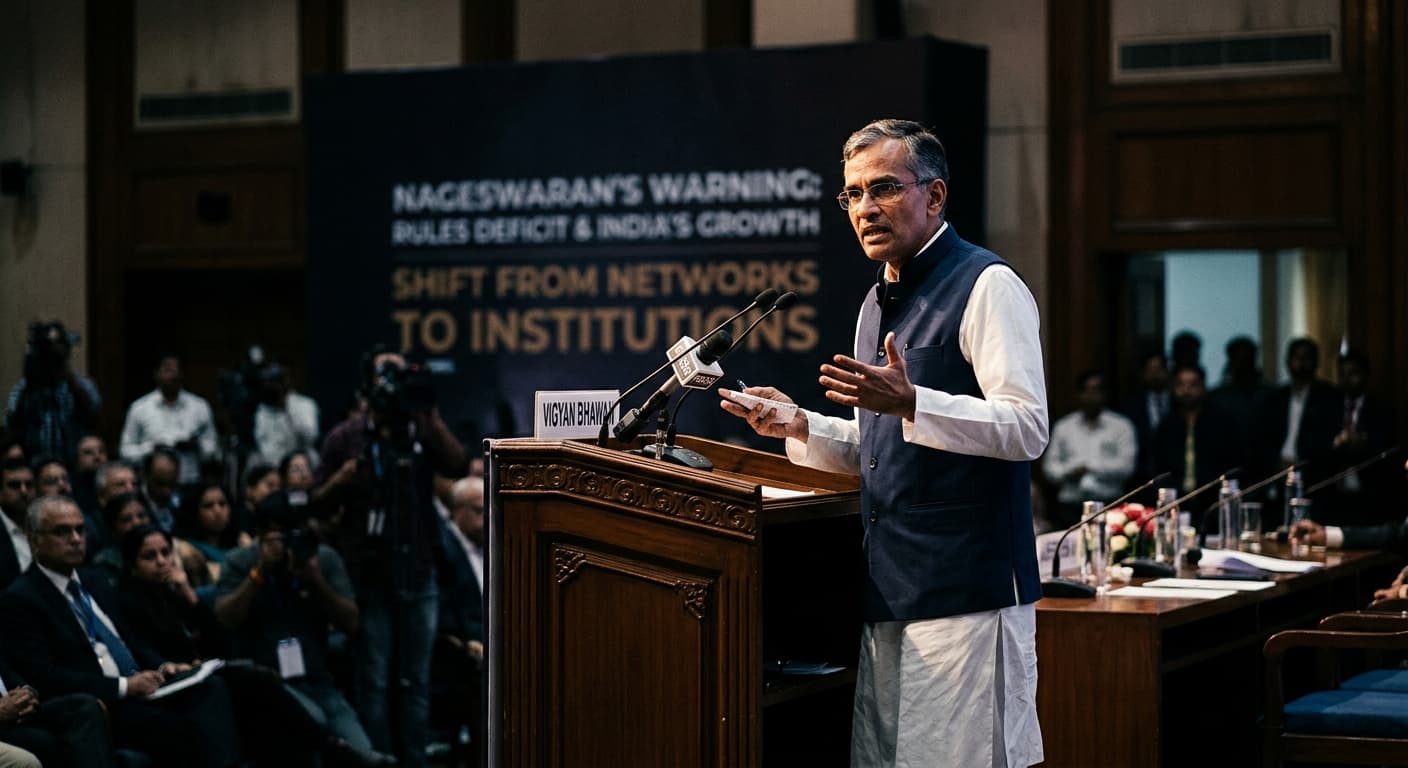
India's Rules Deficit: Why Nageswaran's Warning Matters
Chief Economic Advisor argues institutions trump networks—India's growth model depends on trusting strangers, not just insiders
India needs to do something counterintuitive to sustain growth: stop running everything through personal networks and establish rules that work for strangers. That is the central argument V. Anantha Nageswaran, the country's Chief Economic Advisor, made in a
June 22 opinion piece that cuts to the heart of why India's economy, despite robust headline GDP figures, struggles to build lasting industrial capability.
Nageswaran draws on recent scholarship by economists Avner Greif, Joel Mokyr, and Guido Tabellini to argue that Britain industrialized first because trade organizations and commercial networks broke down family and clan-based governance, creating infrastructure that allowed strangers to do business with confidence. That shift—from trust-within-networks to trust-across-institutions—is precisely what India has failed to do. The result shows up in India's economy as the "missing middle": world-class conglomerates at one end, millions of micro-enterprises at the other, but almost no dense layer of medium-sized, scaling manufacturers that could anchor industrial growth. More than 99% of Indian enterprises remain micro or small, choked by regulatory complexity that penalizes growth, banking systems that favor collateral over productivity, and family-firm culture that prioritizes control over capital-raising.
This is not a new diagnosis, but Nageswaran's framing adds urgency. A manufacturing ecosystem depends on suppliers trusting that contracts will be honored, that prices won't be arbitrarily reset by politically connected insiders, and that regulatory rules apply equally. When decisions flow through relationships instead of rule books, outsiders stay out. Foreign investors doubt the playing field is level. Medium-sized firms stay small rather than risk the regulatory labyrinth that expands as they grow. The cost compounds invisibly: lost innovation, underdeployed capital, suppliers that never emerge to underpin global supply chains.
Family Firms and the Innovation Cliff
The problem runs deeper than governance opacity. Indian industry has developed a structural reluctance to invest in long-horizon bets like R&D. Family control structures show a well-documented pattern: founders build with hunger, second generations consolidate, third generations sit on inherited wealth and avoid the capital-intensive work of innovation. Add 15 years of macroeconomic volatility—the 2008 crisis, India's own balance-sheet reckoning, COVID lockdowns, supply shocks from Russia-Ukraine—and the rational response from boardrooms is to preserve optionality and defer irreversible commitments. Private equity markets have given third-generation families an escape hatch: why invest in manufacturing when financial returns come effortlessly?
The cost is strategic. A private sector that remains technologically dependent, consuming rather than generating intellectual property, faces "slow but accumulating existential threat" as competitors from East Asia climb value chains. Yet Nageswaran's diagnosis suggests the deeper constraint is institutional, not just cyclical. Until India builds formal rules and transparent governance that allow strangers—new shareholders, outside suppliers, international partners—to operate with predictable confidence, family firms will remain risk-averse and fragmented, and medium-sized firms will never scale.
What to Watch
The real test of whether India's policymakers take this seriously will show up in three places: First, whether regulatory complexity actually falls for firms trying to grow beyond the small-business threshold. Second, whether courts enforce contracts consistently enough that suppliers trust long-term supply agreements. Third, whether trade agreements—the Modi government is negotiating new deals with the EU and advancing talks with the US—include binding commitments to transparent, rules-based governance that survive leadership changes.
Nageswaran is essentially arguing that India cannot skip from a relationship-based economy to a competitive developed one without institutions in the middle. That is not a comfortable message for a government that has historically governed through personal relationships and political will. But the economic evidence—stalled manufacturing, weak industrial ecosystems, R&D underinvestment—suggests the message is already written in India's growth model itself.
Discover more

India
India-South Korea $50B Trade Expansion Plan
India and South Korea target $50 billion in trade, enhancing economic cooperation amid shifting global dynamics.

India
UN Expert Albanese: India Violates Law
UN Rapporteur Francesca Albanese claims India is breaching international law, raising human rights issues in Kashmir and beyond.
India
Congress Accuses Modi of Stalling Women's Law
Congress accuses Modi's government of delaying the women's reservation bill for political gain, risking women's representation in India.
India
India's ₹7,100 Crore Chip Incentives for FY27
India commits ₹7,100 crore to boost semiconductor manufacturing and reduce imports.