India's Record Russian Oil Imports Surge
New Delhi pivots from Middle East amid supply risks.
Model Diplomat3 min readAsia
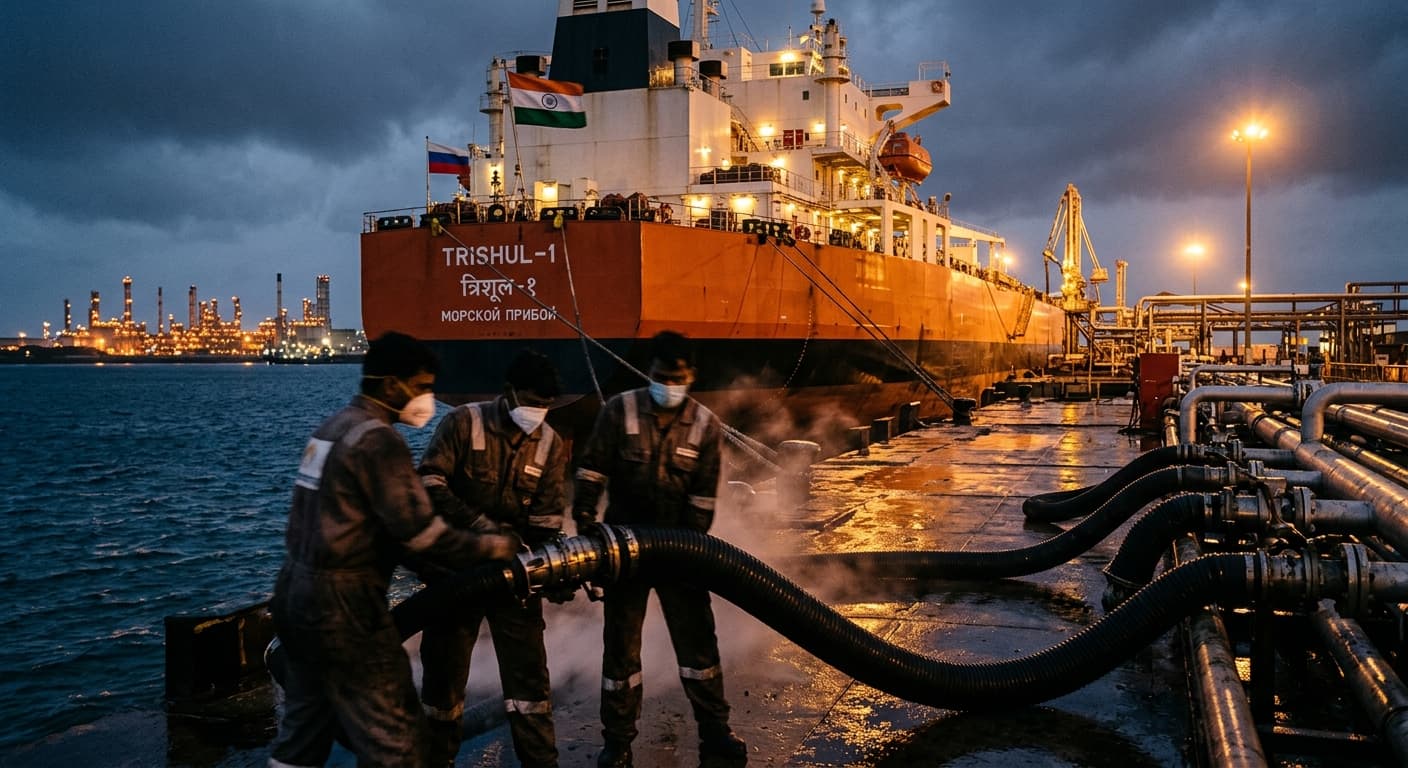
India Locks in Russian Oil, Hedges Against Hormuz Recovery
Record June imports signal New Delhi's pivot away from Middle East risk—even as Iran deal threatens to reopen supplies.
The Indian Express reported that India's crude imports from Russia are on track to hit an all-time high in June at 2.35 million barrels per day, accounting for 53.5% of the country's total oil intake so far. The surge comes as the Strait of Hormuz—which normally carries roughly 20% of global oil and gas supplies—has been effectively shut by conflict between the US and Iran since February 2026, choking off Iraqi and Gulf supplies that historically furnished 40% of India's crude.
This is not desperation. It is strategy. New Delhi is deliberately front-loading Russian volumes before the supply map shifts. A tentative US-Iran deal signed in mid-June includes reopening the Strait of Hormuz and a 60-day period to finalize terms, according to BBC News. That could restore 1–2 million barrels per day of forgone Middle Eastern oil within weeks. Indian refiners are hedging by locking in Russian supply today—even at markups that would have been unthinkable a year ago.
The Price Flip: Why India Pays a Premium Now
Three months ago, Indian refiners enjoyed Russian crude at $8–12 per barrel discounts to Dated Brent. In April, they paid $5–15 premiums—a 425% inversion, IAAN Express reported. Yet they bought more, not less. In May, Russian oil accounted for 36.5% of India's overall imports, up from 35% in April, and major refineries intensified intake: Vadinar saw unloaded volumes rise 36%,
The Hindu Business Line reported.
The calculus is elementary. Supply security beats price. Iraq has exported almost no oil since March because the Strait is blocked. Middle Eastern suppliers are now asking Indian refiners to resume contractual volumes as soon as Hormuz reopens—but refiners have declined to commit, according to The Economic Times. State-run refineries have already secured two months of supply. By locking in Russian barrels at premium pricing, they are buying optionality: supplies arrive on a delivered basis, sidestepping shipping bottlenecks and freight-rate inflation as the market rushes to secure tankers ahead of Hormuz's reopening.
What Changes When the Strait Opens
The US-Iran deal is fragile and time-limited. The 60-day window allows negotiators to hash out Iran's nuclear programme—the core dispute that triggered war on February 28. BBC reported that Iran's parliamentary speaker signaled the Strait will not revert to pre-war conditions, float
ing charges on traffic after the fee-free window lapses. That raises long-term transit costs and infrastructure risk.
But the immediate effect is obvious: Middle Eastern oil floods back. Saudi Arabia and the UAE have pipeline routes bypassing Hormuz, so they are already gaining share in India's mix. Once Iraq's 4 million barrel-per-day capacity comes back online—if the ceasefire holds—Russian discounts evaporate and the arbitrage India exploited dies. Refiners know it. By loading up on Russian volumes now, at premium pricing, they secure baseload supply at a known cost ahead of the transition.
Watch the Waiver Collapse
The Indian Express notes that the US sanctions waiver on Russian oil purchases lapsed on June 19. The Trump administration had extended it repeatedly to prevent an oil-price spike that would roil midterm elections later in 2026. Without it, Indian refiners lose protection against secondary sanctions when dealing with sanctioned Russian firms like Rosneft and Lukoil, and can no longer take delivery on US-flagged tankers.
Yet The Economic Times reports that refiners are "likely to continue taking the country's barrels as the industry has largely found workarounds." Crude remains cheap, rouble payments are routine, and Moscow faces few alternatives to Asian buyers. The real test comes in July: whether refiners start scaling back Russian volumes as Middle Eastern supplies normalize and freight costs stabilize. If they don't, it signals that New Delhi has effectively replaced Gulf dependence with Russian reliance—and accepted the geopolitical handiwork that entails.
Discover more

India
India-South Korea $50B Trade Expansion Plan
India and South Korea target $50 billion in bilateral trade by 2030, focusing on industrial cooperation and strategic alignment amid US pressures.

Global Politics
US Seizes Iranian Ship, Tensions Surge
The US seizure of the Iranian ship Touska highlights a shift in control over the Strait of Hormuz, favoring Iran's strategic position.
India
Modi's Women’s Convention in Varanasi
Modi's Varanasi rally frames women's reservation as a national mission, targeting the 2027 Uttar Pradesh elections with a strategic narrative.

Conflict & Security
Drone Warfare Killing Aid Workers at Unprec
Over 1,000 humanitarian workers killed in three years as cheap armed drones collapse legal protections. Gaza, Sudan, Ukraine, and DRC see deliberate targeting of aid convoys and hospitals with zero prosecutions.