India's Political Landscape Shifts
BJP's sweeping victory reshapes India's political landscape.
Model Diplomat8 min readAsia
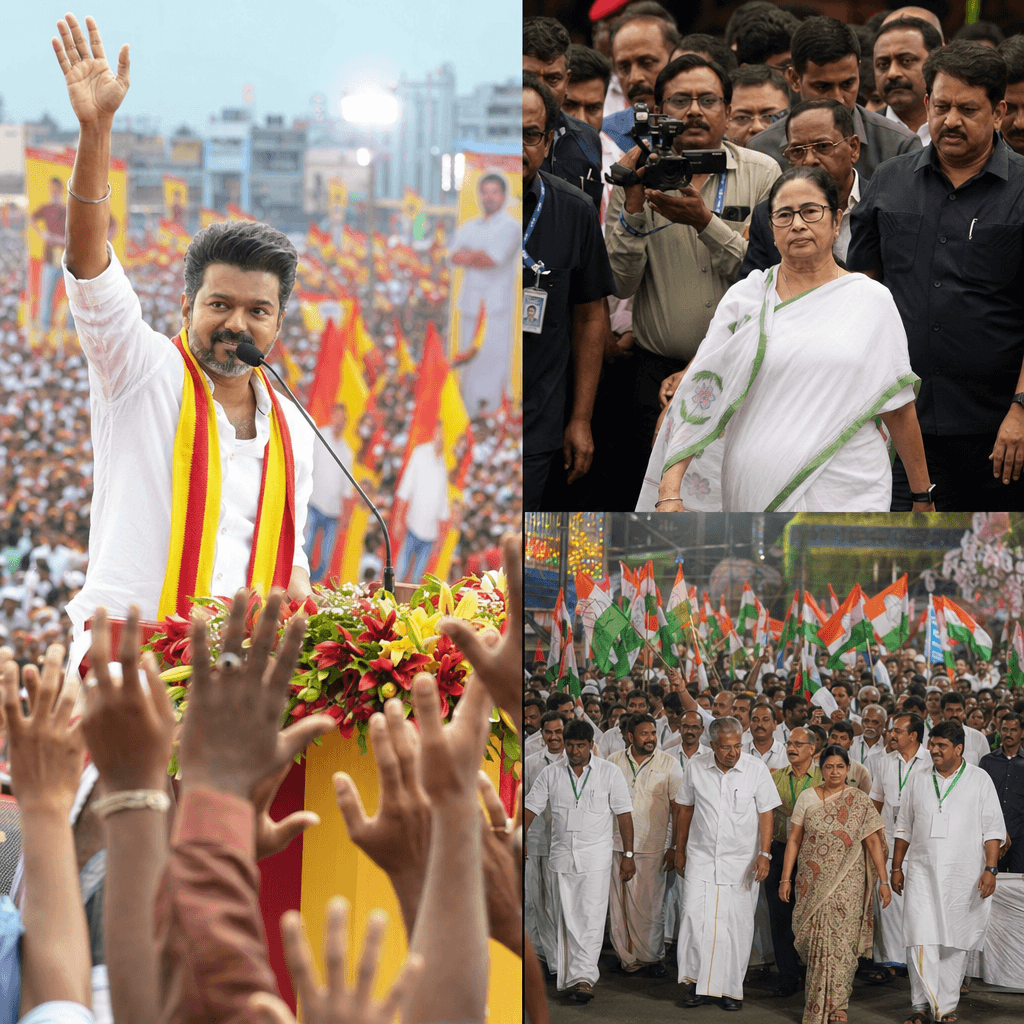
India's Political Landscape Shifts: Modi's BJP Sweeps 21 of 28 States
After the April 2026 state polls, the BJP now governs or shares power in 21 of India's 28 states — a footprint last matched by Congress in the 1960s. What the new map reveals about India's next election.
On May 4, 2026, votes were counted across four Indian states and one union territory — and the country's political map redrew itself in a single afternoon. The Bharatiya Janata Party won 207 of West Bengal's 294 assembly seats, a state it had never governed; a two-year-old party led by a film star, Tamilaga Vettri Kazhagam, took Tamil Nadu; Congress reclaimed Kerala from the Left; and Prime Minister Narendra Modi's BJP retained Assam and Puducherry. The 2024 general election, in which the BJP lost its outright majority, now looks less like an inflection point than an aberration. India is once again drifting toward one-party dominance — but with a twist: the collapse of the regional parties that were supposed to stop it is opening space not for a national opposition, but for post-ideological celebrity insurgents.
That is the story worth telling. The BJP's expansion is real and consequential — its coalition now controls states covering roughly 80% of India's 1.4 billion people, as Al Jazeera reported — but the deeper realignment is on the opposition side of the ledger, where the two-decade-old firewall of powerful regional strongmen has cracked.
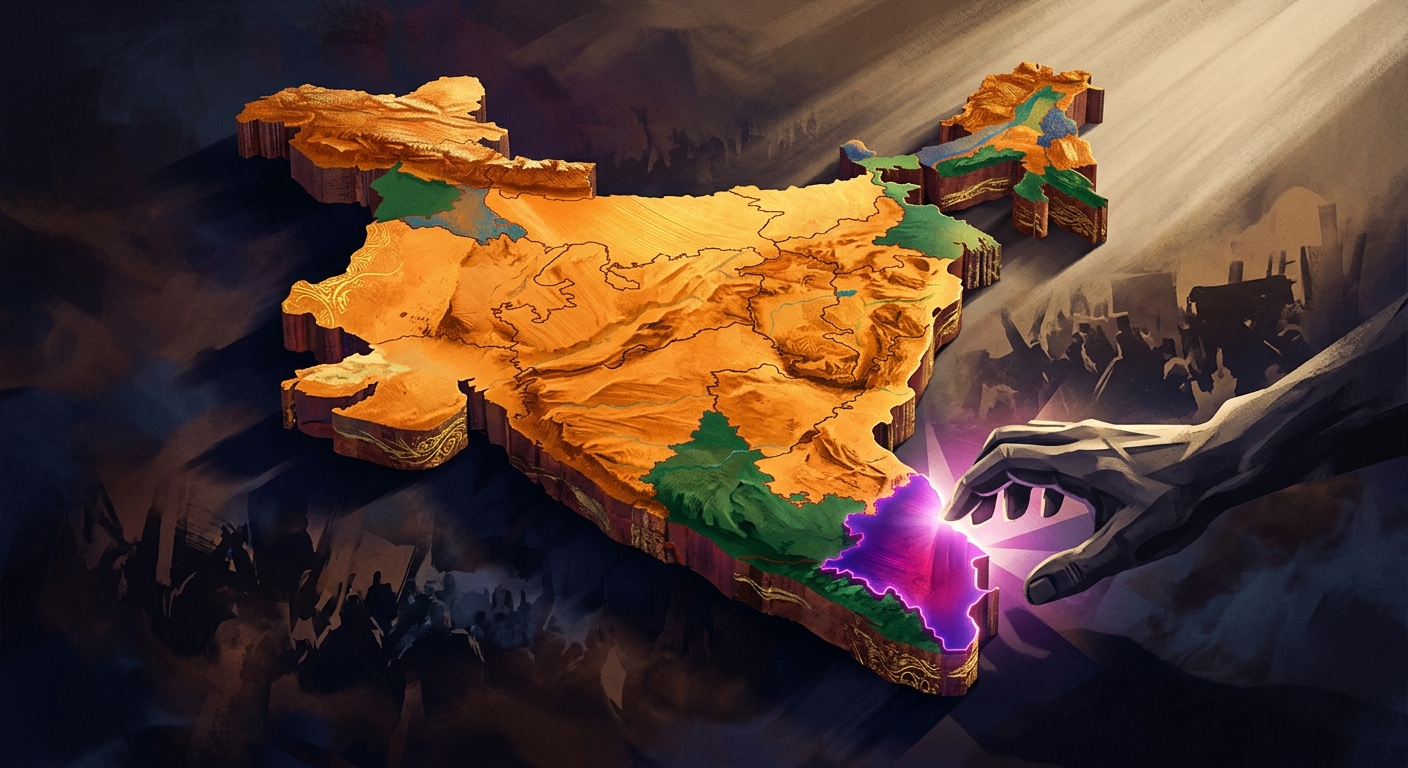
The Bengal breach and the end of the regional firewall
West Bengal was the prize the BJP had chased for 12 years without success. Under Chief Minister Mamata Banerjee, the Trinamool Congress had built what political scientist Dwaipayan Bhattacharya calls "franchisee politics" — a machine of local bosses trading violence and welfare for fealty. In April 2026, it snapped. The BJP took a 46% vote share against the TMC's 41%, converting a five-point gap into a 207-to-80 seat rout, according to the NUS Institute of South Asian Studies. In 2021, those numbers ran the other way: TMC 215 seats, BJP 77.
Three forces did the work. First, anti-incumbency after 15 years of TMC rule, sharpened by a teachers' recruitment scam and industrial stagnation. Second, Hindu consolidation — Muslims are 27% of Bengal's population, and the BJP, led on the ground by Amit Shah and Assam Chief Minister Himanta Biswa Sarma, ran an openly polarising campaign. Third, and most contested, the Election Commission's Special Intensive Revision (SIR) of the voter rolls struck an estimated 2.7 million names before polling, with deletions concentrated in Muslim-majority constituencies, Al Jazeera reported in April 2026. The
BBC put the number of affected voters higher, at close to nine million once the full revision was completed. ISAS analysts judged that the SIR alone plausibly swung roughly two dozen close constituencies — meaningful but not decisive.
The Bengal result matters beyond one state because Banerjee was, until this month, the most credible non-Congress opponent Modi had. Her defeat, and her subsequent inability to steady her own party — the BBC reported on July 2, 2026 that the Trinamool Congress is unravelling from within as senior leaders defect — removes a pillar of the INDIA bloc that denied Modi a majority in 2024. As Delhi-based analyst Rahul Verma told the BBC, the BJP has been polling near 40% in Bengal for three elections; once it crossed that threshold, it needed only "another 5–6%" to break the state. It got it.
The Tamil Nadu surprise: a celebrity fills the vacuum
If Bengal was the expected battle finally lost by the opposition, Tamil Nadu was the unexpected one. Actor C. Joseph Vijay's Tamilaga Vettri Kazhagam (TVK), launched in 2024, won 108 of 234 seats, humiliating M.K. Stalin's ruling Dravida Munnetra Kazhagam, which fell from 133 seats in 2021 to 59 — with Stalin himself losing in Kolathur. The AIADMK, in alliance with the BJP, took 47 seats; the BJP itself won one. That result broke a duopoly Dravidian politics had held for six decades.
Vijay was ten seats short of a majority. Within hours, Congress pledged its five MLAs; the two Communist parties, the Dalit-aligned Viduthalai Chiruthaigal Katchi, and the Indian Union Muslim League added two seats each — putting TVK at 120 in the 234-member house. After a four-day standoff with BJP-appointed Governor Rajendra Vishwanath Arlekar, who initially refused to invite Vijay to form the government, he was sworn in on May 10, 2026 at Chennai's Jawaharlal Nehru Stadium, with Rahul Gandhi in attendance. The composition of the 17th Tamil Nadu assembly is documented on
PRS Legislative Research, which tracks state-level legislative arithmetic.
The Congress choice is the pivot the wire coverage has missed. Congress ran with the DMK in every election from 2016 through 2024 — five straight cycles. On May 6, 2026, Congress general secretary Girish Chodankar met Vijay in Chennai and, in a written statement, pledged Congress support for TVK "for local body polls and 2029 Lok Sabha elections." An 11-year alliance ended in a press release.
The winner Congress just picked — and the fracture it just caused
Rahul Gandhi's party did not make that decision out of principle. It made it out of arithmetic. In Tamil Nadu, TVK now delivers what the DMK used to: a state-level anchor with a mass base. Vijay has cast the BJP as his "ideological adversary," a positioning rooted in Tamil linguistic and Dravidian identity — and one Congress can ride without carrying the DMK's incumbency baggage. Journalist Malan told the BBC's Hindi service that Congress backed Vijay because it calculates he can win more seats in future contests than a fading DMK.
The trade is not free. The DMK holds 22 sitting Lok Sabha MPs; TVK holds none. In 2029, if Vijay's momentum holds, that swap makes sense; if it doesn't, Congress will have discarded a proven partner for an untested one. And it fractures the broader INDIA bloc at the worst possible moment. The Trinamool Congress, humiliated in Bengal, is now internally in crisis. Aam Aadmi Party, ousted from Delhi in early 2025, is depleted. The DMK, jilted, is contemplating a rapprochement with its old rival AIADMK — a scenario the BBC reported was under active discussion during the coalition talks. What is left of the anti-BJP coalition is a Congress party running 3–4 southern states, a handful of regional survivors, and a promise to fight together in 2029.
The one-party question — and why welfare is no longer a firewall
The Carnegie Endowment argued in September 2024 that even after Modi lost his majority, the BJP remained "a system-defining party" — the gravitational centre around which Indian politics organised itself. The 2026 results confirm that thesis with force. Freedom House, in its
2026 India country report, noted that opposition leaders have accused the Election Commission of "large-scale voter roll manipulation" through the SIR exercise, which by 2025 had been extended from Bihar to 12 other states and territories. Whatever one thinks of that charge, the political fact is that the BJP now enters the 2029 general election cycle with an unprecedented structural advantage: control of state governments in 21 of 28 states, dominance of the Rajya Sabha, and no cohesive national opposition.
There is a second-order finding here that deserves attention. Three of the four incumbents defeated in April — Banerjee, Stalin, and Kerala's Pinarayi Vijayan — were the country's most identifiable "welfarist" chief ministers, running the most generous women-focused cash-transfer schemes in India. All three lost. As the BBC's post-poll analysis observed, welfare has become a bipartisan floor rather than a competitive edge: when every party offers ₹1,000-plus monthly transfers to women, none of them wins votes for it. Political scientist Prabha Kotiswaran, cited in that piece, found in interviews across four states that a majority of women beneficiaries did not, in fact, vote for the party paying them. The BJP's model in Assam — welfare plus religious identity plus what analysts call "administrative efficiency" under Sarma — has proven more portable than the pure welfare model.
What comes next
Three catalysts to watch:
- Bihar bypolls and municipal contests, late 2026. The first test of whether Congress-TVK translates beyond Tamil Nadu, and whether the DMK bleeds to the AIADMK or to Vijay.
- The BJP succession question. Amit Shah personally ran the Bengal campaign, according to political analyst Nilanjan Mukhopadhyay quoted by the BBC. A Bengal win of this scale
reinforces Shah's standing as Modi's most likely heir, ahead of Yogi Adityanath. Watch for RSS signalling in late 2026 on succession — Modi turns 79 in September 2029.
- The Supreme Court's SIR ruling. Pending petitions on the voter-roll revision, if they force disclosure of deletion lists ahead of the 2029 cycle, could reshape the political arithmetic in Muslim-heavy constituencies across northern India. The
June 30, 2026 Al Jazeera report that Bengal's new BJP government is now linking welfare eligibility to updated voter rolls raises the stakes further.
Diplomat View
The consensus reading of April 2026 — that Modi has rebuilt the majority he lost in 2024 — is accurate but incomplete. The load-bearing shift is on the other side. India's regional parties, which since the late 1980s formed the country's real check on any national ruling party, are for the first time simultaneously in decline: TMC broken, DMK ejected, Left extinct in state government, AAP diminished. What replaces them is not a stronger Congress; the party's Kerala win rests on the standard anti-incumbent cycle, not on new voters. What replaces them is what Tamil Nadu just delivered — a celebrity vehicle assembled in two years, propped up by a handful of legacy parties, running on personality rather than programme. Expect two more Vijay-style insurgencies before 2029, most plausibly in Andhra Pradesh and Telangana, and expect the BJP to quietly welcome them: every new regional party that fragments the opposition vote is a seat the BJP gains at the margin. The forecast revises if Vijay's government collapses under coalition arithmetic within 18 months, or if the Supreme Court restrains the SIR before Bihar's next full electoral cycle. Neither is the base case.
The Bottom Line
India is not becoming a one-party state — but it is becoming a country where the ruling party governs 80% of the population, the opposition has traded a proven regional partner for an untested celebrity, and the traditional regional firewall against Delhi has collapsed in the same election cycle. The 2024 coalition parliament looks less like a course correction and more like a pause between BJP expansions. For India, the 2029 general election will be fought on a map that no opposition strategist would have drawn in January of this year.
Discover more
India
Modi's Women’s Convention in Varanasi
Modi's Varanasi rally frames women's reservation as a national mission, targeting the 2027 Uttar Pradesh elections with a strategic narrative.
India
Women’s Reservation Bill 2026
The Constitution (131st Amendment) Bill, 2026 was defeated in Lok Sabha, revealing deeper political conflicts over women's reservation and delimitation.
India
Rajnath Singh's Durga Squad for 2026 Polls
Rajnath Singh's Durga Squad promised women's safety in Bengal but has since disappeared from the agenda, revealing BJP's true priorities.

Conflict & Security
Drone Warfare Killing Aid Workers at Unprec
Over 1,000 humanitarian workers killed in three years as cheap armed drones collapse legal protections. Gaza, Sudan, Ukraine, and DRC see deliberate targeting of aid convoys and hospitals with zero prosecutions.