India's Hormuz Dilemma
India faces energy and diplomatic challenges amid US-Iran conflict.
Model Diplomat3 min readSouth Asia

India's Hormuz Dilemma: The War New Delhi Can't Ignore
As the US-Iran war enters a fragile ceasefire phase, India faces an acute energy and diplomatic squeeze with no clean exit.
The US-Iran war — now into its second month — has produced a situation New Delhi has long dreaded: a direct military confrontation between its most important strategic partner and a country it depends on for oil, trade routes, and diaspora security. Two ships were attacked in the Strait of Hormuz on April 21, with Iran's Revolutionary Guard suspected in at least one strike, further destabilizing talks in Islamabad even as President Trump extended a fragile ceasefire at Pakistan's request. For India, the headline isn't the battlefield — it's the bill.
The Energy Arithmetic Is Brutal
India sources roughly 40–45% of its crude oil imports from West Asia, with a significant share transiting the Strait of Hormuz. A full closure of the strait — one of the four scenarios now being modeled by analysts — could shave 0.5 percentage points from India's GDP and push the current account deficit sharply wider. Nomura estimates a 10% oil price rise adds ~0.4 percentage points to India's CAD; Barclays puts the cost of a $10/barrel increase at approximately $9 billion in additional import costs, according to The Hindu. With GDP growth projected at 7.9% for FY2025–26, New Delhi has margin to absorb a short shock — but not a prolonged one.
Beyond oil, over 8 million Indian nationals live and work across the Gulf, many in countries now navigating the fallout of US port blockades on Iranian-linked shipping and Iranian retaliatory strikes on Gulf Arab targets. Evacuations, already rehearsed during the 2025 Israel-Iran escalation, are a live contingency again.
New Delhi's Balancing Act Has a Ticking Clock
India's formal posture — dialogue, de-escalation, non-alignment — is functionally unchanged. External Affairs Minister Jaishankar has engaged both Tehran and Washington. But the diplomatic space is narrowing. The US, under Treasury Secretary Scott Bessent, is actively pressuring third parties facilitating Iranian oil revenues. India, which maintained discounted Russian and Iranian crude imports through the post-2022 sanctions era, now faces renewed exposure to secondary sanctions risk if the conflict deepens and Washington tightens enforcement.
The Islamabad talks — where Iran has not yet formally confirmed attendance — represent the last off-ramp before ceasefire expiry triggers renewed hostilities. Al Jazeera reports four plausible near-term scenarios, ranging from a partial deal to a full collapse. India benefits from the first; it is badly exposed by the last.
Analysts at Frontline/The Hindu note that even European powers — traditionally default allies of Washington — are recalibrating toward interest-driven positioning. India's multi-alignment doctrine actually gives it more room than European capitals, but only if it moves before the diplomacy collapses entirely.
What to Watch
The Islamabad talks are the critical near-term node. Iran's formal confirmation of attendance — or its absence — will signal whether the ceasefire holds past expiry. Watch the Kharg Island blockade: US Treasury has identified it as the chokepoint for Iranian oil revenues; any move to tighten enforcement directly hits India's import calculus. And watch Modi's next call with Trump — if it comes before the ceasefire deadline, New Delhi is playing offense. If it comes after, India is in damage-control mode.
For more on India's evolving strategic posture, see India and
International on Diplomat Briefing.
Discover more

Global Politics
US Seizes Iranian Ship, Tensions Surge
The US seizure of the Iranian ship Touska highlights a shift in control over the Strait of Hormuz, favoring Iran's strategic position.

International Relations
Pakistan's Key Role in US-Israel-Iran Meddle
Pakistan is seeking to mediate the US-Israel-Iran conflict, balancing high-stakes diplomacy against severe economic pressures and steep regional challenges.

Economics
Fed's Amex AML order puts correspondent banking on notice
Federal Reserve's Amex AML order requires board-level controls and a 90-day plan; OCC fined the bank $350 million over enterprise-wide deficiencies.
Conflict & Security
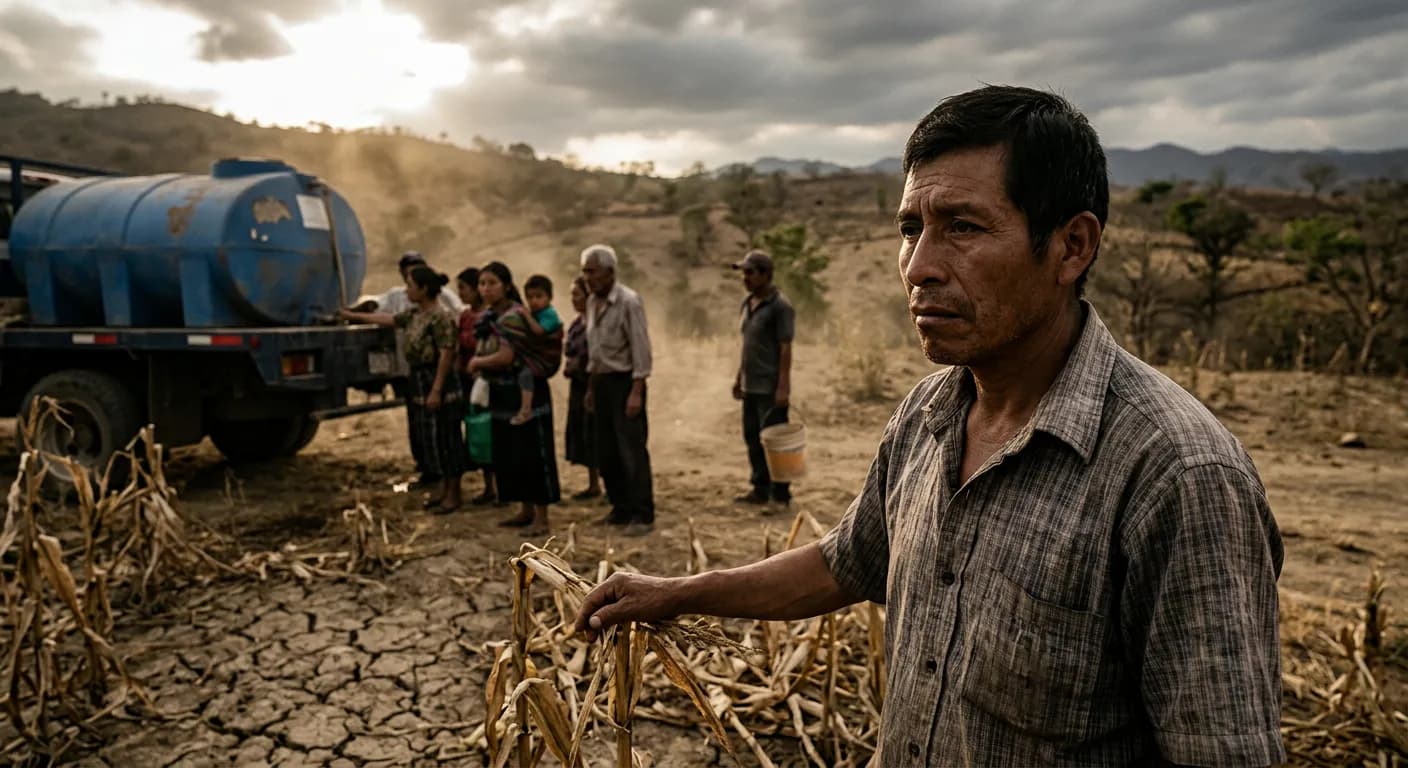
Guatemala: El Niño 2026–27 becomes regional security test
UNICEF: 25.8M children face El Niño risks in Latin America; Guatemala maps 188 municipalities for drought and food insecurity amid regional security test.