India's Critical Minerals Midstream Gap
Despite auctions and deals, India lacks rare earth separation capacity.
Model Diplomat5 min readSouth Asia
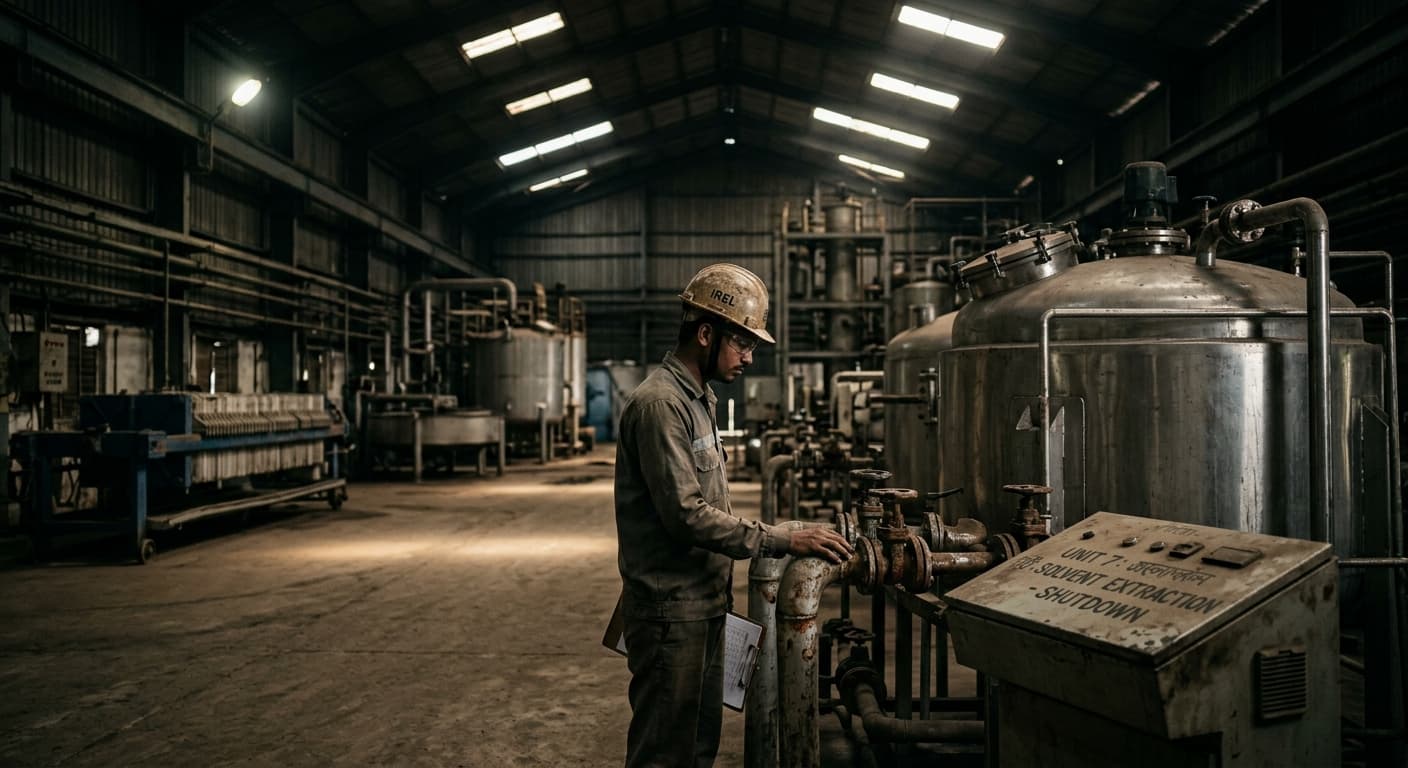
The eighth tranche's mineral portfolio spans lithium, cesium, rubidium, molybdenum, graphite, vanadium, gallium, titanium, REE, bauxite, phosphorite, manganese, potash, halite, and tungsten — a menu of everything the energy transition demands. But extraction is years away from commercial scale. The real chokepoint is what happens after the ore leaves the ground.
The April 2025 shock that exposed the architecture
On April 4, 2025, two days after US President Donald Trump announced sweeping reciprocal tariffs, China's Ministry of Commerce imposed export licensing requirements on seven rare earth elements — samarium, gadolinium, terbium, dysprosium, lutetium, scandium, and yttrium — and the permanent magnets made from them CSIS. The measure was not a ban, but it functioned as one: no shipments reached India for months.
The impact was immediate and surgical. Bajaj Auto, maker of India's best-selling electric scooter, the Chetak, was forced to almost halve its production. "The rare-earth magnet supply situation has been a constraint that created the risk of a sharper production dip in July," Rakesh Sharma, executive director of Bajaj Auto, told Al Jazeera. The company scrambled to redesign motors to use lighter rare-earth magnets, but the damage was done.
The IMF later documented the scale: Chinese permanent magnet exports fell roughly 70% year-over-year by May 2025, a system-wide disruption that extended well beyond the formally controlled products IMF. The restrictions were eased in August after Indian Foreign Minister S. Jaishankar's visit to Beijing, but the IMF noted the episode "heightened economic security concerns and accelerated efforts to reshore and diversify imports of REE production."
The lesson was not lost on New Delhi. But the lesson it drew — auction more blocks, faster — is the wrong one if those blocks produce ore that still must travel to China for separation.
The midstream gap India's policy stack cannot fill
India's critical minerals policy apparatus has grown with remarkable speed since early 2025. The National Critical Mineral Mission (NCMM), launched in January 2025, has a seven-year outlay of ₹16,300 crore and an expected ₹18,000 crore in PSU investment PIB. The Mines and Minerals (Development and Regulation) Amendment Act, 2025, notified on August 21, enhanced the auction regime, allowed critical minerals to be added to existing leases without additional royalty, and raised the National Mineral Exploration Trust levy from 2% to 3% of royalty
ORF.
In November 2025, the Cabinet approved a ₹7,280 crore Scheme to Promote Manufacturing of Sintered Rare Earth Permanent Magnets (REPM), targeting 6,000 tonnes per annum across five units BBC. The Union Budget 2026–27 introduced Dedicated Rare Earth Corridors in Odisha, Kerala, Andhra Pradesh, and Tamil Nadu, removed basic customs duty on monazite, and exempted capital goods for critical mineral processing. A National Critical Mineral Stockpile was announced in October 2025 with a ₹500 crore seeding budget and a two-month rare earth reserve target.
On the diplomatic front, India signed a critical minerals framework with the US in May 2026 during Secretary of State Marco Rubio's New Delhi visit — a deal that the US embassy said would "reduce our collective vulnerability to single-source monopolies" Al Jazeera. The Quad announced a $20 billion critical minerals mobilisation commitment. India struck a separate deal with Brazil in February 2026 and with Australia for uranium and critical minerals cooperation during Prime Minister Modi's July 2026 visit
Al Jazeera.
Yet across this entire architecture — upstream mining, downstream magnet manufacturing, stockpiles, corridors, bilateral deals — midstream processing remains a gaping hole. As the Observer Research Foundation noted in a May 2026 assessment: "What is missing is sequencing around the binding midstream constraint. Until separation, refining, and metallisation move onshore at a commercial scale, backed by dedicated incentives and partnership terms built around technology transfer rather than offtake, India will continue to mine, stockpile, and assemble at the edges of a value chain its policy stack increasingly resembles but does not yet command" ORF.
The numbers make the point starkly. India holds the world's third-largest rare earth reserves — an estimated 6.9 million tonnes, about 8% of the global total — yet produced only about 2,900 tonnes of Rare Earth Oxide in 2024, less than 1% of global mining ORF. Only one rare earth mine is operational in India, in Andhra Pradesh, and until June 2025 most of its output was exported to Japan under a bilateral deal. India is 100% import-dependent for lithium, cobalt, and nickel — the three minerals central to battery manufacturing
ORF. China supplies over 80% of India's lithium needs and between 85% and 90% of its permanent magnet imports by quantity.

This is not a temporary vulnerability. A February 2026 NITI Aayog assessment found that demand for battery-linked minerals under a net-zero scenario will be 51% higher than under current policy — meaning "the concentration of supply in Chinese hands is not a temporary vulnerability but a structural one that will only intensify as India scales its energy transition" NITI Aayog. India spent $4.7 billion on lithium imports in FY 2025–26 alone, a nearly ninefold increase since 2018, according to the London School of Economics' Grantham Research Institute
LSE.
The processing technology India cannot buy off the shelf
Building midstream capacity means mastering technologies India currently lacks at commercial scale: high-purity rare earth separation and refining, metallisation, NdFeB magnet alloy production, and sintered magnet manufacturing. These are not commodities — they are proprietary processes that China has spent three decades and tens of billions of dollars developing.
The Takshashila Institution's December 2024 vulnerability assessment rated lithium, silicon, and titanium as critical vulnerabilities due to "substantial capability gaps that cannot be bridged in the short to medium term" Takshashila. Even if India sources raw lithium from Australia, Argentina, or its own Jammu and Kashmir reserves, China's 58% share of global lithium refining capacity means Indian battery manufacturers will still depend on Chinese chemical processing.
The REPM scheme targets 6,000 tonnes of permanent magnet production annually within seven years. But India already consumes an estimated 7,000 tonnes of magnets annually, and demand is expected to double within five years BBC. Two magnet facilities exist — one at the Bhabha Atomic Research Centre, inaugurated in 2023, and another public-private plant aiming for 5,000 tonnes by 2030 — but neither has yet reported output. Even if both succeed, India would be producing less than it consumes in 2026, in a market growing at double-digit rates.
The cost to close this gap is not trivial. The NCMM's ₹16,300 crore outlay — roughly $1.9 billion — is spread across exploration, mining, processing, recycling, stockpiling, and R&D. For context, the US Department of Defense alone has committed over $439 million to building domestic rare earth supply chains since 2020, and even that effort will produce only 1,000 tonnes of NdFeB magnets by end-2025 — less than 1% of China's 300,000-tonne annual output CSIS.
Discover more

US Politics
House Ethics Committee Pushes Sexual Miscond.
The House Ethics Committee has shifted responsibility for sexual harassment settlement records to the Office of Congressional Workplace Rights, complicating disclosure efforts.

International Relations
Pakistan's Key Role in US-Israel-Iran Meddle
Pakistan is seeking to mediate the US-Israel-Iran conflict, balancing high-stakes diplomacy against severe economic pressures and steep regional challenges.
India
BJP's Misunderstanding of Women's Quota Needs
The BJP's linking of the Women Reservation Bill to delimitation risks delaying women's empowerment in India, misreading the aspirations of female voters.

Conflict & Security
Drone Warfare Killing Aid Workers at Unprec
Over 1,000 humanitarian workers killed in three years as cheap armed drones collapse legal protections. Gaza, Sudan, Ukraine, and DRC see deliberate targeting of aid convoys and hospitals with zero prosecutions.