India's Cockroach Party Exposes the Cost of Online Crackdowns
The parody movement went viral because it captured youth anger; the block shows how quickly India now treats satire as a political threat.
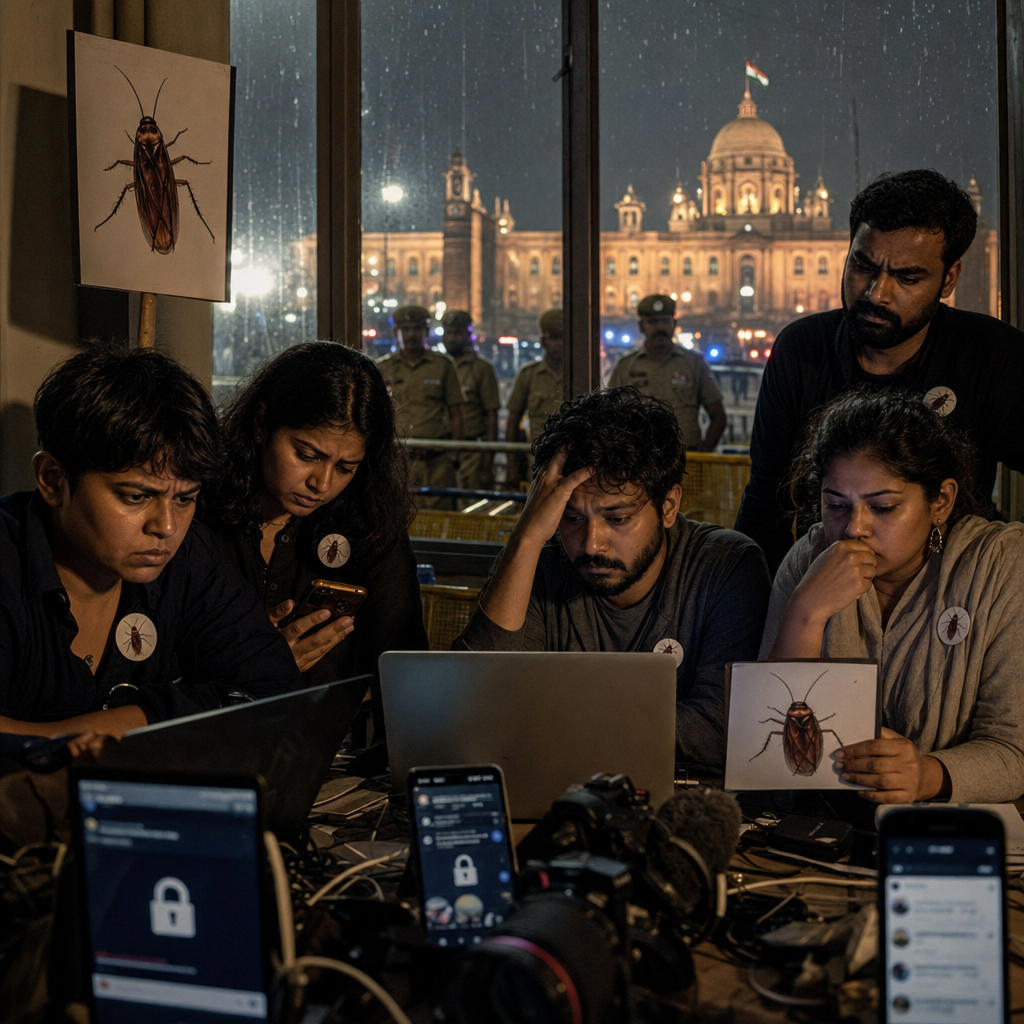
The Cockroach Janta Party says its website has been blocked and its X account withheld in India after a week-long surge that turned an online joke into a magnet for youth frustration, founder Abhijeet Dipke said on Saturday, with  BBC reporting the site was inaccessible and
  The Hindu quoting Dipke as saying all of the group’s accounts had been lost. The state is signaling that the movement has crossed from satire into a nuisance worth containing.
The leverage is with the platform-state nexus
This is not just a website outage. The BBC said the X page now shows a message that it has been withheld “in response to a legal demand,” and The Hindu reported the group also lost access to its Instagram and backup accounts, while Dipke alleged hacking and a coordinated crackdown. The mechanism matters: India does not need to arrest a founder to blunt a viral movement; it can lean on legal takedown demands and platform compliance instead. That is a low-visibility way to shut down a narrative before it hardens into an organizing tool.
The target is a parody party that satirizes Prime Minister Narendra Modi’s Bharatiya Janata Party and has been framed around unemployment, exam leaks, and institutional distrust.  Al Jazeera reported that Dipke tied the launch to remarks by Chief Justice Surya Kant, later clarified as referring to people with fake degrees, while
  The Straits Times said the movement drew on broader anger over jobs and the education system. That gives Delhi a problem: if it tolerates the parody, it tacitly validates the grievance; if it blocks it, it feeds the grievance.
Who benefits, who loses
The immediate winner is the government apparatus that wants to prevent a meme from becoming a movement. The broader beneficiary is the ruling BJP, which avoids letting an anti-establishment joke grow into a youth-facing rallying point with more online reach than its own accounts. BBC reported the group claimed more than 20 million Instagram followers, while The Straits Times said it had already overtaken the BJP on that platform. Even if those numbers are partly a function of virality and platform anomalies, the political signal is clear: the opposition space online can scale faster than formal parties can respond.
The loser is not just Dipke. It is the wider ecosystem of young Indians who are using satire as a substitute for representation. The Hindu said Congress MP Shashi Tharoor called the withholding “foolish” and argued democracies need outlets for dissent and frustration. That critique is politically useful to the opposition, but it also underscores the deeper risk for the government: every takedown now looks like proof that the joke landed.
What to watch next
The next decision point is whether India widens the block to more handles or allows the parody to reconstitute itself under new names, as Dipke suggested it would. Watch for any formal explanation from the Ministry of Electronics and Information Technology, any court filing tied to the “legal demand,” and whether the movement’s offline energy shows up in protests over jobs or exam leaks. If this remains a one-account story, Delhi has contained it. If new “Cockroach” accounts keep multiplying, the state will have turned a meme into a durability test.