India–Indonesia BrahMos Deal Redraws Indo-Pac
A strategic shift in Indo-Pacific missile dynamics
Model Diplomat9 min readAsia
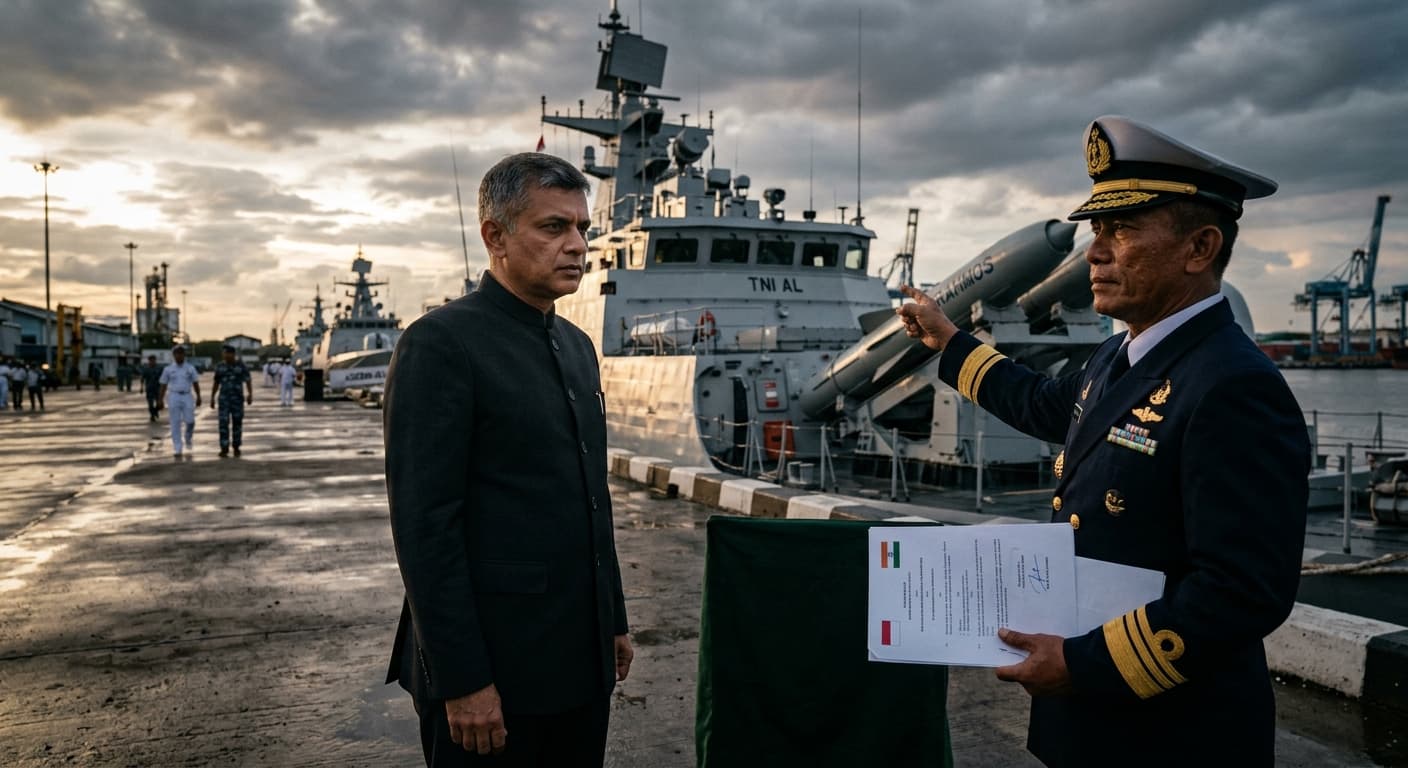
India–Indonesia BrahMos Deal Redraws Indo-Pacific Missile Map
Modi and Prabowo signed >$600M in BrahMos and Astra contracts on July 7, 2026, plus joint control of Sabang — a strategic pivot at the Malacca Strait.
Prime Minister Narendra Modi and Indonesian President Prabowo Subianto signed contracts in Jakarta on July 7, 2026 for BrahMos supersonic cruise missiles and Astra beyond-visual-range air-to-air missiles valued at more than USD 600 million — the largest single-day Indian defence export announcement on record, and the move that finally closes a three-country "anti-ship arc" around the South China Sea running from Manila through Hanoi to Jakarta. The deal matters less as a hardware transfer than as a political signal: Indonesia, ASEAN's largest economy and China's biggest regional trading partner, has chosen an Indian supply chain over a Chinese or Russian one, and simultaneously handed India joint development rights over Sabang port at the mouth of the Malacca Strait. That combination — arms flow plus chokepoint access — is what reshapes the regional balance.
What was actually signed
The two governments concluded 14 agreements. The two headline defence pacts cover an "unspecified number" of BrahMos batteries and a separate contract for Astra missiles, according to Press Trust of India reporting carried by 
Beyond the missiles, the leaders committed to joint development of Sabang deep-water port in Aceh, roughly 163 km from India's Great Nicobar. Prabowo publicly endorsed a "strategic link between Sabang Island and the Andaman and Nicobar Islands," per the Observer Research Foundation analysis.
The joint political language, as PTI reported, invoked "adherence to international law, including the 1982 UN Convention on the Law of the Sea (UNCLOS), freedom of navigation and overflight, while refraining from the threat or use of force" — the standard formula Southeast Asian capitals use to name China without naming China.
Why this deal is the one that closes the arc
The BrahMos, an Indo-Russian supersonic cruise missile, has been marketed to Southeast Asia since 2014. Only three contracts have materialised. The Philippines took delivery of three shore-based batteries under a USD 374.9 million contract signed in January 2022, MP-IDSA records. Vietnam is finalising a five-battery deal reported at roughly USD 700 million, according to
ORF. Indonesia's addition matters for one geographic reason: it puts an anti-ship missile capability at the southern lip of the South China Sea, opposite the entrance to the two chokepoints — Malacca and Sunda — through which 80% of China's crude oil imports transit.
Chinese analysts had already flagged the trajectory. The BrahMos, ORF notes citing Chinese-language commentary, is described in Beijing as a "troublemaker for international security" and its Southeast Asian spread as capable of triggering "a regional arms race" that clamps down the western and southern sides of the South China Sea. That was written before Indonesia signed. It is now describing the situation on the ground.
Indonesia was, until this year, the notable holdout. During Prabowo's January 2025 state visit to New Delhi, Gateway House noted that "no agreement emerged about Indonesia's reported plan to purchase the BrahMos missile system." Jakarta at that stage was hedging: Prabowo's government had, two months earlier, signed a joint maritime development statement with Beijing that
RSIS analyst Janet Fung warned "could be perceived as tacitly recognising China's claim" in the South China Sea. The BrahMos and Sabang decisions taken together are a course correction — not a rupture, but a rebalance.
The Sabang piece is the load-bearing one
The port and the missiles read as separate items on the communiqué. They are the same policy. Sabang sits at the northwestern entry to the Malacca Strait, dredged deep enough to receive submarines, as Indonesia's then-Coordinating Minister Luhut Pandjaitan told India in 2018. A 2018 Beijing Global Times editorial, cited by IPCS, warned of "disastrous consequences" if India developed Sabang into a strategic base. Eight years later, the Indian and Indonesian navies have decided to do exactly that — jointly.
India's Ministry of External Affairs primary brief on the bilateral records that the two navies have conducted 43 coordinated patrols (IND-INDO CORPAT) in the Andaman Sea since 2002, an annual army exercise "Garuda Shakti," and the biennial Samudra Shakti naval exercise. Sabang converts that operational habit into forward basing potential — India's Andaman & Nicobar Command gains a friendly deep-water anchor 100 nautical miles south of Great Nicobar, and Indonesian assets gain reciprocal access to Indian facilities. The Malacca chokepoint, in effect, comes under the joint watch of two navies neither of which is bound by a US alliance treaty.
That last point is where the Indo-Pacific geometry actually shifts. Both India and Indonesia are members of BRICS. Both explicitly reject alliance blocs. Both describe themselves as non-aligned or "multi-aligned." The Sabang–BrahMos package builds a regional security architecture that is neither American-led nor Chinese-permitted — what ORF's C. Raja Mohan, in the Indian Express on July 7, called an "arc of trust… drawn up by those who live here."
The winners, the losers, and the awkward middle
The clear winner is India's defence-industrial complex. Indian defence exports hit ₹23,622 crore (approx. USD 2.76 billion) in FY 2024–25, a 12% year-on-year rise and a 34-fold increase over 2013–14, according to a Press Information Bureau factsheet. New Delhi's stated target of ₹50,000 crore in annual exports by 2028–29 becomes meaningfully more credible with Indonesia added to the customer list. BrahMos Aerospace, until January 2022 an untested exporter, now has three ASEAN customers and a battlefield-tested product line.
The clear losers are Russia and China as arms suppliers to Southeast Asia. Indonesia already operates Russian Yakhont anti-ship missiles — the export variant of the parent system BrahMos was derived from — and had, ORF reports, previously evaluated the Chinese YJ-12E and Ukraine's Neptune. It chose the Indian option, partly because the war in Ukraine renders both Russian and Ukrainian supply chains unreliable and partly because India was willing to accept payment in national currencies. Russia's tolerance of BrahMos exports to countries in territorial dispute with China is now the most visible daylight between Moscow and Beijing on Indo-Pacific arms transfers.
The awkward middle sits in Jakarta itself. Prabowo has spent his first year balancing between a joint maritime development deal with Xi Jinping (November 2024) and, now, a BrahMos-plus-Sabang package with Modi. Lowy Institute analyst Rahman Yaacob has argued in a separate context that Indonesia's Turkish KHAN ballistic missile buys are not aimed at China. That reading gets harder to sustain when a supersonic anti-ship missile enters Indonesia's inventory paired with Indian access to the Malacca chokepoint. As Gateway House put it in January, Jakarta is trying to "expand Indonesia's diplomatic space" without picking sides. That space is narrowing.
The critical-minerals angle nobody is talking about
Read the fine print of the July 7 package and one clause reshapes global battery supply chains. India committed to invest in Indonesian nickel, steel and rare-earth permanent magnet plants. Indonesia produces roughly half of the world's mined nickel. Chinese firms — Tsingshan, GEM, CATL affiliates — dominate the smelting and refining stack. The Australian Institute of International Affairs reported in 2025 that Chinese capital's grip on Indonesia's nickel processing became visible when the China Chamber of Commerce wrote directly to Prabowo objecting to Jakarta's proposed royalty hike from a flat 10% to a progressive 14–19% structure.
That is the door Modi walked through. India's Khanij Bidesh India Limited (KABIL) and Indian battery-cell makers, subsidised under a Performance-Linked Incentive scheme covering 50 GWh of factory capacity, need nickel offtake. Indonesia needs a non-Chinese investor to preserve leverage over Beijing. The BrahMos deal is the security anchor for what is, structurally, an EV supply-chain de-risking pact. This is the "second-order effect" that will show up in Tesla, BYD and Hyundai spreadsheets before it shows up in defence journals.

Diplomat View
The BrahMos–Sabang package is the moment Indonesia stops hedging and starts choosing — quietly, deniably, but decisively. The falsifiable call: within 24 months, expect (a) an Indonesian Coast Guard–BAKAMLA joint patrol regime through the Malacca approaches with Indian participation, (b) at least one Indian Navy submarine port call at Sabang, and (c) a Malaysian or Thai follow-on BrahMos enquiry that BrahMos Aerospace will not confirm publicly but will process. If none of those three markers arrives by mid-2028, the thesis is wrong and Prabowo's Jakarta will have reverted to equidistance.
What would change the forecast: a Chinese economic retaliation package aimed at Indonesian nickel exports, or a Prabowo cabinet reshuffle that removes Defence Minister Sjafrie Sjamsoeddin, would slow the arc's closure. So would any hint that BrahMos Aerospace cannot meet its delivery timetable — a real risk given the Philippines contract took over three years to reach initial operating capability. India's arms diplomacy is now writing cheques its production line must cash.
The larger question is whether "non-aligned" in 2026 means "unarmed" or "armed by everyone except your rival." Jakarta just answered that question. So did Manila and Hanoi before it. The Indo-Pacific security architecture being assembled south of the South China Sea is not the Quad, not AUKUS, and not ASEAN. It is a bilateral latticework of Indian missiles, Indian-Indonesian ports, and BRICS-branded political cover. Washington should notice that this arc holds together without it.
What to watch next
- Late 2026 – MEA joint statement full text: The Ministry of External Affairs'
full communiqué will disclose battery counts and delivery schedules that PTI's initial dispatch left blank.
- Q4 2026 – Indonesian parliament ratification: Any BrahMos contract of this size requires DPR budget approval; watch for opposition PDI-P pushback framed around fiscal cost, not China policy.
- March 2027 – SIPRI arms transfer data: The next
SIPRI trends fact sheet will register India as a top-20 exporter for the first time in the 2022–26 five-year window if Indonesia deliveries begin on schedule.
- 2027 India–ASEAN Summit: Whether Malaysia or Thailand break cover with a BrahMos enquiry after Indonesia signs will be the tell on whether the arc extends to five countries.
Key Takeaways
- India completed the anti-ship arc. BrahMos is now contracted with the Philippines, Vietnam and Indonesia — the three ASEAN states whose EEZs abut the South China Sea's western, northern and southern edges.
- The Sabang port clause matters more than the missiles. Joint India–Indonesia development at the mouth of the Malacca Strait converts an operational habit into forward-basing potential — outside any US alliance.
- Indonesia has quietly stopped hedging. Prabowo signed a maritime deal with Beijing in November 2024 and a BrahMos-plus-Sabang package with New Delhi in July 2026; the second one is heavier.
- Critical minerals are the sleeper clause. Indian investment in Indonesian nickel and rare-earth magnets is a direct challenge to Chinese dominance of the EV battery upstream — the second-order winner is New Delhi's EV ambition.
- Deliveries are the risk. The Philippines contract took over three years to reach IOC. Delivery slippage would blunt the political message.
The Bottom Line
The India–Indonesia BrahMos deal is not an arms sale — it is the political moment ASEAN's largest economy decided that a rules-based Indo-Pacific requires actual missiles pointed at the sea lanes, and that those missiles will come from a fellow BRICS member rather than from Washington or Moscow. Combined with joint Indian access to Sabang, the July 7 package builds the first serious Indo-Pacific security architecture that is neither American-led nor Chinese-tolerated. If Prabowo holds the line, the map of the region's next decade was redrawn this week in Jakarta.
*
Discover more

US Politics
SNAP Food Assistance Faces Legal Challenges
In 2026, SNAP faces stricter eligibility rules and mounting legal challenges, threatening food assistance for the millions of Americans who rely on the program.
Global Politics
Xi Jinping Calls China-Russia Ties 'Precious'
Xi Jinping's description of China-Russia ties as 'precious' reflects a strategic imbalance, with Beijing dictating terms in the partnership.
India
Women's Reservation Bill 2026: A Political Sh
India's Lok Sabha rejected the Women's Reservation Bill, exposing a political maneuver to redraw electoral maps favoring the north over the south.

Conflict & Security
Drone Warfare Killing Aid Workers at Unprec
Over 1,000 humanitarian workers killed in three years as cheap armed drones collapse legal protections. Gaza, Sudan, Ukraine, and DRC see deliberate targeting of aid convoys and hospitals with zero prosecutions.